Are domestic mobile phones raising prices and leaving the poor behind?
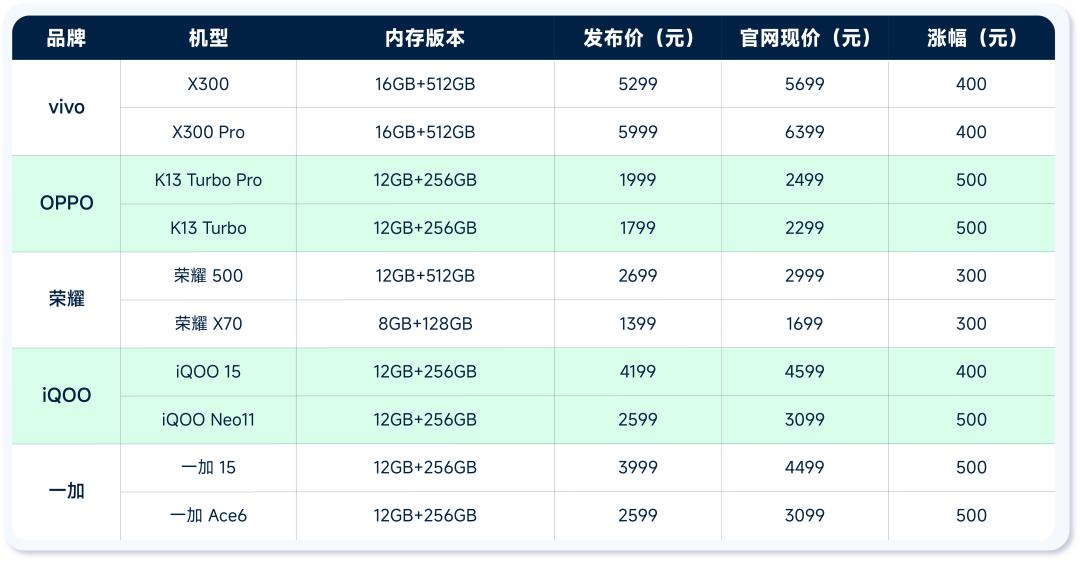
In March, the Chinese smartphone market witnessed a price hike wave sweeping across the entire industry. Mainstream domestic manufacturers such as OPPO, Xiaomi, vivo, and Honor have successively raised the prices of some of their models. The prices of mid - range models generally increased by 300 - 800 yuan, and the once - affordable "1,000 - yuan phones" have almost disappeared.
This collective price adjustment, which is called "the largest in scale and the most significant in increase in the past five years" in the industry, has begun to force many consumers to put their phone replacement plans on hold.
On the surface, the direct cause of this price hike is the sharp increase in the prices of upstream chips. The contract price of DRAM has increased by 80% - 95%, the price of NAND flash memory has risen by 33% - 60%, and the price of HBM high - bandwidth memory has increased by more than 170%. The proportion of storage chips in the BOM cost of mobile phones has soared from 10% - 15% to over 20%. Some mid - and low - end models have even fallen into the dilemma of "negative gross profit".
However, behind the chip price hike, there is the deep - seated AI involution that domestic mobile phone manufacturers have been trapped in in recent years. The huge R & D costs and chip procurement costs that manufacturers have invested in seizing the AI track are ultimately passed on to every consumer through terminal price hikes.
Who will save users who don't need AI phones?
On the way home from work, wearing headphones and opening the phone to play a game of "TFT" is the most relaxing form of entertainment for Wu Fei. As the bus sways slowly, Wu Fei arrives at the stop after two games.
The entertainment turned into anxiety starting a month ago. Since the battery health of his phone dropped below 75%, the phone's performance also deteriorated. Once, just as Wu Fei opened "TFT", a pop - up window of his work WeChat suddenly appeared. After switching to WeChat, the phone got stuck directly and went black for more than ten minutes.
"The phone gets hot as soon as I open a game, and the battery drains rapidly. Sometimes I'm worried it won't last until I get home," Wu Fei said helplessly. But to avoid embarrassing situations, he had to put the matter of replacing the phone on the agenda.
After looking around at the popular models of various mobile phone manufacturers, Wu Fei only had one feeling: the functions are too fancy, and most of them are useless to him. "I only take a few photos a year. Whether it's AI object removal or AI photo editing, they are all useless to me. I don't need an AI assistant at all. Manufacturers don't have to pile up so many functions."
Yang Nan, who has been operating digital products in Chengdu for many years, also reflects from another perspective that the redundant AI functions are actually a burden to users. Yang Nan recently met several newly graduated college students who originally planned to buy mid - range phones priced at 3,000 - 4,000 yuan for daily commuting, socializing, and simple office work. But they found that the price increase of models in this price range was not small, and there were also many useless AI functions.
Yang Nan said that most of these consumers will consider not buying a new phone for the time being. They either wait for a price cut after a while or directly buy a second - hand phone.
This kind of situation is an epitome of many users with basic needs at present. They have not gained any value from the AI involution but are forced to bear the additional costs brought by the manufacturers' competition. The root cause of all this lies in an AI competition among domestic mobile phone manufacturers, as well as the resulting surge in chip demand and sky - rocketing prices.
Against the background of the peaking of the smartphone market's incremental growth and the increasingly fierce homogeneous competition, AI has become the "life - saving straw" for domestic manufacturers to break through the growth bottleneck.
Looking back at the competition history of domestic mobile phones, from the initial price war to the subsequent imaging battles and fast - charging competitions, each track switch is essentially to get rid of the homogeneous dilemma and seize market share. However, the technical thresholds of these competition dimensions are relatively low and are easily imitated by peers quickly, leading to the competition falling into a repetitive cycle.
The emergence of AI technology happens to provide a brand - new competition dimension. It not only involves the upgrade of hardware - level chips but also covers software - level model R & D and algorithm optimization. With higher technical barriers and greater differentiation space, it has become an important means for domestic manufacturers to achieve "overtaking on a curve".
Therefore, major manufacturers have increased their investment in the AI field, forming a competitive and involuted situation.
Huawei has the "One - click Movie" function, which allows users to automatically generate short videos with a cinematic feel from randomly shot footage. Xiaomi has launched the "Lobster AI" system - level intelligent agent to automate complex cross - application tasks. Honor has the "Lobster Universe" intelligent agent platform, which can reconstruct the mobile phone interaction form. OPPO and vivo respectively focus on office efficiency and multi - scenario adaptation, and have launched functions such as AI Flash Notes and offline dialogue.
The intense AI involution has directly led to an explosive growth in the demand for upstream chips. Different from traditional mobile phone chips, the smooth operation of AI functions requires the support of dedicated NPU chips. The R & D and production of NPU chips are more difficult, and the requirements for computing power are more demanding.
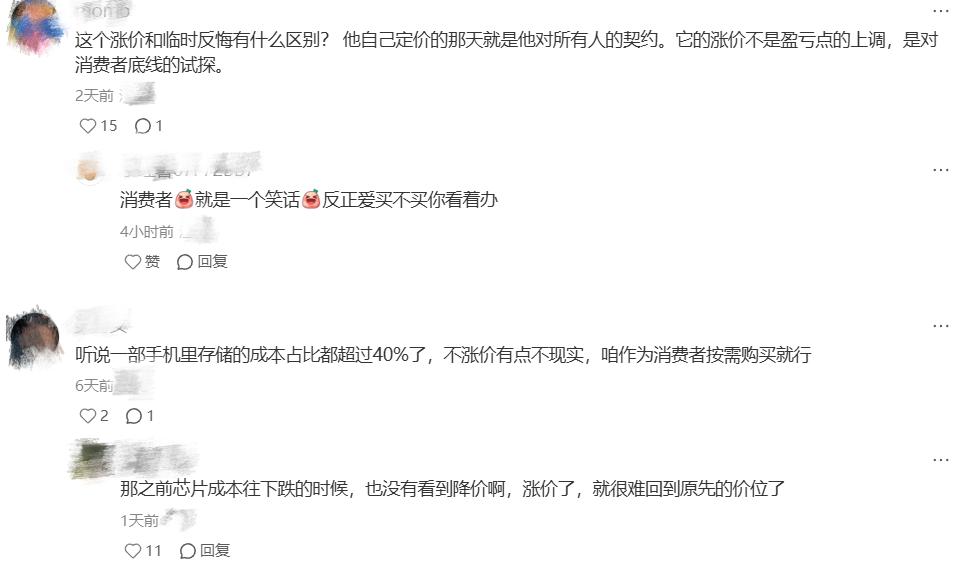
Many consumers have put their phone replacement plans on hold due to the price hike.
According to IDC data, 2026 will be the "year of popularization" of AI phones. The shipment volume of AI phones in China will reach 147 million units, accounting for 53% for the first time. That is to say, for every two new phones sold this year, one is an AI phone. This large - scale popularization of AI phones will directly lead to a surge in the demand for mobile phone chips, especially NPU chips and storage chips.
For domestic mobile phone manufacturers, this chip dependence brought about by AI involution is actually a passive binding. On the one hand, in order to gain an advantage in the AI competition, manufacturers must purchase higher - specification NPU chips and larger - capacity storage chips. However, the pricing power of these chips is completely in the hands of upstream enterprises such as Qualcomm, MediaTek, and Samsung, and domestic manufacturers lack bargaining power. On the other hand, due to the shortcomings of the domestic chip industry, the core chips of domestic mobile phones almost completely rely on imports and cannot be independently replaced. This means that any fluctuation in the price of upstream chips will be directly transmitted to terminal products, becoming an inevitable reason for manufacturers to raise prices.
Stop the involution and stop pursuing AI for the sake of AI
With the popularization of AI phones, there has been an obvious differentiation in consumer demand. Some users have a strong demand for AI functions and are willing to pay a premium for the AI experience. On the other hand, some users, such as the elderly, students, and those who need a spare phone, only need basic functions such as calling, texting, using WeChat, and taking photos. They have no interest in AI functions and even don't know how to use them.
However, the reality is that regardless of whether consumers need AI functions or not, they have to pay for the manufacturers' AI involution. Because the current pricing logic of domestic mobile phones has evenly spread the AI R & D costs and chip procurement costs across every product.
The JD Consumption and Industry Development Research Institute, in cooperation with Jingdong Insights, previously conducted a survey. The data shows that 95.3% of users have used mobile phone generative AI tools. Among them, 57.3% only use AI for daily life assistance, 54.2% use it for work efficiency improvement, and a considerable number of users said they "occasionally use AI functions" or "don't know how to use them".
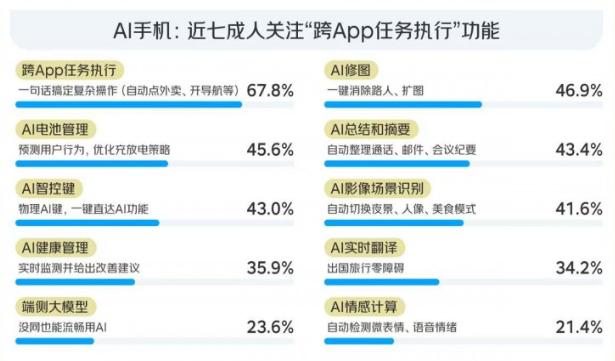
Source: JD Consumption and Industry Development Research Institute
The survey data also shows that 45.8% of users think that AI phones "have a promising future", 39.9% say "it's worth waiting and seeing", and 10.5% think "the concept is greater than the substance". This means that more than half of the users have an unclear understanding of the value of AI functions and even think they are flashy.
However, even so, these users still have to pay a premium for the manufacturers' AI investment when buying a phone. Because currently, there are almost no new phones without AI functions on the market. Even entry - level models are forced to be equipped with basic AI functions, and the corresponding costs are naturally passed on to the selling price.
What's more concerning is that the choice space for users with basic needs is being further compressed.
In this price hike wave, the price increase of mid - and low - end models is the most obvious. The original 1,999 - yuan models have directly risen to 2,499 yuan, completely exiting the 1,000 - yuan phone camp. According to IDC data, in 2026, the price increase of flagship phones in the Chinese mobile phone market will exceed 30%. Models with the same configuration will be 300 - 1,000 yuan more expensive than in 2025, and the large - storage versions will even be 2,000 yuan more expensive. At the same time, the market share of low - end mobile phones in China will decline from 44% in 2024 to 40% in 2026, and the 1,000 - yuan phone market may completely disappear.
For users with limited budgets and basic needs, they either have to pay a higher price to buy models with AI functions or can only choose second - hand phones or old models, and the cost of replacing a phone has increased significantly.
The concentrated AI involution not only fails to achieve overtaking on a curve but also intensifies cost pressure and damages consumers' interests, ultimately leading the industry into a vicious cycle. To solve the current dilemma, domestic mobile phone manufacturers need to get out of the misunderstanding of parameter competition and return to the core of user needs.
For example, high - end flagship models can be equipped with high - end AI functions to meet the needs of business people and young people. Mid - and low - end models can streamline AI functions, retain basic and practical AI auxiliary functions, reduce chip costs and R & D costs, and avoid "pursuing AI for the sake of AI".
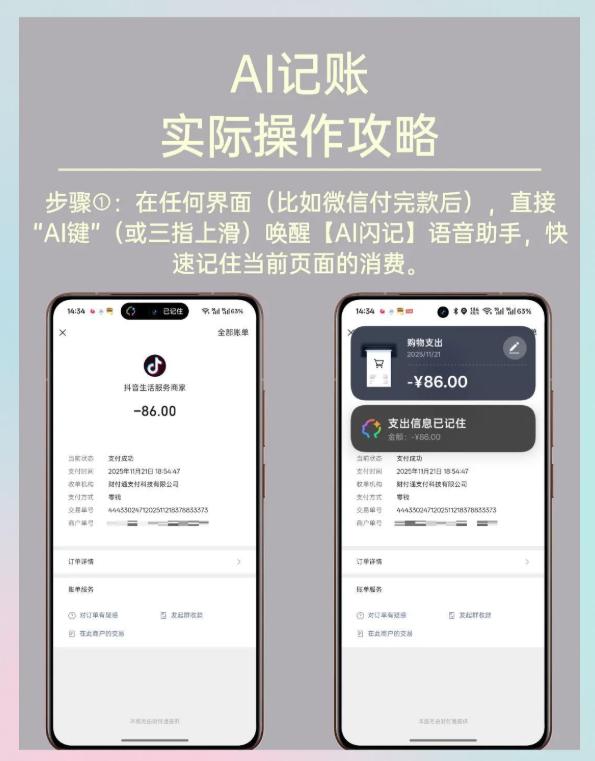
OPPO AI accounting function
In fact, there have been signals of a rational turn in the industry.
The recently released domestic flagship models have begun to shift from parameter stacking to scenario - based optimization. Li Jian, the CEO of Honor, demonstrated the shopping scenario optimization ability of the AI intelligent agent YOYO at the press conference, which can automatically grab hidden coupons and reduce users' consumption costs.
The 128K long - context processing model demonstrated by vivo focuses on improving office efficiency, with a word - output speed of 200 tokens per second, approaching the cloud level. The voice assistant developed by OPPO can automatically recognize bills and complete accounting, solving the pain point of users' information overload...
This kind of scenario - based AI optimization can not only improve the user experience but also reduce unnecessary R & D investment, achieving a balance between cost and experience.
The price hike wave of domestic mobile phones in 2026 is a crossroads in the industry's development. Although it has exposed to some extent the deep - seated contradictions brought about by AI involution, chip dependence, and demand differentiation, it also provides an opportunity for the rational development of the industry.
For consumers, what they need is not fancy AI functions but products with high cost - performance and that meet their needs. Only when manufacturers stop blind involution, stop forcing the transfer of costs, and respect the needs of every user can the domestic mobile phone industry take the initiative in the global consumer electronics market competition.
This article is from the WeChat official account "Zinc Scale" (ID: znkedu), author: Li Jinlin, published by 36Kr with authorization.