Luo Fuli: AGI has already been achieved. The next step is "self-evolution".
"The amount of Tokens consumed for tasks is 10 times or even 100 times that of simple Q&A, significantly increasing the cost."
When answering the question "Why did you raise the price?" from Yang Zhilin, CEO of Dark Side of the Moon, Zhang Peng, CEO of Zhipu, said this.
The above Q&A took place at the open - source themed round - table of the 2026 Zhongguancun Forum Annual Conference held today. Different from the AGI - Next open - source forum led by Tsinghua University three months ago, there are some new faces at today's open - source themed round - table.
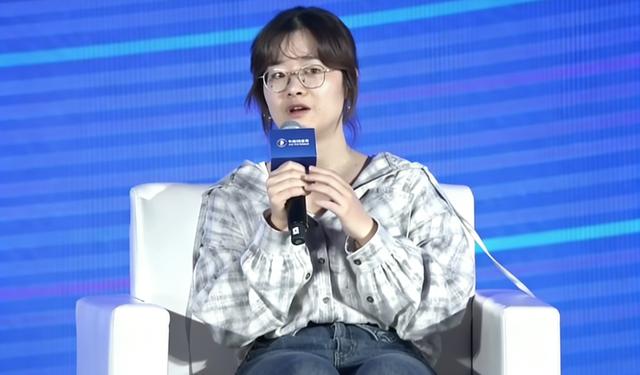
At the AGI - Next event at the beginning of the year, besides Tang Jie, the founder of Zhipu, and Yang Zhilin, the then technical leader of Qwen, Lin Junyang, was also among the speakers.
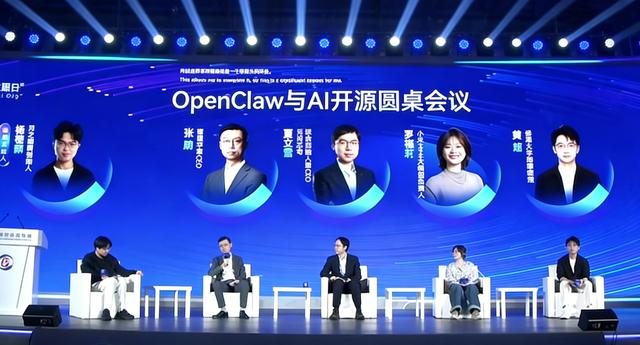
After a few months, Lin Junyang left Alibaba rapidly in a dramatic way. At this round - table, besides Yang Zhilin and Zhang Peng, another representative from the basic model field is Luo Fuli, the person in charge of Xiaomi's MiMo large model, as well as Xia Lixue, the co - founder and CEO of Wuwen Xinqiong, and Huang Chao, an assistant professor and doctoral supervisor at the University of Hong Kong and the leader of the Nanobot team.
Simultaneous with Luo Fuli's appearance is the recent hot performance of MiMo - V2 - Pro in the model market. The latest weekly data from OpenRouter shows that Xiaomi's MiMo - V2 - Pro model took the first place in the weekly list, becoming the first model in OpenRouter's history with a weekly Token consumption exceeding 3 trillion.
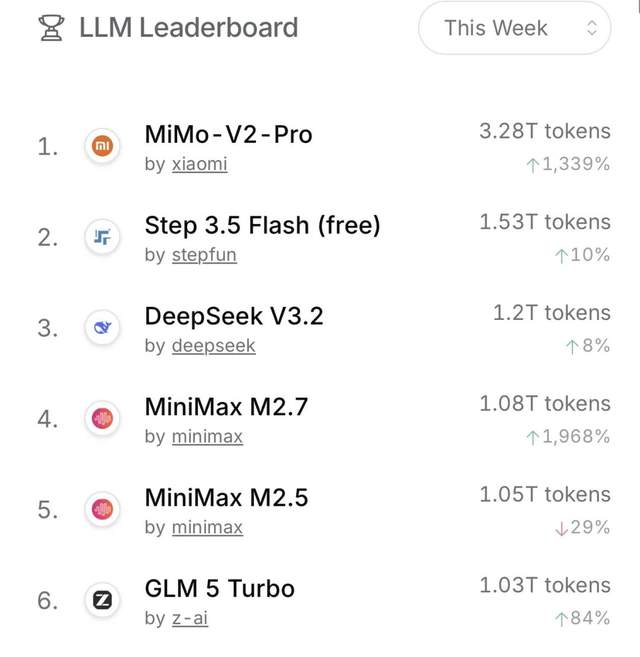
Thanks to the excellent performance of MiMo - V2 - Pro, Xiaomi, along with domestic large - model manufacturers such as Zhipu, MiniMax, Jieyue Xingchen, and DeepSeek, occupied the top six places in the weekly list.
Different from AGI - Next, today's round - table discussion does not only focus on models. Besides the representatives of the three major basic model manufacturers, Dark Side of the Moon, Zhipu, and Xiaomi, Wuwen Xinqiong is an AI Infra enterprise incubated by the Tsinghua system, and Nanobot is an open - source Agent framework released by HKUST at the beginning of this year.
In other words, this forum starts from the Agent ecosystem and actually covers the entire industrial chain of the AI industry.
It is worth noting that when AGI - Next was held a few months ago, Zhipu had just been listed for 3 days, and its founder Tang Jie led that forum. At today's open - source themed round - table, Yang Zhilin and Dark Side of the Moon, who led the dialogue, just spread the news yesterday that they were considering an IPO in Hong Kong.
With this special time node and the "stage" of the Zhongguancun Forum, this round - table forum has been quickly pushed into the spotlight of the industry.
01 Talking about the Opportunities in the OpenClaw Era | Xia Lixue: The Token Amount Doubles Every Two Weeks
Yang Zhilin: Currently, the most popular thing is OpenClaw. When you use it in daily life or similar products, what do you find the most imaginative or impressive? From a technical perspective, let's first invite Zhang Peng to talk about his views on OpenClaw and related Agents.
Zhang Peng: I call it a "scaffolding". It provides the possibility to build something very solid, convenient, and flexible on the basis of the model. Ordinary people can use top - tier models with extremely low thresholds, especially in terms of programming and overall capabilities. In the past, ideas were limited by skills such as not being able to program, but now it can be done through simple communication. This is a very significant breakthrough.
Xia Lixue: At first, I was not used to it. I was used to chat - style interactions and felt that OpenClaw was slow. Later, I found that it can actually help me complete large - scale tasks. From chatting by Token to being able to complete tasks with an Agent now, the imagination space has increased, but the requirements for system capabilities have also become higher, which is why it felt stuck at the beginning.
As an infrastructure manufacturer, I see both opportunities and challenges. Our resources need to support this era of rapid growth. For example, since the end of January, the Token amount of our company has doubled every two weeks. The current Token usage is like the era of 100 - megabyte mobile data back then. We need better optimization and integration to make it accessible to every living person. This is a huge optimization space for the entire community.
Luo Fuli: I think OpenClaw is a very revolutionary and disruptive event. Although those who are deeply involved in coding may still prefer Code, those who have used OpenClaw will feel that it is ahead of Code in terms of Agent framework design. In fact, the latest updates of Code are moving closer to OpenClaw.
Its greatest value to me lies in "open - source": it is beneficial for in - depth community participation. It has raised the upper limit of domestic second - tier closed - source models very high. In most scenarios, the task completion rate is very close to that of the latest models, and at the same time, the lower limit is guaranteed by the Skill system.
In addition, it has sparked everyone's imagination. People have found that there is a huge space in the Agent layer outside of large models. More people, not just researchers, have started to participate in the AGI revolution. To some extent, it has replaced repetitive work and freed up time to do more imaginative things.
Huang Chao: First of all, in terms of the interaction mode, OpenClaw gives people a "more human - like" experience. Previous Agent tools had a stronger sense of tool - use, while OpenClaw, in a "software - based" way, is closer to the personal Jarvis (J.A.R.V.I.S.) that people imagine.
Secondly, it has proven that the framework for architecting an Agent can be both simple and efficient. It makes us rethink: Do we need an all - in - one super - intelligent agent, or a lightweight operating system or a scaffolding - style butler? It makes people more in a "playful" state of mind, leveraging all the tools in the ecosystem. Through the design of Skills or Tools, it empowers all industries.
02 Yang Zhilin Asks Zhang Peng: Why Did You Raise the Price?
Yang Zhilin: Zhang Peng, Zhipu recently released a new GLM Turbo model, which has enhanced the Agent. Can you introduce the differences between the old and new models? And what market situation does the observed price - increase strategy reflect?
Zhang Peng: The release of Turbo is mainly to shift from "simple conversations" to "doing tasks". OpenClaw has shown that large models can do tasks, but the Token consumption behind task - doing is very high, which requires planning, trial - and - error, debugging, and handling of ambiguous requirements. Turbo has optimized in these aspects. In essence, it is a multi - agent collaborative architecture, but with a biased enhancement in capabilities.
Regarding the price increase, since the amount of Tokens consumed for tasks is 10 times or even 100 times that of simple Q&A, the cost has increased significantly. Long - term low - price competition is not conducive to the development of the industry. Adjusting the price is to return to normal business value so that we can continuously optimize the model and provide better services.
Yang Zhilin: As the open - source models and inference computing power form an ecosystem and the Token amount explodes, we are gradually moving from the training era to the inference era. I'd like to ask Xia Lixue, what does this mean for Wuwen?
Xia Lixue: We have been thinking about what the infrastructure in the AGI era should look like and how to achieve it step by step.
The current problem is that the explosive demand brought by AI has put forward higher optimization requirements for system efficiency. We solve this by integrating software and hardware. We have connected almost all types of computing chips, linking dozens of domestic chips and computing power clusters to make the best use of resources and improve conversion efficiency. We have built a standardized Token factory.
However, this is not enough. Agents are more like humans, capable of thinking and initiating tasks in seconds or milliseconds. The existing cloud computing infrastructure is designed for "humans" (with minute - level operations), which limits Agents. We need to build a more intelligent project to make the infrastructure adapt to the high - frequency needs of AI.
The infrastructure itself should also be an intelligent agent, capable of self - evolution and self - iteration, forming an autonomous organization. Agents can communicate and cooperate better with each other. The development of infrastructure and AI should not be isolated but should have a chemical reaction to achieve true software - hardware collaboration and the collaboration between algorithms and infrastructure.
03 Talking about Domestic Models | Luo Fuli: The Inference Demand Will Explode and May Increase 100 Times This Year
Yang Zhilin: Luo Fuli, Xiaomi has recently contributed to the community by releasing new models and open - source technologies. What unique advantages does Xiaomi have in developing large models?
Luo Fuli: I'd like to first talk about the advantages of Chinese large - model teams rather than Xiaomi's unique advantages.
Two years ago, Chinese teams made breakthroughs under the constraints of limited computing power, especially limited inter - connection bandwidth: under the limitation of low - end computing power, they pursued the highest efficiency through model structure innovation (such as DPCV3, M1, MA, etc.). This has given us courage and confidence.
Although domestic chips are no longer restricted now, the exploration of high efficiency and low inference cost is still important. For example, the current Hybrid, SPA, and Linear Attention structures.
Why is structure innovation important? Because the premise for OpenClaw to become smarter with use is inference Context. The current challenge is: how to achieve low enough cost and fast enough speed under a long context of 1M or 10M? Only in this way can high - productivity tasks be stimulated, model self - iteration be realized, and self - evolution be completed in a complex environment relying on an ultra - long Context.
We are now exploring the Long Context Efficient architecture and how to achieve stability and a high upper limit in real - world long - distance tasks.
In the long run, as the inference demand explodes, it may increase 100 times this year, and the competition dimension will extend to the level of computing power, inference chips, and even energy.
04 Talking about Agent Iteration | Huang Chao: Memory Should Adopt a Hierarchical Design
Yang Zhilin: Huang Chao, you have developed influential Agent projects such as Nanobot. From the R & D or application level, which technical directions are worth paying attention to next?
Huang Chao: Regarding Planning: The current problem is that when facing long - term tasks and very complex contexts (such as 500 steps or more), many models may not be able to plan well. This is essentially because the models may not have such implicit knowledge, especially in complex vertical fields. I think future Planning needs to solidify a lot of existing complex task knowledge into the models.
Of course, Skill and Harness are also essentially used to alleviate the errors caused by Planning. Since high - quality Skills are provided, they can help the models complete relatively difficult tasks. This is the solution for Planning.
Then there is Memory: Currently, there are always problems with inaccurate information compression and inaccurate memory in Memory. In long - term tasks and complex scenarios, Memory will explode, bringing great pressure. Currently, all kinds of LLMs and Agents use the simplest file system and Markdown - formatted Memory, sharing files to achieve this. I think future Memory should adopt a hierarchical design to make it more general.
Because the current Memory mechanism is difficult to be general. For example, in coding scenarios, deep learning, and the multimedia field, the modalities are very different. How to do a good job in retrieving and indexing these Memories and making them more efficient is always a trade - off.
Another point is that after OpenCode has significantly lowered the threshold for creating Agents, there may be more than one Agent in the future. I see that Kimi also has an Agent Swarm mechanism, which means that everyone will have a group of Agents in the future. Compared with a single Agent, the context of a group of Agents will explode, and there is currently no good mechanism to manage it. Especially for complex coding and scientific research discovery, it puts a lot of pressure on both the model and the Agent architecture.
Regarding Tool Use: Currently, Skills still have the same problems as MCP did back then, that is, the quality is not guaranteed and there are security issues. There are indeed many Skills now, but there are relatively few high - quality Skills, and low - quality Skills will greatly affect the task completion rate. In addition, it is also difficult to avoid malicious problems with Skills.
So, in the area of Tool Use, the community may need to develop Skills better and upgrade them to the ability to evolve new Skills during the execution process.
These are the current pain points and potential future directions of Agents that I think exist.
05 "In the model industry, 12 months is already a long time."
Yang Zhilin: Finally, let's make an open - ended outlook. I'd like to invite each of you to use a word to describe the development trend of large models in the next twelve months and your expectations. Let's start with Huang Chao this time.
Huang Chao: I think that in the field of AI, talking about twelve months is actually a very long time, and it's difficult to judge what it will be like after twelve months. Originally, it was written as five years here, but I think shortening the time to one year makes it more realistic.
If I have to use one word to summarize, I'll choose "ecosystem".
Currently, "Lobster" has made everyone very active, but I think the truly important direction for Agents in the future is to transform from a "personal assistant" to a real "worker" role. That is to say, it should not just be used because it's new and fun, but should really settle down and become a tool for people's daily work, or even a real coworker.
So I think this definitely requires the joint efforts of the entire ecosystem. Especially, open - source is very important - after relevant technological explorations, including many technologies at the model level, are open - sourced, the entire ecosystem has the opportunity to build together. Whether it's model iteration, Skills platform iteration, or the development of various tools, I think they all need to be better built around Agents to create an ecosystem more suitable for their growth.
From my personal experience, a relatively obvious trend is that in the future, many software may not be mainly for human use. In the past, software was defaulted to be for humans, and humans need a GUI; but in the future, many software may be more for native Agent use, that is, Agent Native. In this case, there may be a very interesting situation: people will ultimately only use the GUI that makes them happy.
So we can see that the entire ecosystem is gradually shifting from GUI and MCP to the CLI model. I think this shows that the entire software system, data system, and various technological capabilities need to gradually become Agent Native. Only in this way will the development of Agents truly be rich.
Luo Fuli: I think narrowing this question down to one year is actually very meaningful. Because if we look at it from my own definition of AGI over five years, I would even think it has already been achieved.
If I