After AI can generate websites with one click, the most brutal gap has emerged: code is no longer valuable, and aesthetics determine survival.
At the end of last year, a website went viral in the developer and design circles simultaneously—the official personal website of F1 driver Lando Norris was launched. It wasn't because of the content but the experience: layers upon layers of 3D animations, a page structure that seems to "breathe", a helmet model that changes in real - time as you scroll, and almost ubiquitous micro - interaction details.
This isn't the kind of website that just "looks good". It's the kind that makes you stop, explore repeatedly, and even study how it was made.
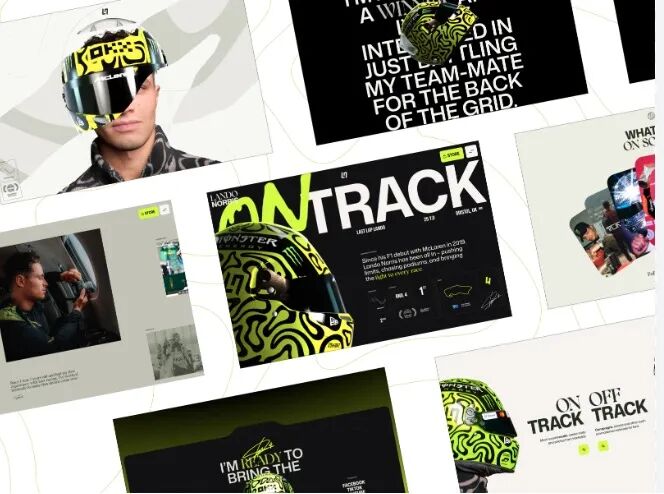
Wes Bos, the co - host of Syntax and a well - known front - end developer, was also attracted. He did a typical "geek move": he directly downloaded all 75,000 lines of code from this website and read them line by line. The more he looked, the more shocked he became—this website isn't just about showing off skills; it's a meticulously crafted masterpiece.
Behind this website are multi - layer 3D rendering, parallax effects driven by depth maps, dynamic masks implemented by shaders, real - time helmet rendering based on glTF, and a performance - optimized animation system mainly relying on the transform property. More importantly, these complex technologies aren't for "showing off technology" but for serving a very clear goal—making users stop and feel the brand.
Wes Bos said bluntly that the most important thing about this website isn't the technology but the "thought". From a simple text hover animation, to the subtle differences in the reflected light of the helmet, to the "curtain - opening" animation when switching pages, every detail is obviously polished repeatedly. "Just a text hover effect might take one or two hours." And such details make up the whole website.
It's precisely because of this "excessive attention to detail" that this website has an effect that is becoming increasingly scarce in the AI era: You can tell at a glance that it wasn't made with a template.
And this is the starting point for Wes Bos to make a bold prediction: 2026 will be the "Year of Design Renaissance".
In his view, after UI frameworks, component libraries, and even AI have enabled anyone to "quickly generate a decent website", the real differentiation no longer comes from "whether you can make it" but from: Do you have aesthetics, the ability to make choices, and the ability to create an unforgettable experience?
At the beginning of this year, Wes Bos further explained this prediction in a podcast. The following is a summary of the podcast:
1 Design Renaissance: Why 2026 Will Be the Year of Design
Kate Holterhoff: Welcome to MonkCast. Today, I'm joined by Wes Bos, the co - host of Syntax. Wes is an accomplished developer and educator. I'm very glad to have him on our podcast.
It's January now, and all the thought leaders are making their predictions. You and Scott Tolinski made a prediction, talking about CVE, some React issues that emerged last year, and RPC. Among them, I'm most interested in the design aspect. You claim that design is having a renaissance. I'd like to hear more about it. Why is this your first prediction?
Wes Bos: Well, I think there has indeed been a shift in the design field in recent years. In the early days, design was crucial because many of the emerging websites and applications were simply unusable. Design ensures the usability and friendliness of applications, providing users with the best experience. At the same time, in terms of brand building, it also concerns how you shape your image on the Internet.
After a few years, many UI frameworks emerged, and many people could easily build very nice - looking websites. Now, we have AI, which can generate code and create websites that are both usable and look great. I think this is very important. Now, we've almost established such a basic framework, and with very little effort, it can be made usable. You can install it via NPM or introduce some Tailwind components and make a few adjustments. It looks okay and is quite easy to use. This is great because the basic framework for all content is quite good.
But the problem we're facing now is, where is your differentiation? If it's easy to get a workable basic framework, then how should we explore now? It's a bit of a double - edged sword, right? In terms of usability, it's not as difficult now. We don't have to work so hard on basic things. I think we have more time to spend on styling.
For example, I might spend a lot of time thinking about: How should the upload interface of this photo selector be designed? Or how can this dropdown filter implement multi - selection? In the past, implementing such functions might have required a huge amount of effort, but now it's easier. So I've started to notice that better products are starting to invest more time in the UX usability design of the actual product. Just like the website of Lando Norris, which was launched a few months ago, it's amazing. The whole website is filled with cutting - edge web technologies, and those 3D effects are unprecedented.
This is its differentiation, right? If everything on the web looks exactly the same from the start, then I might think it's not a big deal that everything looks the same, right? Just like when you open Twitter, Threads, or Instagram. Sometimes I even forget which app I'm using because they look exactly the same. I think many people like this because it makes you feel familiar and know how to use it.
However, from a brand's perspective, we need a striking highlight. You need to make people stop scrolling. You need to make people visit this website, experience it, and enjoy it. I think this is an important way for people to show their own characteristics, that is, those beautiful new - generation websites. And I think we've started to see more and more of this.
Kate Holterhoff: Yes, thank you very much for your introduction. Regarding the RedMonk website, I've written some content discussing Shadcn issues, and there are many AI tools that allow you to quickly build a website, which is great.
Even UI component libraries use Shadcn at the bottom. Because this library allows you to intercept code snippets, it's like the revenge of the copy - paste mode. The model can directly call these snippets for easy import. But I suspect there are deeper reasons behind it, not just the rise of Shadcn and its becoming the underlying technology for those libraries.
Tools enable us to have a basic UI experience on many different websites. For example, you mentioned Raycast on the Syntax website. I'm wondering, besides Shadcn, are there any other factors that I've overlooked that are causing these websites to become increasingly homogeneous?
Wes Bos: Well, I think it's because developers don't want to make changes. We've seen that this isn't a new problem that emerged after Shadcn. Right? Bootstrap had this problem, Foundation did, and so did jQuery UI. Many things related to Tailwind have this problem. That's why many AI - generated things are purple. That is to say, many developers don't necessarily have a design eye.
When it comes to design, if you do something, you might make it worse and it won't look good. It's much simpler to just put things in directly. Interestingly, these tools we use for UI design are all changeable. They were designed to provide a basic framework and allow users to make adjustments. But almost no one is willing to make fine - tuning to them.
There are so many websites that you can almost tell at a glance what they're using. So to answer your question, are there any other similar things? I think there definitely are. For example, people don't have much time to spend on such things. If they can apply a UI that actually looks quite good, much better than what developers cobble together themselves, they won't make any fine - tuning. So I think this reason is important.
Kate Holterhoff: Yes, it makes sense. Gergely Orosz's latest newsletter has been published, and it actually talks about design systems. I like the example he used. If you don't use something similar, your application will look like a university graduation project. If the whole website doesn't have a unified design style and can't meet users' expectations, there will be a sense of disharmony.
Wes Bos: Yes. It's completely cobbled together. In the podcast, we often discuss the problem of decay or drift. Without the support of a design system or similar specifications, on a whim, you think "this looks good, it should work here too". Then, before you know it, two or three years pass, and the interface starts to drift and deform, gradually decaying. In the end, there's just a messy mix - and - match style left.
Kate Holterhoff: Yes, that's exactly it. As we enter the AI era, applications seem to be being created in this makeshift way, and this trend will only become more obvious no matter what happens in the future. It's very interesting. You mentioned Lando Norris's website. Can you briefly explain why this website provides such a cool browsing experience?
Wes Bos: Well, to display all the information they need to convey, they used many interesting ways, right? For example, they have a gallery that shows all the helmets. When you hover the mouse over a helmet, the outline around the helmet changes dynamically. The race track is presented in a 3D model and can be viewed in a 360 - degree rotation. This immersive experience makes people can't help but stay on the website and continue to explore all the different little details. They could have just made a very basic website, but that's not Lando Norris's brand, right? He wants to be the absolute best, and everything he does is an extension of his brand, right?
Every little detail, from the small card hover effect, Bezier curves, easing effects, edge processing, to the delicate special effects of the text when you hover the mouse over a link. All these details took a lot of time. Just the text hover special effect alone probably took at least one or two hours of repeated polishing. Yes. And this is just one percent of the whole. Obviously, they put a lot of effort into it.
They put a lot of effort into this website, and everyone is talking about it. It works, and the effect is immediate. To be honest, I don't watch racing at all and have no idea who this guy is. But now everyone is saying "Oh, this is Lando Norris!" He's a superstar with a huge reputation. Now, it would be stupid not to know who he is. But this just shows that his personal brand has gone beyond his circle and spread further. Now, I know who he is. The other day, I saw his toys at Costco. I heard about him on TV. Obviously, it worked, right?
Kate Holterhoff: Yes, it's very interesting. I'm curious. You mentioned that this website has caused a big stir on the Internet. I've actually seen some things. How do you track excellent design trends? I know there are newsletters and such, but like this website, how did you discover it?
Wes Bos: I always keep an eye on the Twitter trends in the design circle to stay updated. I've found that as long as you interact more on Twitter in the design circle, the algorithm will keep pushing relevant content. People often @ me in their tweets. This might not be a good suggestion for the audience.
There are also some awards. I know Framer is going to launch an award. There are several websites that have web design awards. This used to be a big deal in the CSS circle. But then it became like this: put a photo of a person wearing Nike shoes and stack a button on it, and then claim it's a beautiful website. For a long time, it was all about big photos with buttons. However, computers are getting better. Now people are fully entering the 3D field. Basically, as long as something really cool appears, you'll hear about it.
Kate Holterhoff: Okay, I don't know if you have any recommendations, like newsletters or something, for people to follow.
Wes Bos: People always ask me this question, and I say, I'm the source. Listen to Syntax and follow me. Because I know all the update information of these different software, and I follow a lot of people on Twitter. Actually, it's hard to keep up. My suggestion is to follow those who make a career out of this, so you can handle everything easily like a baby bird being taken care of by its mother.
Kate Holterhoff: Okay, that's really helpful. It seems that social media is an important way to achieve this. Got it. This leads to my second question, which I think is very interesting. You mentioned that many developers aren't interested in design. They seem to hope that someone will directly give them a system, or they think it's not their strong suit, or they want to focus on business logic and other work. But this isn't always the case. Many front - end engineers, especially those who consider themselves designers. So Wes, I'm really curious. Do you consider yourself a designer?
Wes Bos: Yes, I would say so. I like design. For real designers, they might not like this. But when I started my career, I was doing design. I used to design T - shirts and album covers. I started doing print work early on. I consider myself mainly a developer, but for all the things I build, I do the design myself. Of course, this doesn't mean spending time on user experience research and all those things like some people do. They are on another level. The websites they design look cool and are super usable. I don't think I've reached that level yet, but I do consider myself a designer, and I especially enjoy beautiful user interfaces.
2 The Convergence of the Roles of Designers and Developers
Kate Holterhoff: Yes. I think this is not only reflected in your feeling about using the dark or light mode on the website. I find it very interesting, and also in your passion for web design. I think it's really exciting because I feel the same way. But I think there's another interesting thing. When I was a front - end engineer, if the engineering team was overloaded, designers would sometimes build websites themselves using tools like Webflow. That was five years ago, which seems like ancient history.
But now, in this era of AI programming, I know this phenomenon will only become more common and is constantly evolving. So I think we're witnessing these roles converging in an exciting way. At the same time, I think it's even cooler that now, with these AI tools that can handle a lot of thinking tasks for us, we can use more complex tools.
You said in that prediction podcast that you once wanted to become a mathematician to use some new tools, and now, AI can help you achieve that. This opens up unprecedented aesthetic possibilities for designers and front - end engineers—areas that were completely out of reach in the past.
So I think it's really cool—we can not only see the surface things, like "Wow, this is really beautiful". That's just the superficial decoration. But what's really going on behind it? We can also see some deeper problems, like "This is difficult, this is a tricky thing", but now, we can solve these problems in ways that were impossible before.
Wes Bos: Yeah, AI really allows people to step out of their own fields. Now, you can directly borrow others' achievements. Designers are very satisfied with this because they hate dealing with stubborn developers who always refuse to implement their creative ideas. Now, designers can get more involved. I feel the same way. After all, I've written very little C# and C++ code recently.
In the past year or so, when I was working on a hardware project, I started learning the Swift language—code that I've never written before. AI has really broadened the fields that people can get involved in. However, I think many people might not like this change because, throughout my career, I've been understanding how the browser's memory management works. This is my specialty. I think people like this still have their value. But for those who just want to complete tasks efficiently, these tools can help you break through your limitations, which is really great.
Kate Holterhoff: Wow, that's a great analogy. I totally understand. Yeah, I find it really interesting to see how people's roles are constantly evolving and transforming into new forms. Oh my god, who would have thought the term "vibe coding" would be popular for so long. Well, we're all immersed in that vibe now, and we can use tools like Nano Banana to clarify a lot of things we want to express.
I don't know, it's just all kinds of creativity. It permeates everything, from PPT to the whole workflow. So, we're all becoming designers—whether you consider yourself one or not, this ability has, so to speak, become accessible.
Wes Bos: Yes, but the only things missing are creativity and taste. I think these things