Yang Zhilin / Zhang Peng / Xia Lixue / Luo Fuli / Huang Chao, talking about lobsters and "Token economics"
Text by | Zhou Xinyu, Wang Xinyi, Zhong Chudi
Edited by | Zhou Xinyu
In a technical context, a Token is the smallest unit when a model processes text; in a business context, it has become the most mainstream billing method for AI services.
Recently, the fuse that elevated the concept of Token to an "economic" level by people like Huang Renxun and Wu Yongming is the currently most popular open - source Agent framework globally - OpenClaw, commonly known as "Lobster".
For the first time, it has brought the concept of Agent out of the geek circle and into the general public. At the same time, the huge Token consumption of running Lobster has also made ordinary users who are used to free ChatBots for the first time realize that intelligence is an expensive resource that needs to be purchased.
On March 27, 2026, at the Zhongguancun Forum. At the round - table discussion themed "OpenClaw and AI Open - source", five top Chinese AI figures from the fields of large models, computing power, and Agent gathered together because of open - source and Token.
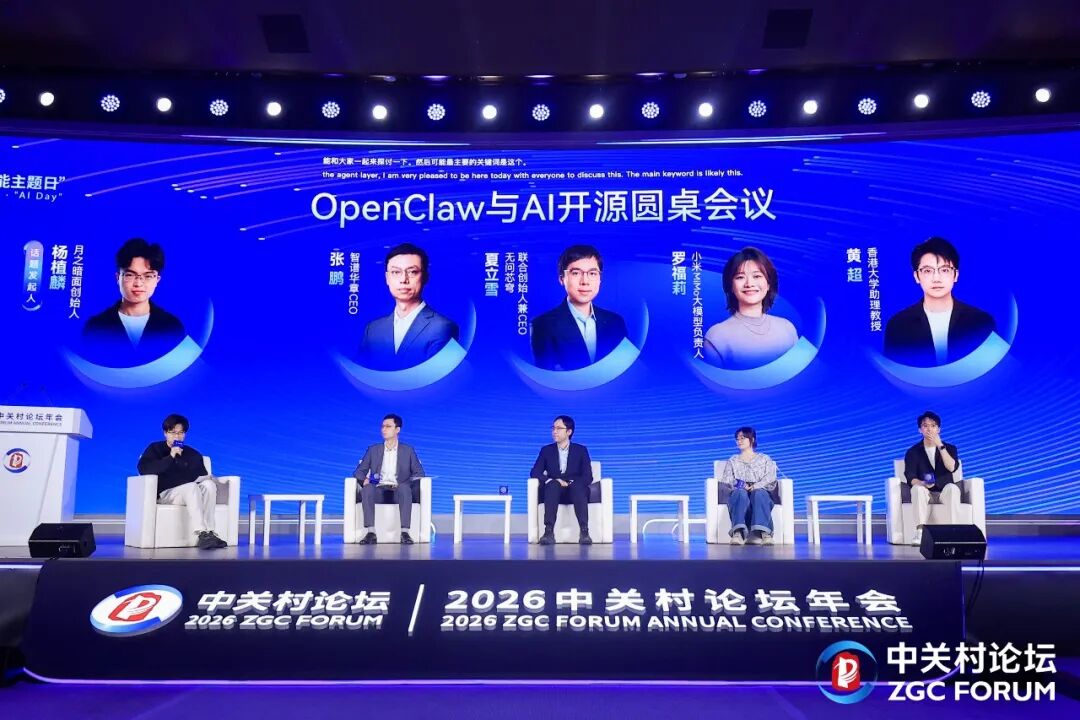
The forum.
Several players in the model layer, including Yang Zhilin, the founder of Dark Side of the Moon, Zhang Peng, the CEO of Zhipu, and Luo Fuli, the person - in - charge of Xiaomi's MiMo large model, have all released their own OpenClaw frameworks recently, or adapted their model capabilities to OpenClaw;
Huang Chao, an assistant professor and doctoral supervisor at the University of Hong Kong, once led his team to develop Nanobot, a substitute for OpenClaw, with only 4,000 lines of code;
For Xia Lixue, the co - founder of Wuwen Xinqiong, the computing power cooperation partner of these model companies, the biggest feeling since January this year is that the Token consumption speed brought by Lobster can be comparable to the mobile data consumption speed in the era when 3G was just popularized.
OpenClaw has brought huge Token business opportunities to the industry, but for these AI practitioners, it is a "sweet trouble", meaning more challenges.
For players in the model layer, limited computing power remains the biggest constraint.
Zhang Peng said bluntly that AI technology, including the intelligent agent framework, has increased many people's creativity and efficiency by 10 times. However, the demand for computing power behind it has increased by 100 times. Standing on the side of computing power supply, Xia Lixue also admitted that the sharp increase in Token demand has brought greater optimization requirements for the system efficiency of computing power manufacturers.
In Luo Fuli's view, the solution to the problem of how to maximize the computing power with limited resources is precisely the advantage of Chinese large - model companies, such as the innovation of DeepSeek V2 and V3 in the MoE architecture.
She mentioned that how to implement a Long - Context Efficient architecture and how to achieve Long - Context Efficient on the inference side will become an all - around competition.
At the level of Agent applications, Huang Chao believes that the thinking brought by Lobster to everyone is: Do we still need an all - in - one powerful intelligent agent? In his opinion, Lobster represents a lightweight operating system and a tool scaffold, but it can leverage all the tools in the ecosystem.
At the same time, he found that there are still various problems in the current Agent ecosystem. For example, the quality of Skill (skill documents) is uneven; Lobster still does not have a good mechanism to manage the user's context.
The consensus formed by several people is: In the future, we need to design the model architecture for Agent and make innovations at the architecture level.
The self - evolution of the model is what Luo Fuli sees as a possibility in the Agent framework. "The Chat paradigm has not fully exploited the upper limit of the pre - trained model," she said. She mentioned that during the long - term task execution process, the Agent is also activating the upper limit of the model.
Huang Chao summarized that in the future, the entire AI ecosystem, whether it is the software system or the data, needs to be in the Agent Native mode.
Of course, there is also computing power. Xia Lixue proposed that in the era of Agent, we need to build Agentic Infra and build a smarter Token factory, "so that the Token factory itself can also self - iterate and self - evolve."
The following is the summary of the round - table discussion by "Intelligent Emergence". For a better reading experience, the text has been slightly edited:
Yang Zhilin: When using OpenClaw or similar products in daily life, what do you think is the most imaginative or impressive? From a technical perspective, how do you view the evolution of OpenClaw and related Agents today?
Zhang Peng: I started using OpenClaw a long time ago. At that time, it wasn't called OpenClaw; it was originally called Clawdbot. After all, I'm a programmer by background, so I have some personal insights when playing with these things.
The biggest breakthrough or novelty brought by OpenClaw is that this is no longer just the patent of programmers or geeks. Ordinary people can also conveniently use the capabilities of top - notch models, especially in programming and intelligent agents.
So I prefer to call OpenClaw a scaffold. It provides a possibility to build a strong, convenient, and flexible framework on the basis of the model. People can call various underlying models and some novel capabilities brought by the models according to their own wishes.
Previously, people with ideas but limited by their inability to write code can now realize their ideas through simple communication. So this has a huge impact on me, or it makes me re - understand some things.
Xia Lixue: I was not used to OpenClaw at first because I'm used to chatting with large models. In comparison, OpenClaw responds very slowly.
But later I realized a problem. It is very different from previous chatbots: OpenClaw is someone who can help me complete large - scale tasks. So when I started to assign more complex tasks to it, it could do very well.
This has a great impact on me. From the initial model chatting by Token to now becoming an Agent, a Lobster to help you complete tasks, this has greatly expanded the imaginative space of AI.
At the same time, it also has high requirements for system capabilities, which is why I felt a bit stuck when using OpenClaw at first.
As a manufacturer in the infrastructure layer, what I see is that OpenClaw has brought more opportunities and challenges to the entire large - scale AI system and ecosystem. Because with the resources we can mobilize now, it is actually not enough to support such a rapidly growing era.
For example, since the end of January, the Token volume of our company has basically doubled every two weeks, and it has basically increased tenfold so far. The last time I saw such a growth rate was when looking at mobile data consumption in the 3G era. The current Token usage is like using 100 megabytes of mobile data per month back then.
In this situation, all our resources need to be better optimized and integrated. Not only in the AI field, but in the entire society, every individual can use AI like OpenClaw.
So as a player in the infrastructure field, I'm very excited and emotional. There is still a lot of room for optimization, which is worth exploring and trying.
Luo Fuli: OpenClaw is a very revolutionary and subversive event for the Agent framework.
Although the first choice for all the people around me who are doing in - depth coding is still Claude Code, I believe that only those who have used OpenClaw can feel that its design in the Agent framework is ahead of Claude Code. Even the recent updates of Claude Code are moving closer to OpenClaw.
My feeling of using OpenClaw is that the imagination brought by this framework can be expanded at any time.
OpenClaw brings two core values. One is open - source. Open - source is a prerequisite that is very beneficial for the entire community to deeply participate in and invest in the Agent framework.
The great value of Agent frameworks like OpenClaw and Claude Code lies in that the upper limit of the capabilities of domestic models that still have a gap with top - notch closed - source models but have certain strength in the closed - source track can be pulled to a very high level.
In most scenarios, the task completion rate of these models can be very close to the performance of Claude's latest model.
At the same time, a set of Harness (governance mechanism) systems, Cache 2 Cache (a data caching mechanism), Skills systems and many other designs can ensure the lower limit, guaranteeing the task completion rate and accuracy.
So from the perspective of the base large model, OpenClaw actually guarantees the lower limit of the model and stretches its upper limit.
In addition, the value that OpenClaw brings to the entire community is that it has inspired more people to discover that there is still a lot of imagination and room for play in the Agent layer beyond large models.
This is also why I see that recently, in addition to researchers, more people in the community have started to participate in this AGI revolution. People use stronger Agent frameworks, such as Harness and Scaffold, to replace their work to a certain extent and free up more time to do more imaginative things.
Huang Chao: The popularity of OpenClaw can be understood from two levels.
First, in terms of the interaction mode, we have been working on Agents for one or two years, but tools like Cursor and Claude Code used to feel more like tools. OpenClaw is the first to use the way of being embedded in IM (instant messaging) software, which makes people feel more like interacting with a real person, closer to the concept of a personal Jarvis in their imagination.
Second, it has inspired us in terms of architecture and ecosystem.
On the one hand, it is a simple and efficient Agent Loop architecture, which verifies the value of the Agent Loop architecture again.
On the other hand, it also makes us rethink a question: Do we need an all - in - one super - intelligent agent, or a lightweight operating system, a small butler like a scaffold?
Through such a super - system or ecosystem of Lobster, OpenClaw allows the entire community to leverage all the tools in the ecosystem with a more playful attitude.
With the emergence of capabilities such as Skills and Harness, more and more people can design applications for such systems to empower all industries. It is naturally very closely integrated with the open - source ecosystem.
These two points are the greatest inspirations it has brought to us.
Yang Zhilin: Following the discussion on OpenClaw, I'd like to ask Zhang Peng. Recently, Zhipu also released a new GLM 5 - Turbo model, which enhanced the Agent capabilities.
Could you introduce to us the differences between this new model and other models? And the model price has increased. What kind of market signal does this reflect?
Zhang Peng: We did have an emergency update a few days ago. In fact, this was originally a stage in our overall development roadmap, but we released it earlier. The main purpose is to achieve the leap from dialogue to task - execution.
Just now, everyone mentioned a point that I highly agree with. OpenClaw makes people truly feel that large models are no longer just for chatting, but can really help us do things.
However, the underlying ability requirements for doing things are actually very high: it needs to plan long - term tasks by itself, keep retrying, compress the context, debug, and may also need to process multi - modal information, etc.
The requirements for model capabilities are very different from those of traditional general models for dialogue. GLM 5 - Turbo has been specifically strengthened in these aspects. Especially what everyone mentioned - enabling it to work continuously, even self - cycle for 72 hours without stopping. We have done a lot of work in this regard.
Another issue is the Token consumption. When a smart model is used to complete complex tasks, the Token consumption is very large. Ordinary people may not realize this and only see the money on the bill keep decreasing.
So we have also optimized in this regard. When facing complex tasks, the model can complete them with higher Token efficiency.
In essence, the model architecture is still a general model architecture for multi - task collaboration, but with some targeted enhancements in capabilities.
As for the price increase, it can be easily explained. Now, it's no longer just a simple question - and - answer process. The thinking process behind it is very long. Many tasks need to interact with the underlying infrastructure by writing code, and also need to debug and correct errors at any time. The consumption is very large.
The Token amount required to complete a task may be ten or even a hundred times that of answering a simple question before. So the price and cost have indeed increased.
The model has become larger, and the inference cost has also increased accordingly. We also hope to return it to a normal commercial value. Long - term low - price competition is not beneficial to the development of the entire industry, which is also one of our considerations.
This can also form a virtuous cycle in our commercialization path, continuously optimize the model capabilities, and continuously provide you with better models and Token services.
Yang Zhilin: Open - source models and inference computing power have now formed an ecosystem. Various open - source models can run on various inference computing powers to provide more value to users.
With the explosion of Token consumption, we have now entered the inference era from the training era. I'd like to ask Lixue, from the perspective of Infra, what does the inference era mean for Wuwen?
Xia Lixue: We are an infrastructure manufacturer born in the AI era. Now we are also cooperating with Kimi, Zhipu, and MIMO to enable everyone to use our Token factory more efficiently.
But we are also cooperating with many universities and research institutions. So we have always been thinking about one thing: what will the infrastructure needed in the AGI era look like?
And how can we gradually realize and deduce it in this process? We are now fully prepared and have also seen the problems we need to solve in the short - term, medium - term, and long - term.
What we need to face now is the sharp increase in Token volume brought by Agent frameworks like OpenClaw, as mentioned just now. This puts forward higher optimization requirements for our system efficiency. Price adjustment is actually a solution under this requirement.
We have always been making arrangements and solutions through the path of integrating software and hardware. For example, we have connected almost all kinds of computing chips we can see, and unifiedly connected dozens of domestic chips and dozens of different computing power clusters to address the shortage of computing power resources in the AI system.
Because when resources are insufficient, the best way is: First, make use of all available resources; second, make every bit of computing power count and achieve the maximum conversion efficiency.
The core problem we need to solve now is how to further build a more efficient Token factory. We have done a lot of optimizations in this regard, including making the model optimally adapt to various technologies such as hardware video memory, and exploring whether a deeper chemical reaction can occur between the latest model structure and the hardware architecture.
But solving the current efficiency problem actually only builds a standardized Token factory. We believe this is not enough for the Agent era. As mentioned just now, an Agent is more like a person, and we can directly assign a task to it.
I firmly believe that in essence, much of the infrastructure in the current cloud - computing era is designed to serve a program and human engineers, not for AI.
The interfaces of our infrastructure are designed for human engineers. We need to add another layer on top of it to connect the Agent, which limits the Agent's scope of play with human operation capabilities.
For example, an Agent can think and initiate tasks in seconds to milliseconds, but the underlying capabilities such as K8S (Sparse) are not yet ready.
Tasks initiated by humans are on a minute - level. This means that these functions need further capabilities. We call it Agentic Infra, that is, building a smarter factory. This is what Wuwen Xinqiong is currently doing.
In the more distant future, when the real AGI era arrives, we believe that even the infrastructure should be an intelligent agent.
The factory we build