A 12-Year Panoramic Map of Chinese Unicorns: The Birth and Exit of 805 Enterprises
As of the end of 2025, IT Juzi records that a total of 805 unicorn enterprises with a valuation of over $1 billion have emerged in the Chinese venture capital market. This is a figure that creates a myth, but more importantly, it is a story full of cycles. Among them, 336 have bid farewell to the unicorn list, and currently 469 still remain in the game.
When we look back at the twelve - year trajectory since 2014, a clear "M - shaped" curve outlines the transformation of China's innovative economy from fanaticism to rationality, from a scale competition focused on speed to an essential return of value verification.
Four Chapters of Capital Sentiment: The M - shaped Trajectory from Fanaticism to Rationality
The fluctuation in the number of unicorn births is essentially the result of the resonance between global capital liquidity and China's macro - economy.
The data on the "time to become a unicorn" tracked by IT Juzi shows that the growth trajectory in these twelve years is not a linear upward trend but has gone through four distinct stages.
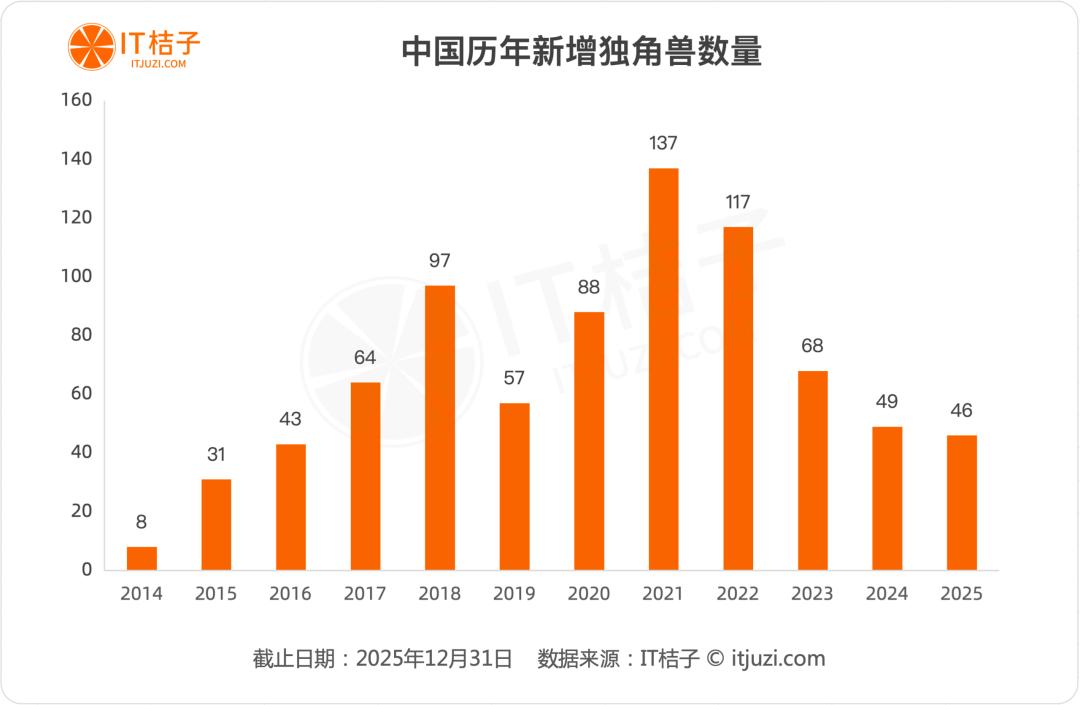
The golden expansion period from 2016 to 2018 was the climax of this capital feast. The annual number of new unicorns soared from 43 to 97, with an average annual growth rate of over 50%. By 2018, the number was 11 times that of 2014. At that time, global liquidity was abundant, the mobile Internet dividend had not reached its peak, and the story of "technological disruption" made capital willing to pay an infinite premium for growth.
The turning point came unexpectedly. In 2019, the number of new unicorns suddenly dropped to 57, a year - on - year reduction of 41.2%, almost halving. The escalation of global trade frictions and economic uncertainties made venture capital tighten its purse strings instantly.
The retaliatory rebound from 2020 to 2021 proved the resilience of the digital wave. The pandemic unexpectedly accelerated the penetration of remote work, e - commerce live - streaming, and fintech, and a large amount of capital flowed back into the venture capital market. In 2021, the number of new unicorns soared to 137, reaching a historical peak.
However, the power of the cycle finally emerged. Since 2022, geopolitical conflicts, global inflation, and rising interest rates have formed triple pressures, and the capital market has entered a full - scale contraction period. However, there are also signals of stabilization in the data: the decline has gradually narrowed from 15.2% in 2022 to 6.1% in 2025, and the market is painfully exploring a new balance point.
The Truth of Exits: 52% of Glory and 48% of Dismay
Liquidity exit data is a key indicator for observing the health of the unicorn market.
Among the 336 enterprises that have exited in total, a cruel dichotomy emerges: only 177 achieved a decent exit through listing, accounting for just over half; while nearly half of the other enterprises quietly bid farewell to the unicorn club through mergers and acquisitions, closures, or valuation downgrades.
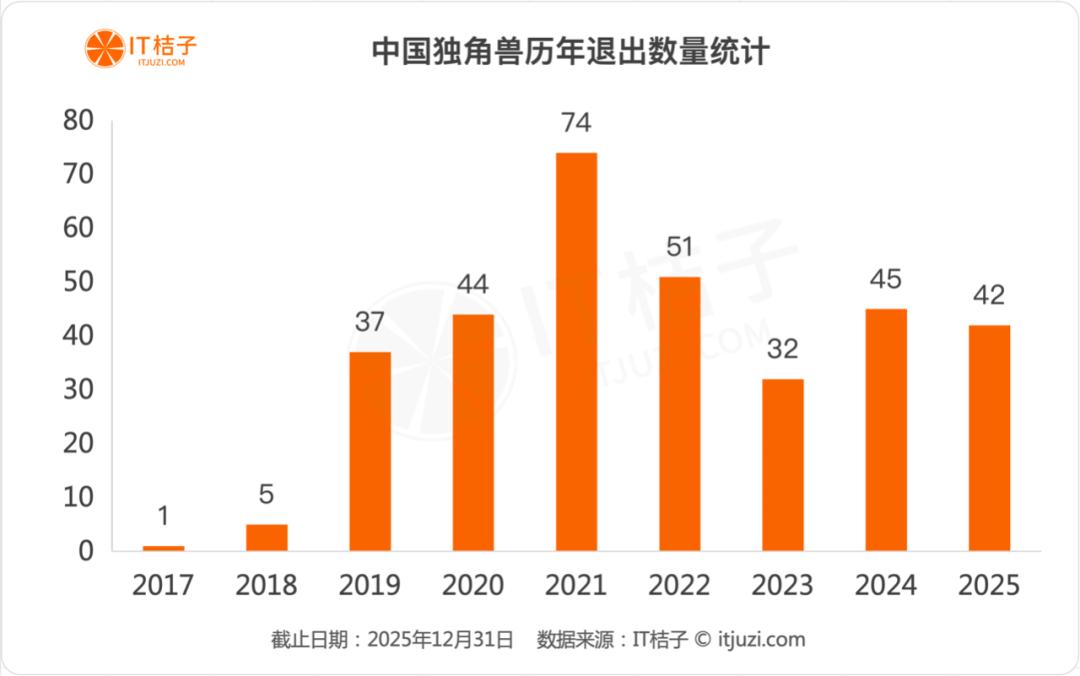
The time distribution of exits shows an obvious "lagged explosion" characteristic. Before 2017, the Chinese unicorn market was a closed garden where "only entry and no exit" occurred. It was not until 2017, when Beijing - based enterprise DotC United was acquired by Tian Shen Entertainment for 2.2 billion yuan, that the history of unicorn exits began. Thereafter, the peak of exits corresponded exactly to the 3 - 5 - year cycle of the peak of new additions from 2017 to 2018, with an average of about 57 exits per year from 2020 to 2022.
What is more worthy of attention is the evolution of the delisting ratio.
After 2019, this ratio increased significantly, reaching 66.2% in 2024 and as high as 85.7% in 2025, which means that the number of unicorns exiting in that year was almost equal to the number of newly born ones. The "shelf - life" of the unicorn status is shortening, and the liquidity and cruelty of the list are rising simultaneously.
The Listing Race: The "Time Codes" of Different Industries
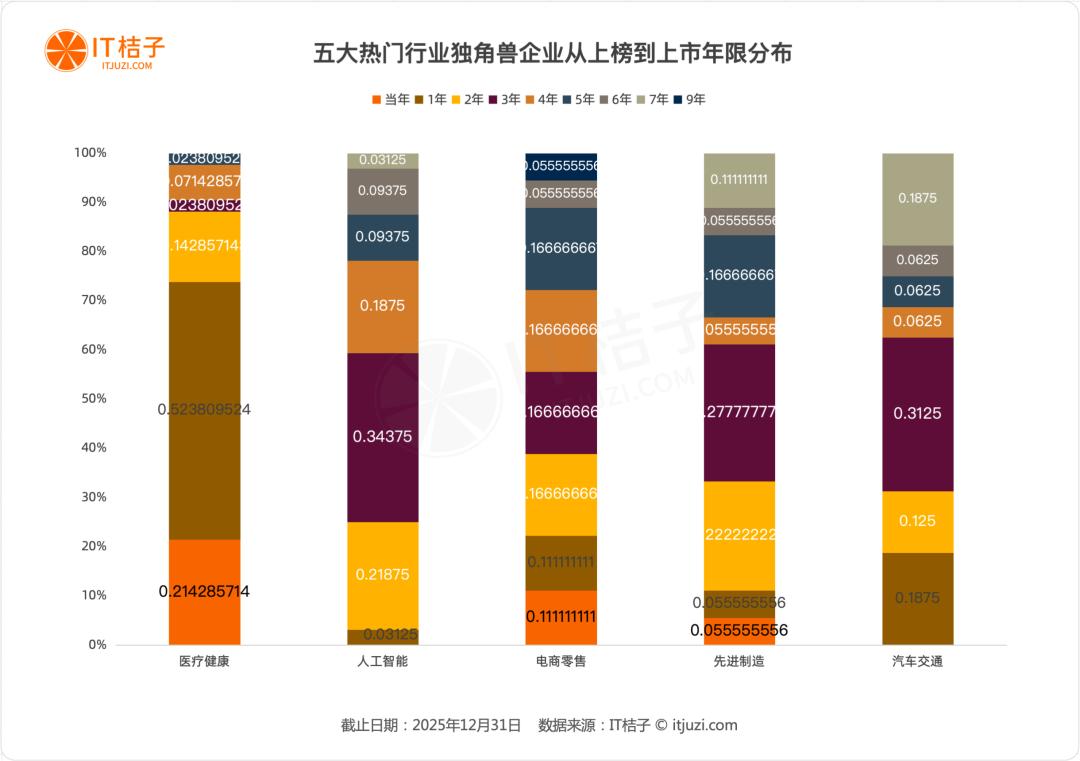
For the 177 enterprises that successfully went public, the average cycle from the valuation exceeding $1 billion to landing on the capital market is 2.75 years. However, beneath this average, there are "speed codes" for different industries, which profoundly reveal the coupling relationship between asset attributes, technology verification logic, and capital market institutions.
Healthcare: Blitzkrieg Mode
This is the fastest track. 73.8% of healthcare unicorns completed their IPOs within one year after being listed, and 21.4% even achieved "being listed and going public in the same year". The tolerance of Chapter 18A of the Hong Kong Stock Exchange and the fifth set of standards of the Science and Technology Innovation Board for unprofitable biopharmaceutical enterprises has replaced revenue proof with clinical data, significantly shortening the compliance preparation period. This also implies that in the healthcare track, the unicorn round is often the pre - IPO round, and the arbitrage window for capital is extremely short.
Artificial Intelligence and E - commerce Retail: Standard Cycle
The listing time of AI enterprises is concentrated in 2 - 3 years (56.3% in total), which exactly corresponds to the window period for algorithms to move from the laboratory to large - scale commercial verification. The listing time distribution of e - commerce retail is the most even, reflecting the high standardization of the exit path in this track. Whether it is a strategic merger and acquisition or an independent IPO, the valuation logic is relatively clear, and the time controllability is strong.
Advanced Manufacturing and Automotive Transportation: A Game for Long - Distance Runners
These two hard - tech tracks show an obvious "long - cycle differentiation" characteristic. They not only have a peak in the proportion at 3 - 4 years (31.3% for automotive transportation in the third year), but also form a secondary long - tail at 7 years (11.1% for advanced manufacturing and 18.8% for automotive transportation), constituting a typical double - peak structure. This differentiation reveals the "mass - production death valley" that hard - tech enterprises must go through - the capacity ramp - up, yield verification, and supply - chain certification from the laboratory to the factory usually take 3 - 4 years. Those who successfully cross this stage complete their listings during this period, while enterprises that encounter obstacles in the technical route or delays in equipment debugging may be postponed to the seventh year or even longer, facing the risk of being eliminated by technological iteration.
This cycle difference is reshaping the investment logic.
For light - asset, regulatory - friendly tracks (healthcare, e - commerce), the time difference between "unicorn and listing" is being compressed. Investors need to complete their layouts before the Series B round and be vigilant against the possible valuation inversion after "going public in the same year".
For heavy - asset, technology - intensive tracks (advanced manufacturing, automotive transportation), capital must have the ability to accompany enterprises across cycles. After the unicorn valuation is established, additional investment for 3 - 5 years needs to be reserved, and industrial mergers and acquisitions (M&A) should be set as Plan B at the key nodes of the 4th - 7th years.
The Migration of Exchanges: The Capital Map from the US Stock Market to the Hong Kong Stock Market
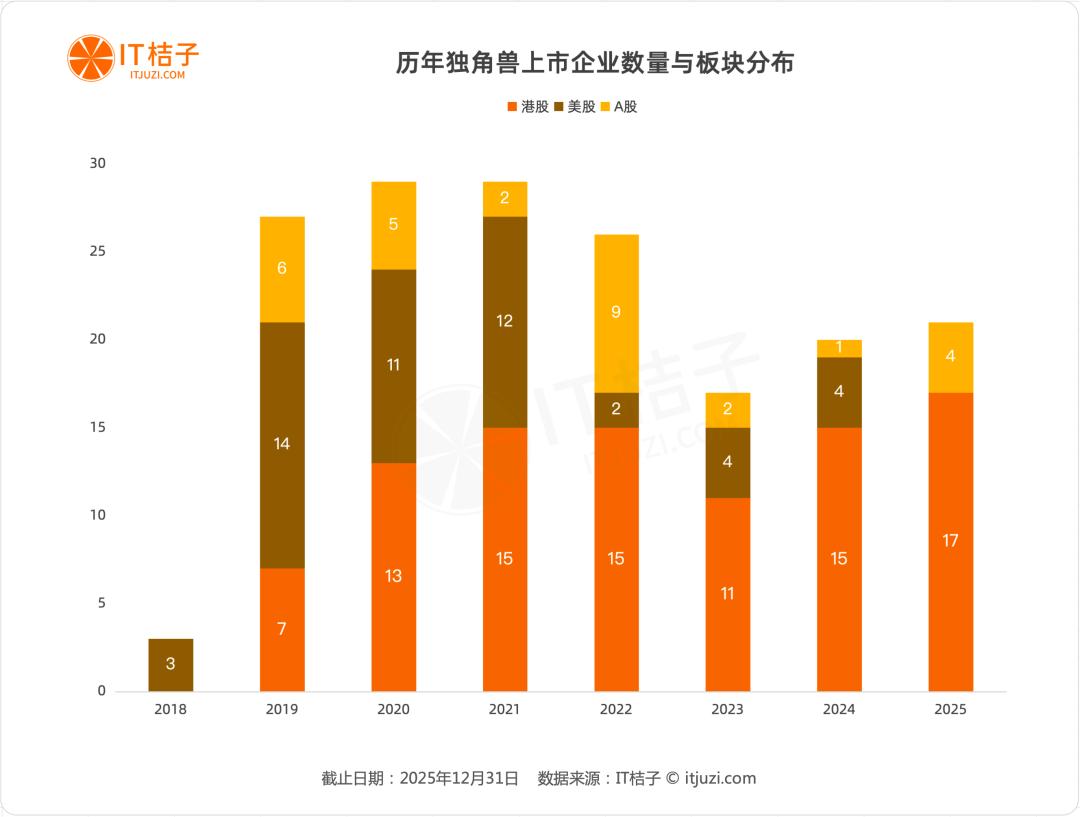
From 2018 to 2025, a total of 177 unicorn enterprises completed their listings. The peak period of listings was from 2019 to 2022, with a total of 111 listings in four years, accounting for 62.7% of the total.
However, a more profound change has occurred in the choice of listing locations.
The Hong Kong Stock Market has become the biggest winner.
In 2018, no unicorns were listed on the Hong Kong Stock Market. By 2025, the Hong Kong Stock Market accounted for 81% of the number of unicorn listings in that year. In the nine - year cumulative view, 98 Chinese unicorns chose the Hong Kong Stock Market, accounting for 55.4%.
This trend is closely related to the listing system reform implemented by the Hong Kong Stock Exchange in 2018, which allows different - voting - right shares and the listing of non - profitable biotech enterprises. The Hong Kong Stock Market is becoming the "home court" for Chinese innovative enterprises.
The US Stock Market has experienced a sharp turn from "hot at first and cold later".
From 2019 to 2021 were the golden three years, with a proportion of 51.9% in 2019 and 41.4% in 2021. However, it suddenly dropped to 7.7% in 2022 and has been zero since 2025. A total of 50 in nine years, accounting for 28.2%, of which more than 70% were concentrated from 2019 to 2021.
This turn is closely related to the regulatory frictions between China and the US and the audit and regulatory issues of Chinese concept stocks.
The A - share Market shows policy - driven characteristics.
The A - share Market has accepted 29 unicorn listings in nine years, accounting for 16.4%. There was a small peak in 2022 (9 listings, accounting for 34.6%), which is closely related to the deepening of the registration - based reform of the Science and Technology Innovation Board and the Growth Enterprise Market and the opening of the Beijing Stock Exchange.
The Chinese Unicorn Ecosystem in Search of a New Balance Point
When we look back at the end of 2025, the Chinese unicorn market is undergoing a paradigm shift from "valuation inflation" to "value verification".
The narrowing of the decline in the number of new additions, the high exit ratio, the industry differentiation in the listing cycle, and the strong rise of the Hong Kong Stock Market together outline the survival rules in the post - high - growth era.
The fast - in - and - fast - out of light - asset tracks and the long - cycle precipitation of hard - tech tracks form two sides of the current Chinese unicorn ecosystem. For market participants, what matters is no longer chasing the unicorn label itself, but understanding the differences in the "value verification rhythm" of different industries and adjusting the patience of capital and the exit expectations accordingly.
After all, among the 805 unicorn enterprises, whether former or current, only a few can achieve an exit through listing. How to reduce losses in the 48% of dismal exits and capture value in the 52% of listing paths will define the investment wisdom in the next cycle.
This article is from the WeChat official account “IT Juzi” (ID: itjuzi521). Author: Judy. Republished by 36Kr with permission.