StoReel Secures $34 Million in Funding: Reconstructing Story Production with AI, Building a Content Ecosystem Driven by Both Tool Community and Platform | Emerging New Projects
Text by | Wang Xinyi
Edited by | Wang Yuchan
One-sentence Introduction
StoReel is a global AI-native entertainment content platform. Its core products are the AI drama platform StoReel App and the AI drama tool community StoReel Canvas, which are committed to building a creation, distribution, and monetization system for serialized drama content.
The company evolved from the short drama track in the overseas market. Since the end of 2024 to the beginning of 2025, it has systematically explored the application of AI in short drama production and content creation.
Financing Progress
Recently, StoReel has received $34 million in growth funding. This round of financing includes a $9 million Seed round equity financing led by Play Ventures, with the participation of T-Accelerate Capital, Tirta Ventures, VRF, etc., and a $25 million user growth financing from PVX Partners.
According to StoReel, this fund will be used to improve AI content production capabilities, expand the creator ecosystem, and accelerate global user growth.
Products and Business
StoReel's two core products are StoReel App and StoReel Canvas.
StoReel App is an AI short drama content platform targeting the overseas market. More than 50 AI short drama contents have been launched, of which 80% come from the PUGC creator ecosystem. These short dramas uniformly adopt a realistic visual style and are fully generated by AI throughout the process.

△Posters of some self-produced dramas, Source: Provided by the enterprise
Before fully shifting to the AI track, StoReel had long been deployed in the overseas short drama market and accumulated mature content production and distribution capabilities. Currently, StoReel App focuses on AI-native content, continuously launches various types of drama content, and continuously optimizes content production and user experience through AI technology.
Users can not only "watch dramas" on the platform but also participate in content evolution by voting on the plot direction and key plots, and interact with character IPs in multiple dimensions, gradually extending from "watching" to "participatory experience."
At the product level, users can interact with AI characters in text and gradually unlock multi-modal content such as voice, pictures, and videos. At the same time, combined with various interactive forms such as mini-games and immersive mini-theaters, the connection between users and the plot and characters is enhanced.
In addition, StoReel conducts personalized operations on some core characters, builds an independent character content matrix, and conducts continuous content extension and interactive operations around the plot development to enhance user stickiness and IP value.
Meanwhile, StoReel has self-developed the one-stop AI film and television creation tool community StoReel Canvas, which serves as the core production platform for the internal AI director team and the creator ecosystem.
Its tools integrate multiple mainstream generation models and build a full-process production workflow covering storyboard design, character and scene asset management, image and video generation, project collaboration, and release, realizing the integrated production ability from creativity to finished products.
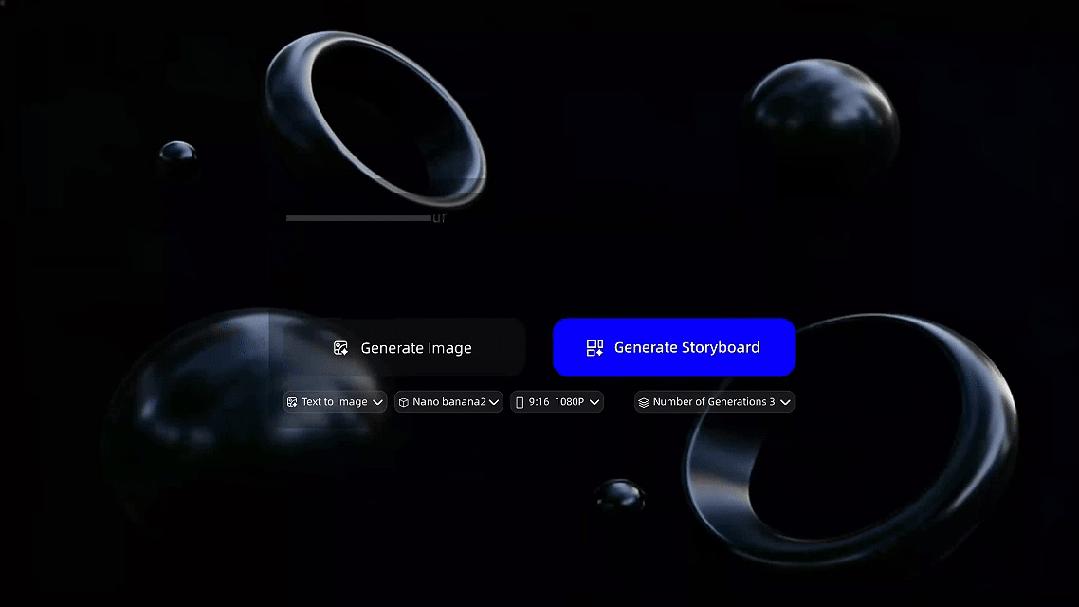
△StoReel Canvas, Source: Provided by the enterprise
In terms of specific capabilities, StoReel Canvas can meet film and television-level production requirements such as ultra-clear and super-resolution processing, character consistency control, lip-sync generation, lighting, and picture style adjustment. Through the templated process and asset reuse mechanism, it significantly reduces repeated production costs and significantly improves content production efficiency and stability.
Overall, StoReel Canvas is not only a generation tool but also an AI production system that supports large-scale and standardized content production, providing underlying capabilities for high-frequency and high-quality content supply.
StoReel's drama creation is not a one-time event but an iterative creation model. On the drama content side, the platform has added a plot voting feature. Users can participate in voting to influence the development direction of the plot and the content development of the script.
If it is found that the plot of a few episodes is not suitable, the creator can also adjust the script at any time and then continue with content production.
In terms of the time cycle, it may only take a few weeks from the completion of user voting to the completion of drama creation.
StoReel's goal is to achieve a monthly output of 100 AI short dramas by the end of 2026, including self-produced content within the platform and content provided by the PUGC creator ecosystem.
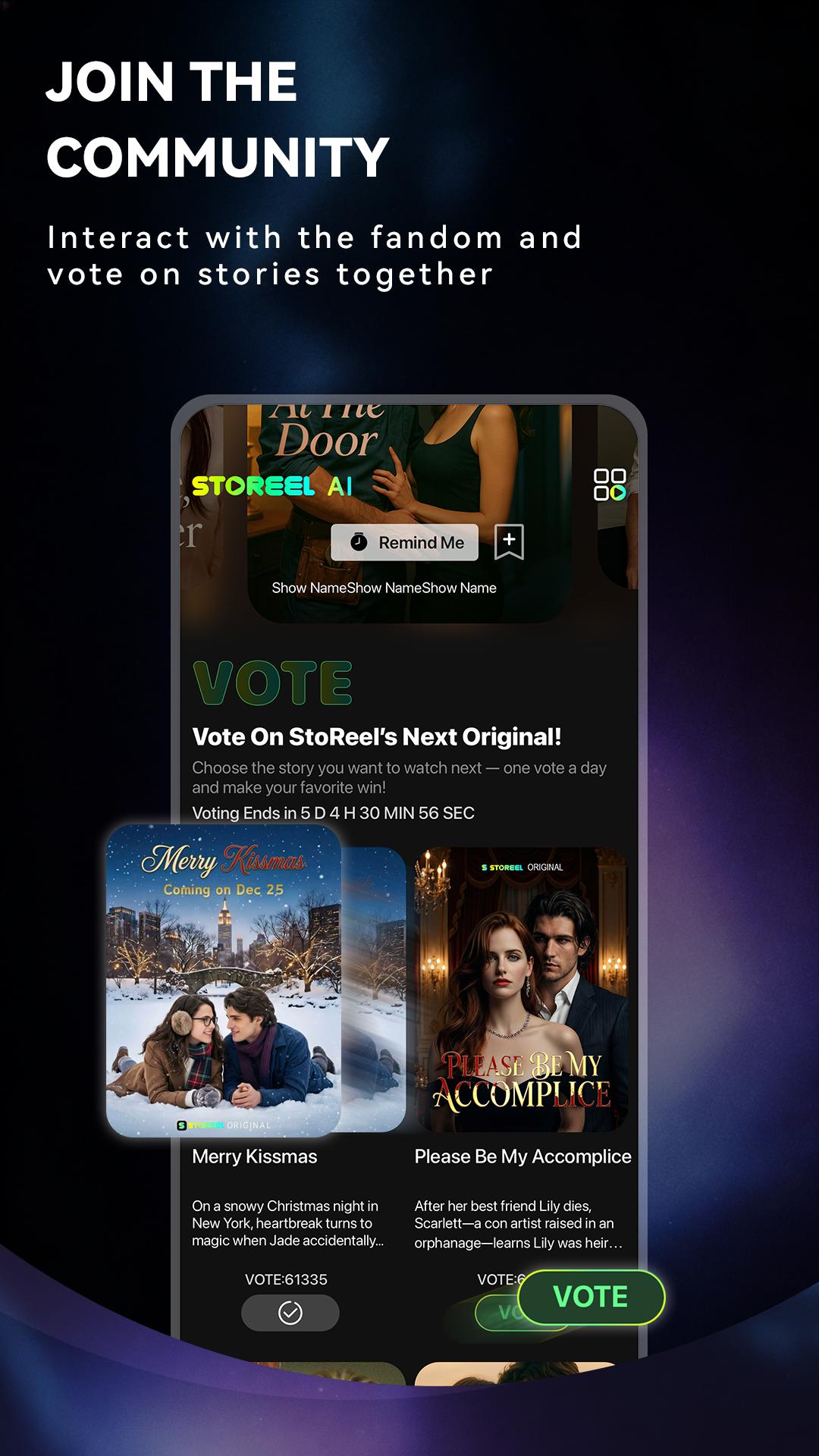
△The script voting function on StoReel App, Source: Provided by the enterprise
Compared with live-action short dramas, the data performance of AI short dramas is also very good. From the unit economic model of a single piece of content, the ROI performance of AI dramas continues to improve. High-quality content can achieve stable positive returns, and it also has a stronger efficiency advantage in user acquisition costs.
StoReel's current main revenue model is subscription payment. In the North American market, the price of membership subscriptions is a weekly membership subscription of $19.9 to $29.9 and an annual membership subscription of $269, with slight price adjustments made for different regions and models. Some dramas also adopt the model of regular free viewing or unlocking through advertisements.
In addition, StoReel is also exploring the monetization possibilities of gamification and interactive gameplay, such as virtual gifts, in-app purchases related to characters, and brand collaborations.
Currently, StoReel mainly focuses on the English content market, targeting users in English-speaking countries such as North America, the UK, and Canada, and also covering markets in Japan, South Korea, Southeast Asia, and Latin America.
It is worth mentioning that the community ecosystem version of StoReel Canvas will be launched in mid-April and start internal testing. On the basis of providing complete AI creation tools, the platform will further open up task matching and creative collaboration capabilities. Creators can choose the scripts provided by StoReel on the platform to accept orders for production. After completion, the platform will distribute and monetize them uniformly, forming a closed loop from creation to distribution.
Meanwhile, the platform will gradually launch content and asset resource libraries, template systems, and creator community communication functions to support creators to collaborate, reuse, and iterate under a unified workflow, continuously improving creation efficiency and content quality.
Overall, StoReel Canvas is evolving from a creation tool to an integrated ecological platform that connects creators, content production, and distribution monetization.
Core Barriers
StoReel's core advantage lies in building a "creator tool community + content platform" dual-engine structure.
On the one hand, StoReel Canvas, as a creative infrastructure, continuously improves content production efficiency. Through the order-taking and task mechanism, it helps creators complete the closed loop from creation to monetization more quickly, promoting the large-scale growth of high-quality content supply.
On the other hand, the C-end content platform extends the content lifecycle through character IPs and interactive gameplay (such as character interaction and plot participation), enabling single content to be transformed into sustainable operational assets, bringing long-term value and diversified monetization space for creators.
More importantly, these two parts of the business do not exist independently but reinforce each other: the creator tool community continuously improves supply efficiency, while the content platform undertakes consumption and monetization capabilities, forming a self-reinforcing growth flywheel.
This structure makes StoReel not just a content company or a tool platform but a next-generation content infrastructure based on AI that integrates the content layer and the creator ecosystem.
Team Introduction
StoReel was co-founded by Fan Shipeng (Eric), Zhang Rui (Janry), and Angela Yu.
Founder & CEO Eric once led the short drama business construction of Lemon Entertainment, was responsible for the domestic short drama architecture and the overseas short drama content system construction, and successfully promoted Lemon Entertainment's listing.
The StoReel team has an international background and comprehensive capabilities. The core members graduated from top universities such as Peking University and Columbia University. The team members come from fields such as Internet products, content production, and AI technology, and have rich experience in global product and platform operation.
The team forms a collaborative ability in key links such as content creation, product R & D, and user growth, and can efficiently promote the large-scale implementation of AI content from production to commercialization.
Founder's Thoughts
-
The emergence of AI provides new solutions to problems in the short drama industry, such as high content costs, limited production capacity, and rapid consumption of user freshness.
On the one hand, AI can significantly lower the threshold and cost of content production, allowing more creators to participate in short drama creation.
On the other hand, AI can also make content production more flexible, forming a content production model closer to Internet products.
-
The model capabilities of the entire industry will only improve, and the key lies in the integration of capabilities.
Seedance 2.0 has brought a relatively obvious improvement in efficiency to the industry. Compared with the first-generation model, Seedance 2.0 has made obvious progress in video generation quality and stability, which is very important for AI short drama production. However, from our perspective, the iteration speed of AI models is very fast, and it is more important to integrate model capabilities into the content production workflow rather than relying on a single model.
-
The supply of short drama content in the overseas market is far less than that in the domestic market, but the content distribution channels are more diverse.
The short drama industry in China developed earlier and is mainly under the ByteDance ecosystem, having formed a relatively mature creator and production supply chain with more industry talents. In contrast, the overseas market has more diverse traffic selection channels and content distribution platforms, such as YouTube, TikTok, Instagram, Meta, etc.
Overseas, we can publish content on our own platform and distribute it on other platforms, and formulate more flexible traffic investment strategies according to different content types and user groups. For example, the content is first launched on the StoReel App platform for payment, and then distributed for free on TikTok. The overseas market is still in its early stage, and the competition is relatively less intense than in the domestic market. The overall customer acquisition cost and monetization space will be more flexible.
-
In the long run, the core of ROI depends on content quality and product capabilities rather than the traffic environment of a single platform.
Traditional short dramas are essentially a one-way content consumption. We are exploring the product form of "playing dramas." AI short dramas are just our entry point. In the long run, we are more inclined to build an AI-native content platform focusing on gamification and interaction. The AI-driven character interaction and hidden plot unlocking model transform short dramas from one-time content consumption into a continuous interactive entertainment experience.
We will gradually lower the price system of short dramas and focus the real monetization modules on interactive and gamified gameplay, allowing users' personal emotional needs to drive payment. From the actual data, after introducing AI interactive content, users' viewing time and interaction frequency have significantly increased, which has also driven more content unlocking and payment behaviors. After users establish an emotional connection with the characters, they are more willing to continue to advance the plot or unlock new interactive content.
-
Cultural understanding is an important challenge in the overseas market.
If we want to develop more niche products, we need to consider the key factor of "culture." For us, the North American market is our basic market, and content in Spanish, Japanese, Korean, Indonesian, and other regions is also being launched simultaneously.
However, users in different regions have obvious differences in theme preferences, emotional expressions, and narrative rhythms. For example, the North American market emphasizes character relationships and emotional tension more, while some emerging markets may prefer more intense plot reversals and plot density.
Assuming that a drama is mainly targeted at the North American market, we will regard the English market as the main battlefield and distribute it to other places such as South America, Japan, and South Korea. However, since the cultural background of this drama comes from the English cultural background, its main position must still be English-speaking countries. Before we firmly establish ourselves in the English market, we will not specifically develop content for a certain region for the time being. After that, we may develop some localized content.
-
In the early stage, it is necessary for the platform to provide scripts for users to "accept orders."
The process of creators accepting orders is phased. At the current stage, although most creators have strong video production capabilities, there are deviations in their understanding of the script logic and commercialization of overseas short dramas. The platform needs to help them make up for these cognitive deviations. Creators can improve their success rate by using the carefully polished scripts provided by the platform.
In the long run, of course, we hope that creators will have the ability to write their own scripts. After creators have cooperated with the platform on a lot of content and have figured out the rules, they can then turn to self-submission.
-
Create content that C-end users really want to see.
Currently, there is a plot voting section on the App, and we hope that this section can evolve into a vertical community section for plots in the future, similar to the Zhihu model, allowing users to participate in plot planning and discussions. Based on this model, we can develop plots based on users' real feedback.
Cover Source | Provided by the enterprise

Scan the QR code to join the "Intelligent AI Exchange Group"

Welcome to communicate!