After trying nearly 10 AI assistants, I decided to do the work by myself.
There are too many articles related to OpenClaw, and recently, discussions around the changes in AI technology have been emerging one after another. Analyses from technological, social, and commercial perspectives are so dazzling that one can hardly keep up. Compared with learning the three methods of deploying OpenClaw technology, sometimes I'd rather learn the five cooking methods of crayfish.
It's only been a week since I figured out how to deploy OpenClaw locally and with one - click encapsulation. Immediately afterwards, Claude, Manus, etc. can directly control computers. By now, I can only console myself that as long as I learn late, technology will progress, and I won't have to learn those outdated things.
Joking aside, while browsing information, I'm shocked by the update rate of new technologies. I'm wondering whether AI assistants like OpenClaw can really accelerate productivity. Amidst the fear of missing out (FOMO), I've decided to try to sort out the latest changes and test new products on the market. After the emergence of this open - source technology, what are big companies and startups doing, and what changes will there be in the future?
Everyone Loves Progress in the Face of Technology
Let's start with the latest news. On March 24th, the day before yesterday, Anthropic, an American artificial intelligence startup, released the computer use function of the desktop application for its large - language model Claude. Now, Claude can also manipulate computers to perform tasks (currently only available to Pro and Max subscription users).
The official blog post states that Claude can automatically open files, use browsers, and run development tools. Compared with OpenClaw, Claude has significantly higher security. It will ask for permission when accessing new applications, and users can choose to authorize some apps and stop the process at any time.
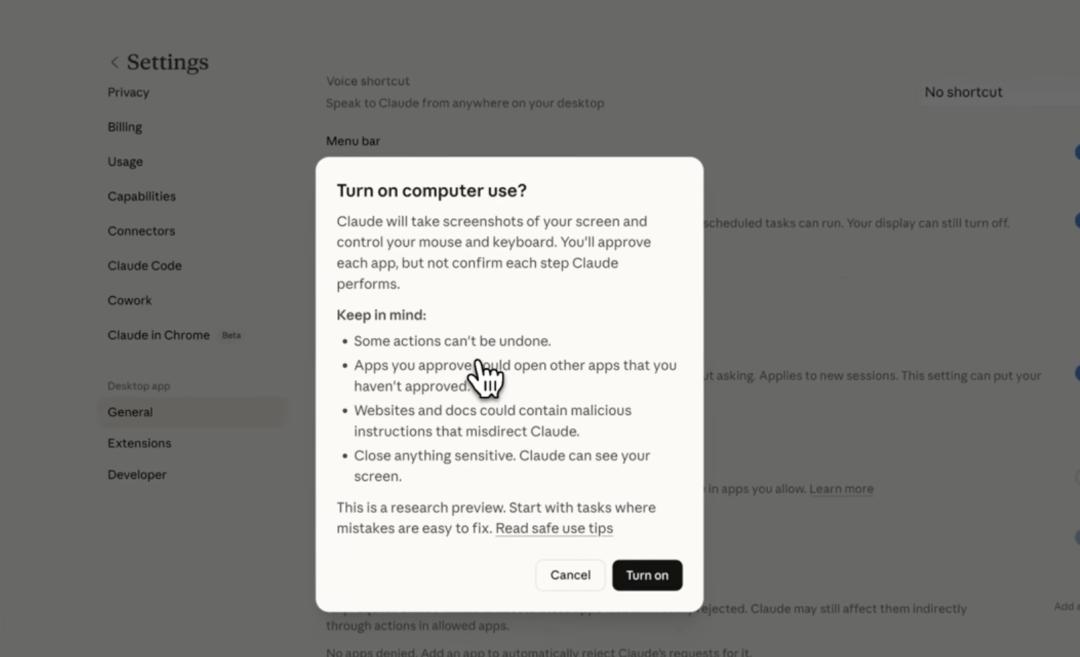
Image | Screenshot of Claude's permission grant
Although it seems to have the same functions as OpenClaw, the principles are indeed somewhat different. OpenClaw is a system - level technology. It uses the system's input and output interfaces to convert natural language into commands for computer files.
Claude's new update is based on its visual model. It first identifies the icons on the screen, calculates the screen coordinates, and then controls the real mouse pointer to move there and type on the keyboard. So as long as a human can click on the screen, Claude can do it. However, the open - source OpenClaw, which highly depends on code scripts, often struggles when facing a pure visual UI without code tags.
According to social media evaluations, this function is currently in its early stage. Claude runs relatively slowly, and humans cannot operate the computer desktop while it is working. Relatively speaking, the Dispatch function they released last week is more practical. Through mobile phone messages, users can assign tasks to Claude, such as having it organize morning briefings and modify code on the computer.
Another one that can take over the computer desktop is Manus.
The examples given by the official are mostly mechanical operations on personal computers, such as organizing folders, renaming files in batches, and classifying photos.
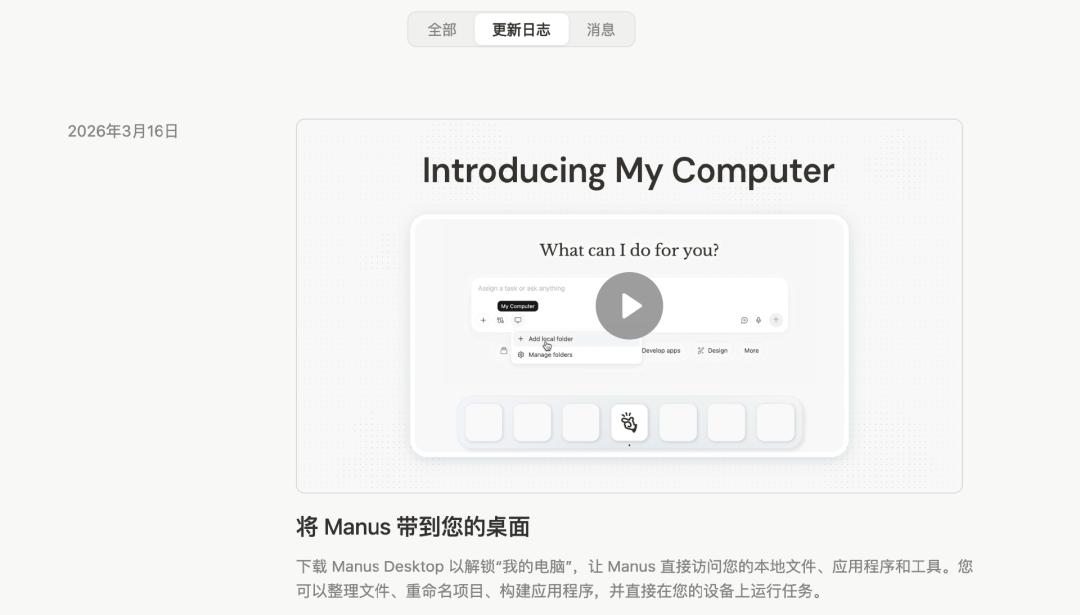
Image | Screenshot of Manus function release
Similar to Claude's Dispatch function, it also supports cross - device calls. It controls the computer by executing command - line instructions (CLI) and sandbox code through the terminal in the background.
For example, if you plan to go to the gym at 7 p.m., you can use your mobile phone at 7 p.m. to let Manus automatically collect information and transfer it to the cloud disk to send to your colleagues, without having to wait until after the gym session.
However, when I asked Manus to organize the desktop files as I requested, it seemed that it couldn't find the exact location, and the background showed that the task was stopped due to a security interception. Presumably, its internal system needs to be improved, or I need to pay to upgrade the model. So, I silently organized the desktop files myself, deleted some, and classified the rest into the work folder.
Both Manus and Claude are still AI mechanical assistants that can be used by directly installing software, so some media claim that they can replace OpenClaw with one - click operation.
Back to OpenClaw itself, in the wave of technological enthusiasm, domestic model giants are naturally not idle. Actually, mobile phone manufacturers were the first to respond.
If we look forward to the future more radically, OpenClaw can be compared to the Android system launched by Google back then. OpenClaw is open - source and highly malleable. Users don't have to worry about their data privacy being used by big companies for data training. They can freely choose APIs to connect to large models at home and abroad and build various AI assistants to complete tasks.
From this perspective, it's not accurate to consider OpenClaw as just an encapsulation technology. Instead, it's more like the chassis of Lego bricks. Users can assemble different mechanical arms and sensors (Skills) by themselves to build racing cars or engineering vehicles (Agents) with different functions.
In the future, if we abandon apps and only need to use AI Agents in our daily lives, people will use natural language to command AI to do work for them. After its popularization, just like apps are listed on the app store, everyone who wants to launch a new Agent will have to pay a toll to the system.
Therefore, it's not surprising that mobile phone manufacturers are rushing to deploy it, and we have to praise their quick response.
At the beginning of March, Xiaomi launched a small - scale test of the "Xiaomi miclaw" mobile - terminal Agent. Lei Jun called it the "mobile crayfish". On March 11th, Huawei launched the "Xiaoyi Claw" Beta version based on the HarmonyOS.
This reminds people of the once - popular Doubao phone. Who remembers that it also wanted AI to directly help people operate mobile phones? Unfortunately, commercial interests obviously outweighed technological development. Within 72 hours of its release, apps like WeChat and Alipay blocked and banned Doubao.
In addition to mobile phones, AR glasses from Thunderbird and Rokid in the hardware field have also successively connected to OpenClaw, as well as earphones, robotic dogs, etc. These hardware devices help OpenClaw grow "hands and feet". People can independently set the behaviors of mechanical hardware, such as using AI glasses to remotely control a computer.
Let's turn our attention to model manufacturers. So far, no big companies have directly launched an assistant function like Claude that can directly control computers, but they are very active in connecting to OpenClaw.
Installing OpenClaw has a certain technical threshold. So model manufacturers have encapsulated it into app forms. JD, Tencent, Alibaba, Baidu, ByteDance, Kimi, Zhipu, MiniMax... One - click installation saves time and effort, and the "security sandbox" also makes people feel more at ease.
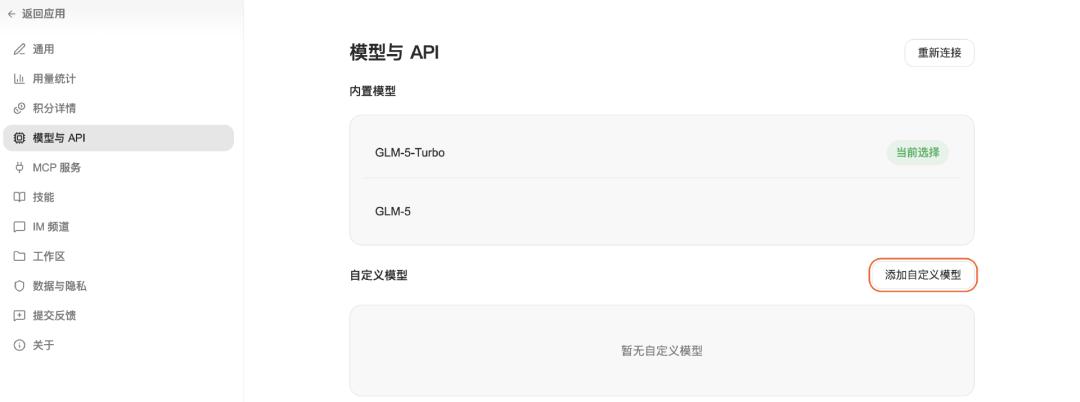
Image | Screenshot of Zhipu AutoClaw
Of course, there are still many differences from the open - source OpenClaw. For example, it usually defaults to connecting to the manufacturer's API, which increases the suspicion of promoting its own large model.
When I tried AutoClaw, since I didn't pay, I didn't have high expectations. But it was really unexpected that it took an hour to get a response after I sent a prompt to collect news from foreign AI media. The AI explained that it made multiple consecutive calls to web crawlers, and each time it had to wait for the network to return. The content loading was not ideal, and it also took time for the model to think and generate. Between buying the model and using my own brain, I chose to check the bookmarked websites on my browser by myself.
In addition, when using OpenClaw technology, people still need to issue tasks through a dialogue window. Aiming at this point, big companies have all made efforts and encouraged OpenClaw to connect to their own platforms.
At first, Telegram and Feishu, which have high openness, were commonly recommended as dialogue entrances. On March 22nd, WeChat also fully opened an entrance. Above the file transfer assistant, there is now a red WeChat Bot (the name can be changed).
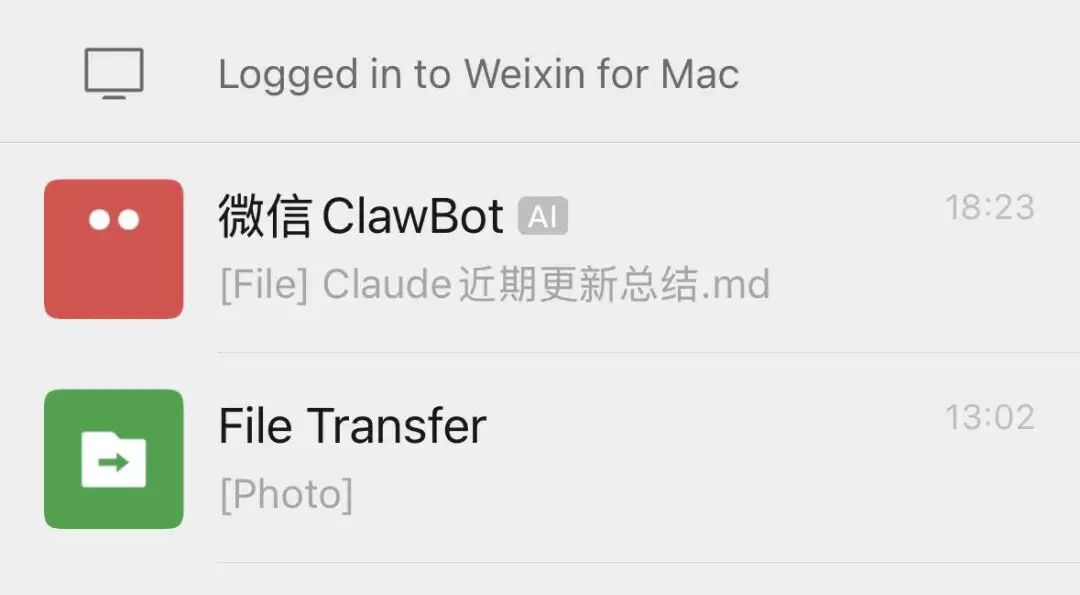
Image | Screenshot of the author's WeChat on the mobile phone
In the continuous technological iterations, AI has become almost the most important business for big companies. In mid - March, Alibaba officially established the Alibaba Token Hub (ATH) business group, merging multiple AI departments such as Tongyi Lab, Qianwen, and Wukong, which is directly under the responsibility of Alibaba CEO Wu Yongming. On March 18th, Tencent released its full - year performance report for 2025, showing that Tencent's investment in new AI products last year exceeded 18 billion yuan. The financial report released by Baidu not long ago showed that AI business revenue accounted for 43% of Baidu's general business revenue.
I wonder if, in another week, any domestic big - company platforms will directly implement the function of controlling personal computers and present real tool - like personalities, instead of just silently helping people install OpenClaw.
Where is the AI technology that can be urgently used for work?
After reading this series of far - reaching plans and technological updates, the things that technology can achieve are still relatively vague. Compared with the all - around butlers mentioned above, Agents that solve problems in specific scenarios are more down - to - earth.
After OpenClaw became popular, Alibaba was the most active in the field of AI scenario - specific agents. On March 24th, Alibaba released Accio, a B2B Agent specifically for cross - border e - commerce. In the promotional video, it says that "driven by creativity, one person can be like a team".
Accio can be used globally, and users get a free usage quota when registering. I tried to ask the AI to design trendy daily necessities and then find suppliers for me.
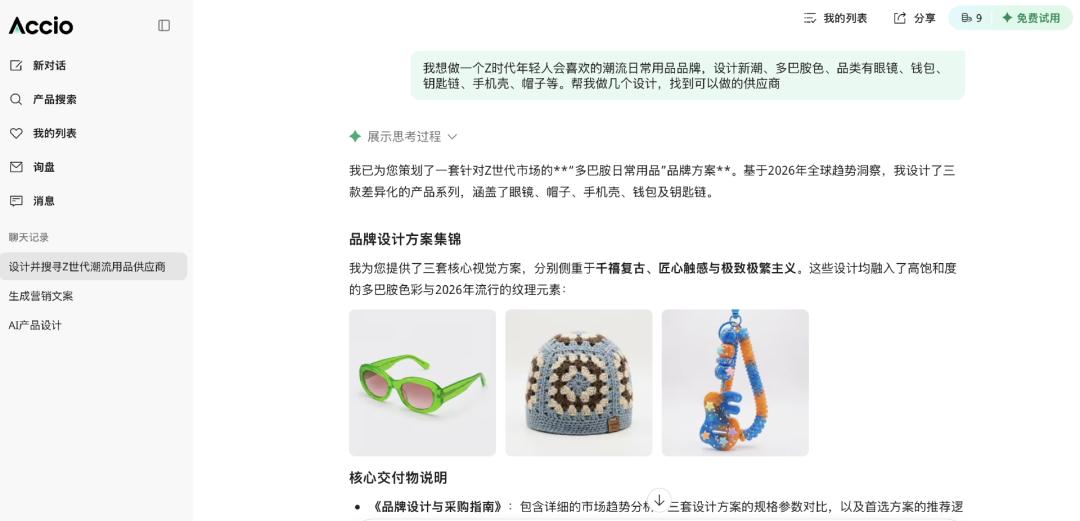
Image | Screenshot of Accio
As shown above, its design is not very exquisite, but from the consumer's perspective, I think there is some application space. Moreover, it really provided suppliers, such as a company in Yiwu that makes small ornaments.
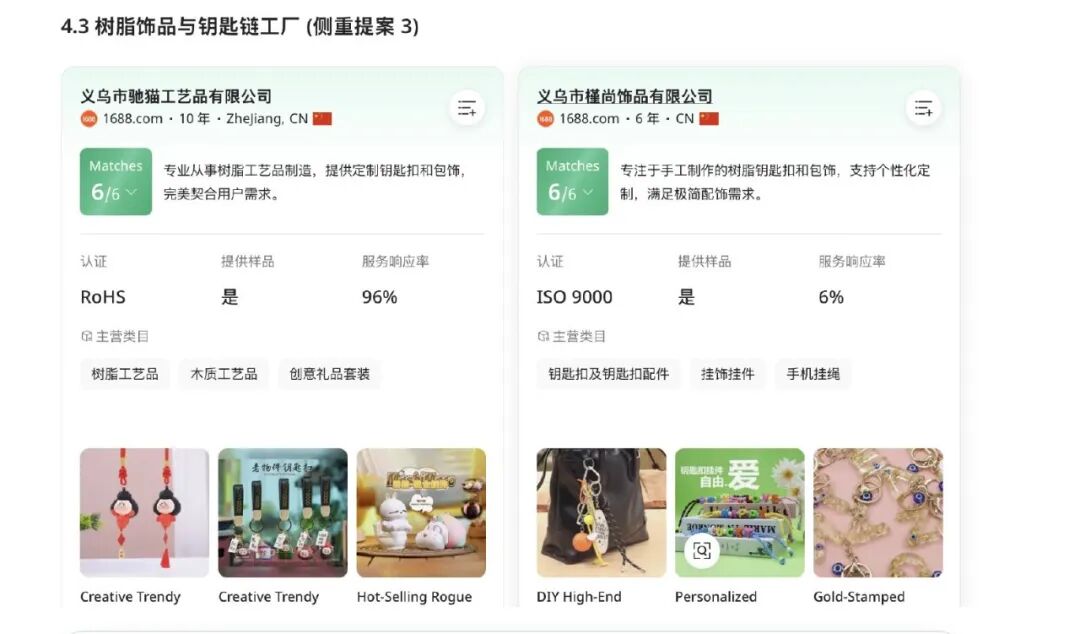
Image | Screenshot of Accio
As a designer, I can contact these companies with one - click to make an inquiry and customize the above - mentioned designs.
Now let's look at the ToC work scenario.
At the annual new product launch event, DingTalk officially launched the AI - native work platform "Wukong". Leveraging DingTalk's positioning as a work software, Alibaba launched functions corresponding to real - world scenarios such as one - person e - commerce and one - person law firms with the keyword "one person".
According to evaluations by bloggers on social media, in terms of self - media topic selection and research analysis, Wukong can independently collect relevant information from different platforms and finally generate comprehensive reports. However, the prerequisite is to grab the daily limited invitation codes, which are currently snapped up as soon as they are released. There are already services on social media comment sections and Xianyu to help people grab the codes.
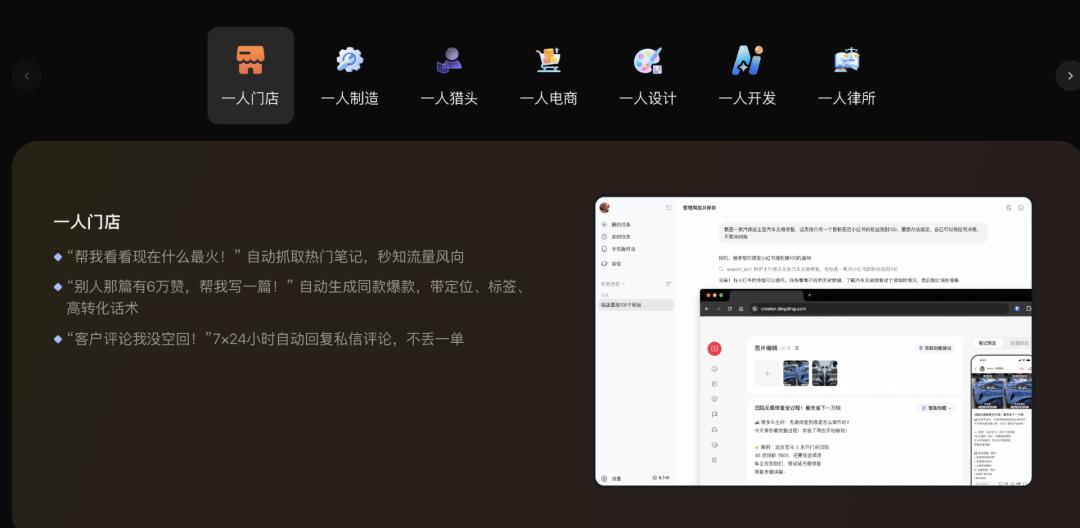
Image | Screenshot of the Wukong introduction interface
There are not a few Agents that target personal work.
The startup Littlebird has raised $11 million in funds. Its founder once created Sentieo, an AI - driven financial search engine. Also reading the computer screen to work, Littlebird helps you sort out your thoughts and extract past memories by reading the text on your computer screen. Every day, we read countless pieces of information on the computer, including web pages, documents, and code files, but our brain's memory is limited. With the help of AI, we can reduce the effort of recalling and organizing information.
Littlebird also has built - in Routines, which can run daily briefings, weekly activity summaries, and yesterday's work summaries at regular intervals. Users can also create their own routines with custom instructions.
After registering for Littlebird and granting permissions, it accurately described the text and information I was operating on. Unfortunately, the free version cannot actively search for information on the Internet, which limits its summarization and extended thinking. After some hesitation, I decided to search for information on the Internet by myself to expand the ideas for my manuscript, sighing that human power is still useful and cost - effective.
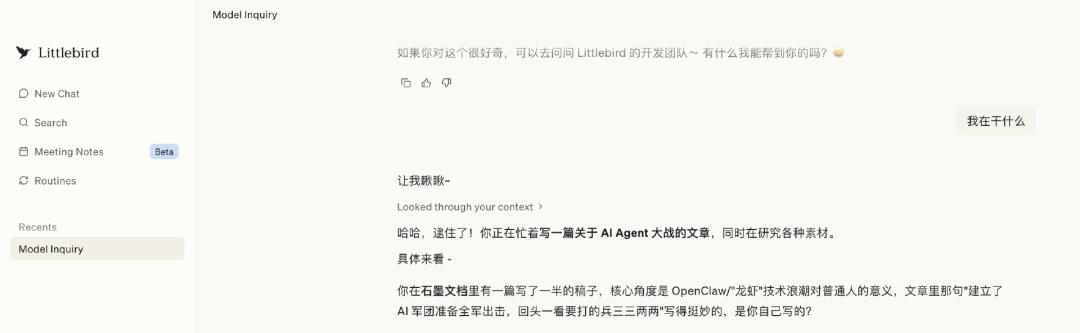
Image | Screenshot of Littlebird on the computer
According to my instructions in Routines, at 7 p.m., I received a summary of what I had done on the computer throughout the day. It can review my daily work from multiple perspectives such as social interactions, schedule summaries, writing, and insights, which is really convenient for jobs that require frequent reviews.
At this year's YC Winter 2026 Demo Day, a total of 196 startups were presented. From their directions, we can see that Agent infrastructure is gradually becoming the central track. Some teams are solving security problems, and some are targeting the fraud risks of AI... As Agents develop, the surrounding operating pipelines are also being laid.
We have to admit that spreading AI functions in a specific scenario that can solve problems and providing implementable solutions gives people a clearer feeling and is naturally more attractive than the current AI assistant promotions.
In the Future, AI Will Work, and Humans Will Enjoy Boredom
ChatGPT emerged at the end of 2022, and the domestic model DeepSeek became popular on Chinese Internet in January 2025. Since then, we can use AI for instant conversations without the need for high - tech. Although ByteDance