Aoyi Technology Secures $150 Million in Series C Funding, with Overseas Revenue Growth Outpacing Domestic | Exclusive Report by 36Kr
36Kr has learned that OYMotion Technology recently completed a Series C financing of 150 million yuan. This round of financing was led by the Shenzhen Brain Science and Brain-like Intelligence Industry Investment Fund under CICC Capital (hereinafter referred to as the "CICC Brain Science Fund"), and several existing shareholders continued to participate.
OYMotion Technology was founded in 2015 and focuses on non-invasive neural signal sensing and AI analysis technologies. It has independently developed products such as EMG/EEG sensors, intelligent bionic hands, neural rehabilitation exoskeletons, and embodied intelligent dexterous hands, and holds more than 100 independent intellectual property rights.
As the core and cutting-edge tracks of the new generation of scientific and technological revolution, both the brain-computer interface and embodied intelligence fields have received intensive policy support: in the 15th Five-Year Plan of the country, "brain-computer interface" and "embodied intelligence" are both listed as one of the six future industries, and local governments have successively established special funds for brain-computer interfaces and brain science.
It is understood that the CICC Brain Science Fund, the leading investor in this round of financing of OYMotion Technology, was jointly established by the Shenzhen Guidance Fund, MicroPort NeuroTech (02172.HK)'s MicroPort Neuro and CICC Capital. It is also the only special fund in Shenzhen's "20+8" industrial cluster strategy that is completely focused on the brain science and brain-like intelligence industry. Previously, the company also received investments from institutions such as the actual controller of Sanbo Brain Hospital Group and Tianjin Heying Capital. Currently, OYMotion Technology has formed a shareholder lineup of "professional brain science funds + industrial parties of medical listed companies".
In terms of products, OYMotion Technology has established a three-in-one technical path of "brain (EEG) - muscle (EMG) - machine (ROBOT)". Relying on this technical path, OYMotion Technology is accelerating the large-scale implementation of non-invasive brain-computer interfaces in the field of neural rehabilitation. Among them, the ORF series of rehabilitation exoskeletons have been applied to the motor function reconstruction of patients with stroke and brachial plexus injury, forming a complete solution from neural signal collection, AI algorithm analysis to the execution of rehabilitation robots, providing high-performance and low-cost neural interaction infrastructure for the field of neural rehabilitation.
In the field of embodied intelligence, the shipment volume of the ROHand series of dexterous hands for industrial automation scenarios has increased by five times, covering nearly 100 downstream humanoid robot customers, and has become the core supplier of key components for intelligent interaction.
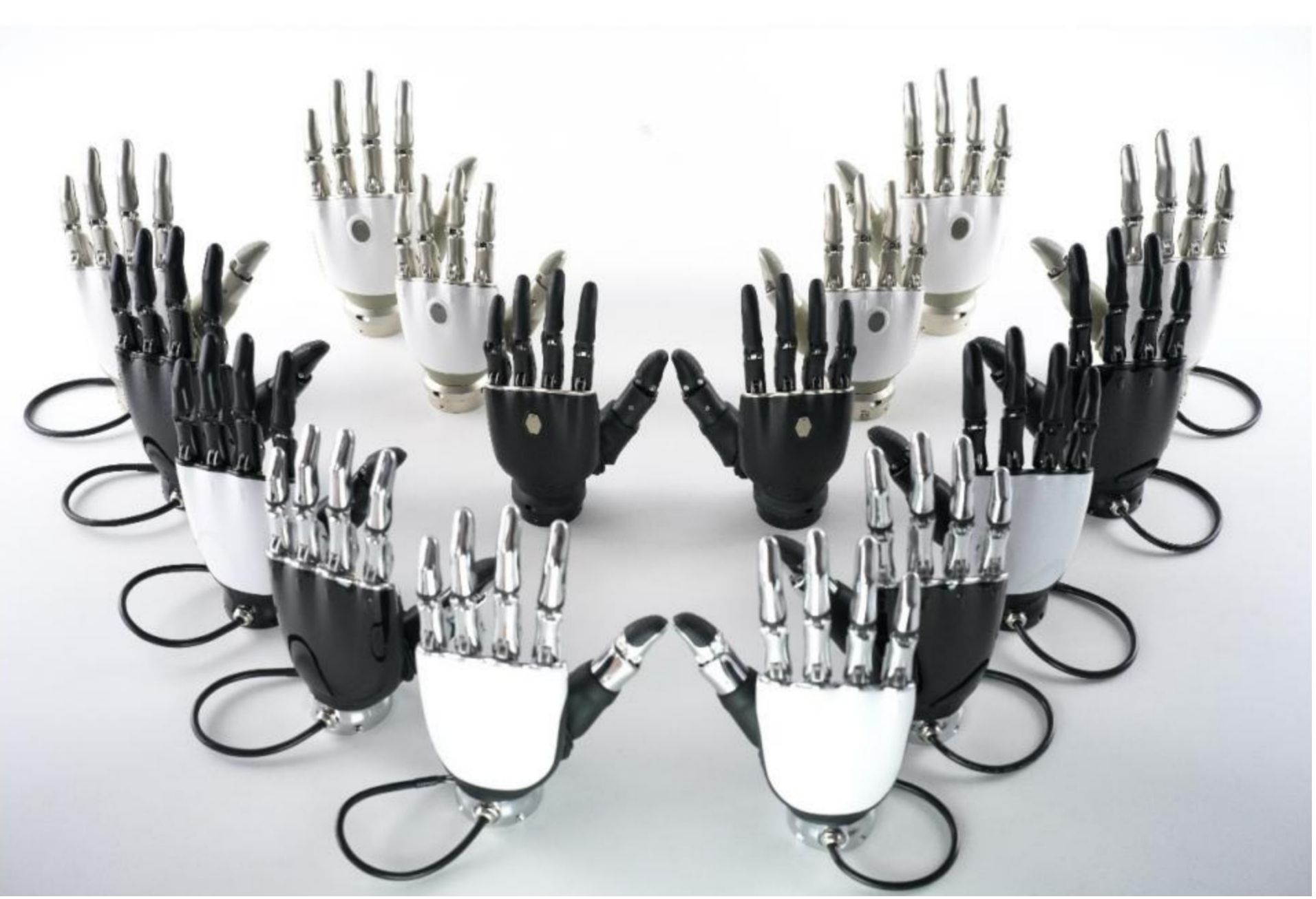
OYMotion Technology's ROHand dexterous hand family (Source: OYMotion Technology)
Data provided by OYMotion Technology shows that currently, the company's products for the medical rehabilitation sector have been implemented in many top-tier hospitals across the country, and the embodied intelligent dexterous hands have been delivered in batches to leading humanoid robot manufacturers. In the past three years, the company's overall performance has "doubled". If divided by region, OYMotion Technology's "overseas business volume and revenue growth rate have both exceeded those of the domestic sector", covering countries and regions such as Europe, the United States, the Middle East, and Southeast Asia.
When talking about the issue of how to adapt to local needs given the great differences in medical systems among different countries and regions overseas, Ni Hualiang, CEO of OYMotion Technology, believes that it is necessary to improve and adjust multiple dimensions such as products and services. "For example, in terms of products, users in the European and American markets have high requirements for the appearance simulation and privacy protection of products. Therefore, it is necessary to optimize the skin color restoration and wearing concealment of prosthetic hands. In emerging markets such as India and Vietnam, more emphasis is placed on the durability of products and their adaptability to high-temperature and humid environments."