From the 400 hotlines forgotten by the Internet, a group of "non-consensus individuals" in the AI era have emerged.
Disruptors in the AI era often don't emerge where everyone is looking but in those long - neglected corners.
Zhao Ying (nicknamed Xing Chen), the founder and CEO of Hangzhou Xingyu Artificial Intelligence Co., Ltd. (hereinafter referred to as "Xingyu Intelligence"), is often asked the question: "Why would you want to do this?"
"This" refers to the 400 service hotline, a niche track that almost represents tradition, inefficiency, and heavy reliance on human resources.
In many people's perception, the hotline service industry is on the verge of "exiting the stage": low labor efficiency, poor economies of scale, difficult to improve service quality, and it is a typical cost center. Internet companies aren't interested, and investors are hard to excite. However, Xing Chen and CTO Zhao Jun, a pair of former CEO and CTO of Xihu Xinchen respectively, plunged right into it.
Just one year after its establishment, the company achieved profitability in eight months. This small team of 10 people won the full - intelligent service projects of 400 hotlines for industry leaders such as Didi and Haidilao. These big clients were amazed by Xingyu Intelligence's "incredible input - output ratio" and the "generational gap" of its products.
Xing Chen said that when others couldn't figure it out, they saw three "non - consensuses" in the industry and firmly acted on them: do B - side business with the requirements of C - side business, must develop vertical models independently, and voice will be the mainstream interaction method in the future.
This also allowed Xingyu Intelligence to find an entry point to a trillion - level market in a track neglected by giants.
01. Do B - side business with a C - side mindset
Xingyu Intelligence has an impressive list of clients: Didi, Haidilao, Yuwell Medical, Panasonic... But they didn't follow the traditional B - side sales route. Their logic is: First, make the C - side experience perfect, and B - side clients will pay voluntarily.
This logic stems from a deep understanding of industry pain points. There is an old - fashioned contradiction in the customer service industry: enterprises evaluate customer service staff on a piece - rate basis, and there is a natural conflict between service duration and service quality. For a complaint call, the customer service wants to end it quickly, while the user needs to be heard.
Xingyu's AI service has no piece - rate pressure. When serving Didi drivers, the longest call lasted 124 minutes, and the AI chatted with the driver for over two hours. This is a task impossible for human customer service, but it was exactly this call that made the driver feel warm.
Xingyu's AI can process a large amount of system data during the conversation, enabling it to "be ready for service" when consumers call in. There is no longer a cumbersome process of confirming order numbers and models. It can also accurately recognize the intentions according to the expression habits of the elderly. After purchasing products from an established large company, Yuwell Medical still decided to buy Xingyu's products. The reason given was four words: "Generational gap."
If you serve C well, you will naturally gain the B market. This logic from the consumer goods era has been introduced into enterprise services by Xingyu Intelligence. Because Xing Chen firmly believes that the product itself is the best salesperson. When end - users are well - served, enterprise clients will come on their own. As of today, the 10 - person team of Xingyu Intelligence doesn't have a single salesperson, but it has already won many large B - side orders.

Xing Chen shares the service concept of Xingyu Intelligence's AI hotline
02. To provide services, you must have your own large - scale model
In 2025, most AI startups were using general large - scale model APIs to quickly assemble products and seize the time window. Xingyu Intelligence made an "unconventional" decision: to independently develop a vertical large - scale model, deeply train the model's "professionalism and stability" in the field of service communication to achieve "industrial - level" large - scale service capabilities.
In February 2026, Xingyu's large - scale model passed the record - filing of the generative large - scale model service by the National Internet Information Office. It is also currently the only end - to - end voice interaction large - scale model that has undergone vertical training for "human - like service communication ability."
In the eyes of Xing Chen and Zhao Jun, the general model solves the problem of "can it answer," while the service model solves the problem of "can it communicate." The former deals with problems, and the latter deals with relationships; the former tests knowledge and generalization, while the latter tests the understanding of emotions, roles, order, and real - life situations. The so - called professionalism of service is not about knowing more but about being more tactful, being able to enter the situation, and knowing how to say a sentence, how to promote a process, and what a real person really needs to be solved at the moment. A detail: when an elderly user repeatedly describes the same problem, Xingyu Intelligence's AI product doesn't rush to give an answer but listens first - this is an unconscious understanding of people.
Similarly, stability in the service field is the lifeline of whether services can be delivered. Enterprises don't need a model that has occasional outstanding moments. They need a system that doesn't deviate, lose control, or overstep the boundary in thousands of real - life interactions. It's not rare for a model to answer like a human once, but it's rare to be able to provide stable services every time. This is the truly commercially valuable ability in the service scenario.
Xingyu Intelligence's products are verifying this judgment. Their AI 400 hotline is the only product on the market that has achieved full - link intelligence, from the global cloud communication platform, intelligent hotline dialogue service, full - system operation and execution, dual - intelligent quality inspection of manual and AI operation results, to intelligent analysis of the full data chain, forming an upgrade of the entire Call Center system in the AI era to the "electric vehicle era."
The "generational advantage" evaluation given by clients to Xingyu's products also comes from the ultimate product experience: Xingyu's AI 400 hotline product can operate without manual intervention throughout the process, work 7*24 hours across time zones and languages, compress the delivery cycle to 1 - 2 weeks, control the interaction delay within milliseconds, and achieve an intention recognition accuracy and execution completion rate of up to 99.9%. This performance shows an absolute cost - advantage in any tender competition. Currently, Xingyu Intelligence's products have been launched and delivered in North America, supporting the global service layout of Chinese enterprises.
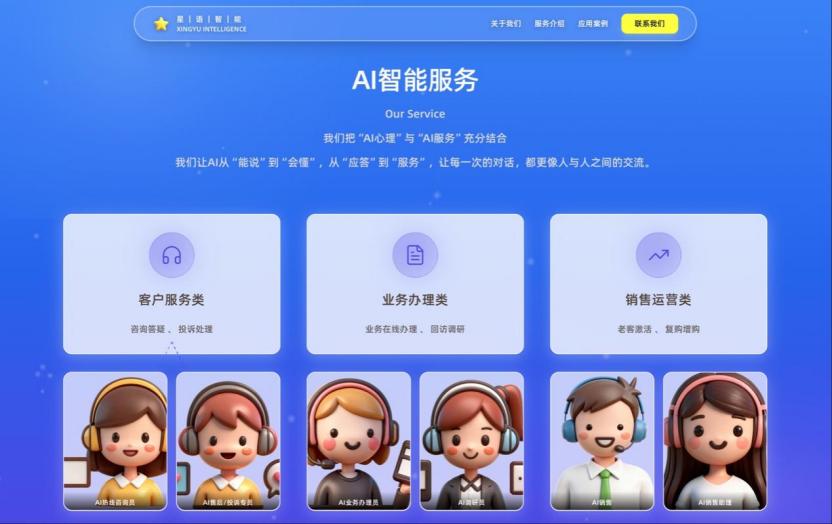
Product service types displayed on Xingyu Intelligence's official website
03. In the AI era, voice interaction will become the infrastructure of services
Xing Chen also noticed that more and more young people are starting to send a large number of voice messages again. On the surface, this is a change in communication habits. However, on a deeper level, it shows that when the cost of expression and understanding both decrease, people will naturally return to a more instinctive way of communication. "In the Internet era, human interaction habits changed from'speaking' to 'typing'; in the AI era, the interaction habits between humans and machines will return from 'typing' to'speaking.'"
In the past two decades, the Internet has established a "navigation - style interaction" - users click on menus, enter keywords, and complete operations step by step according to the page process. But in the AI era, the reason why the mainstream interaction method returns to voice is not complicated: humans are born to speak, not to click buttons. When the model can understand spoken language, tolerate noise, understand interruptions, handle emotions, and keep the cost of real - time response low enough to be usable, voice will no longer be just a supplementary entry but will become the most natural and lowest - threshold interaction interface again.
For the service industry, this change is especially crucial.
Because what is transmitted over the phone is never just information but also emotions, stances, trust, and a sense of being understood. Many service scenarios are difficult to be replaced by text, not because information cannot be expressed, but because many real - life interactions must be completed through voice, tone, pauses, and response methods.
This means that voice service may not just be a cost center in the future but may become part of an enterprise's experience - providing ability. When phone service is professional, stable, and low - cost, it will change from a "have - to - do" channel to an infrastructure worthy of long - term construction. Because what users really need is not just answers but also to be understood, accepted, and taken seriously.
From this perspective, what Xingyu Intelligence is doing is not just a traditional 400 hotline business but redefining the way AI enters the real service world at the oldest entry point.