The Story of IDG Capital's Fission: 20 Top Investors Have Left to Set Up Their Own Firms
This is the second installment of IT Juzi's series on the pedigree map of founding partners of Chinese investment institutions. The previous installment focused on Sequoia China, and this one will discuss IDG Capital.
IDG entered China more than a decade earlier than Sequoia China. It is a very established representative of US dollar - denominated investment institutions, and its story is more long - standing and complex.
Originally, IDG was a company headquartered in Boston, USA. Its founder and chairman, McGovern, established the first Sino - foreign joint - venture company in China in 1980, namely China Computer World Publishing & Service Corporation, which mainly published the weekly magazine "Computer World". In 1993, it established the first US dollar - denominated venture capital institution in China.
In 1999, IDG began to develop into an independent GP and no longer relied on its parent company, IDG Group (International Data Group).
In the following decade or so, led by Xiong Xiaoge, IDG's venture capital business in China developed rapidly, and it also introduced a distinct approach - "investing in the racers". According to this strategy, IDG successively invested in a group of founders who changed China's Internet, such as Li Yanhong, Ma Huateng, Liang Jianzhang, and Zhang Chaoyang, covering the elite generation of Internet entrepreneurs in China.
From the renaming of IDG VC to IDG Capital in 2009 to the acquisition of IDG Group by IDG Capital in 2017, IDG has continuously evolved. It has gradually transformed from a small - to - medium - sized VC focusing on early - stage investments into a "behemoth" covering all stages. The weight of the original "investing in people" approach has been more inherited in the narrative of early - stage investments but has also been continuously weakened in the mid - to - late stages.
In the development history of more than three decades, as a pioneer of US dollar - denominated venture capital in China, IDG has cultivated and delivered many excellent investment talents to the industry and has also witnessed the departure and re - establishment of a group of senior partners and VPs.
20 Founding Partners and 16 Independent Institutions, All "Graduates" of IDG
According to the data statistics of IT Juzi, as of February 2026, a total of 20 investors left IDG Capital to establish new investment institutions, and the number of institutions is 16.
Among them, 12 investors started their own businesses right after leaving IDG Capital, and 7 investors left IDG, jumped to other institutions for experience, and then started their own businesses many years later.
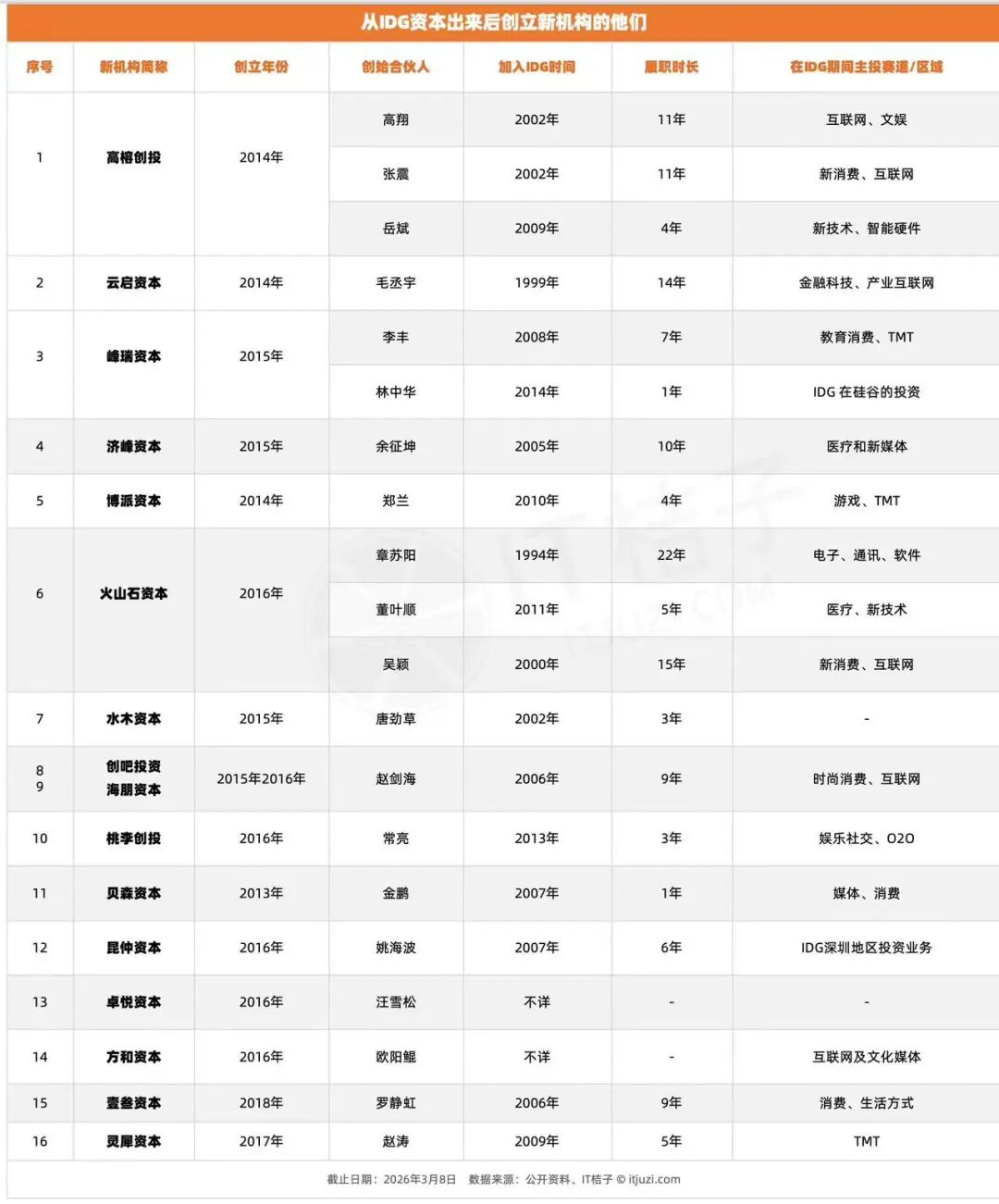
In terms of time, the period when they established new institutions was concentrated in the five - year period from 2014 to 2018. After 2020, there have been no relevant reports on new "IDG - affiliated" institutions, but several partners from Sequoia China have left to start their own businesses.
Comparing these two top - tier institutions, an interesting phenomenon is that those who left Sequoia China basically "went solo", while several of those who left IDG Capital founded businesses in partnerships of two or three people: Gao Xiang, Zhang Zhen, and Yue Bin jointly founded Gaorong Capital; Li Feng and Lin Zhonghua co - founded Fengrui Capital; Wu Ying, Zhang Suyang, and Dong Yeshun jointly founded Volcanic Stone Capital.
In the investment industry, "lone - wolf" investors are a common path. They capture opportunities based on personal judgment and create performance on their own. Investors with such characteristics may be more inclined to work alone. IDG's culture is more democratic and cooperative.
Looking at the length of service of these departing investors at IDG Capital, the shortest tenure at IDG was only one year, and the longest reached 22 years.
Among them, Zhang Suyang, as one of the earliest team members of IDG Capital and a pioneer in China's venture capital industry, joined IDG as early as 1994 and "honorably retired" from IDG Capital in April 2016. Subsequently, he and two partners jointly founded Volcanic Stone Capital, which mainly invests in new technologies such as healthcare and artificial intelligence.
There are also 4 investors who served at IDG for more than 10 years and have reached the partner - level position, including Gao Xiang and Zhang Zhen of Gaorong Venture Capital, Mao Chengyu of Yunqi Capital, and Yu Zhengkun of Jifeng Capital.
It is worth mentioning that Zhao Jianhai, the former vice - president of IDG Capital, founded two institutions alone after leaving IDG Capital where he had worked for more than 9 years in 2015. He serves as the founding partner of Chuangba Investment and Haipeng Capital.
The "Three Musketeers" of Gaorong Capital, Gracefully Parted from IDG to Create a New Chinese Wealth Fund
Zhang Zhen and Gao Xiang both joined IDG Capital in 2002. Starting as investment managers, they went through positions such as investment director and partner, and are typical representatives who grew up within the IDG system.
Zhang Zhen focused on the TMT field in the early days. The projects he led in investment and management include Gibit Networks, Razer, 3G.cn, Shenzhoufu, LanGame, Chengmai Technology, Wondershare Technology, Ping An Good Doctor, Pinduoduo, Mogujie, Beibei.com, etc.
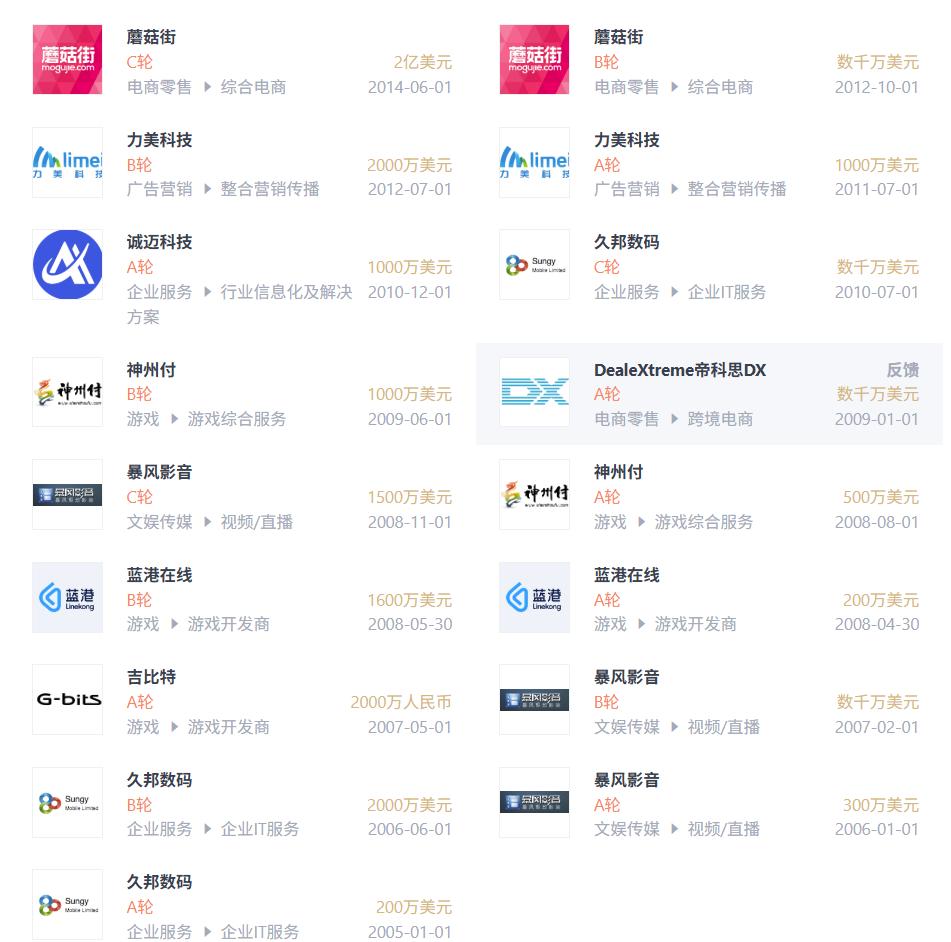
Representative early - stage investment cases of Zhang Zhen. Source: IT Juzi
Gao Xiang mainly focused on the Internet and new entertainment tracks. The projects he led in investment and management include Huya Live, Bigo (acquired by YY), Tudou, 91 Assistant (acquired by Baidu), 3G.cn, Dongwang Pioneer (acquired by Changyou.com), Lexin Medical, Wondershare Technology, Jianyue Games (acquired by Alibaba), Lilith, etc.
The two worked together at IDG for 11 years and jointly experienced the complete cycle of China's Internet from the PC era to the mobile Internet era.
Yue Bin joined later. He was invited by Zhang Zhen to join IDG. His well - known achievement was discovering and investing in Xiaomi at the Series A round.
Yue Bin, who was the vice - president of IDG at that time, deduced Xiaomi's ambition to make smartphones by researching the MIUI forum and recruitment information. He actively contacted Lei Jun and finally convinced the team to invest. IDG entered Xiaomi at a valuation of $250 million in the Series A round and received a return of about several hundred times when Xiaomi went public.
In January 2014, Zhang Zhen and Gao Xiang, former partners of IDG Capital, joined hands with Yue Bin to found Gaorong Capital.
Why did they leave the large platform at the peak of their careers? In fact, their departure was not an impulsive act.
As early as 2013, the three proposed to create a new fund with LPs composed of the newly wealthy class (including many financially free entrepreneurs). This concept is currently defined as China's Founders’ Fund.
The seven partners of IDG were very democratic and open - minded. They even supported their internal entrepreneurship, but the plan was ultimately shelved because the original LPs of IDG disagreed.
IDG's way of seeing them off has also become a widely - circulated story in the VC circle: Zhou Quan not only helped them revise their business plan but also personally introduced partners of Accel Partners as LPs. At the same time, Zhou Quan, Xiong Xiaoge and other IDG veterans also personally invested to become LPs of Gaorong Capital.
This "help - on - the - horse and see - off - for - a - while" attitude enabled Gaorong Capital to complete the fundraising of its first - phase fund of over $200 million just three months after its establishment. Since then, it has maintained a close cooperative relationship with IDG. For example, when Gaorong Capital invested in the Series A round of Pinduoduo (Pinhaohuo), IDG Capital followed up with an additional investment in the Series A+ round.
Currently, Gaorong Capital has developed into one of the most successful representatives of IDG - affiliated VC 2.0 institutions and firmly ranks in the first echelon of the industry.
As of 2025, its management scale has exceeded 30 billion RMB. By heavily investing in super unicorns such as Pinduoduo, Roborock, and BOSS Zhipin in the early stage, it has established a leading voice in the cross - field of consumption and technology and has continued to maintain a certain level of activity in cutting - edge tracks such as large AI models (e.g., Dark Side of the Moon).
Li Feng, a Minority in the VC Field, "Took Away Projects" from IDG to Found Fengrui Capital
Li Feng has some unique labels - restless and fond of making changes, not quite in line with mainstream investors.
In 1991, he entered the Department of Chemistry at Peking University. After graduation, he went to the University of Rochester in the United States for further study. After returning to China, he started his own business and also worked at New Oriental Education & Technology Group for 7 years. It was also during this period that he focused on and invested in many education projects during his time at IDG.
At the beginning of 2007, Li Feng left his job to found the well - known Internet advertising big data company "Miaozhen Systems" (the predecessor of Minglue Technology). Later, he joined Huaxing Capital and participated in and led the financing of multiple cases, including Ambow, Wanxue, Red & Yellow Blue, Tsinghua Digital Boshi, etc.
In 2008, Li Feng joined IDG Capital.
During his seven - year tenure at IDG, Li Feng led the team to invest in 61 companies in multiple industries such as education, new consumption, and Internet finance. The overall book return was 6.14 times - this data was reviewed by himself.
Specific investment cases include: Yixin, Zhubajie, Prosper, Three Squirrels, Tongbanjie, Dida Chuxing, Bilibili, Coinbase, Qingqing Jiajiao, Wacai, HeliJia, Wangli Finance, Youdao Wealth, Liulishuo, Tongdun Technology, Ripple Labs, Shanyin, Jiangxiaobai, Handu Yishe, Baifendian, Bairong and other startups.
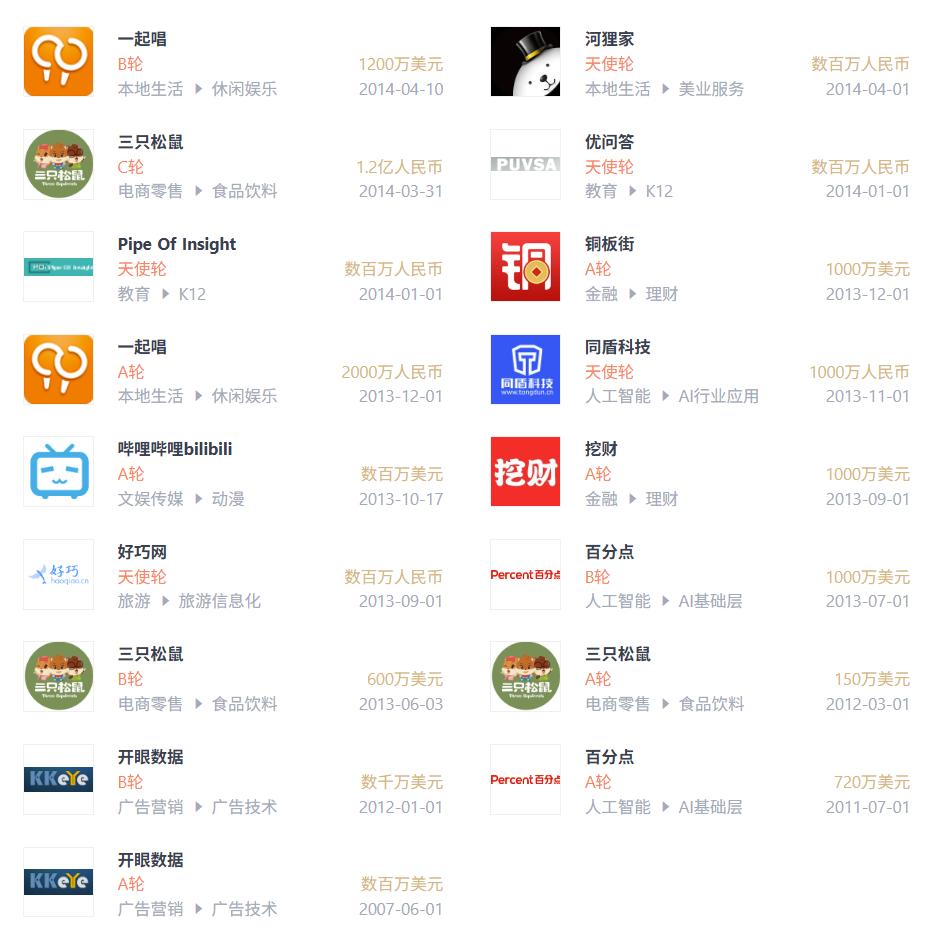
Representative early - stage investment cases of Li Feng. Source: IT Juzi
Among them, IDG Capital led the Series A investment in Three Squirrels in 2011, which is a landmark case of IDG in the food e - commerce field and is also one of Li Feng's highest - return projects (the early - stage return exceeded 50 times).
According to reports, in 2015, Li Feng, a partner who had worked at IDG for 7 years, left with "more than 20 potential investment projects" to found Fengrui Capital.
Seeing this, readers may have questions. Why could Li Feng take away investment projects when he left?
First of all, what Li Feng took away were not the existing equity of IDG that had been settled, but "in - progress projects" and "investment rights for subsequent rounds".
It is reported that among the 21 projects disclosed by Li Feng in the early days of Fengrui Capital's establishment, 13 - 14 were early - stage projects that had been approved within IDG but had not yet completed the settlement. These projects had not used the funds of the IDG fund.
Secondly, this was the special permission and support from IDG Capital to its core partner Li Feng after the failure of an internal innovation attempt.
Li Feng initially planned to establish an innovation platform within IDG (similar to internal entrepreneurship), and the two sides communicated about this for several months. Eventually, due to mechanism conflicts (such as the all - staff Carry distribution model proposed by Li Feng), it could not be implemented within the IDG system, and the two sides parted ways amicably.
Finally, it was the trust of the company founders to "follow the person".
After Li Feng left, Zhang Liaoyuan, the founder of Three Squirrels, actively accepted the investment from Fengrui Capital in the subsequent Series D round. This transfer of "network assets" is another form of "taking away projects".
Fengrui Capital was known for its "flat decision - making" in the early days, implementing a voting system of "one person, one vote" in the investment committee, trying to break the hierarchical barriers of traditional VCs. At the same time, it dared to introduce an innovative mechanism of "no management fees for returns below 3 times", which is a rather alternative approach.
With the change of investment tides, Fengrui Capital has transformed from an early - stage consumer Internet hunter to an early - stage heavy investor in deep technology and interdisciplinary fields - highlighting Li Feng's profound insight into the economic cycle and investment trends.
Currently, Fengrui's management scale is about 20 billion RMB (including RMB and US dollar funds). Its core strategy is "non - consensus" - conducting in - depth layout of the upstream and downstream of the industrial chain on the eve of technological breakthroughs (such as AI - powered drug discovery, embodied intelligence, new materials), and seeking excess returns brought by cognitive differences in the long - cycle of hard technology through the mechanism of "research - driven + heavy post - investment empowerment".
Further Fission of VC 2.0: They Left IDG - Affiliated Institutions to Found Independent Ones
An interesting point is that the resumes of two investment managers are quite special. After leaving IDG, they went to IDG - affiliated VC institutions such as Fengrui and Gaorong, and finally left to found new institutions themselves, presenting a typical path of "established IDG Capital → IDG - affiliated 2.0 institutions → going independent".
This reflects the evolution logic of mid - generation investors in the VC 2.0 era. After accumulating sufficient resources and knowledge, they seek more independent decision - making power and brand identity.
Luo Jinghong: A Three - Step Jump from the "Queen of Consumption" to Yisan Capital
IDG period (2006 - 2015): Luo Jinghong joined IDG Capital in 2006 and was promoted from an analyst to a partner. During this period, she led investments in classic consumption cases such as Quanjude, Bama Tea, and Jiangxiaobai, establishing her status as the "queen in the consumption field".
Fengrui period (2015 - 2019): In 2015, she joined Li Feng's team to jointly found Fengrui Capital and served as a founding partner. During this period, Fengrui was in the experimental stage of "research - driven" and "mechanism innovation" led by Li Feng. She continued to deepen her presence in the consumption field and participated in the exploration of mechanism innovation.
During her time at Fengrui, she led or participated in the investment in projects such as Three Squirrels (food and beverage), Tingjiandan (smart parking), and Kuaihaowei (catering O2O).
In terms of style, she is more inclined to look for certain opportunities in "traditional industries being transformed by the Internet", paying attention to the business intuition and implementation ability of founders, which complements Li Feng's more macro and hard - technology investment perspective.
Going independent (2019 - present): In 2019, Luo Jinghong left Fengrui Capital to found Yisan Capital. The new institution continues her focus on the consumption track but focuses more on early - stage and growth - stage investments and has core independent decision - making power.