The triple bubbles of embodied intelligence: 4.5% truth, a four-fold divergence, and a math problem that no one can solve correctly
Have you noticed that in the past 70 days or so, there has been a collective FOMO (fear of missing out) frenzy involving 20 billion yuan?
Within 70 days at the beginning of 2026, about 20 billion yuan in hot money poured into the embodied intelligence track. Thirteen unicorn companies with a valuation of over 10 billion yuan emerged, and more than 20 companies clearly announced their listing plans.
On March 20th, Unitree Technology officially submitted an IPO application to the Science and Technology Innovation Board and it was accepted. It plans to raise 4.202 billion yuan and strive to become the first listed company in the humanoid robot field. Meanwhile, Galaxy Universal completed a new round of financing of 2.5 billion yuan in March, Xingdong Jiyuan completed a strategic round of financing of 1 billion yuan with a valuation exceeding 10 billion yuan, and Songyan Power completed a Series B financing of nearly 1 billion yuan... The entire industry is filled with a suffocating sense of urgency, as if being one step late would mean being left behind by the times.
However, the more everyone is accelerating, the more we need to stop and do some arithmetic.
A few days ago, I read an article published by well - known tech blogger Ben Thompson on Stratechery. He believes that AI is not a bubble. His core logic is that AI is going through three paradigm shifts from chatbots, to reasoning models, and then to intelligent agents. Each shift exponentially increases the demand for computing power, and the rise of AI agents has turned computing power investment from speculation into a necessity. He even self - deprecatingly cited his long - held judgment criterion: As long as everyone is worried about a bubble, there is no bubble; when someone declares that it is not a bubble, the bubble may really be coming.
But what I want to ask is a different question: Can Thompson's anti - bubble argument be applied to the embodied intelligence and humanoid robot tracks?
The answer is no. The reason is that although humanoid robots with embodied intelligence borrow the same AI narrative, the maturity of their commercialization closed - loop, the quality composition of their revenue, and the matching relationship between production capacity and demand are in a completely different stage from pure virtual AI agents.
Today, I want to use three "scalpels" to dissect the current valuation bubble in embodied intelligence. This is not to talk down the market, but rather a rational "medical report" from me as an industry observer for an industry I deeply love.
The truth of less than 5%: When over 90% of the revenue comes from viewing rather than production
Unitree Technology's prospectus is a rare perspective on the industry. While everyone was cheering for the 335% revenue growth rate, I carefully analyzed its revenue structure and found a fact that almost all analysts had overlooked.
Unitree Technology's humanoid robot revenue comes from three types of customers: scientific research and education, commercial consumption, and industrial applications. In 2023, all the humanoid robot revenue came from scientific research and education. By the first three quarters of 2025, although the proportion of scientific research and education decreased, it still accounted for as high as 73.60%. Commercial consumption contributed 17.39%. And the industrial applications, which the market had high hopes for, only accounted for 9.01%, with an absolute amount of 53.6036 million yuan.
If the analysis stopped here, the 9% proportion of industrial applications, although not high, was at least in the right direction. However, when I delved deeper into the internal composition of industrial applications, I found a more disturbing fact: The prospectus revealed that the revenue from corporate guided tours in industrial applications accounted for a relatively high proportion, about 50% to 70%, and the rest was from scenarios such as intelligent manufacturing and intelligent inspection. This means that the revenue truly invested in clear industrial production scenarios only accounts for about 30% - 50% of industrial applications.
Let's do a multiplication: 9.01% multiplied by 30% - 50% equals about 2.7% - 4.5%.
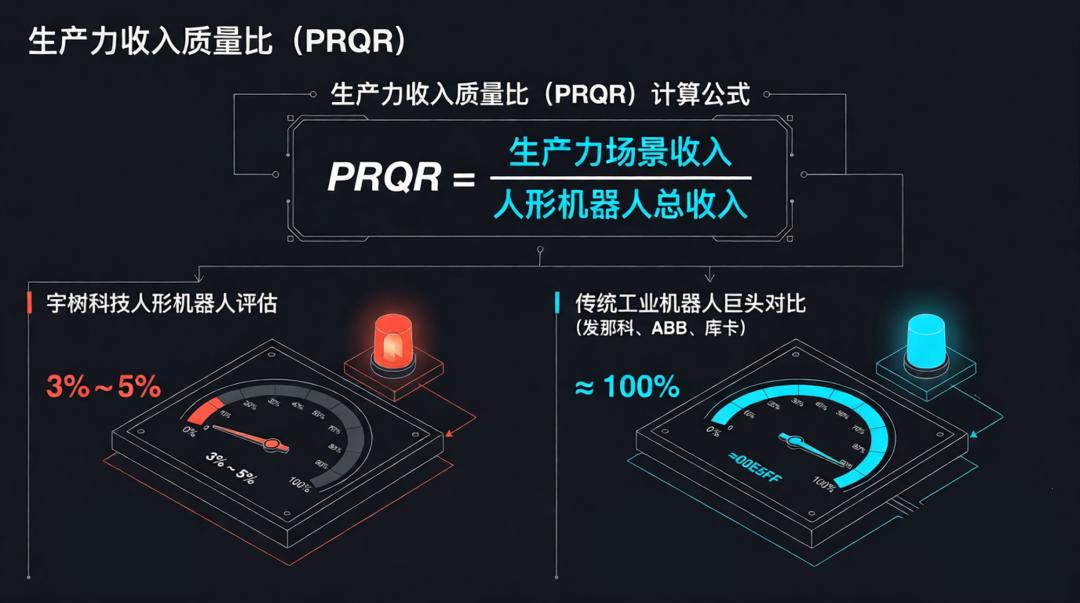
This means that in Unitree Technology's total humanoid robot revenue, the part that truly comes from industrial production scenarios and truly creates quantifiable productivity value for customers is only about 3% - 5%. The remaining over 95% of the revenue comes from purchases by universities for scientific research experiments, by companies for exhibition hall guided tours, and by consumers for the novelty experience.
I define this key ratio as the Productive Revenue Quality Ratio, abbreviated as PRQR. It is calculated by dividing the revenue from productive scenarios by the total humanoid robot revenue.
Currently, Unitree's PRQR is about 3% - 5%. In contrast, the PRQR of traditional industrial robot giants such as Fanuc, ABB, and Kuka is close to 100% because each of their robots creates measurable output on the production line.
This number reveals a core contradiction.
The valuation narrative of the entire humanoid robot industry is based on the grand vision of industrial substitution. The high valuations given by investors are pricing the future of a general - purpose productivity tool. However, the current revenue structure tells us that this tool spends over 95% of its time being viewed rather than working.
Let's use a more intuitive number to feel this contradiction.
Unitree Technology's humanoid robot revenue in the first three quarters of 2025 was about 595 million yuan, and the annualized revenue was about 800 million yuan. The IPO - corresponding issue market value is at least 42 billion yuan, and the market expects the post - listing valuation to possibly reach the level of 100 billion yuan. If we only look at the industrial scenario revenue that truly creates productivity value, estimated at the median PRQR of 4%, the annualized revenue is about 32 million yuan. Based on a valuation of 42 billion yuan, the corresponding PS multiple of productive revenue is as high as about 1300 times. Even if calculated at the more optimistic upper limit of PRQR of 5%, the PS multiple still exceeds 1000 times. While the PS multiples of traditional industrial robot leaders are usually in single - digits. The gap between thousands and single - digits cannot be explained by growth potential.
From "Internet of Everything" to "Intelligent Mobility of Everything", the key lies in "mobility". It means truly moving on factory production lines, in logistics warehouses, and deep in mines, rather than on the Spring Festival Gala stage, in exhibition halls, or in short - videos. When over 90% of the revenue of a product category defined as a general - purpose productivity tool comes from non - productive scenarios, is the capital market pricing a productivity tool or a high - tech toy?
A 4 - fold divergence: When no one can figure out how big the market is
If PRQR reveals the revenue quality problem at the micro - enterprise level, then the second "scalpel" I'm going to introduce will cut into a more macroscopic and systematic bubble signal: the extreme divergence of industry forecasts.
As an observer who has been tracking the Internet of Things and intelligent hardware industries for a long time, I have an almost reflexive alert to the market forecast reports of major research institutions. Because when an industry is at different development stages, the dispersion of these forecasts will show completely different characteristics. Forecasts for mature industries will converge, those for emerging industries will diverge, and for industries in a bubble period, the forecasts will be extremely divergent.
I sorted out the forecasts of the global mainstream institutions for the humanoid robot market size in 2030, and the results were shocking.
Grand View Research gave a figure of 4.04 billion US dollars, with a CAGR of 17.5%. ABI Research gave 6.5 billion US dollars, with a CAGR of 138%. BCC Research gave 11 billion US dollars, with a CAGR of 42.8%. Markets and Markets gave 15.26 billion US dollars, with a CAGR of 39.2%. Just in the forecasts for the same time window of 2030, there is a nearly 4 - fold difference between the lowest 4 billion and the highest 15.3 billion.
If we extend our view to 2035, the divergence will further explode.
Goldman Sachs raised its baseline forecast to 38 billion US dollars in early 2024, more than 6 times the previous 6 billion US dollars. By May 2025, Goldman Sachs further raised its optimistic scenario forecast to 154 billion US dollars, and the most optimistic scenario reached 205 billion US dollars. Morgan Stanley predicted that the global humanoid robot market size will reach 5 trillion US dollars in 2050. From the most conservative 4 billion US dollars in 2030 to the most radical 5 trillion US dollars in 2050, there is a gap of three orders of magnitude.
If we use another bubble detection tool: the Forecast Entropy Index (FEI), which is calculated by dividing the highest forecast value of mainstream institutions in the same forecast year by the lowest forecast value.
Taking 2030 as the anchor year, the current FEI of the humanoid robot industry is equal to 15.26 billion divided by 4.04 billion, approximately equal to 4. If we compare across years (including Goldman Sachs' latest forecast of 154 billion US dollars for 2035), the FEI soars to 154 billion divided by 4.04 billion, approximately equal to 38. Even if we only look at the strict comparison within the same year, the 4 - fold divergence is quite significant; and the 38 - fold divergence across years reveals a fundamental problem: Different institutions have completely different judgments on when and at what speed the industry will take off.
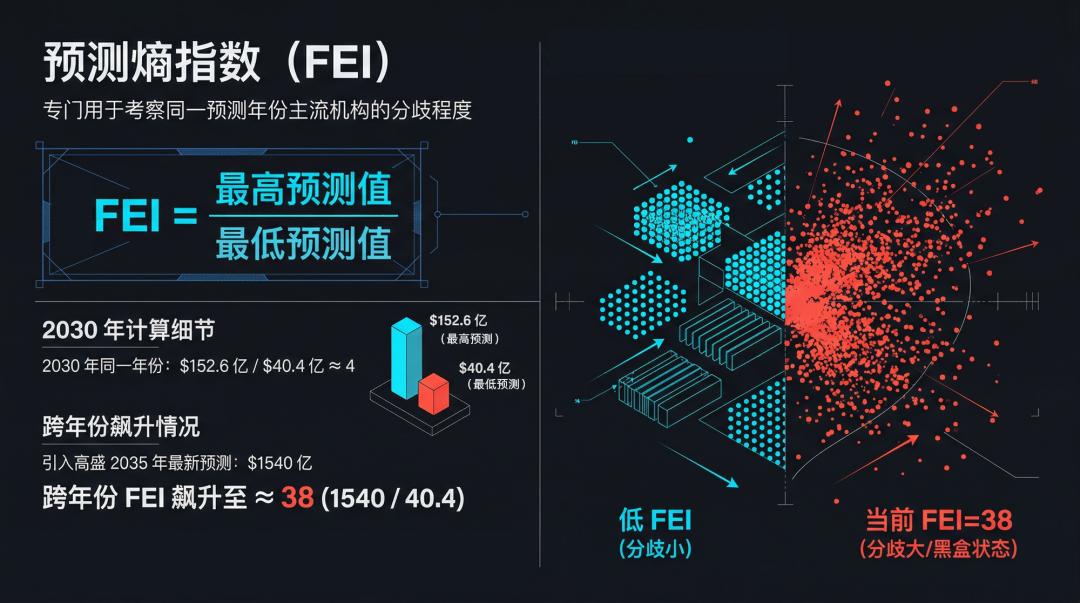
Why is the extreme divergence of forecasts itself a bubble signal? Because when the business model, unit economic model, and penetration curve of an industry have been verified, the forecasts of different institutions based on similar methodologies will naturally converge. Some divergence is normal, but a nearly 4 - fold divergence in the same year and a 38 - fold divergence across years indicate a fundamental problem: No one really knows how big this market is.
I looked back at two historical cases to verify the effectiveness of FEI.
The first is the Internet of Things. From 2014 to 2015, the IoT industry was in a period of concept explosion. IDC predicted that the global IoT market size in 2020 would be 1.7 trillion US dollars, while Gartner only predicted about 190 billion US dollars, with an FEI of about 9. Subsequently, the IoT industry went through a bubble - squeezing period from 2016 to 2018, and the forecasts gradually converged. The actual market size finally fell close to the lower - end forecast. We all witnessed that cycle.
The second is autonomous driving. From 2017 to 2018, the FEI of the autonomous driving industry was as high as over 15. Some predicted that the global L4 market would exceed 1 trillion US dollars in 2025, while some institutions predicted only 10 billion US dollars. Subsequently, the industry went through a deep adjustment from 2019 to 2021, and the valuations of many star companies were halved again and again.
I witnessed the astronomical number competition of various institutions for the market size when the concept of the Internet of Everything exploded around 2010 in the IoT industry, and also witnessed the subsequent cruel expectation adjustment. When everyone says that a market is in the trillions, but the numbers differ by several times or even an order of magnitude, it means that no one really knows how big this market is. The divergence of forecasts itself is the most honest thermometer of a bubble.
An arithmetic problem that no one can solve correctly: When a company's production capacity exceeds the entire demand of China
The third "scalpel" will cut into the overall matching of production capacity and demand. This is a primary - school math problem, but the entire industry seems to have selectively ignored it.
Unitree Technology clearly disclosed in its IPO prospectus that one of the fundraising projects is the construction of a manufacturing base. After the project is completed, it is expected to achieve an annual production capacity of 75,000 humanoid robots and 115,000 quadruped robots.
Please remember this number: an annual production capacity of 75,000 humanoid robots.
Now let's look at another number. IDC predicted that the commercial sales volume of humanoid robots in China in 2025 would be about 5,000 units, and it would increase to nearly 60,000 units by 2030, with an annual compound growth rate of over 95%. Goldman Sachs' baseline forecast is that the global humanoid robot shipment volume will exceed 250,000 units in 2030, almost all for industrial use.
That is to say, Unitree Technology's planned annual production capacity of 75,000 units has already exceeded IDC's forecast of the entire Chinese market's commercial shipment volume of 60,000 units in 2030. One company alone can't fit into the entire Chinese market.
If we broaden our view to other leading companies, the picture will be even more magical. The founder of Ubtech revealed that the industrial humanoid robot production capacity will strive to reach 10,000 units in 2026. The shipment volume of Zhiyuan Robotics exceeded 5,000 units in 2025. According to its development speed, the shipment volume in 2026 can reach tens of thousands of units, and it is continuously expanding production... Conservatively estimated, the total planned production capacity of the top 5 leading companies in China has reached tens of thousands of units per year and is rapidly approaching the level of 100,000 units.
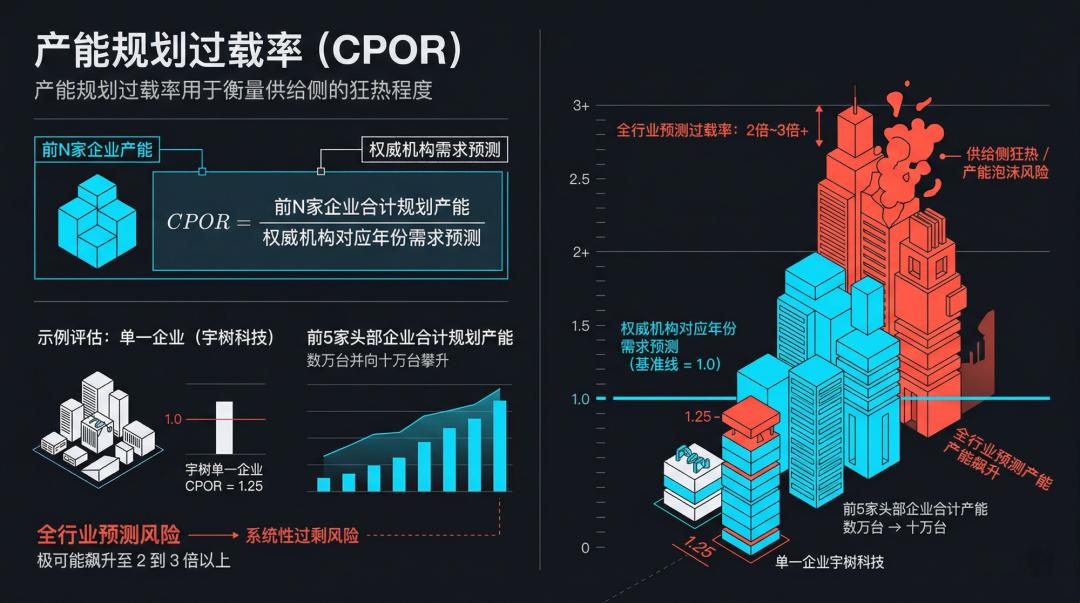
Based on this, let's look at the third bubble detection indicator: the Capacity Proclamation Overload Ratio (CPOR), which is calculated by dividing the total planned production capacity of the top N companies by the demand forecast of authoritative institutions for the corresponding year.
Currently, the long - term production capacity planning of Unitree Technology alone (75,000 units) has exceeded IDC's forecast of the entire Chinese demand in 2030 (60,000 units), and the CPOR reaches 1.25. If we include the production capacity plans of all leading companies, the CPOR is likely to reach 2 to 3 times or even higher.
This means that the production capacity planning on the supply side is several times the authoritative demand forecast on the demand side.
Why does this collective irrationality occur? The answer lies in the IPO narrative mechanism.
Every company rushing for an IPO faces the same narrative pressure: they must show a grand enough production capacity blueprint in the prospectus, otherwise investors will question your growth ceiling. They must depict a trillion - level market, otherwise the company's valuation logic will not hold... So everyone is doing the same thing: taking the most optimistic demand forecast as their production capacity target. When 20 companies do this at the same time, the total becomes an astronomical number.
Of course, some people will defend this. As an analysis of Unitree Technology's prospectus by Huxiu pointed out, the real logic of planning a total production capacity of 190,000 units is not that there is so much demand today, but to use the production capacity to drive down the price and create demand for tomorrow. This logic holds at the single - company level, but when all companies hold this logic at the same time, it will lead to a systematic risk of over - capacity.
This is exactly the same as the scenario of the new energy vehicle production capacity expansion wave in 2015. At that time, the annual sales volume of new energy vehicles in China was about 330,000 units, but