Exclusive Report by Yingke | Former Core Members of Huawei's Autonomous Driving Team Start a Business to Create an "Ambulatory" Emotional Companion Robot
Author | Lin Qingqing
Editor | Yuan Silai
Yingke learned that the small embodied robot company for emotional companionship scenarios, "Qingxin Yichuang", has recently completed a Pre-A round of financing. This round of financing was led by Houxue Capital and Tianji Capital, with the old shareholder Lopu Capital continuing to follow up. Xinhui Capital served as the long-term financial advisor. This round of financing will be mainly used for the product R & D and technology platform construction of ultra-small bipedal companion robots, the iteration of core algorithms, and team expansion. Previously, the company had completed an angel round of financing participated by Chuxin Capital, Lopu Capital, and several individual investors in the technology field.
The core team of "Qingxin Yichuang" was established in early 2024. It applies full-stack technical capabilities such as cutting - edge embodied intelligence and the coordinated software and hardware of the large and small brains of autonomous driving to the R & D and exploration of companion robots. It has achieved straight - knee walking globally for the first time and pioneered the "emotional gait large model" of reinforcement learning, completing the verification and integration of core algorithms such as emotional gait generation, whole - body motion control, and multi - modal interaction. Currently, the company is promoting the development of the first embodied character intelligent robot, and its first - generation version has completed full - stack self - research and model construction.
With the increase in the number of single people in cities and the emergence of the trend of emotional consumption, the market attention of companion robots with interaction capabilities has gradually increased. Currently, the relevant products on the market are mainly divided into two categories: one is desktop intelligent hardware based on large language models, with voice - based interaction and a fixed form; the other is mobile robots with wheeled chassis, with limited motion ability and anthropomorphic expression. The overall industry is still in its early stage, with obvious product function homogenization and mostly concentrated in the mid - to low - price range. At the same time, humanoid robots with stronger versatility and mobility are difficult to achieve consumer - level popularization in the short term due to high technical complexity and high costs. How to find a balance between technical feasibility and users' emotional needs has become one of the exploration directions for embodied intelligence companies.
Yingke learned that the R & D path of "Qingxin Yichuang" follows the platform - based idea of software - hardware collaboration. The company uses the general embodied humanoid robot "ORCA" about 1.5 meters tall as the technical base, sinks the entire technology stack, and develops the first small robot for emotional companionship scenarios. The team has independently developed an ultra - small joint module with high torque density, integrating the bipedal motion control ability of embodied intelligence into a robot body less than 80 cm tall. The whole machine adopts a non - angular design, and the surface is covered with multiple layers of soft velvet materials, which has high visual recognition and affinity. The robot is equipped with a multi - modal perception system and a three - mode integrated Agentic OS intelligent agent. In the future, it will also be equipped with a self - developed world model, which can integrate multi - dimensional perception information such as hearing, vision, and touch, realize full - autonomous capabilities such as independent person - searching and low - power companionship, and achieve multi - dimensional input and expression through language, expressions, and actions.
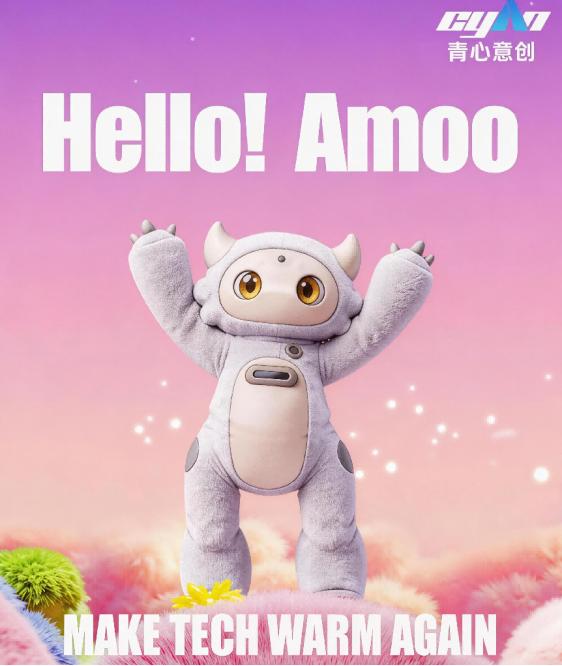
Promotional poster of "Amoo" (Source/Enterprise)
In terms of business strategy, the small embodied robot products of "Qingxin Yichuang" are positioned in the high - end price range. The target customer groups are mainly single middle - aged and young people and families with high consumption ability in first - tier big cities. The interaction mode is adaptively adjusted according to the user intimacy model and can be extended to all age groups in the later stage. In addition to hardware sales, "Qingxin Yichuang" also considers adopting a model of combining hardware with subscription services to provide continuous interaction content and software updates. In terms of channels, it plans to promote through online content platforms and offline high - end retail channels and has discussed appearance co - branding cooperation with some fashion brands and IP parties. In addition, its technology platform also plans to expand to B - end scenarios such as commercial display and elderly care companionship. The product is expected to be officially launched this year and mass - production will be gradually promoted.
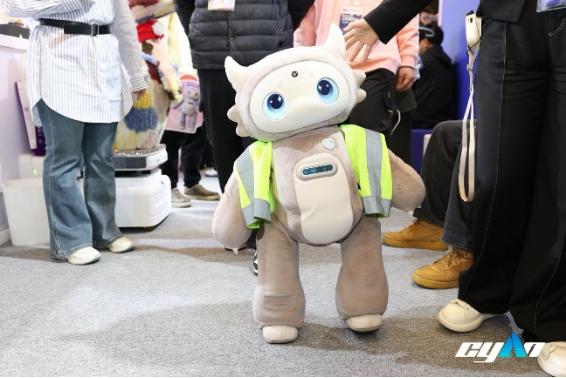
AWE site (Source/Enterprise)
In terms of the team background, the founder and CEO, Niu Tenghao, is a post - 90s doctor from the University of Cambridge. He was previously responsible for the R & D of decision - making and planning algorithms and the implementation of engineering products in Huawei's autonomous driving team. The core technical team has full - stack capabilities in the field of embodied intelligence, including core members from the Berkeley Robotics R & D Laboratory and leading autonomous driving companies. The product and marketing teams are from first - tier platforms such as ByteDance, Huawei, Xiaohongshu, TikTok, and NIO, with experience in product building from scratch and commercial implementation.
Currently, "Qingxin Yichuang" has started to prepare for a new round of financing to support team expansion, world model iteration, product R & D, and mass - production promotion.