Young people are becoming more and more shrewd. Why do they still choose Maicong repeatedly?
In today's consumer electronics market, a significant change is taking place: the competitive logic of the peripheral industry is being rewritten.
When "mechanical keyboards" have evolved from toys for geeks to standard equipment for ordinary players, and when "magnetic axis" technology has spread from professional arenas to the mass market, this track, once dominated by international giants setting the rules and white-label products disrupting prices, has entered a real reshuffle period.
36Kr has learned that according to the latest market research by the international authoritative research institution Frost & Sullivan, in terms of the sales volume of mechanical keyboard products in 2025, MaiCong ranked first in the Chinese mechanical keyboard market and was awarded the market position certificate of "No. 1 in sales volume of Chinese mechanical keyboards in 2025".
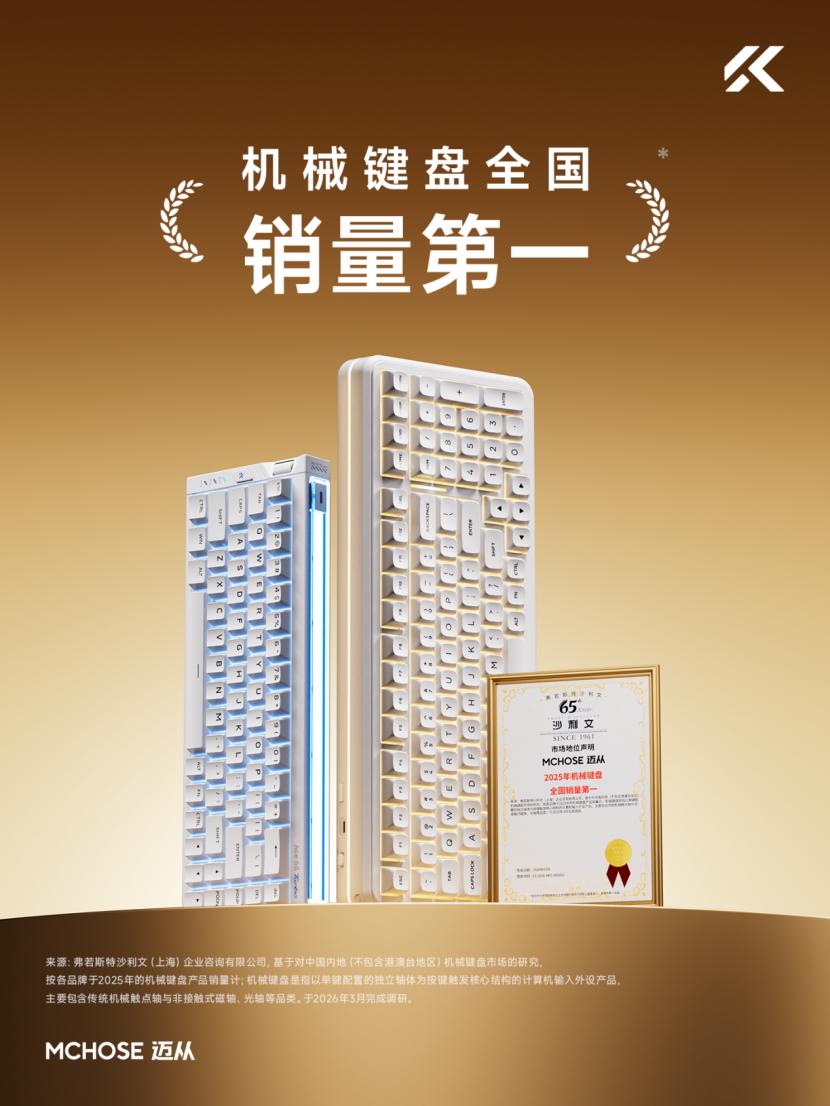
A domestic peripheral brand established less than five years ago achieved the first place in the national sales volume of mechanical keyboards in 2025. This achievement would have been unimaginable five years ago.
After all, for a long time in the past, the mainstream perception, mainstream choices, and mainstream discourse power in the peripheral market were mostly in the hands of international brands. But today, young people aged 18 - 26 are rewriting these rules with their purchasing decisions.
What are these young people thinking when buying peripherals? Why is it MaiCong that has passed the "rigorous screening" of this group first?
Behind this is not only the rise of a single brand but also reflects a new winning logic after young domestic peripherals have entered the stage of large-scale maturity.
In the "confusing" consumption era, seeking "certain" choices
It is undeniable that today, with the information barrier broken down by the Internet, the consumer market is becoming more transparent.
For the peripheral industry, this means that the "screening rules" that have been in place for many years are being rewritten. The young "digital natives" aged 18 - 26 are using their own information verification systems to screen out the "certain" choices that are truly worth holding in the long term.
Their consumption path shows a highly consistent characteristic of "information pre - placement": their first stop for shopping is not offline stores, and not even the search box on e - commerce platforms, but the horizontal review videos of Bilibili UP owners, the real experience notes on Xiaohongshu, the long technical analysis articles on Zhihu, and the photo - attached follow - up reviews in the JD.com comment section.
This consumption logic runs through their decision - making chain.
First, they repeatedly compare products within the same price range through horizontal review content to find the "comprehensive optimal solution" rather than the "strongest in parameters"; second, they penetrate the technical black box through disassembly videos and in - depth evaluations. The feel of the key switch, latency data, and internal filling process have become compulsory courses before placing an order; finally, to verify the deviation between KOL evaluations and real experiences, they delve into the comment section, especially preferring the "hardcore feedback" with photos and follow - up reviews to complete the "secondary verification" of the product's long - term reputation.
Meanwhile, the new decision - making mechanism is also reshaping the competitive logic of the peripheral market. What influences consumers' purchasing decisions is no longer the brand's popularity, but who has a more solid product, who is more reliable in long - term use, and whose user feedback is more real.
Brands that can withstand the test of the "information verification system" are being pushed to the top by young users with their orders. MaiCong is the most representative example of this trend.
Behind the certification of being No. 1 in the national sales volume of mechanical keyboards in 2025 issued by Frost & Sullivan are the objective data of MaiCong's products topping the charts on major e - commerce platforms for a long time: No. 1 on the best - selling list of e - sports headphones on Tmall, No. 1 on the best - selling and repurchase lists of mechanical keyboards, and No. 1 on the hot - selling list of keyboards; No. 1 on the list of popular keyboard products on Douyin, No. 1 on the brand keyboard repurchase list, No. 1 on the list of popular mouse products, and No. 1 on the list of popular headphone products; No. 1 on the hot - selling list of gaming headphones on JD.com.
On the Tmall platform, the data of over 400,000 repeat customers in the MaiCong flagship store far exceeds the 100,000 data of well - known peripheral brands in the industry, directly reflecting MaiCong's significant advantages in user stickiness and brand loyalty.
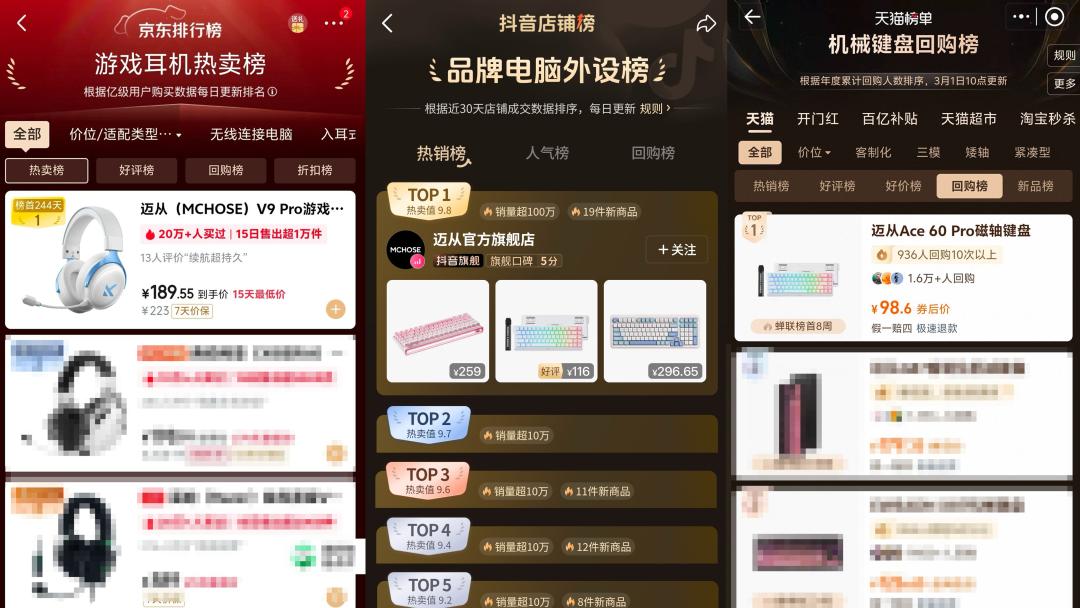
Obviously, MaiCong was "selected" and was also pushed to the first place in sales volume step by step by users.
From this, we can see that for the entire peripheral industry, this may be a new starting point: future competition will no longer be about brand popularity but about product trust.
From being "pushed" in front of consumers to being actively "selected" by consumers
MaiCong has won the trust of the consumer market by responding to three core demands of users.
One of the foundations for building trust is to make choices simple. Different from the past, the new generation of consumers are very clear about their own needs: on the premise of price anchoring, they look for the optimal solution for core parameter configuration.
MaiCong's product logic exactly meets this demand. Different from the common "parameter arms race" in the industry, MaiCong's strategy is not to pursue the extreme stacking of single - item indicators but to pursue a comprehensive balance with "no obvious weaknesses" within the target price range.
The MaiCong V9 Turbo series provides an observation sample: in the price range of 200 - 400 yuan, it simultaneously achieves a 60mm driver unit, an aluminum alloy headband, a contactless charging base, and the fully self - developed driver M HUB. It doesn't pursue the extreme of a single parameter but makes up for the common problems in sound quality, material, and battery life at this price.
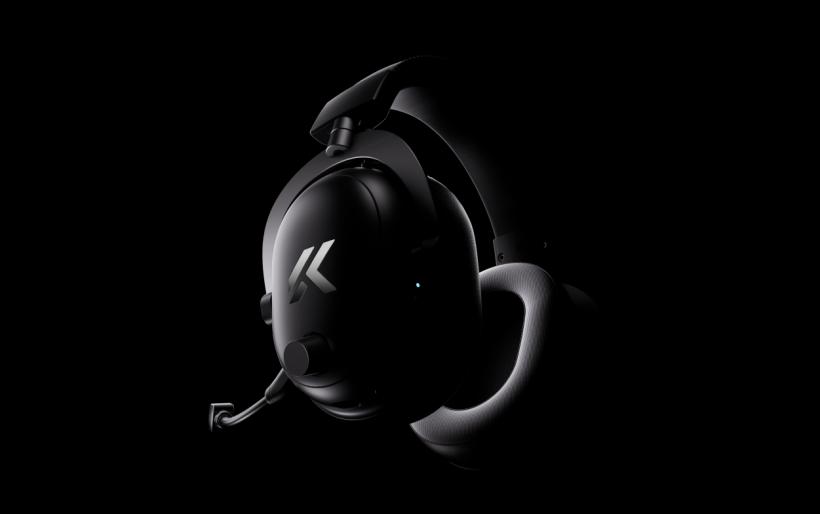
Parameter anchoring is just the first step. The characteristic of this generation of users is that they not only look at what the brand says but also at what KOLs disassemble, what the comment section feedbacks, and what remains after long - term use.
And this is another foundation for building trust: every claim of the product must be able to withstand the multi - dimensional scrutiny of users.
MaiCong's self - developed "Tianwen Solution" and "Xingdou Solution" both point to this demand. The significance of R & D investment is not just about "telling stories" at the enterprise level but about determining whether the product can be externally verified.
The value of the self - developed solution does not lie in the technical terms themselves but in whether it can ultimately be transformed into an actual experience that users can perceive. Users may not remember the names of the solutions, but they will remember whether the keyboard is more stable, smoother, and more user - friendly.
The software ecosystem is also an extension of this "verifiability". The long - term continuous iteration of the fully self - developed driver M HUB and the MAU exceeding one million mean that what MaiCong sells to users is not a one - time delivered hardware but a product system that continues to improve after being purchased. This certainty is what users value more and more today.
Finally, MaiCong has compressed the circulation link through the DTC model. The direct connection between the official website and the flagship store, on the one hand, reduces the information loss in the intermediate links, making the product selling points more transparently reach users; on the other hand, it constructs a fast feedback loop: allowing user opinions to enter the product optimization process more timely, and the brand has thus changed from a one - way output symbol to a sustainable dialogue entity.
This short - link brings two results: first, the price gives way more directly to the product experience, and users are more willing to pay for the experience itself; second, the product evolution ability. The rapid iteration based on real - time feedback makes the choice no longer a one - time transaction but an access to a continuously optimized system.
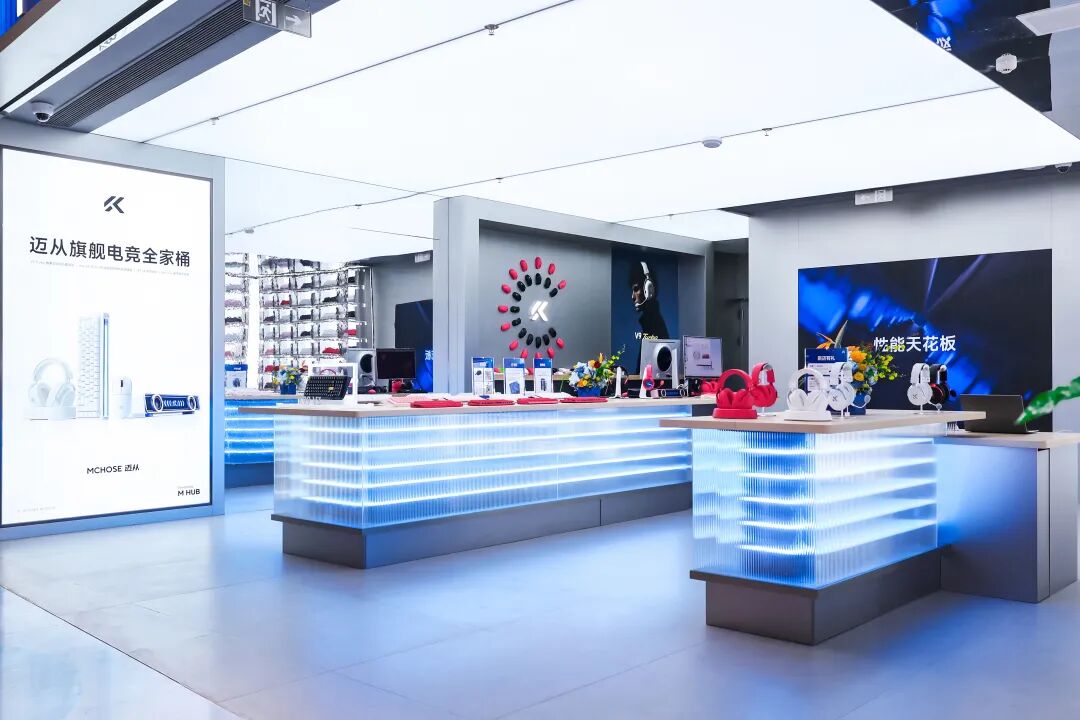
Meanwhile, MaiCong does not adopt the common machine - sea tactic in the industry but concentrates resources on a few core single products by streamlining SKUs. When users don't need to difficultly screen from dozens of models, the choice cost is compressed to the lowest. The opening of two stores in Shanghai and Shenzhen by MaiCong further extends the online trust to the offline field.
The transfer of brand definition power, MaiCong leads to a new competition point for domestic peripherals
The reason why the "MaiCong phenomenon" is worthy of attention is not the sales volume figures themselves but how these figures are generated.
In other words, in the high - information - density category of peripherals, the way brands are selected is changing.
Five years ago, the core of competition among peripheral brands was "channel coverage" and "marketing volume": whoever could enter more stores and invest more in advertising would win. Three years ago, the core of competition in the peripheral industry shifted to "parameter stacking": whoever had more key switches, more dazzling RGB lights, and a lower price would win.
Currently, consumers have more initiative than brands think. They watch disassembly videos, compare parameter tables, browse the comment section, and follow long - term feedback. The choices they make are not the result of being convinced by advertisements but the judgment after active verification.
This points to a fundamental change: the power to define brands is shifting.
In the past, a brand was a cognitive symbol shaped by enterprises through channels and advertising; now, a brand is a consensus jointly confirmed by users in the process of searching, comparing, and repurchasing.
MaiCong's winning path confirms this. It didn't build its awareness through large - scale early - stage advertising but emerged gradually through community discussions, evaluation verifications, and word - of - mouth fission, and was finally "found" by users.

The establishment of this growth path is based on a premise: when information is transparent enough, users no longer need to rely on the top - down indoctrination of brands but can make judgments through the bottom - up verification of the community. MaiCong's technical solutions can be disassembled, the list data can be traced, and user feedback can directly affect product iteration. All these constitute verifiable facts rather than unfalsifiable words.
This is where the competition point in the era of transparent consumption lies.
When all brands can achieve similar parameters and similar price ranges, the core of competition is no longer "who can talk better" but "who can withstand closer inspection". MaiCong's sales data shows that at this stage, the scarcest ability of a brand is not marketing volume but the certainty that still holds after repeated scrutiny.
And this is exactly the scarcest ability of brands in the "era of transparent consumption".