Jishu Technology Completes Pre-A+ Round Financing Worth Tens of Millions of Yuan, Offering High-Quality Spatial Intelligence Data Services | Exclusive Report by 36Kr
36Kr has learned that Jishu Technology, a high-quality spatial intelligence data service provider, has announced the completion of a pre-A+ round of financing worth tens of millions of yuan. This round of financing was invested by Gengzhi Fund, and the funds will be mainly used for the R & D of the underlying technology platform, the expansion of data assets, and market promotion.
Jishu Technology was founded in May 2023. It aims to provide a core data foundation for fields such as autonomous driving and embodied intelligence with the new paradigm of "using data to automatically annotate data", and solve the contradiction in the supply of spatial intelligence data. Currently, the company's products are mainly focused on the autonomous driving field and have served more than 20 leading intelligent driving industry customers.
Zhou Yuan, the founder and CEO of Jishu Technology, is a doctor of surveying engineering from Wuhan University and a postdoctoral fellow in surveying and geoinformatics from Tongji University. He has been deeply involved in the fields of autonomous driving perception data, surveying, and geoinformatics for many years. He participated in the formulation of the national standard GB/T41450 - 2022 and won 1 science and technology progress award from the Ministry of Natural Resources and 3 municipal - level awards in Shanghai. Zou Xiaodi, the co - founder and marketing director, has 20 years of experience in the automotive industry and has served as the sales director of Bosch China and the sales director of Baidu IDG. Ye Wenkai, the CTO, is a doctor of surveying and remote sensing from Tongji University and has worked in Huawei and Geely ZEEKR's intelligent driving team, deeply participating in the development of high - level intelligent driving.
1. Deliver 1.5 million frames of key annotated data in half a year
The rapid development of the intelligent driving industry has made the data bottleneck increasingly prominent. Traditional data companies rely on manual collection and annotation, and it is difficult to meet the needs of algorithm models for large - scale, high - quality data in terms of efficiency, cost, and data consistency.
"Our core ability is to provide high - quality data delivery services for customers based on the fine description of the physical world and the spatio - temporal alignment of multi - modal data," Zou Xiaodi introduced. The Jishu Technology team uses high - precision surveying and mapping technology to scan and "atomize" static elements such as roads with centimeter - level accuracy, especially for the precise excavation and collection of high - value scenarios such as complex intersections, long slopes, and curves, and builds a set of high - precision data foundation.
When customers have data annotation requirements, Jishu Technology uses self - developed algorithms to perform spatio - temporal alignment and fusion of the collection data provided by customers with its own data foundation, and then deduces the annotation results of all road structures without manual frame - by - frame drawing. If traditional manual annotation is like a painter drawing all the details subjectively and manually based on a photo, Jishu Technology's "using data to annotate data" technology is like making an accurate physical plaster model, which can be directly "printed" accurately from any angle.
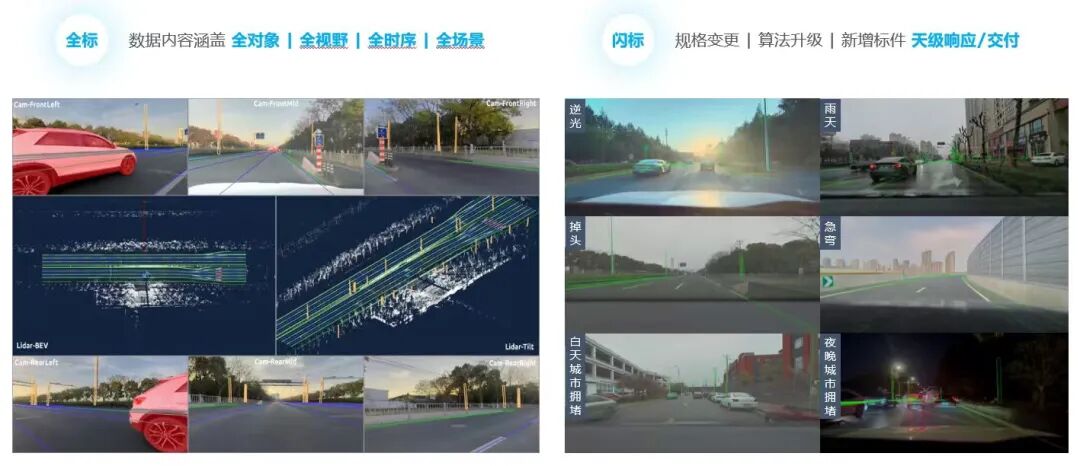
Annotation illustration
Compared with the traditional manual annotation method, Jishu Technology's automated annotation can avoid the individual subjective differences of annotators, ensure the annotation quality, and greatly improve the annotation efficiency. Jishu Technology disclosed that the delivery efficiency of 2 technical operation and maintenance personnel is equivalent to the output level of 300 manual large - scale annotations, and the annotation efficiency is increased by 150 times.
2. Build customer trust with industry know - how
Currently, Jishu Technology provides two types of service products: one is data annotation service, that is, customers provide raw data, and Jishu Technology uses its own data assets and toolchains to process and deliver standardized annotation results, including from road structure cognitive annotation to one - segment end - to - end homologous data annotation service; the other is customized data sets, directly providing customers with special data set products from generalized data to cover various high - value scenarios.
"The company established a project delivery system at the beginning of its establishment," Zou Xiaodi said. "The common practice of traditional companies is to annotate whatever the customer wants, which is just processing the incoming materials. However, we understand the customer's needs better, participate in discussing the overall data supply plan, help customers define and use data more economically, and finally achieve engineering - scale delivery." The more times the company serves customers, the stronger the feedback to the data asset library and algorithm model, and the lower the marginal cost of data reuse. Thus, a self - strengthening data flywheel is formed, continuously deepening Jishu Technology's moat.
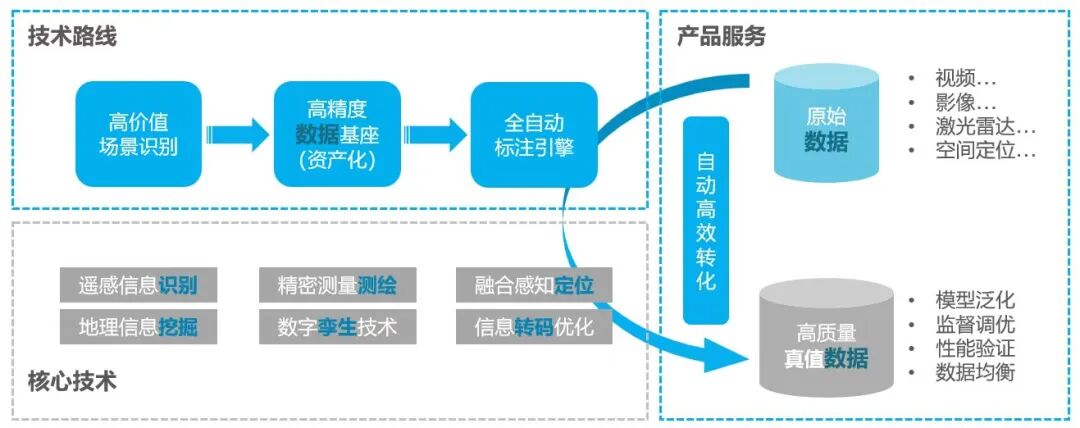
Technical route
In the traditional manual data annotation service model, old data will quickly become obsolete with algorithm iteration, and customers need to re - collect and annotate, resulting in new costs and more delivery time. To solve this problem, Jishu Technology is currently promoting the TCO (Total Cost Ownership) data asset service covering the entire data life cycle.
Specifically, the TCO service changes the customer's investment model in data assets. By helping customers quickly upgrade the specifications of the serviced data and excavate various high - value scenarios, it eliminates the work of re - collection and re - annotation. While reducing the trial - and - error cost in the customer's model R & D process, the TCO model brings a continuous data life cycle, which can effectively solve the data inheritance problem in the customer's perception paradigm iteration process, and meet the requirement of "one set of data, suitable for multiple model paradigms", transforming the customer's one - time "consumption" of data into an "asset" that can be repeatedly mined for value.
3. Expand to spatial intelligence and achieve a leap in core capabilities
In addition to continuously focusing on the end - to - end data supply in the autonomous driving field to further improve the company's revenue - generating ability, Jishu Technology is also seeking to migrate its underlying core capabilities - the description of the physical world and the spatio - temporal alignment of multi - modal data - to embodied intelligence, world models, and more vertical industry scenarios involved in spatial intelligence data.
"Embodied intelligence also has the need for multi - modal data source alignment. For example, the autonomous navigation (Navi) of robots and vehicle movement have a high degree of commonality in the environmental perception level, and our toolchain has a natural advantage in this regard," Zou Xiaodi introduced. In terms of world models, another technical extension direction is to generate synthetic and simulation data based on high - precision data assets, that is, to provide a multi - modal spatio - temporal aligned and accurate digital base of the physical world for the simulation environment required for training world models or end - to - end algorithms.
In addition, Jishu Technology is exploring the application of spatial data processing capabilities in fields such as power inspection, urban management, and smart agriculture. These traditional industries undergoing digital transformation have a strong demand for the collection, processing, and application of spatial data but lack the corresponding technical capabilities. Following the overseas expansion of Chinese automobile enterprise customers, Jishu Technology also plans to expand its product capabilities overseas.