Qianwen launches "AI taxi-hailing". How difficult is this?
Have you ever had such an experience when taking a taxi?
If you need to add a stop before reaching your destination, you can only tell the driver after getting in the car. When a family of six goes out by taxi, they need to carefully choose the car model, and sometimes they also need to consider the size of the trunk. When the elderly pick up and drop off children but don't know how to use the taxi - hailing app, family members need to call a taxi for them and then call to remind them to come downstairs when the car is about to arrive...
These trivial but real pain points expose a fact: today's digital services still require people to adapt to machines, rather than the other way around.
At this time, you may wonder: Since AI is so powerful, when will it be able to handle the matter of taking a taxi?
In the past year, "AI helping people work" has become a hot topic in the industry. Writing weekly reports, making PPTs, and automatically generating marketing copy... Large - scale models can already handle a large amount of mental work. But when you want it to help you take a taxi, it remains silent.
It's not that the technology is not good; it's difficult to rely on AI's sense of responsibility.
In the digital world, the cost of AI making mistakes is almost zero. Incorrectly retrieved information or wrongly written text can be corrected at any time. But in the physical world, if AI has a bit of an illusion, it will waste ordinary people's irreversible travel, money, and even endanger their safety.
For this reason, most AIs choose to stay in the safe zone of "suggestion", "assistance", and "generation" and dare not step into the real - service scenarios that require strong performance.
Behind this is actually the biggest weakness of current large - scale models and agents: they are good at completing tasks but do not have the "awareness of performance" - understanding consequences, taking responsibility, and delivering in a closed - loop manner like an ordinary person.
01. Why is "AI - assisted taxi - hailing" a touchstone?
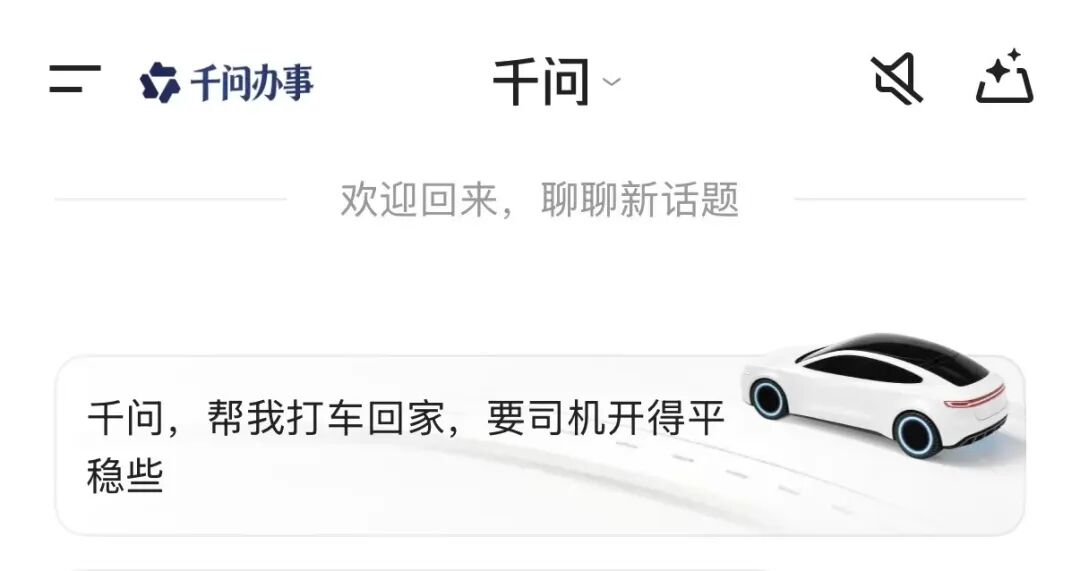
On March 23rd, Qianwen launched the AI - assisted taxi - hailing function. Users only need to naturally state their needs: "Take a taxi to Chaoyang Park within 20 yuan, no carpooling, and I want a new car." The rest can be handled entirely by AI - no need to switch screens, no need to tick boxes, and no need for repeated confirmations.
This may seem like just a simplification of the interaction method, but in fact, it is a leap from the "information layer" to the "action layer": AI no longer just listens to what you say but ensures that things are actually done.
Taxi - hailing is precisely an ideal test field to check whether AI can enter the physical world: high - frequency, low - fault - tolerance, strong performance, and strong awareness of loss. Users are highly alert throughout the process - Will anyone accept the order? Is the route reasonable? Will the driver be late? Any mistake in any link will directly turn into a negative experience.
More importantly, the success of this kind of service does not depend on the accuracy of a single module but on the reliability of the connection of multiple links.
To understand the difficulty of implementing this service, we can observe from an engineering perspective: In digital application development, adding processes often means addition. But in the actual performance in the physical world, the result depends on the interlocking of each link.
Suppose an AI - assisted taxi - hailing instruction involves five key steps: voice recognition, intention understanding, spatial reasoning, route planning, and vehicle dispatch. Even if the success rate of each step is as high as 95%, far exceeding the user satisfaction of mainstream AI - generated services, since these steps must be completed in sequence, any mistake in any link will lead to overall failure, and the final success rate may only be 77%.
If we add factors such as real - world traffic conditions and fluctuations in vehicle availability, the entire process may involve more than a dozen strongly - dependent sequential steps, and the success rate may even drop below 60%. More importantly, the previous steps have a "veto" effect: as long as there is an illusion in semantic understanding, no matter how powerful the backend scheduling computing power is, the entire service will collapse instantly.
In such a service that requires strong performance and real - time on - site execution, passengers who are stood up do not understand it as a probability problem but think "This AI is so stupid and has wasted more time" and then angrily file a complaint.
In fact, Qianwen's exploration of "AI handling affairs" did not start with taxi - hailing.
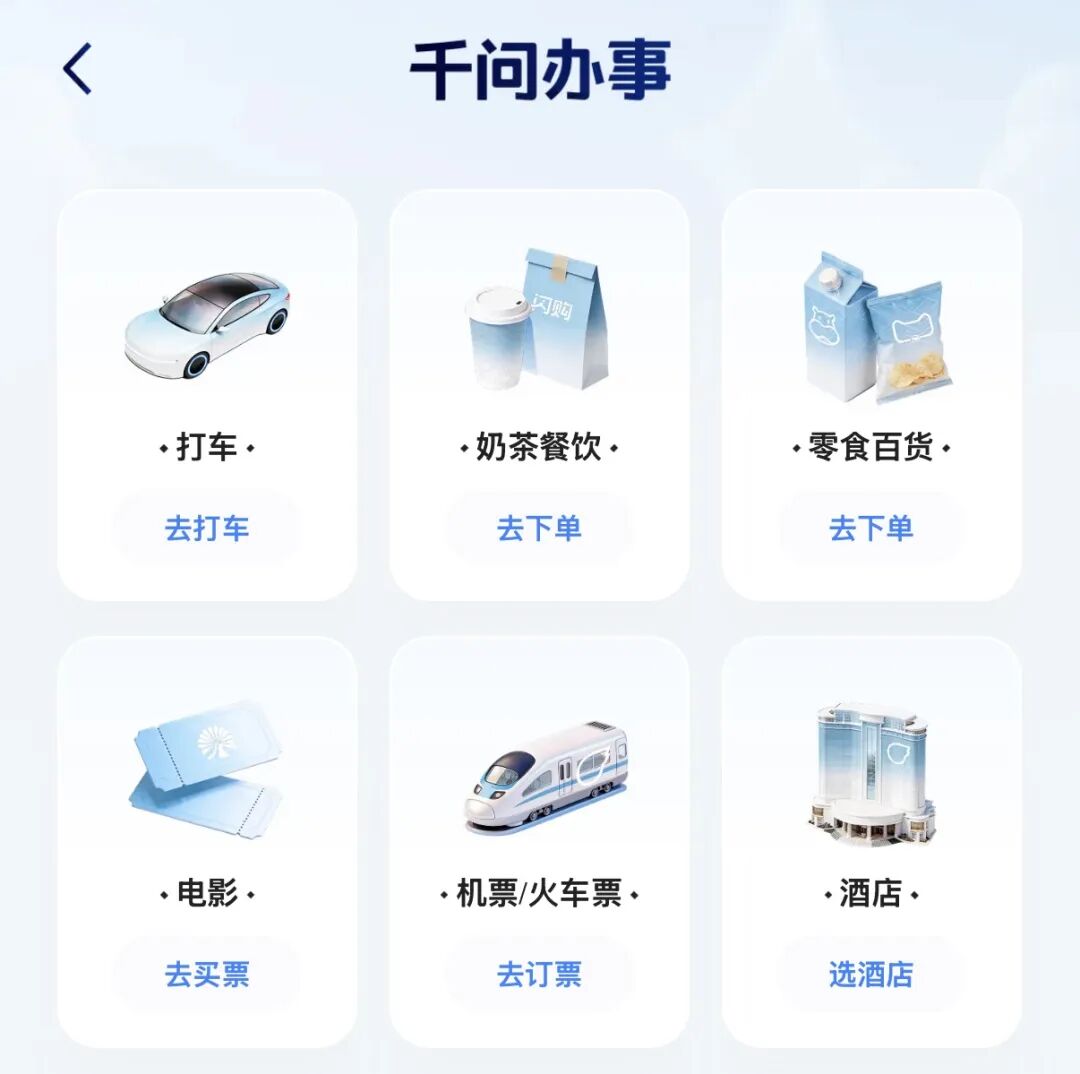
During the Spring Festival this year, through the "Spring Festival Treat" program, Qianwen first let the large - scale model step out of the dialog box - users only need to say one sentence to complete actions in the real world such as ordering takeout, booking a hotel, and buying movie tickets. This was the first time that AI systematically intervened in offline performance scenarios, verifying the possibility of "language as service".
The "AI - assisted taxi - hailing" launched at the end of March is a further deepening of this path. If the attempt during the Spring Festival was still at the "order - placing" level, then taxi - hailing means that AI must respond to the dynamic environment in real - time: vehicle model matching, price constraints, route changes, fluctuations in vehicle availability... Each variable cannot be preset, and each decision is related to the immediate experience.
This marks that Qianwen's AI's ability to handle affairs is moving from "being able to do" to "reliably doing", from a "digital closed - loop" to a "physical closed - loop". AI is no longer just a smart assistant on the screen but a real action agent shuttling between roads, restaurants, and cinemas.
Particularly crucial is that Qianwen is not accessing simple functions but a complete "Taxi - hailing Skill" - it can accurately understand complex instructions such as "Six people need a business car" and "Add a stop to pick someone up on the way", support location memory and time reservation, and will gradually introduce proactive services, such as optimizing the itinerary in advance according to the weather or traffic conditions.
This is not only a functional upgrade but also a reconstruction of the travel interaction paradigm and a deep - seated challenge to traditional taxi - hailing apps. In the past, users had to select the car model, enter the address, and manually add stops in the multi - level menus, and could not express vague needs such as "Go to the popular tulip photo - taking spot in the city center". This also excluded groups such as the elderly and the visually impaired from digital services.
With the AI assistant + Skill model, users only need to state their needs in natural language, and AI will automatically understand, disassemble, and execute. This not only releases the suppressed potential demand but also enables those isolated by the digital divide to become service recipients again.
Once the core travel scenarios are taken over by the AI assistant, calling up the taxi - hailing app is no longer a necessity. Just as the stock prices of Adobe and Figma dropped significantly after Claude launched the design Skill, when general AI can directly complete vertical tasks, the value of single - tool apps will be fundamentally diluted.
More importantly, Qianwen's Skills can collaborate across domains. The Taxi - hailing Skill is linked with the abilities of hotel booking, takeout ordering, and ticket purchasing. With a single sentence "Help me arrange a weekend trip to Hangzhou", it can automatically complete a series of actions such as hotel reservation, taxi - hailing, local cuisine recommendation, and cruise reservation - Multiple agents collaborate in the background to truly achieve "language as action, demand as a closed - loop".
This marks that Qianwen's AI's ability to handle affairs is moving from "being able to do" to "reliably doing", from the digital world to real life. AI is no longer just a smart assistant on the screen but an action agent shuttling between streets, restaurants, and cinemas.
02. Why can't Silicon Valley achieve "one - sentence taxi - hailing"?
On the surface, AI - assisted taxi - hailing seems to be just connecting voice commands to the API of the travel platform. With Silicon Valley's technological reserves, this should not be a difficult problem. But the reality is far more complicated than expected: the real obstacle lies not in the interface but in the attribution of responsibility and the system closed - loop.
Companies such as OpenAI, Anthropic, and Google DeepMind do have the world's top - level large - scale model capabilities and have even launched agent prototypes with tool - calling (function calling) and memory mechanisms. But when these AIs try to intervene in physical services like taxi - hailing, they immediately hit three "glass walls":
First wall: The performance chain is too long, and the fault - tolerance rate is too low
Taxi - hailing is not just sending a message or generating a picture. It involves a complete chain from user intention analysis, geographical location understanding, vehicle model matching, price estimation, driver dispatch, itinerary tracking to exception handling. Any mistake in any link - for example, misunderstanding "No taxis" as "Need a taxi" or misidentifying "Chaoyang Joy City" as "Chaoyang Park" - will lead to the collapse of the entire service.
The design logic of mainstream AI products in Silicon Valley is still based on the paradigm of "probabilistic output + manual backup": ChatGPT can say "I may answer incorrectly, please verify", but AI - assisted taxi - hailing cannot say "I may dispatch the wrong car, please forgive me".
Second wall: There is a natural trust gap between the platform and AI
Even if OpenAI wants to cooperate with Uber, it is difficult for the two sides to achieve deep coupling. Uber's core assets are its vehicle - availability network and dispatch algorithm. Any external AI that wants to directly intervene in the order - dispatching logic must be given extremely high permissions - this is equivalent to letting a "black - box model" control its core business process.
For Uber, this means: If AI misjudgment leads to a large number of invalid orders, empty driving of drivers, or user complaints, who will bear the cost? Will the AI company pay for it? Or will the platform accept the bad luck? There is currently no mature business mechanism to solve this kind of "responsibility - division" problem.
In contrast, in the traditional app interaction, if users choose the wrong car model or enter the wrong address, the responsibility clearly lies with the individual. But once an AI agent is introduced, the responsibility boundary becomes blurred - and this is exactly the gray area that the platform is most reluctant to touch.
Third wall: Lack of "end - to - end controllable" infrastructure
AI companies in Silicon Valley are good at developing general models but generally lack control over offline service networks. Google aggregates third - party travel services with its map as the core and tries self - operated driverless taxi - hailing through Waymo. Apple has a powerful ecosystem but has never built an entrance for local - life services. Meta focuses more on social networking and online e - commerce and is far from the closed - loop of local - life transactions.
This means that even if they can create a "seemingly taxi - hailing" demo, they cannot guarantee a consistent experience across the country, during peak hours, and in rainy or snowy weather. AI - assisted taxi - hailing is not a function demonstration but an infrastructure - level service - it needs to sense vehicle availability in real - time, adjust strategies dynamically, and respond quickly to exceptions. Behind it is a whole set of engineering systems that integrate perception, decision - making, and execution.
And this kind of system cannot be pieced together by temporarily calling a few APIs.
Qianwen chose to enter the taxi - hailing field not because it is easier but precisely because it is difficult enough - difficult enough to force out the real ability boundary of AI: not "whether it can talk" but "whether it can get things done".
To some extent, Silicon Valley's hesitation also reveals a cruel reality: When AI moves from the information world to the action world, being smart is far from enough. It also requires courage, patience, and respect for the complexity of real life.
03. Teaching AI to learn "responsibility" is more difficult than being smart
In the past few years, our standard for evaluating whether an AI is good was very simple: Can it write fluent copy? Can it draw amazing pictures? Can it outperform humans in exams?
These abilities are indeed important, but they all occur in the digital space where things are reversible, low - cost, and have no consequences. If it goes wrong, it can be redone; if it is not good, it can be deleted - AI always performs its smartness in the safe zone.
But when AI starts to intervene in real - world services - such as taxi - hailing, ordering meals, and ordering takeout - the rules of the game change.
Here, a mistake is not a "bad output" but a "real loss": Users may miss their flights, children may be left unattended, and the elderly may get caught in the rain on the roadside. At this time, what users need is not a "high - IQ assistant" but a "reliable person to handle affairs".
This is exactly the gap between current large - scale models and truly usable AI agents: the former is good at generation, while the latter must perform.
What does performance mean?
It should be able to understand the definite needs behind vague instructions ( "A fresh - smelling car" is not just the literal meaning but a comprehensive expectation of smell, cleanliness, and vehicle model);
It should actively ask questions or make inferences when information is incomplete (When a family of six takes a taxi, 5 - seat cars are excluded by default);
It should quickly provide backup when the system malfunctions (After the driver cancels the order, it should re - dispatch within 30 seconds and notify the user);
Most importantly, it should be responsible for the final result - even if the intermediate links are completed by multiple systems in collaboration.
This "sense of responsibility" cannot be obtained by fine - tuning the model or increasing the token length. It requires a brand - new product architecture:
Intention engine: It not only analyzes sentences but also models users' life scenarios and potential constraints;
Execution closed - loop: From the issuance of the instruction to the completion of the service, the whole process can be tracked, intervened, and compensated;
Trust mechanism: When AI makes a mistake, there should be a clear attribution path and repair strategy, rather than just saying "I've done my best".
In other words, real AI responsibility is not a moral slogan but an engineering commitment.
What Qianwen is trying to build in "AI - assisted taxi - hailing" is such a "responsible intelligence":
When you say "Within 20 yuan", it won't quietly relax the budget to increase the success rate;
When you say "No taxis", it won't secretly dispatch one because of the tight vehicle availability;
When the elderly don't know how to operate the mobile phone, it supports completing the taxi - hailing task through a few sentences of interaction.
Behind this design philosophy is a deeper - level cognitive transformation:
The value of AI does not lie in how much it is like a human but in whether it can "take responsibility".
This is difficult. Because responsibility means restrictions - not over - promising for the sake of showing off skills, not sacrificing certainty for the sake of efficiency, and not using users as samples for A/B testing.
But precisely because of this, it is worthy of trust.
Throughout history, every time a technology has truly integrated into life, it is not because it is the most advanced but because it is the most reliable.
Electric lights replaced oil lamps not because they were brighter but because they were safer; Smartphones became popular not because they had more functions but because of the intuitive "what you see is what you get" interaction.
Today, for AI to enter thousands of households, it also needs to cross the last mile from "being smart" to "being reliable".
And taxi - hailing may be the most crucial touchstone.