Bid farewell to the "seven-step marathon" of scientific research, an AI agent is rewriting the mode of knowledge production.
Scientific research has long been romanticized.
It is not a unified action, but a finely split assembly line. Retrieval, screening, reading, sorting, hypothesizing, experimenting, verifying, and finally returning to writing and publishing — these seven links almost constitute the basic path of all academic work.
The problem is that every link in this path consumes time, but not all of it creates value.
Literature retrieval often means filtering out dozens of truly relevant contents from thousands of papers. The reading stage requires understanding the methods and conclusions one by one, and then building a yet unstable cognitive structure in mind. When it comes to the problem definition stage, researchers start to enter the "creation" part, which has usually consumed a lot of time already.
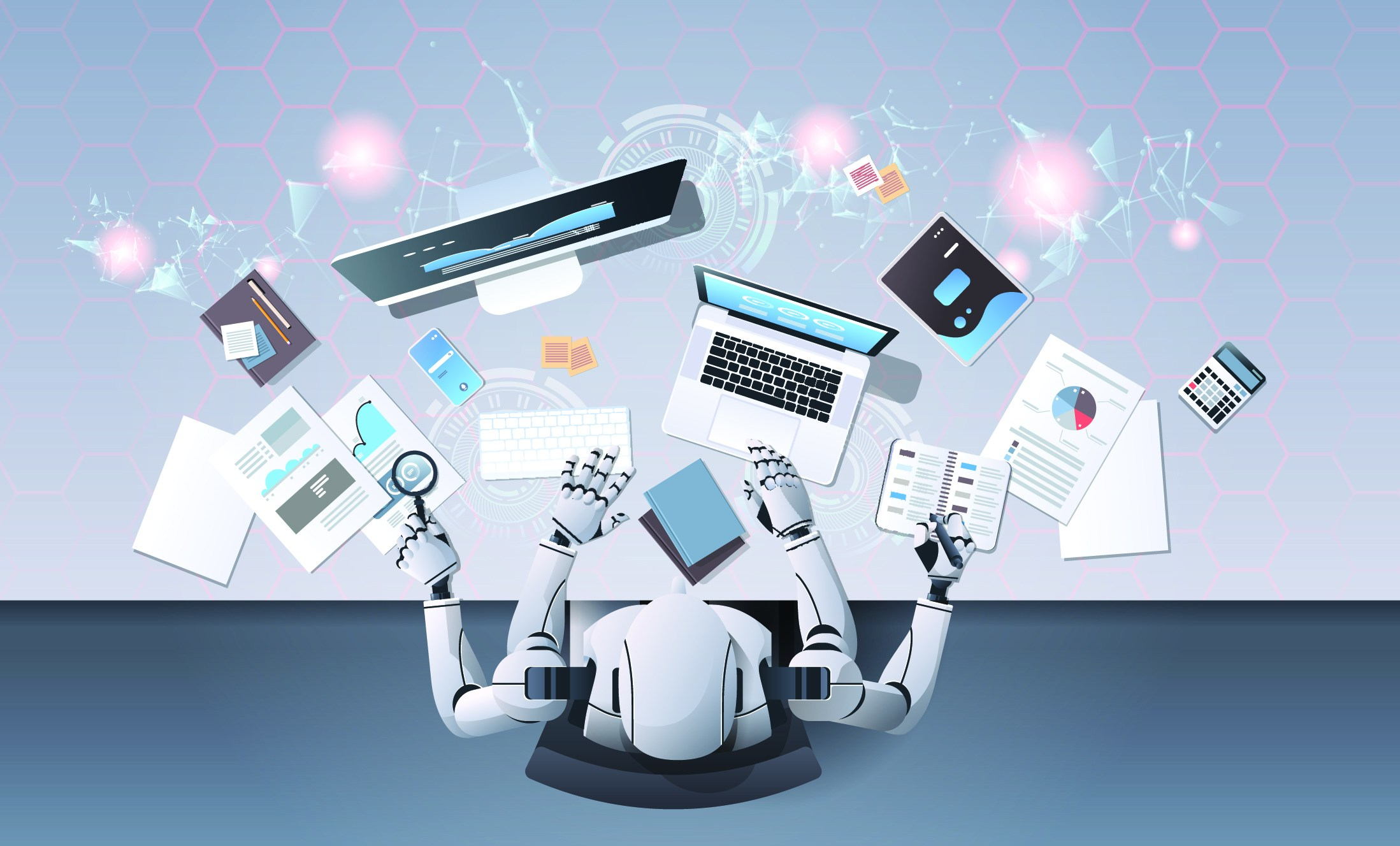
Essentially, all these links belong to "deterministic labor". They can be disassembled, described, and executed repeatedly, but still rely on manual completion. This forms a typical mismatch: The most precious cognitive resources are largely consumed in the most easily replaceable parts.
Over the past decade, AI has indeed entered the field of scientific research, but it mostly stays at the edge. It helps people find papers faster, translate texts more smoothly, and even write a review with a complete structure, but these capabilities have not changed the basic form of scientific research. Scientific research is still a "seven-step marathon", only a little faster.
A more radical proposition has been put on the table: What will happen if the entire scientific research process is handed over to agents for execution?
The recently upgraded AI academic agent WisPaper (the Chinese version is called Qiewen Academic) offers a new possibility. Leave the deterministic labor to computing power, and return the uncertain inspiration to people. Behind this sentence is a complete set of redistribution of the scientific research production mode.

AI does not produce papers, but accelerates the process
In the traditional scientific research process, the seven-step scientific research marathon requires people to repeatedly switch and connect between different links.
The emergence of Qiewen Academic does not mean that it can directly produce papers. It is more embedded in the advancement of scientific research and becomes a penetrating capability. Given a research task, the system can start from literature retrieval, complete reading, analysis and information structuring, identify potential problems on this basis, further proceed to experimental design and execution, and finally output results and reports.
The role of AI in scientific research has also changed accordingly. In the past, AI was more like an "assistant", providing suggestions beside you, or helping you complete part of the work. Most of these tasks are local, such as translating a paper, summarizing a paragraph, or completing a piece of code. Researchers need to constantly take over the process, switch back and forth between different tasks, and maintain the overall advancement.
The unavoidable machine hallucination also requires this part of work to be reviewed to avoid possible risks of academic fraud and forgery. As an AI agent, Qiewen Academic is more positioned as an "executor", which can independently complete part of the content without continuous manual intervention. This means that for the first time, there is the possibility of "being hosted" in the scientific research process.
To use a more intuitive analogy, it is a bit like autonomous driving. In the autonomous driving system, humans are responsible for setting goals, and the system is responsible for path planning and execution.
The same logic is being introduced into scientific research, and a similar division of labor is emerging. Researchers define problems, and Qiewen Academic as an agent is responsible for the advancement process.
Changes in the scientific research process begin to emerge here.
First, the ownership of the process is re-divided. Tasks that originally required people to complete step by step are integrated into a process that can be taken over by the system as a whole. Links such as retrieval, reading, and sorting, which originally highly relied on manual work, no longer need to be intervened one by one, but are continuously processed under the same logic.
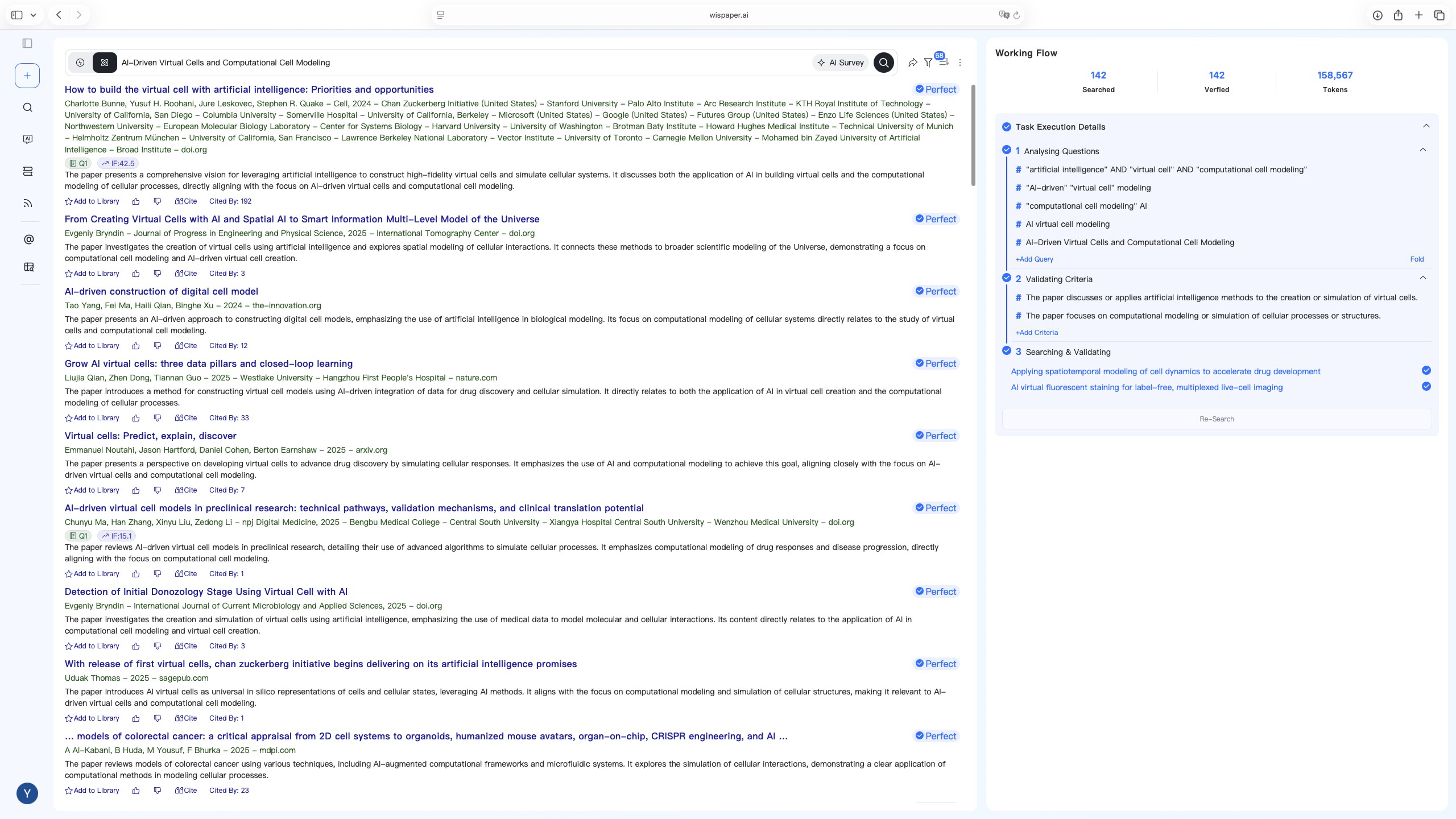
Second, the working mode of scientific research has shifted from a serial process to a parallel structure. After the intervention of such AI agents, scientific research can no longer only advance along a single path. Multiple hypotheses can be expanded at the same time, and multiple directions can be verified in parallel. A researcher's working mode has changed from completing one problem to managing a set of problems.
When the process itself begins to be reorganized, the rhythm of scientific research will also change accordingly.
100x Speed Engine, the first "generation gap" appears in scientific research
In terms of product capabilities, the first thing Qiewen Academic does is to "decouple" the chain of the traditional scientific research path. In the traditional path, there are waiting and switching costs between each link. What Qiewen Academic brings is an exponential improvement in efficiency.
This change is concrete. According to its public information, compared with traditional manual work, the AI4S mode of Qiewen Academic is estimated to increase efficiency by 10 to 100 times in literature retrieval. The literature screening that originally took weeks to complete is compressed to the minute level; the paper reading efficiency is increased by 20 times, and the reading and sorting that took months to complete is compressed to hour-level structured extraction; problem identification can be systematically scanned and located in global data, with a 50x speed lock. Such a leap in efficiency can almost be said to reshape the scientific research life cycle.
At the same time, the efficiency improvement of Qiewen Academic is built on an effective and reliable basis. According to its published data, the literature search accuracy of Qiewen Academic reaches 93.78%, while mainstream models are roughly at around 70%; the accuracy of document layout parsing, formula parsing and table parsing are all above 90%, which is overall higher than the industry average.
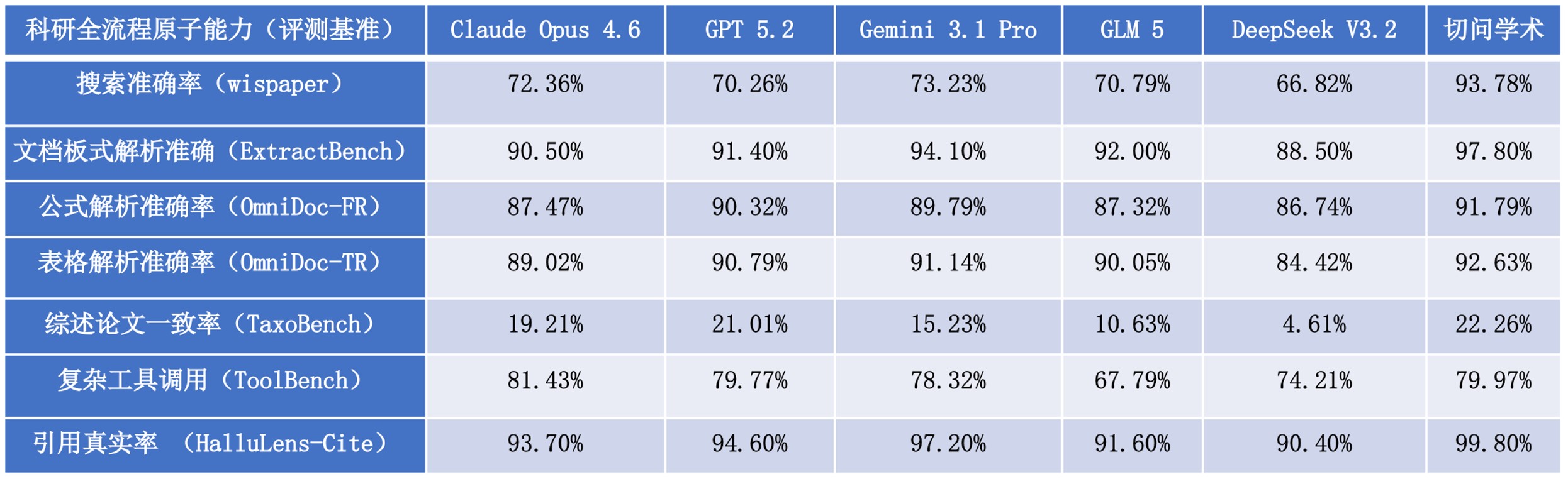
These capabilities do not directly generate conclusions, but determine the form in which information enters subsequent processing. Variable relationships, experimental structures, and data distributions are disassembled in advance, and reading changes from piece-by-piece processing to structured reception.
In particular, the review consistency of Qiewen Academic in the test reaches 22.26%, and the citation authenticity is close to 99.8%. The former determines whether information from different sources can be incorporated into the same logical framework, while the latter has taken a big step in truly eliminating the machine hallucination of generative models.
It is precisely on this basis that the value of its embedding in the scientific research process has room to be established.
One of the highlights of this upgrade lies in the deepening of links such as experiments. Upload a paper, the system will automatically complete reading and understanding, disassemble the core tasks and algorithm logic; on this basis, parse the experimental methods, generate executable experimental schemes; then automatically build the computing environment, including computing power configuration and dependencies; generate code and execute the experimental process, and finally output results and a complete experimental report.
The whole process does not require step-by-step manual intervention. Qiewen Academic can automatically generate experimental paths based on existing literature or research gaps identified by the system, independently match or find data, complete environment construction, execute experiments and output results.
In the traditional scientific research process, "cognition" and "execution" are separated. Understanding can be accelerated, but verification still relies on humans. Now the whole section that originally required people to switch back and forth and make repeated trials and errors is speeded up as a whole. The scientific research process has changed from "human-driven" to "intelligence-driven".
In this sense, it may represent a generational change in scientific research efficiency.
And all this cannot be achieved by general large models. For example, in terms of learning ability, traditional large models may be good at taking exams, but they have learning obstacles for new knowledge that they have never seen before. In the CL-bench test, large models need to understand a completely unfamiliar set of rules and apply them immediately in the context. Most models fail in this link, with an average success rate of only 17.2%.
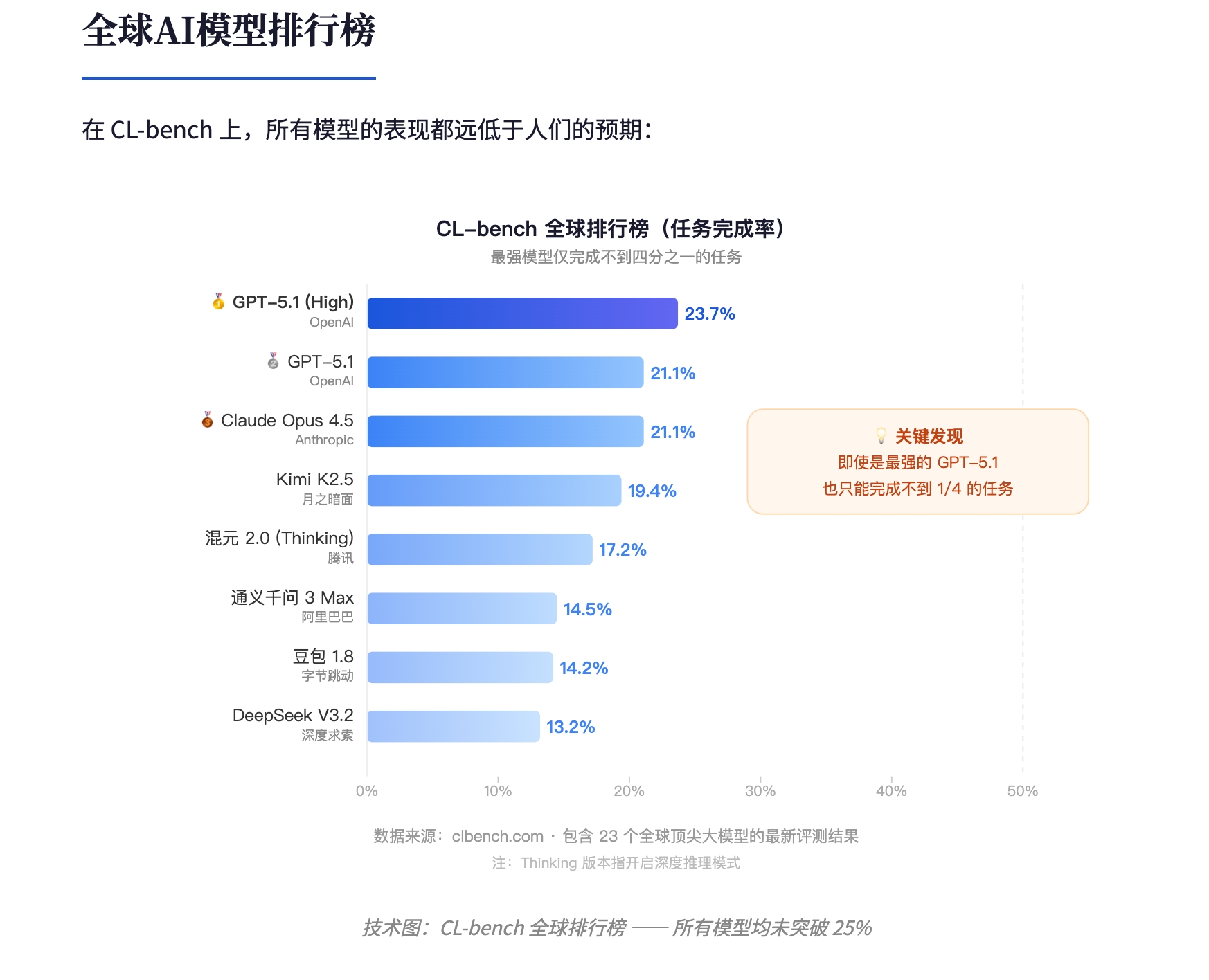
The scientific research scenario precisely relies on this ability, and every problem is new. Only when the model can quickly establish rule understanding in the context can it have the foundation to enter the scientific research process.
For this reason, Qiewen Academic has targeted optimizations on how to advance tasks in the real environment. Its AgentGym-RL training method is an environment closer to real scientific research, where the model needs to continuously adjust paths in tasks such as web page operation and experimental process. Execution cannot rely on preset answers, but must be continuously corrected in feedback.
According to relevant papers and literature, a small model with only 7 billion parameters (Llama-3.1-8B), after AgentGym-RL training, has achieved equivalent or even better performance than GPT-4o and Claude 3.5-Sonnet in multiple scenarios.
At the same time, during the training process, it assigns higher weights to Tokens related to key capabilities such as reasoning and code, so that capability improvement is aligned with training indicators.
But even with the ability to advance tasks in the real environment, this matter is still not that simple. For the model to truly enter the scientific research process, a more hidden problem needs to be solved: the stability of training itself.
RLHF is almost the core path for all large model alignment capabilities. But this method has a recognized difficulty: PPO training is extremely unstable. That is why many models perform well in short tasks, but once they enter complex processes, they begin to have uncontrollable deviations.
Qiewen Academic uses PPO-max to maintain the stability of the training process through more fine-grained constraints and reward mechanisms, no longer relying on luck.
After stabilization comes execution. Calling tools, writing code, and handling environmental dependencies are full of uncertainties in themselves. Traditional models often rely on templates in this part, or stay at the level of "generating code", and once they enter the real execution environment, deviations will occur.
In the scientific research environment, the information itself is not always consistent. There may be conflicting conclusions between different papers, and data sources may also bring deviations. If the model simply integrates information, it is easy to lose accuracy in multi-source information.
When Qiewen Academic faces the inconsistency between "existing memory" and "current input", it will form two processing paths internally, and finally make a choice according to different signal strengths. This enables the model to have basic judgment ability in a complex literature environment, rather than passively accepting information.
When these capabilities are aggregated, the change is no longer a partial improvement. It more represents that the production mode of scientific research is undergoing a real paradigm shift.
When scientific research returns to "human", the critical point of accelerated breakthrough
In this change, not only efficiency is changed.
The working mode of scientific research has begun to shift from completing every step in person to making judgments at key nodes. When execution is taken over by the system, researchers no longer need to repeatedly enter those deterministic processes, but gradually withdraw from specific operations, and turn to a higher level to understand problems, select paths, and review results.
This seemingly subtle change is also quietly rewriting the division of roles in scientific research. Those smartest brains no longer need to run in the process. They shift from a role closer to an executor to an architect or a leader.
At the same time, another invisible threshold is disappearing. In many fields, there is code, computing power and experimental environment between ideas and results. Once this part of the demand is solved by agents like Qiewen Academic, the entry threshold for scientific research will be redefined.
As a result, scientific research competition has begun to move forward. From who can achieve results first, it has become who can see the problem earlier, returning to the "human" who defines the problem. Some researchers who were originally limited by technical conditions can also participate in the problem itself more directly.

The essence of scientific research is knowledge production. When the cycle of knowledge production is compressed, it affects the rhythm of the entire technical system. In addition to the reduction of time cost, the update frequency of the knowledge base is also accelerating simultaneously. For example, in fields such as new materials, targeted drugs, and clean energy that are limited by verification costs, once verification is compressed, path screening will be significantly accelerated, wrong directions will be eliminated earlier, and feasible paths will emerge faster.
This means that research will continue to approach the answer in a higher density of trials. The trial-and-error process that originally took many years to accumulate is compressed to occur repeatedly in a shorter cycle.
The way technological breakthroughs emerge has also changed accordingly, shifting from accidental discoveries relying on individual experience to gradual convergence in high-frequency verification.
When this rhythm continues to superimpose, a state closer to the critical point begins to appear. Scientific research has begun to enter a new division of labor structure: AI is responsible for advancing known paths and continuously compressing the deterministic part; while humans stay in the unknown area to judge which problems are worthy of further inquiry.