Feishu, riding on the wave of OpenClaw, aims to enable even novices to raise shrimps effortlessly.
In recent months, OpenClaw has rapidly gained popularity in the developer community. It has quickly amassed a large number of Stars on GitHub, and relevant tutorials, videos, and practical cases have been continuously flooding the community.
The reason for its attention is that it has changed the way AI works. Beyond the question - answer mode, AI can also call tools, execute tasks, and work continuously. From automatically organizing information and operating content to participating in the development process, a large number of new usage scenarios have emerged, and the concept of Agent, which was mostly discussed in research before, has been perceived by a wider audience.
In the past two years, most of the attention from OpenAI to domestic large - model companies has been focused on two things: computing power and models. But since last year, a new question has gradually come to the forefront: If the biggest breakpoint is that the model ends after output, then how can AI truly enter production and daily life?
It is precisely against this background that the Agent has begun to become a hot topic of discussion globally.
This year, this trend has further accelerated. More and more companies are starting to launch their own agent products. Manufacturers such as MiniMax, Kimi, and Zhipu are all releasing new Agent capabilities, hoping to enable AI not only to have conversations but also to execute tasks, call tools, and complete complex processes. However, the subsequent problem is that without a real working environment, it is difficult for Agents to truly enter the daily collaboration of an organization.
Therefore, in this round of Agent exploration, platforms capable of hosting agent operations have begun to emerge and are playing an increasingly important role.
Globally, some productivity platforms have become important scenarios for agent experiments. For example, Notion, a collaboration tool centered around documents and databases; Google Workspace, an enterprise office suite that connects Gmail, Docs, and Sheets; and Slack, the core entry point for enterprise team communication. Similar ones include office platforms like Airtable and Microsoft 365. These systems are naturally connected to team communication, documents, and data, so they inherently provide an environment for Agents to participate in work.
In China, a similar trend has also emerged. Some productivity platforms have gradually become common environments for agent operations in developer practices. Many teams choose to connect agents to Feishu robots when deploying Agents, allowing them to run directly in the team collaboration system. When configuring Claw products launched by some model manufacturers, Feishu is often the default connection.
Feishu didn't stop there. On March 19th, Feishu also released enterprise - level products such as the "Feishu version of Lobster" and the multi - dimensional table agent.
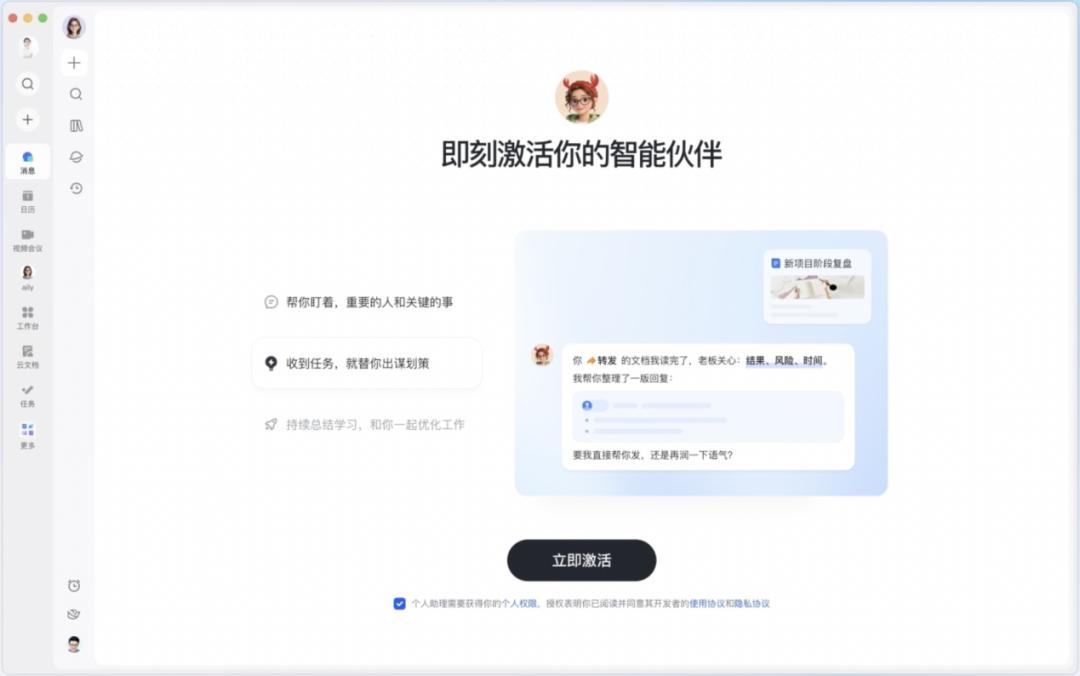
From Feishu aily for ordinary users, to the professional version of aily that can handle complex tasks, to the Miaoda Agent that can build applications and agents, and the AI building ability of the multi - dimensional table, Feishu has brought a complete set of Agent product combinations for individuals and organizations to implement.
In this wave of Agent enthusiasm, a core idea is: If AI can only answer questions, it is still just a tool; only when AI can participate in task processes can it become a productive force.
From this perspective, the series of products released by Feishu are, to some extent, answering this question.
The productivity scenario has finally waited for the suitable AI
Microsoft CEO Satya Nadella has mentioned many times that the resource allocation of future enterprises will change: computing power and agents will gradually become production resources as important as human resources. AI researcher Andrew Ng also proposed the concept of "Agentic Workflow" - instead of relying on a single model, it is better to let multiple agents collaborate in the workflow to complete tasks.
These judgments are gradually becoming a reality.
A very obvious change is that mainstream large - model manufacturers are starting to pay more and more attention to the Token consumption and the resulting usage duration, task depth, and user stickiness.
Domestic manufacturers such as Kimi and Zhipu have successively launched their own Claw - like products, bringing the "calling tools, continuous working, and long - chain execution" capabilities represented by OpenClaw into their own ecosystems; overseas, Anthropic is also continuously strengthening the usage scenarios of Claude in complex tasks, multi - step execution, and workflows.
On the surface, what everyone is competing for is Tokens, but what they are really vying for is the users' real work. Therefore, the Agent has jumped out of the limitation of the technical concept and has begun to become the core means for large - model companies to compete for the next - stage usage intensity and product form.
This change has also quickly spread to the platform layer. At the Tencent Holdings performance communication meeting on March 18th, Tencent's senior management publicly talked about their views on "raising lobsters" - "Lobster" - like applications have enabled the implementation scenarios of AI to no longer be limited to ChatBot, and have the opportunity to enter more diverse office and business scenarios; for Tencent, this has also inspired the planned WeChat Agent, and the long - existing decentralized idea of mini - programs in the WeChat ecosystem may also be incorporated into the future Agent design.
Different from Tencent, which mainly considers the implementation of Agent from the WeChat ecosystem, Feishu's initial role in this round of changes is more like a collaboration platform: As the popularity of OpenClaw increases, more and more developers will connect agents to Feishu robots; by March 19th, platforms such as Volcengine, Jieyuexingchen, Kimi, Kouzi, MiniMax, and Zhipu have all completed the docking with Feishu's official OpenClaw plug - in.
Why has an OpenClaw caused such a big chain reaction in the industry?
In the past few years, large models have proven their abilities in text generation and knowledge Q&A. However, in real - world work scenarios, this ability still remains in an auxiliary role: AI can give answers, but it is difficult to continue to execute tasks. Humans often need to copy and organize the AI's results and then manually put them into the actual work process.
The emergence of OpenClaw has changed this situation. Through the agent framework, AI can not only understand users' needs but also call tools, trigger processes, and continuously run tasks. From organizing materials and generating reports to automatically processing data and updating documents, these steps that originally required repeated manual operations can be automatically completed by the Agent.
For an Agent to exert its execution ability and enter the production process, it needs to handle at least three things: context, workflow, and data structure.
Context requires AI to understand the team's documents, historical communications, project background, and organizational information; otherwise, it is difficult for it to judge the real requirements of tasks. Workflow requires the Agent to enter the work process, such as multiple links including approval, data processing, and project management. Structured data requires AI to have stable data structures such as tables, databases, and knowledge bases to store and read information and further complete complex tasks.
The difference between OpenClaw and other Agents is that the interaction of other Agents is complex, with extremely high experience and usage thresholds, while OpenClaw encapsulates these capabilities into a very simple interaction method - conversation.
Users no longer need to understand complex technical logic, nor do they need to write scripts or configure systems. They only need to put forward requirements like chatting with colleagues, and the agent can complete a series of operations in the background.
This "chat - driven task" model further explains why the release of Feishu's products that further lower the Agent threshold is more important in the Agent ecosystem.
After embracing the Agent, Feishu wants to do more
When large - model manufacturers start to compete for the next - stage usage scenarios around Agents, Feishu has also taken advantage of this trend and gradually become an important collaboration environment that domestic Agent products are default - adapted to.
Whether they are model manufacturers, entrepreneurs, or ordinary developers, many people will finally connect agents to Feishu.
This is not accidental. For Agents, chat windows are everywhere, but there are not many complete sets of collaboration soils - context, data structure, permission system, and open interfaces, and these are exactly what Feishu has been doing in the past few years. These actions have continuously lowered the threshold for enterprises to put Agents into real - world collaboration systems.
One of the most important values of an enterprise collaboration system is to accumulate real - world work information. The large number of message records, project documents, meeting minutes, and task progress generated by the team every day are the historical trajectories of the organization's operation. For Agents, these contents constitute the key background for understanding work. Without this context, AI can often only give general answers and is difficult to truly participate in specific tasks.
After this information is accumulated, the problem becomes how to organize and call the data. In many teams, Feishu's multi - dimensional table has gradually taken on the role of a lightweight database to manage project progress, business data, and process status. Such structured data is very friendly to Agents: it is convenient for both reading and writing. Agents can automatically organize the collected information into the table and can also retrieve and update data from the table, thus forming a continuously running task cycle.
When Agents start to participate in real - world work processes, the most complex thing in the enterprise system also emerges - permissions. Different departments and roles have different access to data and functions, and the permissions between many systems are often fragmented. Feishu designed its communication, document, table, and approval modules under the same set of permission systems, which means that an Agent only needs to obtain authorization once to execute tasks in the entire system. For enterprises, this significantly reduces the complexity of deploying and managing agents.
When the context, data structure, and permission system are all in place, Agents can truly enter the collaboration environment, and the open ecosystem further extends this ability. Feishu's open platform provides rich APIs and robot capabilities, and developers can easily connect external tools or systems. When an agent framework like OpenClaw appears, developers only need to use the robot interface to connect the Agent to Feishu and let it directly participate in team collaboration.
More and more developers, practitioners, business owners, and even ordinary users who hope to improve efficiency have gradually realized that OpenClaw brings agent capabilities, and Feishu provides an environment where it can truly work. In this environment, Agents can of course chat, and more importantly, they can read and write documents, process data, promote tasks, and participate in processes.
Moreover, Feishu is continuously lowering the threshold for Agent deployment. For example, one of its recent key actions is to gradually standardize the process of connecting Agents to the organizational system. After the official OpenClaw plug - in is launched, authorized agents can directly call modules such as messages, documents, multi - dimensional tables, calendars, and tasks in Feishu.
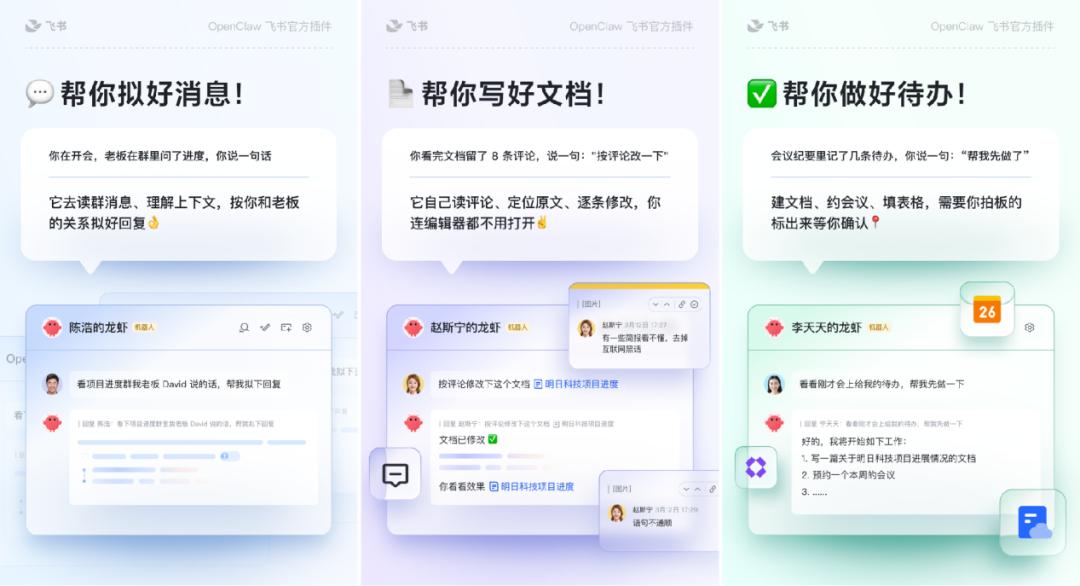
This standardization ability is also being followed by more manufacturers. Public information shows that Zhipu's AutoClaw already provides Feishu integration capabilities; Volcengine's ArkClaw has released an access plan for Feishu and clearly mentioned the built - in Feishu official plug - in; Alibaba Cloud has also launched official documentation for OpenClaw integration with Feishu. Therefore, Feishu is no longer just an entry point for developers to explore on their own, but has begun to become a collaboration environment that more and more mainstream model manufacturers and cloud providers are default - adapted to.
At the same time, the API call quota of Feishu's open platform has also been adjusted. The free version has been increased from 10,000 times per month to 1 million times. For developers and enterprises, this means that when testing and deploying Agents, the call cost and quota constraints have been significantly relaxed, and many attempts that could only stay at the demonstration stage have more opportunities to enter real - world scenarios for repeated iterations.
For enterprises, the Agent is gradually evolving from a concept into a production tool that can participate in the collaboration system and undertake specific tasks. When AI truly enters the organizational system, platforms that can connect people, data, and work processes will gradually become important infrastructure in the Agent era.
Next, what Feishu is doing is not just "making it easier for everyone to connect OpenClaw."
On March 19th, Feishu officially released multiple enterprise - level Agent products. The most attention - grabbing one is the newly upgraded Feishu aily. Compared with the previous AI assistants that only answered questions, this aily is more like a "crayfish" native to Feishu: it resides permanently in the contact list in the form of an intelligent partner, directly embedded in the message flow and workflow. Users can have their own exclusive Agent with a single click.
This is also a very important change in Feishu's upgrade. In the past, when many ordinary people wanted to try Agents, the first step was often stuck on the question "What tasks should the Agent help me complete?" Now, Feishu's answer is that Agents can participate in the process of "building tools, building processes, and building systems" itself, and finally completing tasks and improving efficiency will become a natural result.
Of course, in addition to meeting the needs of ordinary users, Feishu has also considered the higher - level usage requirements of core developers for Agents, which is reflected in the product update by continuing to standardize the underlying capabilities.
If we connect these actions, we will find that what Feishu really wants to promote is the entire set of conditions required for the implementation of Agents in enterprises: on the upper level, there is aily that everyone can use, Miaoda that can build systems, and the multi - dimensional table Agent; in the middle, there are workflows and permission systems as a foundation; on the bottom level, there are plug - ins, APIs, and mainstream manufacturers' access to further lower the engineering threshold.
OpenClaw has allowed more people to see the possibilities of Agents, and what Feishu is doing is to promote these possibilities from experiments in the developer community to product capabilities that everyone can use and every team can access.
Next, a new round of productivity explosion
When Agents truly enter the collaboration system, human productivity is further amplified.
This "amplification" can already be seen in some early practices.
Fu Sheng, the CEO of Cheetah Mobile, once shared an experiment: During his bed - rest period due to a skiing injury during the Spring Festival, he tried to "raise" a group of AI Agents in Feishu and let them participate in content creation, information organization, and daily operations. Public information shows that in 14 days, he had a total of 1,157 messages and 220,000 - word conversations with these Agents, and finally evolved an automated team consisting of 8 Agents. Among them, an official account article automatically published by an Agent at midnight reached one million views. He tried to let different Agents undertake different tasks through continuous conversations and division of labor.
Another entrepreneur, Li Zhifei, used Agents in the development scenario. He tried to let AI assist in product development in the Feishu environment. He built a prototype of a collaboration platform in just two days and let AI generate the product official website in a few minutes. The work that originally required a small team to complete was compressed into a very short time with the assistance of agents.
This change has even occurred not only in the groups of engineers and entrepreneurs. At the Feishu "Playing with Lobsters Conference", the talk - show actor Li Dan demonstrated how he used Agents in Feishu: from assisting in learning English word roots, participating in philosophical discussions, to helping handle some more complex cognitive tasks, Agents have begun to enter a wider range of people and higher - level usage scenarios. This case at least shows that when an Agent is placed in a convenient working environment, its usage threshold is not necessarily limited to technical people.
Although still in the exploration stage, these attempts have shown a new possibility. Just as it was difficult to predict that smartphones would become the entrance to the mobile Internet when they first appeared, Agents may also be at a similar starting point. Some people even describe OpenClaw as the first - generation iPhone. It may not be mature, but it has for the first time allowed many people to intuitively see a new interaction paradigm.
More importantly, the changes brought by Agents may not only be reflected in the level of personal efficiency.
When agents can run continuously and participate in the collaboration system, the ability boundaries of the organization will also change. In the past, the output of a team largely depended on the number of members, professional division of labor, and communication efficiency; after Agents start to undertake information processing, task execution, and process promotion, the organization can significantly expand its execution radius without linearly increasing the number of human resources.
This means that effectively mobilizing a large number of Agents and forming a smooth collaboration relationship between humans and Agents may also become one of the key factors in future business competition.
When agents run continuously and participate in the collaboration system, the organizational structure may also change