Half of the investment circle is grateful to Unitree.
"Thank you for giving us an opportunity to invest in Unitree five years ago."
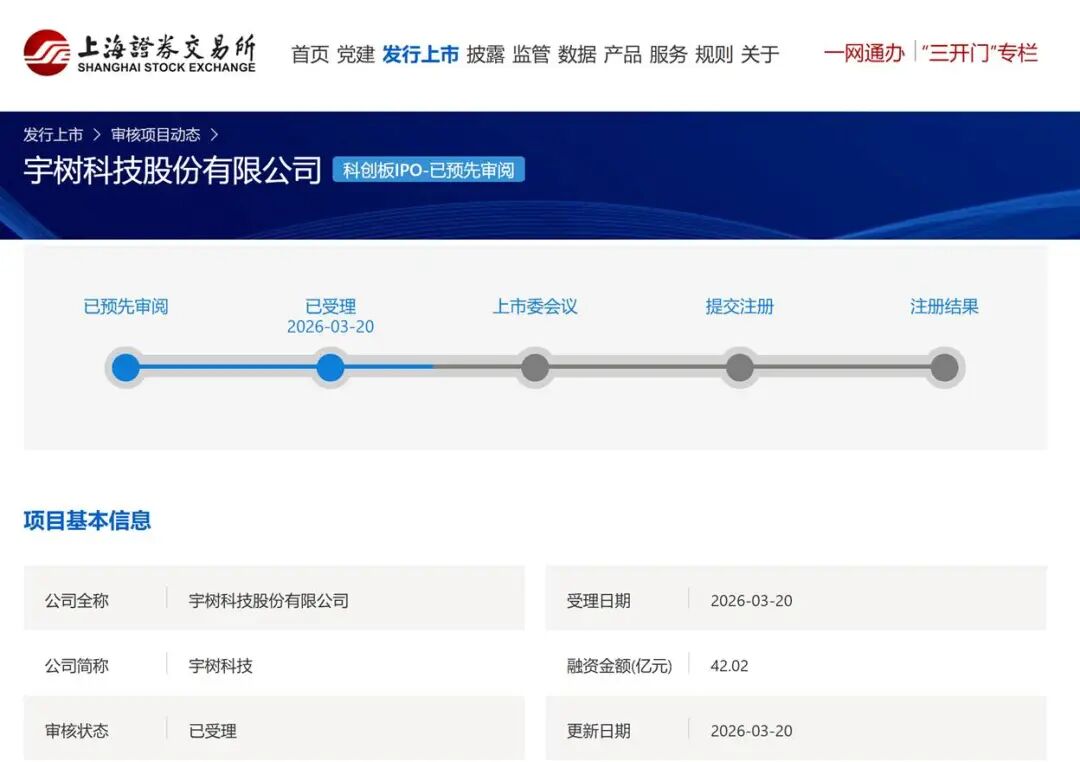
At the Xiaomi press conference on March 19th, Lei Jun said this to Wang Xingxing standing beside him in front of the entire audience. The next day, on March 20th, the official website of the Shanghai Stock Exchange showed that Unitree Technology's application for IPO on the Science and Technology Innovation Board was officially accepted.
The timing is so precise that one can't help but sigh - Lei Jun really has a sharp eye. The money invested five years ago is about to turn into a stock that everyone wants to hold.
This is not an exaggeration. According to IT Juzi data, as of March 20, 2026, there have been 207 financing events in the Chinese robotics track this year, among which 133 are for humanoid robots, and a total of 115 companies have received funding. Among all these robotics companies in the primary market, Unitree is the only one that has achieved profitability, with a gross profit margin approaching 60%, the world's highest shipment volume of humanoid robots, and has officially knocked on the door of the A-share market.
The prospectus clearly states that in 2025, the revenue was approximately 1.708 billion yuan, a year-on-year increase of 335%; the net profit after deducting non-recurring gains and losses exceeded 600 million yuan; and it plans to raise 4.202 billion yuan. More remarkably, Unitree achieved profitability in 2024, and its gross profit margin soared to 60.27% in 2025. The gross profit of both humanoid and quadruped robots exceeded 60%, while most of its peers are still in the red or have a gross profit margin of less than 30%. Of the 4.2 billion yuan in fundraising, more than 2 billion will be invested in core technologies such as embodied large models, and it also plans to expand production capacity to an annual output of 75,000 humanoid robots and 115,000 quadruped robots.
While its peers are still burning investors' money to make prototypes, Unitree has been able to sell 5,500 humanoid robots, with an average selling price of 167,600 yuan, and still maintain a gross profit margin of 62.9%.
This is the cruel rule of hard technology - whoever can first turn the technology in the laboratory into a product that users are willing to pay for will have the highest pricing power in the capital market.
From Quadruped to Humanoid,
Unitree's "Product Leap"
If you look at Unitree's revenue structure, you will find a clear strategic transformation trajectory.
In 2022, the company's main business revenue was 121 million yuan, and quadruped robots accounted for 76.57%, being the absolute main force. At that time, Unitree was still known as a "maker of robotic dogs". As of now, Unitree has sold more than 30,000 quadruped robots in total, ranking first in the global market share, stably earning cash flow and achieving large-scale production.
In August 2023, Unitree's first full-size humanoid robot, H1, was launched. Only 5 units were sold that year, with an income of 2.9671 million yuan, which was almost negligible.
In 2024, the medium-sized humanoid robot G1 was officially mass-produced, with a starting price of 99,000 yuan. It became Unitree's first general-purpose humanoid robot to be launched on the market on a large scale, marking the key process of the commercialization of humanoid robots. In this year, Unitree achieved profitability.
The turning point occurred in 2025. At the beginning of the year, 16 H1 humanoid robots from Unitree appeared on the CCTV Spring Festival Gala and completed a fully AI-driven group dance performance in the program "Yangko BOT" directed by Zhang Yimou. Wang Xingxing, the founder of the company, personally supported the event. Overnight, "humanoid robots" became a hot technological topic among the public.
In the first three quarters of 2025, the sales revenue of Unitree's humanoid robots was 595 million yuan, accounting for 51.53%, surpassing that of quadruped robots (488 million yuan, accounting for 42.25%) for the first time. In terms of sales volume, 3,551 humanoid robots were sold, 8.6 times that of the whole year of 2024.
It only took two years to increase from 5 units to 3,500 units.
More importantly, there is the price curve. The average selling price of humanoid robots dropped from 593,400 yuan in 2023 to 260,700 yuan in 2024, and then to 167,600 yuan in the first three quarters of 2025. Unitree explained in the prospectus that this is both due to the change in product structure (the lower pricing of G1) and the result of active price adjustment, aiming to "build long-term competitive advantages".
Use cost-effectiveness to gain scale, use scale to obtain data, and use data to speed up technological iteration.
This strategy has been proven in the quadruped robot market. Unitree has sold more than 30,000 quadruped robots in total, leading in the global market share. Now, they are replicating this path in the humanoid robot track.
Wang Xingxing's ambition doesn't stop there. In a recent public speech, he said, "Humanoid robots will outrun Usain Bolt by the middle of 2026." Usain Bolt's world record for the 100-meter dash is 9.58 seconds, corresponding to a speed of about 10.4 meters per second. And the best speed record achieved by Unitree's H1 in preparation for the competition has exceeded 5 meters per second.
Can it be achieved? At least Unitree has made the market believe in this possibility.
Luxurious Shareholder List:
Half of the Hard Technology Investment Circle is on Board
The reason why Unitree's IPO has shaken the entire industry is not only because of its performance but also because of the shareholder list that can be called an "all-star lineup".
Wang Xingxing, the founder, directly holds 23.82% of the shares and indirectly holds 10.94%, making him the controlling shareholder of the company. However, through the special voting rights arrangement, he actually controls 68.78% of the voting rights.
Among institutional investors, the Meituan group (Hanhai Information, Galaxy Z, and Chengdu Longzhu) holds a total of about 9.6488% of the shares, making it the largest shareholder after Wang Xingxing and the equity incentive platform Shanghai Yuyi. Sequoia China (Ningbo Sequoia and Xiamen Yaheng) holds about 7.1149% of the shares. Matrix Partners (Matrix No. 1 and Matrix No. 3) holds about 5.4528% of the shares.
What's more noteworthy is the entry of Internet giants. Tencent Technology directly holds 0.5986% of the shares, and the Alibaba group (Hangzhou Haoyue) and the Ant group (Shanghai Yunchang) also appear at the same time. It is extremely rare in the capital market for two major camps to bet on the same robotics company.
In terms of industrial capital, BYD, Geely, funds under China Mobile, Beijing Robotics Industry Development Fund, Shenzhen Capital Group, and Jinshi Investment (under CITIC Securities) have all joined in. The national team, industrial players, and financial investors are all involved.
This list sends two key signals:
First, a consensus on the track has been formed. From the early pure financial investment (Shunwei and Sequoia) to the later participation of industrial capital (BYD and Meituan) and national team funds, it shows that robotics has been regarded by all parties as a national strategic industry with certainty. BYD's entry implies the imagination space in the automotive manufacturing scenario, while Meituan's support points to the potential in the logistics and distribution field.
Second, it has a very strong ability to command a valuation premium. Against the background of tightened liquidity in the primary market, Unitree can still attract such a large amount of capital, which proves its scarcity as an industry leader. When the Series C financing was completed in 2025, Unitree's post-investment valuation exceeded 10 billion yuan. Now that it is sprinting for an IPO, the market value is expected to be even higher.
The money Lei Jun invested through Shunwei Capital five years ago will surely yield a high return. No wonder Lei Jun thanked Wang Xingxing in person - this is probably one of the most successful early investments of the Xiaomi group in recent years.
Unitree is the First
Unitree is the first humanoid robot company to officially submit an application for listing on the Science and Technology Innovation Board.
According to public information, more than 20 robotics companies, including Leju Robotics, Yun Shenchu, Stand Robot, Youibot, Luoshi, Seer Industry, Atomrobot, Jiazhibot, Canop, and Jiuwu Intelligence, have clearly announced their listing plans. As the first one to cross the finish line, Unitree's current time point is March 20, 2026, which coincides with the tenth anniversary of the company's establishment.
What does this "first" mean?
First, there is the scarcity premium of being the "first humanoid robot stock" on the A-share market. Although there are already robotics companies like Ubtech (listed in December 2023) and Dobot (listed in December 2024) on the Hong Kong stock market, the valuation logic of the A-share market for hard technology companies is completely different. The liquidity of the Science and Technology Innovation Board, the institutional allocation demand, and the support of the "domestic substitution" narrative all make Unitree one of the most scarce targets at present.
Second, it establishes the industry's valuation anchor. Unitree's issue price, price-earnings ratio, and market value performance will directly affect the valuation expectations of subsequent queuing companies. If Unitree can obtain a high premium, the entire industry will benefit; if the market reaction is mediocre, the following companies may be forced to adjust their expectations.
Third, it opens up the capital exit channel. In the past two years, the robotics track has seen a boom in financing, but the exit channels are limited. The successful IPO of Unitree means that early investors have a model for exiting, and the subsequent financing and M&A transactions in the robotics track will be more active.
However, risks also exist. Unitree admitted in the prospectus that "in view of the fact that the embodied large model technology is still in the R & D and testing stage globally, the company has not yet applied its self-developed general embodied large model to robot products on a large scale during the reporting period." However, Unitree has made preparations in advance and has open-sourced two embodied large models, WMA and VLA, to occupy the future technological direction in advance.
This is a common bottleneck faced by the entire industry. Unitree divides the capabilities of robots into the "brain" and the "cerebellum" - the cerebellum is responsible for motion control (running, jumping, and somersaulting), and the brain is responsible for understanding, interaction, and autonomous decision-making. Currently, Unitree's cerebellum has reached the top level in the industry, but the brain is not yet mature. Without a mature brain, robots can only execute preset instructions and cannot truly understand the environment and plan tasks autonomously.
When this technological bottleneck will be broken through will determine whether general-purpose robots can move from the laboratory to factories and households, and will also determine the valuation ceiling of Unitree after its listing.
In 2026,
"Multiple Rounds of Financing" for Star Companies Become the Norm
If we broaden our view to the entire robotics track, the financing enthusiasm in 2026 is simply crazy.
According to IT Juzi data, as of March 20, 2026, there have been 207 financing events in the robotics track, among which 133 are for humanoid robots, involving a total of 115 companies.
A notable trend is that the financing rhythm of star companies is getting faster and the amount of each round is getting larger.
Take Zhipu Robotics as an example. Since 2026, it has completed multiple rounds of financing, and the latest round of valuation exceeds 7 billion yuan. Its cleaning robot business, "Zhidings Robotics", completed a Series A financing of hundreds of millions of yuan in February, with investors including Shenzhen Investment Holdings and Lake Electric.
Galaxy General Robotics completed a Series B+ financing of 2.5 billion yuan in March, with a post-investment valuation of 22.5 billion yuan. The investors include the National Integrated Circuit Industry Investment Fund, SMIC Juyuan, Yizhuang State Investment, Bank of China, and Sinopec Capital, among other "national team" members.
Lingchu Intelligence completed a Pre-Series A financing of 2 billion yuan in March, with a post-investment valuation of 8 billion yuan.
Pacini completed a Series B financing of 1 billion yuan in March, with a post-investment valuation of 10 billion yuan.
Xingdong Jiyuan completed a strategic financing of 1 billion yuan in March, with a post-investment valuation of 10 billion yuan.
Another thing worth noting is that on March 18, the robot leasing platform "Qingtianzu" completed an angel round financing of hundreds of millions of yuan. The list of investors includes Lehua Entertainment and Mingjia Capital - an investment institution co-founded by Huang Xiaoming. As an idol brokerage company, Lehua Entertainment has also started to layout the robot leasing track.
After the Spring Festival Gala, the sales volume of Unitree's humanoid robots "soared". When robots start to do yangko dancing and martial arts, they become consumer products with entertainment and traffic attributes. Entertainment capital has smelled this opportunity.
The financing rounds are also moving forward rapidly. Many companies have completed multiple rounds of financing within less than a year, with Pre-Series A, Series A, and Series A+ rounds following one after another. Companies such as Shenqiong Xinghe, Lingyu Intelligence, Luobo Party, and Gesong Technology completed angel rounds or Pre-Series A rounds of financing intensively in March, with the amount ranging from tens of millions to hundreds of millions of yuan.
The logic behind this is that the track is too hot, there is too much capital, and there are too few good projects. Institutions are afraid of missing out, so they have to rush ahead.
Conclusion
Let's go back to the moment when Lei Jun thanked Wang Xingxing.
On the surface, it is an investor thanking the founder for giving an investment opportunity. But the deeper meaning is: thank Unitree for proving that the humanoid robot track is really valuable, and thank Wang Xingxing for making it possible for everyone's bets to pay off.
Unitree's IPO has opened up the imagination space for hard technology companies in the A-share market and paved the way for more than 20 subsequent queuing companies.
Of course, the challenges are still huge. The "brain" technology is not yet mature, the overseas trade environment is complex, and the industry competition is intensifying. These risks are clearly stated in Unitree's prospectus. But the market is willing to price this risk because everyone believes that embodied intelligence is the ultimate form of AI.
Wang Xingxing wrote in the "Statement to Investors" in the prospectus: "2026 marks the tenth anniversary of Unitree Technology. For ten years, we have always kept our original intention and dreamed of using technology to promote the progress of human society. At present, we are on the eve of a breakthrough in global AI and embodied intelligence technology, at the dawn of humanity's march towards a more advanced civilization."
This narrative may seem a bit grand, but when spoken by the founder of a company about to go public, it's hard not to be inspired. After all, in 2025, Unitree was able to sell 5,500 robots, achieve a revenue of 1.7 billion yuan, and maintain a gross profit margin of 60%.
And for those early investors in Unitree, they only need to do one thing:
Thank Wang Xingxing and then wait to count the money.