With a higher net profit margin than Tencent, why is Unitree so profitable?
On March 20th, the well - known robotics company Unitree Technology released its prospectus on the Shanghai Stock Exchange, planning to issue 40.4464 million shares, accounting for no less than 10.00% of the total post - issue shares, and raising 4.2 billion yuan, which is equivalent to an issue market value of at least 42 billion yuan.
In 2025, Unitree Technology's revenue reached 1.708 billion yuan, a year - on - year increase of 335.36%. Its net profit after deducting non - recurring items was 600 million yuan, a year - on - year increase of 674.29%, and the net profit margin reached 35.13%, higher than Tencent's net profit margin in 2025 (34.5%).
It should be noted that Tencent has well - recognized high - margin businesses such as games, fintech (WeChat Pay), and advertising.
Isn't it said that robots are currently just toys in laboratories, schools, and other fields? Other robotics companies are still frantically raising funds and burning money for the research and development of brain models and attempts in application scenarios. How can Unitree make so much money?
Children from poor families become independent early
Unitree Technology was founded in 2016 by Wang Xingxing after receiving a personal angel investment of 2 million yuan. In 2017, based on the robot product Xdog he developed during his postgraduate studies, Wang Xingxing created a quadruped robot driven by motors. In 2019, he launched the second - generation quadruped robot, AlienGo, with performance leading the world.
Thanks to the leading robotics technology of Unitree Technology, Sequoia China Seed Fund and DeXun Investment invested tens of millions of yuan in Wang Xingxing. With the funds, Wang Xingxing launched the cost - effective quadruped robot A1 in 2020, reducing the price to the consumer - grade range and starting commercialization. In 2021, Unitree Technology's high - performance quadruped robot appeared on the CCTV Spring Festival Gala.
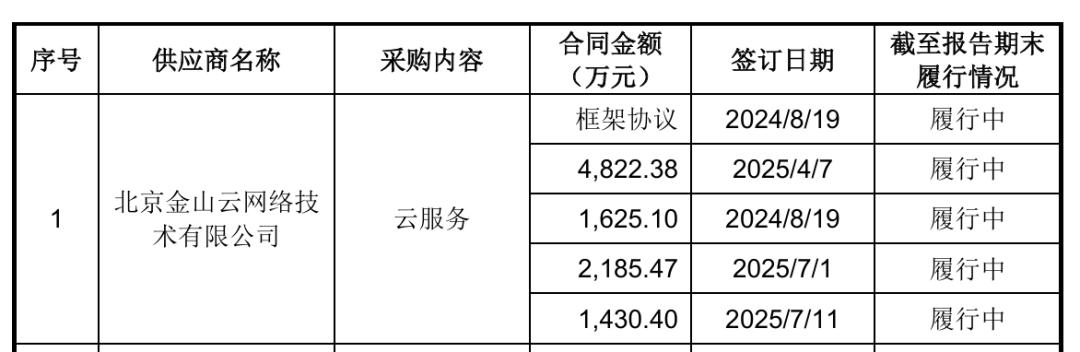
Riding on the popularity of the Spring Festival Gala, Wang Xingxing launched the first - generation consumer - grade quadruped robot Go1 in the same year, with the price dropping to 16,000 yuan per unit, officially entering the mass market. In 2021, Shunwei Capital under Lei Jun led an investment of tens of millions of dollars in Unitree Technology (this is the origin of Lei Jun's in - person thanks to Wang Xingxing on March 19th. Of course, this investment was very cost - effective. On the one hand, the financial return was substantial; on the other hand, Unitree Technology also purchased at least 100 million yuan of cloud services from Kingsoft Cloud), which helped with the global sales of Go1. It is estimated that Wang Xingxing also wanted to sell products through the Xiaomi platform at that time, after all, Xiaomi's ecosystem has helped the rise of technology companies such as Roborock and Ninebot.
Source: Unitree Technology's prospectus
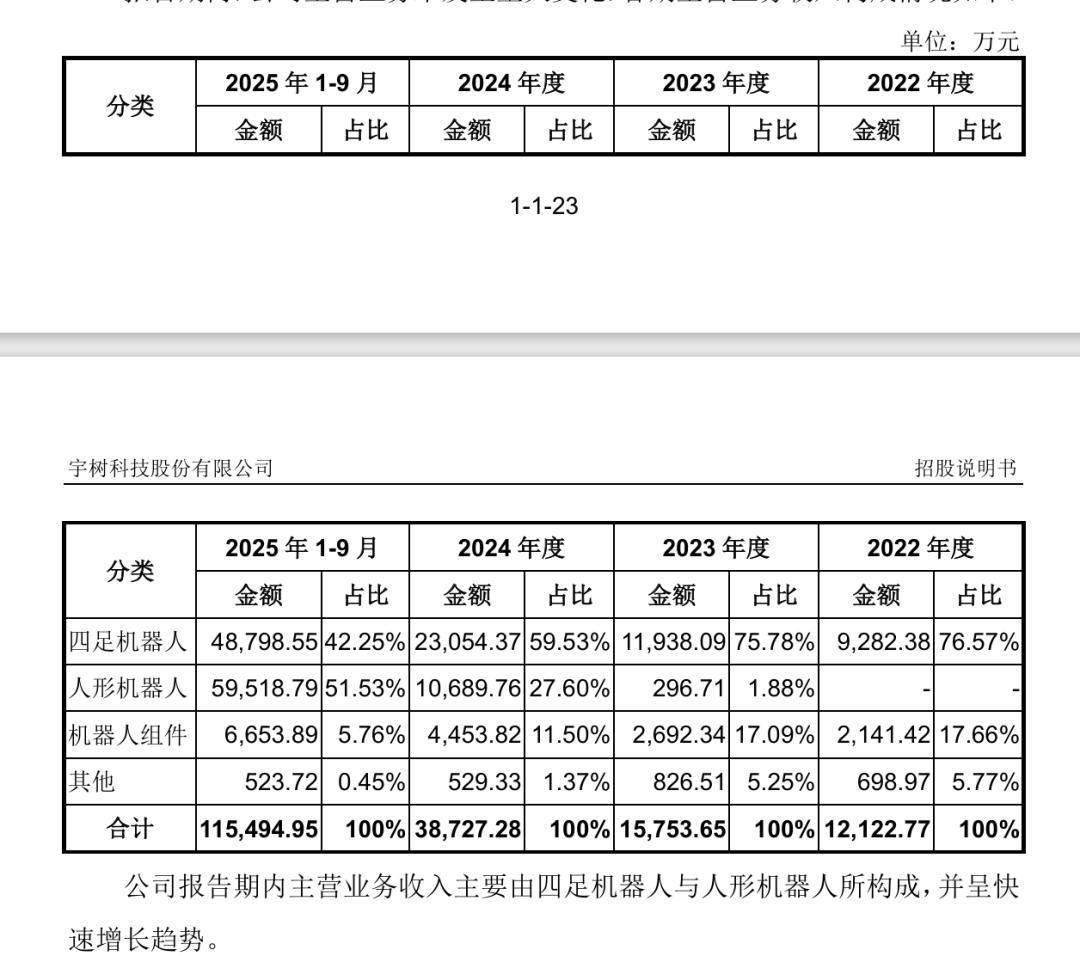
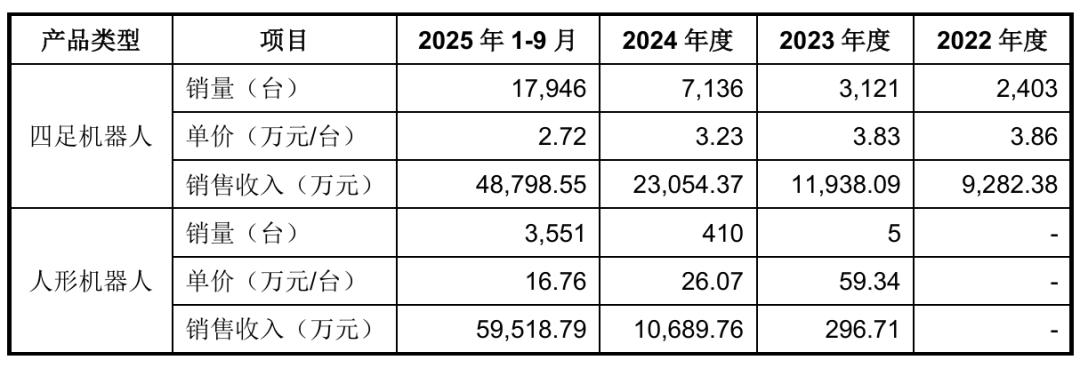
In 2022, Unitree launched the industry - grade quadruped robot B1 for industrial inspections, still aiming for profit. The consumer + industry layout attracted Matrix Partners China, Shenzhen Capital Group, etc. to invest hundreds of millions of yuan. By selling consumer and industry - grade quadruped robots and robot components, Unitree Technology achieved a revenue of 120 million yuan in 2022 (selling 2,403 units), gaining both fame and fortune.
Tips: Unitree Technology's consumer - grade quadruped robots are mainly used in scientific research, education, intelligent services and other fields. The industry - grade quadruped robots are mainly used for inspections, operations, rescues, surveys, and related scientific research and application development in vertical industries such as energy and chemical, intelligent manufacturing, fire emergency, public services, and smart cities.
After tasting success, Unitree Technology continued to make appearances and performances at the 2023 US "Super Bowl" (February 2023), the 19th Asian Games (Hangzhou, October 2023), and the 4th Asian Para Games (Hangzhou, October 2023). In 2023, Unitree took the opportunity to release the new - generation consumer - grade quadruped robot Go2, reducing the price to less than 10,000 yuan - 9,997 yuan, and launched the new - generation industry - grade quadruped robot B2. It was still the sales of quadruped robots/components in the consumer and industry sectors that enabled Unitree Technology to achieve a revenue of 157 million yuan in 2023 (selling 3,121 quadruped robots).
With a revenue of over 100 million yuan in 2022 as a foundation, and the rise of large language models (GPT - 3.5), Wang Xingxing finally had the confidence to enter the humanoid robot market. In August 2023, Unitree's first self - developed full - size humanoid robot H1 was launched (priced at 593,400 yuan per unit). Supported by the concept of AI + humanoid robots, Unitree Technology completed a financing of nearly 1 billion yuan in February 2024, led by Meituan, accelerating commercialization. In May 2024, Unitree launched its first self - developed medium - sized humanoid robot G1 (which can perform long - sequence dances, boxing, martial arts, etc. through adjustment), with the price dropping to the 100,000 - yuan level.
In 2024, Unitree's humanoid robots achieved a revenue of 107 million yuan (selling 410 units, with an average selling price of 260,000 yuan per unit). In September 2024, Unitree received investments from the Beijing Robotics Industry Fund and others at a valuation of 8 billion yuan.
Wang Xingxing saw the potential of humanoid robots and made H1 perform the Yangko dance on the 2025 CCTV Spring Festival Gala, replicating the success of the high - performance quadruped robot and becoming an instant hit. From January to September 2025, Unitree Technology's revenue from humanoid robots (H1 + G1) was 590 million yuan (selling 3,551 units, with the unit price dropping to 167,600 yuan), accounting for 51.53% of the total revenue, surpassing the 42.25% of quadruped robots. Unitree Technology said that G1 was the best - selling humanoid robot in the world from 2024 to 2025.
Source: Unitree Technology's prospectus
At the 2026 CCTV Spring Festival Gala, Unitree Technology sent G2 and H2 (launched in October 2025) to perform kung fu, indicating that they are the products Unitree wants to promote in 2026.
From 2022 to September 2025, Unitree Technology had sold over 30,000 quadruped robots. In 2025, the shipment volume of Unitree's humanoid robots (excluding bipedal wheeled humanoid forms) exceeded 5,500 units, ranking first in the world. In 2025, the shipment volumes of overseas robotics companies such as Figure and Agility Robotics were only about 150 units; except for a few domestic competitors, the shipment volumes of others were all below 1,000 units.
Source: Unitree Technology's prospectus
Vertical integration is a powerful "profit - making" weapon
In the early days of Unitree Technology's establishment, the global robotics industry chain was incomplete, forcing it to conduct independent research and development in all aspects, including joint drive (motors, reducers, drivers), energy management (high - power batteries, thermal control), overall mechanical structure (high - integration and lightweight design), and whole - body control systems.
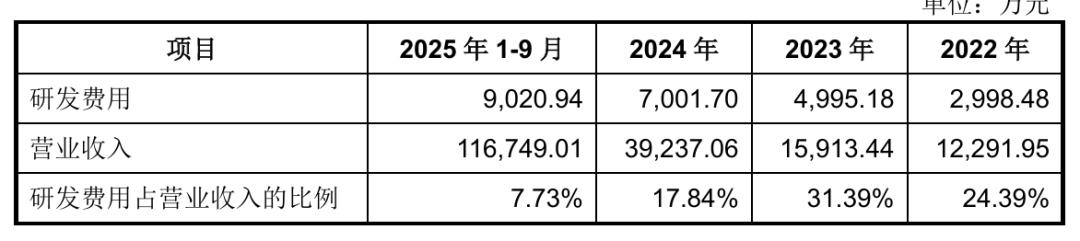
Thanks to full self - research and early technology prediction, Unitree Technology's humanoid robots and quadruped robots have achieved large - scale technology reuse and collaborative research and development in core modules such as joint drive, mechanical structure, battery management, and software algorithms. This has not only significantly reduced the repeated investment in research and development (in 2023, Unitree Technology's R & D investment accounted for as high as 31.39% of the total revenue, and it decreased to 7.73% in 2025, but the absolute value increased. The money saved is all profit), diluted the development cost of a single product, but also accelerated the process from product prototype to mass delivery. In addition, the technology verification and data feedback from multiple products and scenarios are beneficial for the iterative optimization of key technologies, forming a technology closed - loop.
Source: Unitree Technology's prospectus
When Elon Musk was building reusable rockets, he emphasized the use of mature components. Wang Xingxing, who is building robots, also emphasizes the stability and reliability of production processes and component selection. He prefers to use highly mature and stably - supplied solutions and then conducts in - depth optimization and customized development according to the needs of robots, which has the same effect.
Unitree Technology self - develops and self - produces its core components and has its own production lines, deeply controlling the supply chain. This vertical integration model may seem familiar, as BYD and Leapmotor also adopt it. This not only ensures the rapid iteration of products and technologies but also helps to launch new products in a shorter cycle according to market changes, better serve 2B customers such as scientific research and industry, respond quickly, and improve customer satisfaction.
When Unitree Technology's quadruped robots and humanoid robots are sold and produced on a large scale, it can enhance the company's bargaining power with upstream suppliers, significantly reducing material procurement and manufacturing costs. Thus, the cost - reduction flywheel starts to turn. For example, the starting price of the basic version of the G1 humanoid robot is 85,000 yuan, and the starting price of the R1 Air humanoid robot is only 29,900 yuan.
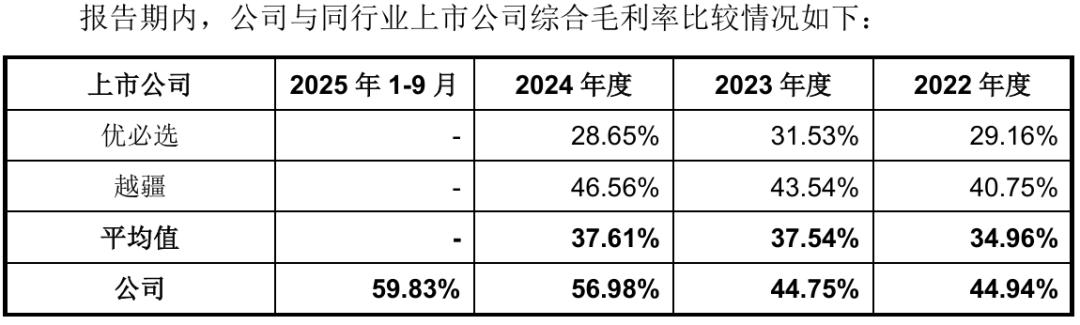
The cost advantage brought by the vertical integration model enables Unitree Technology to reduce the product price to a level lower than the market expectation (the average price of Unitree's humanoid robots decreased from 260,700 yuan in 2024 to 167,600 yuan in 2025, a decrease of 35.71%; the average price of quadruped robots decreased from 38,600 yuan in 2022 to 27,200 yuan in 2025, a decrease of 29.5%), rapidly increasing sales volume while maintaining a gross profit margin much higher than that of its peers (the gross profit margin of quadruped robots increased from 42.36% in 2022 to 55.49% in 2025; the gross profit margin of humanoid robots was 59.45% in 2025). How can the profit not be good?
Source: Unitree Technology's prospectus
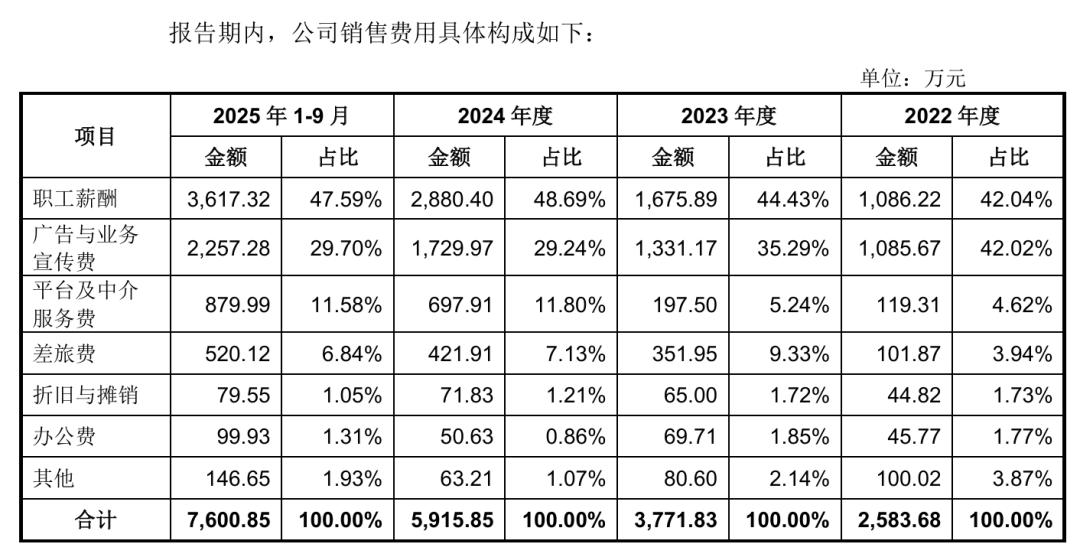
Actually, Unitree Technology also controls its personnel costs well. As of September 2025, Unitree Technology had 175 R & D personnel, accounting for 36.46% of the total number of employees, the largest proportion; sales and production personnel with lower salaries together accounted for 53.55%. The sales expenses (including sales staff salaries) only accounted for 6.51% of the total revenue (the sales expense ratio of Ubtech in 2024 reached 40.14%).
Unitree Technology, which has appeared on major stages such as the CCTV Spring Festival Gala and the Super Bowl, has lower advertising expenses than many people think. For example, Unitree Technology appeared on the CCTV Spring Festival Gala in 2025, but its advertising expenses from January to September 2025 were only 22.57 million yuan. In 2023, Unitree Technology participated in the Super Bowl and the 19th Asian Games, and its advertising expenses were only 13.31 million yuan. This is much less compared to the tens of millions or even hundreds of millions of yuan in sponsorship from several robotics companies for the 2026 CCTV Spring Festival Gala.
Source: Unitree Technology's prospectus
Thanks to Unitree Technology's multiple appearances on large - scale stages such as the CCTV Spring Festival Gala and the Super Bowl, which have brought huge advertising effects, the demand for scientific research and industry - grade robots (quadruped and humanoid) has been significantly boosted. Therefore, it adopts a production model of "production based on sales + safety stock", arranging production each month according to the sales plan and product inventory situation, minimizing inventory pressure and reducing raw material investment such as stockpiling.
Looking at the data from January to September 2025, the proportions of Unitree Technology's major costs - R & D expenses, management expenses (after excluding equity payment), and sales expenses in the total revenue were 7.73% (17.84% in 2024), 2.8% (4.23% in 2024), and 6.51% (15.08% in 2024) respectively, all showing significant year - on - year decreases. The raw materials, which account for the largest proportion of the cost, are firmly controlled by the self - research and self - production model, and their proportion in the total revenue decreased from 55.81% in 2022 to 40.55% in 2025. No wonder Unitree Technology's net profit exceeds that of Tencent.
