When AI starts to "spend money for you": How does AI reshape the efficiency of advertising and marketing?
AI is moving from the technology showcase to the main commercial battlefield. DeepSeek R1 has propelled domestic models to a new level, and OpenClaw has brought the concept of Agent into the public eye. Behind these hot topics, a deeper transformation is taking place in the advertising and marketing field: The conversion rate of AI-generated advertising materials is 20% - 30% higher than that of manually created materials, and the cost of a single piece of material has dropped to just a few cents. The "generative reinforcement learning bidding" technology has significantly improved the ROI of advertisers. When AI starts to "spend money" for advertisers and does it better than humans, the ceiling of business efficiency is being redefined.
With these questions in mind, we invited Jiang Peng, the vice president of Kuaishou Technology and the person in charge of commercialization algorithms, and Kazik, the CEO of Virtual Reality Media and the person in charge of the "Digital Life Kazik", to have a chat about how AI can improve efficiency and create profits in real business practices.
This conversation mainly focuses on the following questions:
- What was the most surprising "Aha Moment" for you in the AI field in the past year?
- Why has OpenClaw become so popular? How is it different from previous Agent products?
- Why do AI-generated advertising materials perform better than those created by humans?
- How does the "generative reinforcement learning bidding" help advertisers spend less money and earn more returns?
- How should advertisers respond in the context of the fierce competition in the AI market?
- How big is the commercial impact of AI on the content creation industry? Can AI comic dramas really make money?
- Where is the next step for AI commercialization? What are the certain trends in 2026?
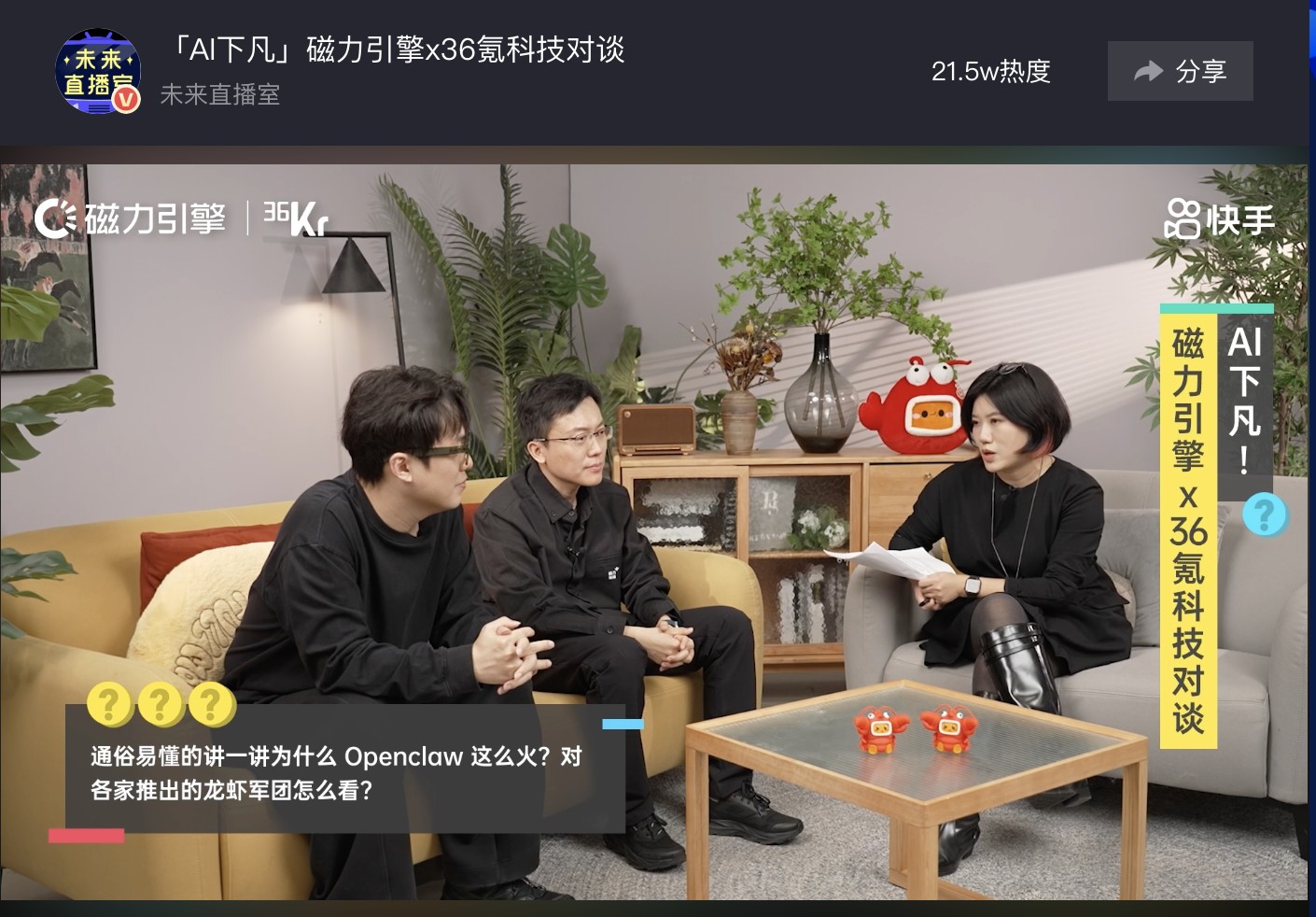
The following is the conversation between the guests, with some content organized and edited:
36Kr: What was the most surprising "Aha Moment" for you in the AI field in the past year?
Kazik: Although DeepSeek R1 has been widely discussed, it is still a key milestone. Every Spring Festival, there are new releases in the AI industry. Last year, DeepSeek R1 really showed the industry the rapid progress of domestic models - it turns out that domestic models can also reach the level of OpenAI o1 in terms of capabilities, and the cost has been significantly reduced. Its popularity has sparked discussions across the country.
The second key milestone is Nano Banana. As a designer, this product has completely changed the complex workflow of using ComfyUI and Stable Diffusion in the past. Overnight, 80% of the many nodes I built in the past have lost their value. Now, with just one sentence, most needs such as photo editing, background changing, and ID photo processing can be completed. Its core advantage lies in its excellent consistency.
The third is OpenClaw. Although Claude Code has been a heavily used tool before, the popularity of OpenClaw really exceeded expectations and was quite a pleasant surprise.
Jiang Peng: I was deeply impressed in three aspects. First, AI has deeply transformed the content industry - the content production ability of AI has recently experienced a leap forward, which has had a profound impact on the entire content ecosystem.
Second, in 2026, Agent will become the main line of AI industry implementation. From "answering questions" to "completing tasks", the application space of AI will be greatly expanded, realizing the transformation from "providing information" to "being able to do work".
Third, the attention to AI commercialization has increased. A colleague in Silicon Valley created a digital colleague through Agent to assist with work, but found that the cost of Token consumption exceeded his own salary, so he had to reduce the number of "digital colleagues". This shows that the industry is paying more and more attention to the cost and monetization of AI.
36Kr: Why has OpenClaw become so popular? How is it different from previous Agent products?
Kazik: From the perspective of the communication path, OpenClaw is highly similar to DeepSeek R1 - not in terms of the technical route, but in the path of emotional communication and cognitive leap.
Technology never grows linearly in the public's perception, but in a step - by - step manner. For most people, there are only three stages of AI perception: ChatGPT made them first realize that "AI can have conversations", DeepSeek R1 made them first realize that "AI can think", and OpenClaw made ordinary users first understand what "Agent" is.
Although Manus has attracted attention in the technology and financial circles, it has not yet entered the general public. OpenClaw has elevated the public's perception from the "inferable dialogue model" to the "Agent" level, which is the essential reason for its popularity - technology communication has always been step - by - step rather than curve - based.
Another difference lies in the product form. Previously, both Manus and Claude Code were cloud - based services, and users' perception was like "renting a house"; although the model of OpenClaw is still in the cloud, users can "raise" it in their own dialogue system and have exclusive memories. This psychology of "Chinese people prefer to buy a house rather than rent" deeply meets the public's need for a sense of ownership.
Jiang Peng: I agree with the above analysis. OpenClaw allows ordinary users to truly use and experience Agent for the first time, and feel the value of "artificial intelligence solving practical problems", which is of positive significance for promoting the public's understanding of AI.
From a technical perspective, OpenClaw is basically consistent with the Agent technology system in the past two years. Its unique value lies in enabling ordinary users to deploy AI locally to solve daily problems. We look forward to the emergence of new applications, new industries, and the monetization space brought by Agent after this wave of popularity.
36Kr: Why do AI-generated advertising materials perform better than those created by humans?
Jiang Peng: Material production is one of the fields most thoroughly transformed by AI in the past two years. On the Kuaishou platform, the cost of a single piece of material has dropped to just a few cents, saving a large amount of advertising costs for customers. More importantly, the effect - the quality of AI - generated materials in advertising placement is better than that of self - made materials by customers, and the overall conversion rate has increased by 20% - 30%. During several major promotion periods, the AI - generated materials customized for key customers have shown very outstanding performance in terms of volume.
What's more noteworthy is the user experience. AI - generated materials not only have a high conversion rate, but also provide a better viewing experience and feedback from users than traditional materials, and the marketing feeling is not too strong. The reason is that AI has access to the user feedback data of the entire platform, can identify which materials are more popular among users, and continuously optimize based on the model algorithm. The output effect is bound to be better than the self - made content of customers.
In terms of material strategies, there is no universal "one - size - fits - all approach". The platform adopts a "personalized" strategy, customizing materials and placement plans according to the characteristics of different products and user features. Even for competitors in the same category, a differentiated strategy is always the best choice - it is impossible for two companies to be exactly the same, and personalized placement is always better than homogeneous competition.
Actually, we've been doing a very simple thing: making AI the infrastructure for business growth.
Kazik: In the field of video production, even if the cost of AI increases tenfold, it is still negligible compared with traditional production. Take TVC (television advertising) as an example. The cost of traditional production can reach 100,000 or even two or three hundred thousand yuan per minute, while the cost of AI production can be achieved at about 10,000 - 20,000 yuan per minute. For current TVC works in the AI field, even for high - end customizations, the maximum cost is about 100,000 yuan; while for high - end traditional TVC works, it can reach 1 million yuan per minute. The two are not in the same order of magnitude at all.
Both the labor cost and time cost of AI content production have decreased exponentially - work that originally took several months can now be completed in days. If investing a certain amount of cost in using top - level models can significantly improve the effect, choosing AI is an inevitable trend.
36Kr: How does the "generative reinforcement learning bidding" help advertisers spend less money and earn more returns?
Jiang Peng: Advertising placement is essentially a sequential decision - making problem - the market environment is highly uncertain, and each operation step will affect the subsequent results. The goal is to maximize the overall process revenue rather than optimize a single point.
The "generative reinforcement learning bidding" technology mentioned by Kuaishou in its financial report is an industry - first, which solves two core problems: First, the generative model solves the problem of environmental uncertainty - at the same time, a large number of users and customers are placing ads on the platform, the traffic fluctuates greatly, and the system is highly uncertain. The generative model is naturally suitable for such scenarios. Second, reinforcement learning solves the sequential decision - making problem, aiming to maximize the overall process revenue.
This technology has increased advertising revenue by 3% - 4%, and the volume - running ability of some customers has increased by 20% - 30%. The ROI performance is better - it's equivalent to spending less money and achieving better results. Advertisers have very strict ROI assessments, so whether the platform can make customers' money more valuable is very obvious to customers.
Currently, the automation level of the entire advertising placement process has reached about 90%. Customers only need to set the ROI target and the products to be advertised, and the platform can automatically complete the entire process, including material generation, infrastructure construction, and intelligent bidding.
Kazik: There is an essential difference between quantitative advertising and quantitative trading. The advertising platform has a global perspective and aims to maximize the interests of all customers, which is a "common prosperity" rather than a zero - sum game. Therefore, human participation can be gradually reduced.
However, quantitative trading is a game between players. You may obtain excess returns at a certain stage, but your strategy will be imitated and sniped. When the excess return drops from 10% to a negative value, you must immediately stop using it and iterate again. This process requires people to make the final decision based on market dynamics and the difficult - to - quantify "human factor" - data such as industrial chain factors and insider information are not exposed on the public network and cannot be uniformly attributed by quantitative strategies.
36Kr: How should advertisers respond in the context of the fierce competition in the AI market?
Jiang Peng: From the platform's perspective, in the past year, a large amount of advertising investment has been made in AI tool - related ads. Sponsoring the Spring Festival Gala, subsidy wars, and giving out red envelopes - various companies have been very active. When their user scale grows to a certain level, all major companies will feel threatened, and it's hard to say that this war is completely unnecessary.
However, customers' focus is changing significantly. In the past, they paid more attention to the volume - running ability, but now they are increasingly emphasizing user quality and retention. The core essence is the ROI assessment: customers focus on the input - output ratio after advertising AI tools, rather than just the user growth figures. This is also the most concentrated demand in customers' feedback.
It is expected that the competition in the AI tool market will continue in the future, but participants will pay more attention to input - output efficiency. Ultimately, we hope that users can really use AI tools, rather than "grabbing the benefits and leaving". This places higher requirements on the product capabilities of each AI tool - whether it can meet users' needs and retain users is the key to winning this war.
Kazik: From a communication perspective, the essence of the Spring Festival AI war is the same as the explosion logic of DeepSeek R1 and OpenClaw - they are all competing for the "steps" of public perception. Every Spring Festival war is an opportunity for each company to occupy the next cognitive position in the minds of ordinary users.
However, the problem is that the public's cognitive leap in AI is step - by - step and cannot be promoted simply by investing a large amount of money. ChatGPT occupies the perception of "AI can have conversations", DeepSeek R1 occupies the perception of "AI can think", and OpenClaw occupies the perception of "Agent". If the product itself does not bring a cognitive leap, simple subsidies and advertising cannot form long - lasting user stickiness.
36Kr: How big is the commercial impact of AI on the content creation industry? Can AI comic dramas really make money?
Jiang Peng: In the production of AI comic dramas, only the story framework needs to be determined, and a large amount of subsequent work can be completed by AI. The production cycle has been shortened from several months to a few days, and the cost per minute is about 1,000 - 2,000 yuan, which has been significantly reduced. The low cost has led to the emergence of a large amount of content. Customers look for hit works through mass production, and a single hit can recover all the costs, forming a "infinitely replicable" business model.
However, this model also has bottlenecks: user aesthetic fatigue and content homogenization will restrict the effect, and the production process needs to be continuously adjusted and iterated. Most of the novels generated by AI are formulaic "feel - good stories", which conform to the public's taste but lack breakthroughs - the ability to explore the "divine move" is still a high - level challenge for AI.
Kazik: AI has significantly expanded the boundaries of personal capabilities. Human capabilities include breadth and depth. Although AI may not necessarily expand depth, it has a significant effect on breadth. Take development as an example. In the past, back - end engineers could not independently complete front - end work, but with the help of tools such as Claude 4.6 and Gemini 3.1, aesthetic and animation requirements can be met. Product managers do not need to wait for scheduling and can iterate quickly on their own.
However, the core of content creation is never technology or special effects, but the story core. The output of AI often shows an average - level characteristic. Currently, AI can cover all content below 60 points, forming a range of 60 - 90 points. The space for human creators within this range has been significantly compressed. However, the real goal of humans is to create top - level content of 90 - 100 points. How to break through the upper limit still requires a flash of inspiration or a stroke of genius from humans. AI can efficiently complete average - level content, but such works can only obtain basic returns and are difficult to become the "shining stars".
Comic dramas belong to the category of short dramas, but the concentration effect at the top is more extreme than that of traditional short dramas - it has changed from "one hit out of a hundred" to "one hit out of ten thousand". AI comic dramas need to distinguish between "high - quality comic dramas" and ordinary AI comic dramas. The former makes a profit through the revenue - sharing model, while the latter currently mainly relies on platform subsidies.
36Kr: Where is the next step for AI commercialization? What are the certain trends in 2026?
Jiang Peng: From the perspective of the platform and advertising marketing, the certain trend is the in - depth integration of "AIGC + generative recommendation + generative bidding" with the Agent model.
The past year was the first year of "generative recommendation" and "recommendation model scaling". Kuaishou has done a lot of work in recommendation and distribution, mainly solving three problems: First, the representation problem - how to effectively represent multi - modal content such as videos, texts, and marketing elements; Second, the learning paradigm - end - to - end learning, allowing user feedback to directly affect the full - link recommendation effect; Third, model performance - the search, advertising, and recommendation scenarios have extremely high requirements for concurrency and single - request cost, which requires targeted reasoning optimization, including changing the serial structure to parallel to significantly improve efficiency.
The AI capabilities directly bring a 4% - 5% increase in revenue every quarter. In the context of the slowdown in Internet growth, a cumulative double - digit growth in a year is very impressive.
The future direction is: Once advertisers express their advertising intentions, an Agent will replace all processes - from material generation, infrastructure construction to intelligent bidding, all will be completed automatically. This form has already emerged and will become more and more intelligent in the future.
Kazik: In 2026, the main track in the AI field can be summarized by a couplet: Coding on the left, video on the right, and Agent as the horizontal scroll. Agent is the