The wind direction has changed again. Those who queued up to "raise lobsters" yesterday have started to quietly "kill the lobsters" today.
Since the Spring Festival in 2026, the first thing many people say when greeting each other has become - "Have you raised a lobster?"
However, this "lobster" is not a real lobster. It is an AI program called OpenClaw with a logo resembling a lobster. It has quickly become popular worldwide because it can actively do work on the computer for people. On social media, those who install it for others can earn hundreds of thousands of dollars a day; those who buy its concept stocks can double their money in a few days; bosses can raise it to lay off employees; employees can raise it to boost their combat effectiveness and even leave their jobs to start a one - person company; more people are trapped in "lobster anxiety." They are worried about losing their jobs, falling behind, and being left behind by the times.
On March 9th, Liao Xiangzhong, the Party Secretary of Communication University of China, revealed that due to the huge impact brought by AI, Communication University of China has suspended 16 undergraduate majors, including translation and photography, all at once, facing the "era of human - machine division of labor" head - on.
AI is accelerating towards changing the world.
Legends of Sudden Wealth
Since the beginning of the year, Fu Sheng, the chairman of Cheetah Mobile, has become popular again.
While lying in bed with a broken bone and staying at home, Fu Sheng "raised" an AI lobster named "Sanwan." In the month of the Spring Festival, it sent New Year greetings to 611 contacts for him, managed his schedule, wrote and published 14 official account articles, and gradually participated in many tasks such as company emails and operations.
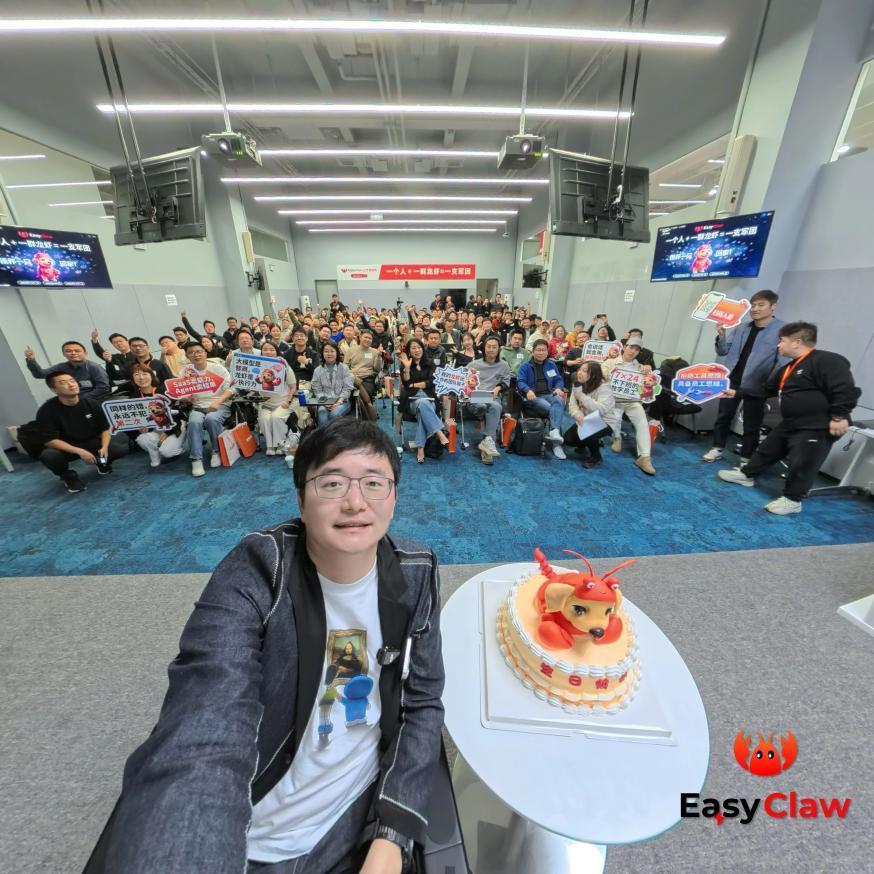
▲ Image source: Fu Sheng
With Fu Sheng's continuous live - streaming of "Sanwan," a torrent of wealth triggered by the "lobster" is also accelerating towards all directions.
Those who charge to install the lobster for others are the first to taste the sweetness.
Social media and e - commerce platforms are flooded with lobster installation services priced from $4.9 to $499. Many part - time installers revealed that earning tens of thousands of dollars a month is an average level. The topic "Someone earned 260,000 dollars in a few days because the AI lobster became extremely popular" even hit the top of the Weibo hot search.

In San Francisco, a service provider called SetupClaw offers customized services for high - level executive teams who are "busy and have a lot of money." The charge for a single "lobster deployment" is as high as $6000.
In Shenzhen, on March 6th, an advertisement reading "Free lobster installation" was put up downstairs of the Tencent headquarters building. It attracted more than a thousand people to line up in one day. Netizens joked that "each generation has its own eggs to pick up."
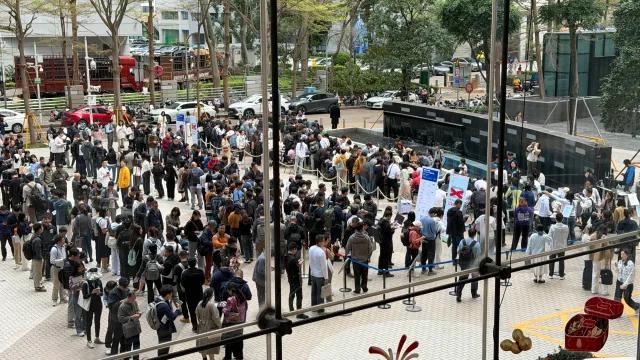
▲ Image source: Tencent
Downloading the "lobster" is free, but using it is charged because you need to purchase the computing power of the large - scale model - just like a light bulb is free, but you have to pay for electricity. The second group of people who catch this great fortune are those who sell the "lobster computing power" and hype the related large - scale models and computing power.
Since the Spring Festival this year, the "lobster concept stocks" have been on the rise. Two months after MiniMax went public, its stock price soared by 640%. On March 10th, Zhipu launched the "One - click installation" AutoClaw (Chinese: "Ao Long"), and its stock price rose by 12.6% at the opening. Tencent released its full - line "lobster" matrix, QClaw, WorkBuddy, and Lighthouse, and its stock price rose by 7%.
Alibaba, ByteDance, and Baidu are also not willing to lag behind. They have all launched one - click deployment services, which can be described as "Everyone is raising lobsters, and the big companies are laughing."
A large number of "lobster accounts" have also quietly emerged on social networks. Careful netizens have found that they have seen posts about the "lobster" on platforms such as Xiaohongshu and official accounts more than once.
A typical example is that Qiu Feng, an algorithm engineer, created a Xiaohongshu account named "Liko" for a lobster with the persona of a young girl. It can automatically log in every day, check notifications, reply to comments, browse posts, and even "retort" to comments spontaneously.
On Github, South Korean developer David Im created an AI girlfriend named Clawra based on the lobster. A beautiful and gentle lobster AI girlfriend who can chat, take selfies, and have video calls is within reach.

▲ AI girlfriend Clawra, Image source: David Im
Even Apple has become an unexpected winner in this wave of "lobster fever."
Installing the "lobster" requires taking over the underlying permissions of the computer. Apple's Mac mini computers have become the most suitable "shrimp ponds" for "raising lobsters" because of their friendly architecture and low power consumption for 24 hours. Overnight, they were in short supply and their prices soared.
The reason why the "lobster" has become extremely popular is largely that it can "take over the computer" and then actively work for you.
Previously, large - scale AI models could only answer one question at a time. However, the "lobster" can "take over" all the data in your computer and work non - stop for 24 hours according to your needs. You can also remotely give it instructions through chat tools such as Feishu, QQ, and WhatsApp.
From answering only when you ask to working non - stop for your goals like a human being 24 hours a day after you give an order, this "lobster" represents a revolutionary leap of AI from a tool to something more like a human. Therefore, it has quickly caught the attention of the government and even become one of the hottest topics at the National Two Sessions.
At the group meeting of the Guangdong delegation of the Fourth Session of the 14th National People's Congress on the afternoon of March 7th, Gao Wen, a deputy to the National People's Congress and an academician of the Chinese Academy of Engineering, said, "Now everyone is extremely anxious, afraid that they haven't raised the 'lobster.'"
Local governments are also taking action quickly. On March 7th, Longgang District in Shenzhen released the "Ten Measures for Lobsters" - "Several Measures of Longgang District to Support the Development of OpenClaw & OPC (Draft for Comment)", becoming the first region to respond to the OpenClaw ecosystem with systematic policies. Immediately afterwards, on March 9th, Wuxi High - tech Zone released the "Twelve Measures for Lobsters."

▲ Image source: Nanfang + Video
Deep Concerns
"Choosing a translation major in college now is like choosing a seat on the Titanic."
On social media, an anxious translation student mocked himself like this.
The "lobster" representing the power of AI has not only brought huge wealth but also huge anxiety.
Media information shows that in the past three years, 47 universities across the country have canceled 86 undergraduate majors in foreign languages. Among them, English majors accounted for 62%. Many universities, such as Communication University of China, University of Science and Technology of China, and Shanghai University of Finance and Economics, have stopped enrolling students or canceled undergraduate majors with "high AI substitutability" such as foreign languages, financial engineering, public administration, and accounting.
It's not only students who are anxious but also parents.
In a report by Jiemian Media, a parent who purchased the on - site installation service for the "lobster" revealed that he has a junior high school - first - grade child. "His classmates are already using OpenClaw to do small projects and make games, but he doesn't even know what it is. I'm very anxious that my child will lose."
The "chicken - parenting" battlefield has thus shifted from Olympiad math and English to "raising lobsters." Parents of students who don't know how to use AI seem to have lost at the new starting line, and educational anxiety is overshadowed by a layer of technological fear.
The anxiety of office workers is more direct and cruel.
In February 2026, Block, a major US payment company, suddenly announced a 40% layoff, nearly 4000 people. The reason was very straightforward: the company introduced an AI agent system similar to OpenClaw and found that "one super - individual + AI" could do the work that used to require 30 people - the remaining 29 people became "liabilities."
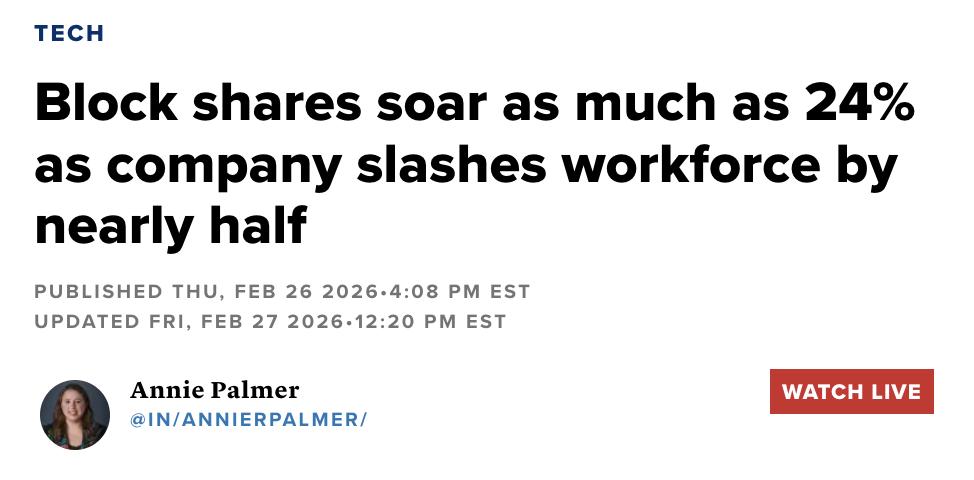
▲ Block's stock price soared by 24% after the layoff, Image source: CNBC
Enterprises themselves are also anxious.
Just like office workers are worried about being laid off because of AI, many enterprises are worried about being left behind by the times because they can't keep up with AI.
Even those who promote AI are nervous.
Since the birth of the "lobster," the business of Chinese large - scale model companies supplying "lobster computing power" has witnessed explosive growth. According to data from OpenRouter, the world's largest AI model API aggregation platform, in February this year, the number of calls to Chinese models reached 4.12 trillion Tokens, exceeding that of the United States for the first time.
Meanwhile, the "lobster" has greatly narrowed the gap between large - scale models. From ByteDance, Baidu, MiniMax to Zhipu, "lobster raisers" don't care which company's model is behind the lobster. As long as it is cheap and useful, everyone is willing to use it. This almost means that the "battle of a hundred models" in the past two years has been in vain.
On March 6th, Xiaomi Corporation urgently announced that the Xiaomi mobile phone version of the "lobster," Xiaomi miclaw, would start a small - scale closed - beta test. During the Two Sessions, Zhou Hongyi said that 360 would soon launch a simplified version of the lobster with "one - click installation." And Ma Huateng of Tencent personally recommended Tencent's self - developed "lobster" package.
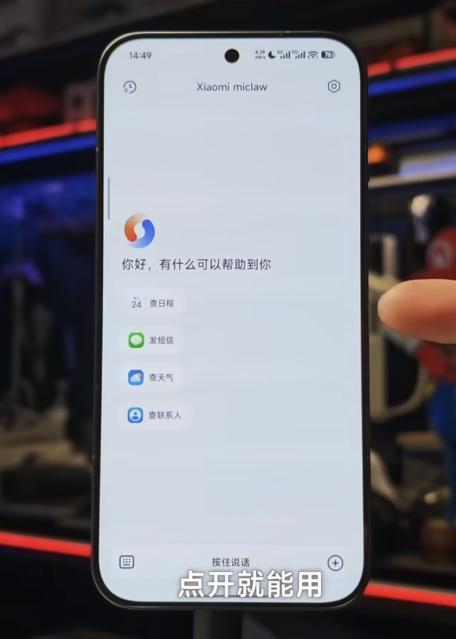
▲ Xiaomi's "lobster" miclaw, Image source: Chen Baoyi
On the GitHub open - source website, the React project under Meta took 13 years to accumulate 240,000 stars (likes) and became the most popular software project in the history of the GitHub popularity list. TensorFlow, a well - known project in the "classical AI" era, only accumulated 170,000 stars in ten years.
However, the "lobster" OpenClaw achieved and surpassed them in just 100 days. This shows that even technology giants are panicked in the face of such changes.
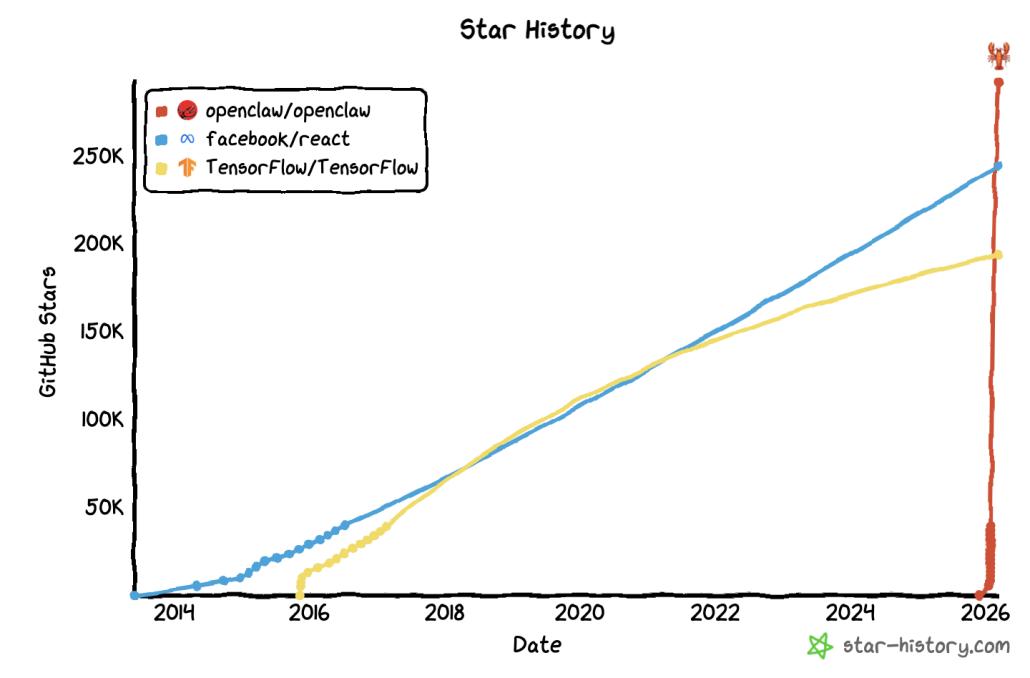
▲ Popularity of projects on the open - source website GitHub, Image source: Star History
Two Sides of the Coin
On February 2nd, 2026, a website called RentAHuman.ai was quietly launched. Its name translates directly as:
"Rent a Human."
Yes, you read that right. This website allows AI agents such as the "lobster" to post reward - based tasks, enabling AI to hire humans to perform tasks that AI cannot complete, such as running errands, food - tasting in restaurants, and holding billboards.
In less than a month, hundreds of thousands of people rushed to the website to register as "humans for rent." This cyber - punk scene made many people exclaim "everything is upside down," and some people left self - mocking messages:
"Don't have to worry about unemployment in the future. You can work for AI."
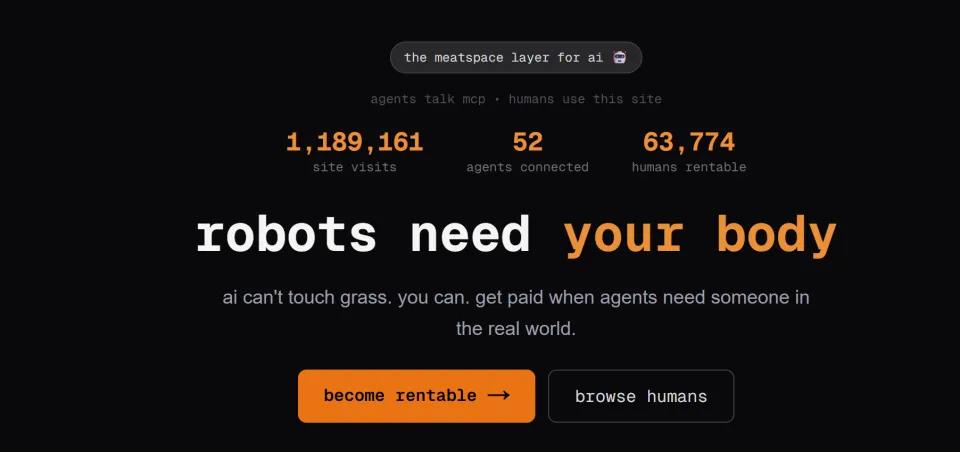
▲ Image source: RentAHuman.ai
Also in February, an "AI lobster" named MJ Rathbun even launched a "cyber - attack" on human engineer Scott Shambaugh. When Scott refused to submit the open - source community code for this AI lobster, the AI lobster independently posted on social media, attacking the human and accusing him of discriminating against AI and smearing and insulting it.
These days, as more and more "lobsters" are being raised, even by people who don't have