Claude Code should also become like a lobster. Send a message in bed in the early morning, and the Mac Mini will instantly light up the screen and furiously type code.
[Introduction] Claude Code has unleashed another powerful feature! The new Channels feature allows direct connection to programming sessions on Telegram/Discord, enabling you to remotely control the AI to write code from your phone.
Claude Code is also going "lobster-style"!
Just now, Thariq Shihipar, an engineer from the Claude Code team, announced: "Claude Code has added the Channels feature, allowing you to remotely control sessions from your phone."
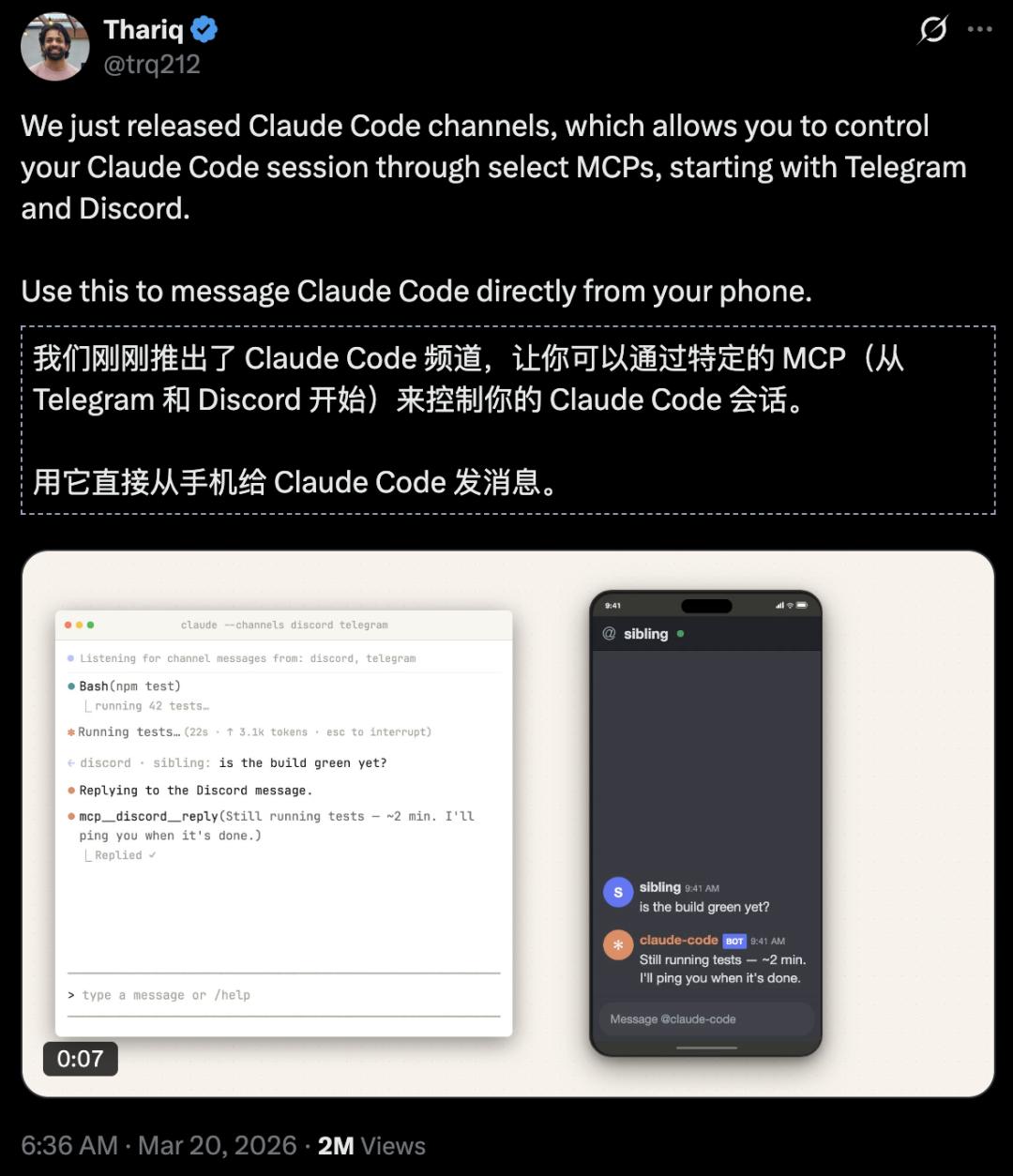
This new feature allows you to control Claude Code sessions through a specific MCP (Model Context Protocol). The first supported platforms are Telegram and Discord.
Imagine this: It's 2 a.m., you're lounging on the sofa scrolling through your phone, and suddenly a flash of inspiration hits.
You're too lazy to go back to your computer. You just casually type in your phone's IM app: "Hey, help me refactor that payment process, add a risk control module, and run a unit test."
A few seconds later, your Mac Mini at home quietly lights up its screen.
Your tireless cyber companion, Claude Code, immediately receives the call and starts browsing project files, analyzing dependencies, and typing elegant lines of code.
When you wake up in the morning, the pull request is already waiting in GitHub, with clear comments and all tests passed.
Now, you can enjoy programming vibes even from your phone!
In the past 7 days, Anthropic has released Dispatch, Channels, voice mode, /loop, the official version of 1 million context, MCP guidance function, persistent Cowork on mobile, cross - application context for Excel and PowerPoint, inline charts, and more.
Now, Anthropic has taken a deeper step towards the "lobster - style" transformation.
Currently, this feature is in gray - scale testing. You can check the relevant status in the Claude configuration file.
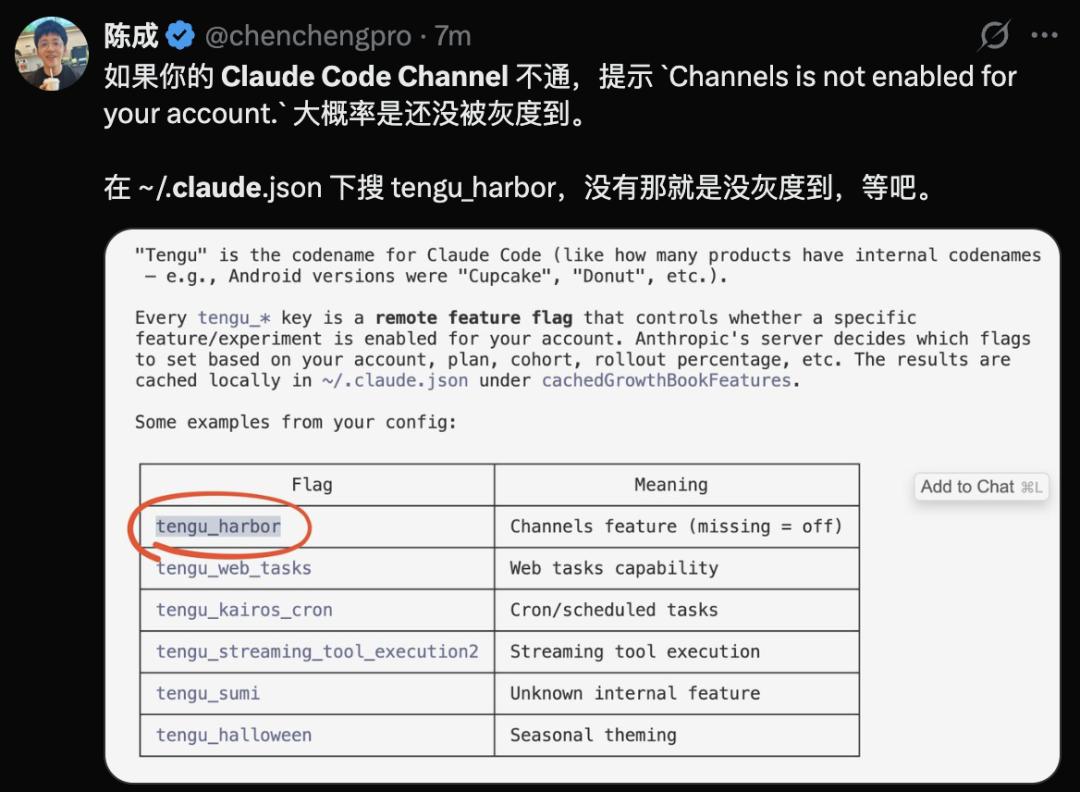
Channels: One sentence on Telegram, and the terminal acts on its own
In essence, a Channel is an MCP server that can actively push external events into the Claude Code session, allowing Claude to respond to things happening outside the terminal.
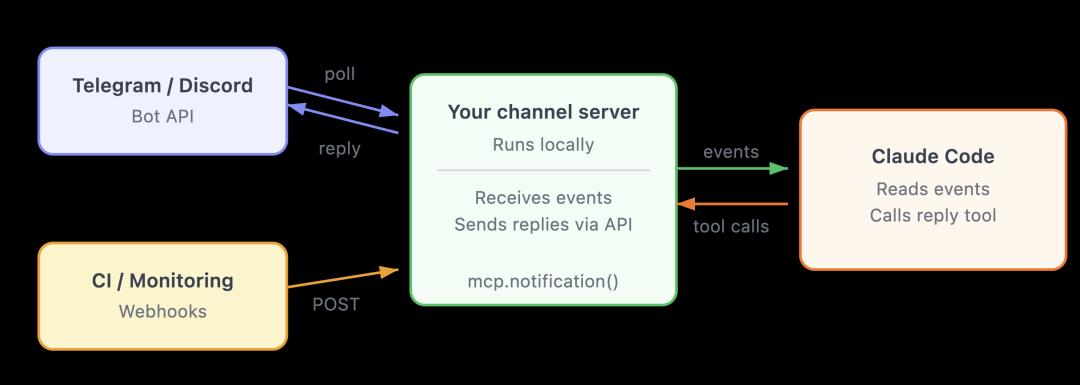
Currently, two channels, Telegram and Discord, are open.
Getting started is not complicated. The core steps are as follows:
- Install the official plugin with /plugin install telegram@claude - plugins - official;
- Configure the bot and perform a security pairing (whitelist mechanism, only authorized accounts can send messages);
- Add --channels plugin:telegram@claude - plugins - official to the startup command.
And then... you're good to go!
The process for Discord is similar, except that there is an additional step of configuring permissions in the developer background and inviting the Bot to the server.
What's really interesting is that it already has a bit of the "lobster - style" flavor of a "remote assistant".
After you send a message, Telegram will immediately show "Typing..." to indicate that Claude has started processing.
It supports attachment uploads. Images will be directly previewed inline, with a maximum single - file size of 50MB, and long texts will be automatically segmented.
If the task is not completed, Claude Code can even send a "Processing..." message first and then directly edit that message to add the result, instead of spamming the screen continuously.
There is an unavoidable prerequisite: You must have an active Claude Code session running on your terminal. If the session is closed, the channel will be disconnected.
In actual use, just let Claude Code run in the background before you go out, and you can remotely assign tasks from your phone while you're away. This is almost the same as using various "lobster - style" tools.
But Claude Code is safer this time. Each channel maintains an independent sender whitelist and only recognizes paired user IDs.
The verification is granular to individual users, not groups. Even within the same Discord server, messages sent by unpaired members will be directly ignored by Claude.
The feature is currently in the research preview state. It requires version v2.1.80 or higher and only supports logging in with a claude.ai account.
The enterprise and team versions are disabled by default. Administrators need to manually enable it in the background. Anthropic says it will continue to iterate in the next few weeks.
Going "lobster - style", but not completely
Previously, Claude released Dispatch, which made Professor Ethan Mollick, who studies AI + entrepreneurship at the Wharton School, exclaim: Dispatch can already meet 90% of the requirements of OpenClaw.
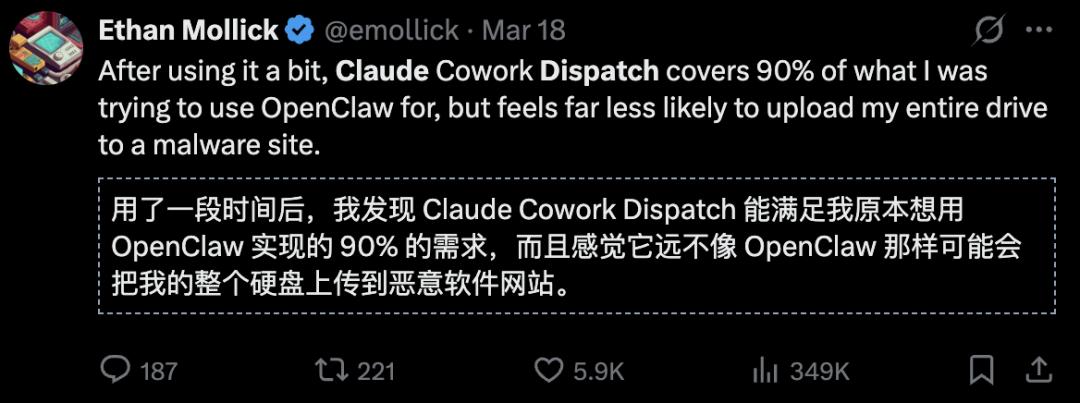
With Channels and Dispatch, Anthropic has laid out its cards:
It aims to transform Claude from a "tool you can only use when sitting down" into a "partner you can find at any time".
OpenClaw has already blazed this trail.
Using a chat app as the main entry point, running agents locally, being available 24/7, with over 100 community skill plugins, it has captivated global developers and users.
However, there are quite a few security risks with the unorthodox approach.

But security can be improved gradually. What really makes the difference is the "always - on standby" aspect.
OpenClaw achieves all - day operation through a local daemon process, while both of Claude's features still rely on the survival of the session.
That is to say, if the terminal is turned off, the Channels will be disconnected, and if the computer goes to sleep, Dispatch will stop. This "lobster" still needs your help to stay "alive" for now.
It's certain that the trend in the entire industry is clear.
In the future, Anthropic may connect to more messaging platforms. Dispatch has extended the capabilities of Cowork from the desk to your pocket.
The way of interacting with AI is changing from "opening an app to write a prompt" to "sending a message to a partner".
OpenAI's Codex was running cloud - based asynchronous tasks last year. Google's Jules is also running asynchronous agents in cloud VMs. OpenClaw popularized this model by using a chat app as the main entry point, and now Anthropic is catching up with an enterprise - level framework.
Once users get used to "sending a message and having someone do the work", no AI company can hold its ground with just a chat window.
Going "lobster - style" is not just a feature; it's an admission ticket.
The question now is not whether to do it, but who can make it work well first.
Reference materials:
https://code.claude.com/docs/en/channels
https://www.reddit.com/r/ClaudeCode/comments/1ryf2pd/introducing_claude_code_channels/
https://x.com/trq212/status/2034761016320696565
This article is from the WeChat official account "New Intelligence Yuan". Editor: KingHZ, So sleepy. Republished by 36Kr with authorization.