10x acceleration of the chemical reasoning large model. The Haven team contemplates molecular formulas in the latent space, outperforming the explicit CoT.
AI may not always rely on "writing out the steps" for scientific reasoning.
In the past few years, once large models enter the "reasoning mode", they almost always follow the same route:
First, output a long chain of thoughts, and then give the final answer.
This method is common and effective in math problems, coding problems, and complex Q&A. However, in the chemical scenario, it may not be the most convenient way.

LatentChem, newly proposed by Ye Xinwu, Tang Xiangru from the Haven team, in collaboration with Cong Le from Stanford University and Wang Mengdi from Princeton University, aims to achieve one thing:
Move chemical reasoning from the "text surface" to the "inside of the model".
The model doesn't have to translate every step into words. It can also complete multiple steps of calculations in the continuous latent space first and then output natural language.
This is not "canceling reasoning", but changing the medium of reasoning.
Why is it not good enough to describe chemistry with words?
Most people who have done molecular optimization, molecular editing, and reaction prediction have probably encountered this situation:
The model can write very systematically at the beginning.
It can talk very professionally about electronic effects, steric hindrance, functional groups, and reaction sites.
However, in the end, the generated SMILES or molecular structures don't match the previous analysis.
It seems to be thinking seriously, but often "says one thing and does another".
The explanation given in the LatentChem paper is straightforward:
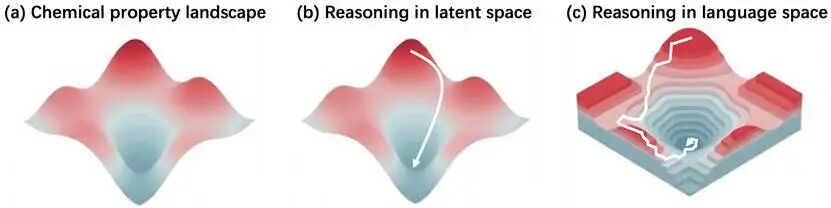
Chemical reasoning itself is more like searching, adjusting, and updating in a continuous and structured space;
While natural language tokens are essentially discrete.
When the model is required to break down the processes that are more suitable to be completed in continuous representation into natural language sentences, the core problem proposed in the paper arises:
continuity–discretization gap
Simply put, the chemical reasoning that should be smoothly completed in the continuous space is forcibly divided into text steps.
This is not only slow but also prone to disconnect the "reasoning description" from the "final result".
What is LatentChem doing?
The core idea of LatentChem can be summarized in one sentence:
Think in the latent space first, and then answer in the language space.
It doesn't simply remove CoT but redesigns the location where chemical reasoning occurs.
The whole system can be roughly understood in four steps:
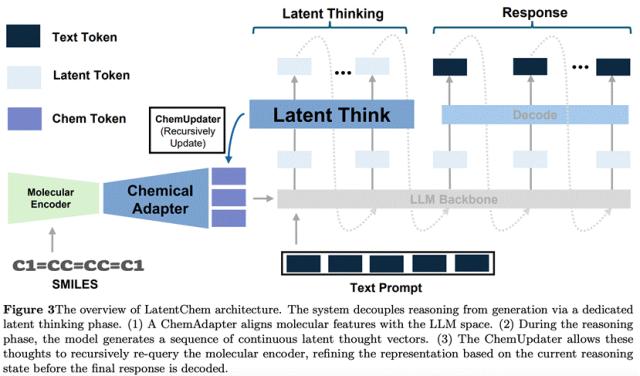
1. First, transform molecular information into "soft prompts" that the model can use
LatentChem first extracts the structural representation through a molecular encoder and then compresses it into a fixed number of ChemTokens.
These ChemTokens will be sent into the model together with text instructions, which is equivalent to giving the molecular context to the model first.
2. The real intermediate reasoning is no longer mainly completed by words
Different from the traditional CoT that generates text step by step, LatentChem will generate a series of latent thought vectors in the latent space.
These vectors are not "thought processes explained to humans", but the real intermediate states used by the model to advance reasoning.
3. During the reasoning process, the model can constantly "look back at the molecule"
This is a very crucial point of LatentChem.
It doesn't start reasoning in isolation after reading the molecule once. Instead, through a module called ChemUpdater, each step of latent thought can act on the ChemTokens again.
In other words, the model can constantly look back at the molecular representation during the reasoning process and dynamically focus on different key information.
4. Map the internal state back to the input for the next round of reasoning
Through the Latent Projector, the model can map the current latent state back to the input space for further iteration, forming a closed - loop of multi - step continuous updates.
In a nutshell:
LatentChem separates "reasoning" from "expression".
Reasoning is completed internally first, and then output based on language.
What's more interesting is that the model is not forced to "stop writing CoT", but gradually stops writing it on its own
One of the most interesting observations in this paper occurred during the reinforcement learning phase.
When the authors used GRPO for training,
The reward doesn't care whether the model writes a beautiful chain of thoughts or how complete the explanation process is. It only looks at the results:
- Is the output format correct?
- Is the answer valid?
- How accurate is the final result?
As a result, a very representative phenomenon occurred:
The model will spontaneously reduce explicit CoT.
It usually completes latent thinking internally first, then only outputs a very short transition symbol, such as "." or ":", and then directly gives the answer.
What does this indicate?
It indicates that once the training goal no longer explicitly encourages "writing out the reasoning", the model will naturally complete the main calculations internally.
It doesn't stop thinking, but no longer relies on expressing all its thoughts.
This is not "being lazy", and the paper specifically conducted a verification
To prove that latent thinking is not useless, the paper also conducted a very crucial experiment:
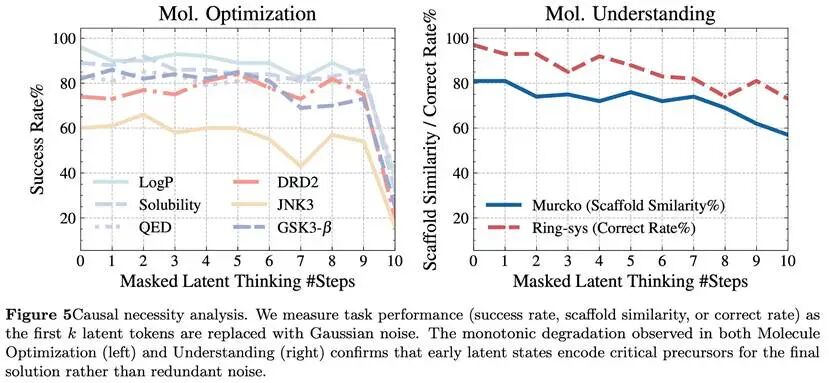
The research team replaced several previous latent steps with Gaussian noise and then observed the model's performance.
The results showed that the more latent steps were replaced, the more significantly the model's performance declined.
This means that these latent states are not insignificant intermediate variables but truly carry the key information required for reasoning.
That is to say:
Less explicit CoT doesn't mean less reasoning.
Many reasoning processes are actually "hidden inside".
There is also a detail that is particularly worth noting
LatentChem doesn't learn a rigid rule.
If it simply "prohibits outputting CoT", the model should never write long - form reasoning.
However, the phenomenon observed in the paper is more subtle:
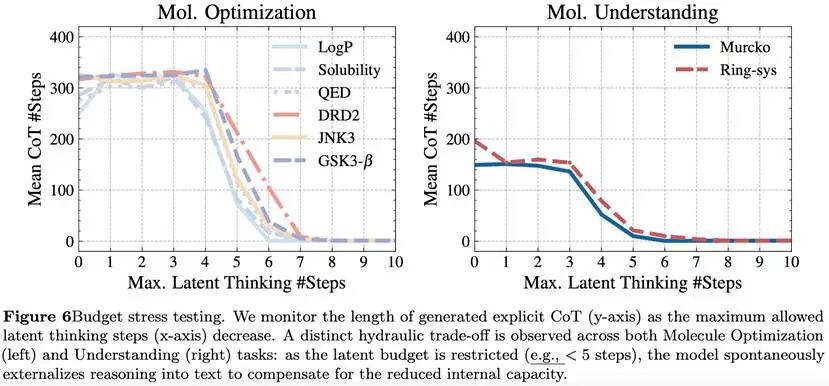
When the budget for latent thinking is insufficient, the model will write out part of the reasoning again.
That is to say, if it is given enough internal reasoning space, it will complete more thinking in the latent space;
If the internal budget is compressed, it will re - enable explicit text reasoning to supplement its capabilities.
This is actually very important.
It shows that what LatentChem learns is not "don't write", but a more flexible allocation strategy:
Calculate internally as much as possible; if the internal capacity is insufficient, externalize part of it into words.
Therefore, the real significance of this work is not to "make the model silent", but to prove that:
CoT is just an external manifestation of reasoning, not necessarily the essence of reasoning.
Not only faster, but also more accurate
This internal reasoning paradigm of "doing without saying" brings real performance benefits. In major chemical benchmark tests, LatentChem has delivered excellent results:
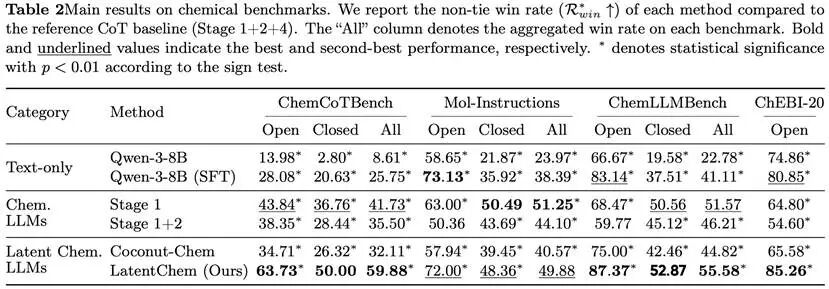
In the ChemCoTBench test that highly depends on reasoning, it achieved a non - draw win rate 59.88% higher than that of the powerful explicit CoT baseline model.
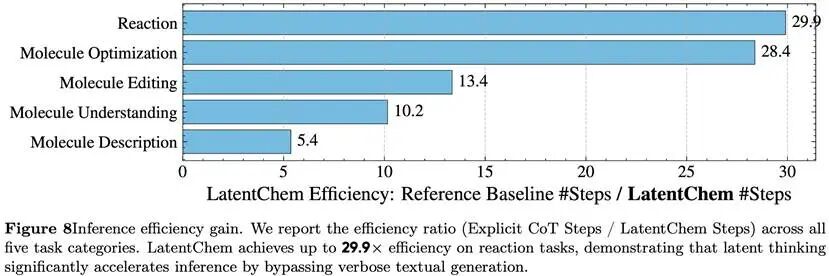
By converting verbose text into compact latent states, it significantly overcomes the bottleneck of generation delay, and the average reasoning speed has skyrocketed by 10.84 times. In specific reaction tasks, the efficiency has even soared by nearly 30 times.
For teams committed to building future AI Scientists, LatentChem proves one thing: Explicit natural language may just be a shell for scientific reasoning. Bringing heavy logical calculations back to the latent space not only breaks the trade - off paradox between efficiency and depth but also lays a more fundamental computational foundation for the next - generation scientific AI.
From LatentChem to AI Scientist
For Haven, the significance of LatentChem is not just a new chemical model. It is more like a key component of the AI Scientist system.
Haven is building an AI system that can automatically execute scientific workflows, including:
- Molecular design
- Literature analysis
- Experiment planning
- Hypothesis generation
- Result verification
In these complex tasks, reasoning often occurs in structured continuous spaces, rather than in natural language.
LatentChem demonstrates a new possibility: Let AI complete scientific reasoning in the latent space and then output interpretable results when needed.
At the same time, LatentChem raises a question worth thinking about: Is explicit CoT just an externalized form of reasoning, rather than reasoning itself?
What LatentChem shows is not "removing reasoning", but: Bringing reasoning back from the text surface to the inside of the model.
Future AI Scientists may not write out every step of their thinking,
But they are still continuously reasoning, exploring, and discovering.
It's just that these reasoning processes occur in the latent space.
Paper title: LatentChem: From Textual CoT to Latent Thinking in Chemical Reasoning
Paper link: https://arxiv.org/abs/2602.07075
Code link: https://github.com/xinwuye/LatentChem
This article is from the WeChat official account "QbitAI", author: LatentChem team, published by 36Kr with authorization.