OpenClaw is not important. What matters is where it will run in the future.
In March this year, the charge for on-site installation of OpenClaw was between 500 and 800 yuan per order. A queue of thousands of people formed at the entrance of the technology company building. Nine-year-old primary school students and retirees in their late 60s crowded together waiting for engineers to help install the "lobster" (OpenClaw). A group of gig workers emerged in major cities, making a living from this. Those with good business could take on more than 30 orders a week. In less than half a month, posts appeared on Xianyu saying "On-site uninstallation, charged at 299 yuan, safe and thorough, no residue". There have been similar moments in history. In 1995, the spread of Doom once exceeded that of the newly released Windows 95. When a new experience is shocking enough, users will bypass all obstacles and embrace it directly. Of course, after Doom, the value of the PC far exceeded that of the game, and the same goes for OpenClaw.
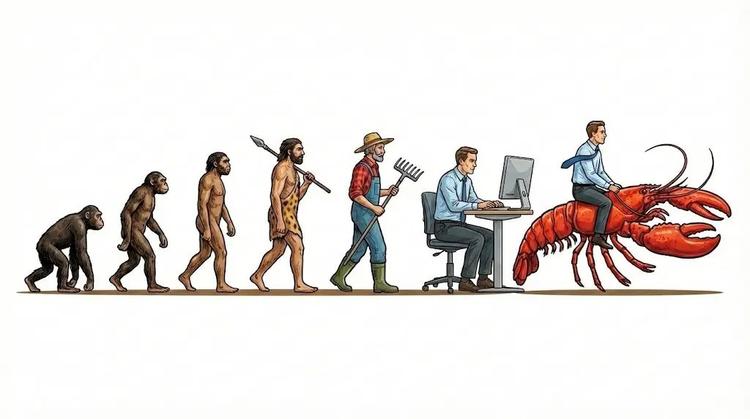
Most people's enthusiasm stops at the installation. But those users who really want the "lobster" to do something practical almost all made the same choice: open Feishu. This was not planned by anyone. Feishu's robots support long connections. As long as your home computer can access the Internet, you don't need to buy a server, apply for a domain name, or do intranet penetration. Few mainstream office software in China offers such convenience.
The early users of OpenClaw were originally developers and people from Internet companies, and these people happen to use Feishu for their daily work. The two circles highly overlap, and connecting to Feishu is the path of least resistance. Yang Mingfeng, the founder of the Chinese community of OpenClaw, recalled, "I judged that in the domestic environment, Feishu might be the fastest and most suitable platform to connect to OpenClaw." He first implemented the Feishu plug-in in the Chinese branch he maintained, and on February 4, he was invited by the OpenClaw official to merge it into the upstream main branch.
From the public timeline, Feishu didn't take any official product actions regarding OpenClaw before early March. Developers voted with their feet first, and Feishu followed later. It formed a plug-in team during the Spring Festival. On March 5, the official plug-in was open-sourced, and the API quota was increased from the initial 10,000 to 1 million per month after two rounds of upgrades. On March 10, Miaoda launched one-click deployment. On March 19, it was announced that six model manufacturers, including Volcengine, Jieyue Xingchen, Kimi, Kouzi, MiniMax, and Zhipu, had completed the connection.
1
From OpenClaw to Intelligent Partner
In the past two years, the core experience of AI products has been dialogue, answering one question at a time. But the execution power has always been in the hands of humans. You still have to click buttons, fill out forms, and run processes by yourself. OpenClaw starts to take over the operation layer. The essential difference between an agent and a traditional AI assistant is that an agent has "hands". But an OpenClaw running in isolation on a computer often faces a blank slate. It doesn't know who you are, what your colleagues are discussing, or what's on your schedule. "It's easy to install the 'lobster', but hard to keep it running" is the most common feeling after this wave of enthusiasm.
On March 19, Feishu held a release event themed on agents and gave its answer.
The core product is the intelligent partner in Feishu aily, which can be understood as the official version of the "lobster" on Feishu. It addresses the same need as OpenClaw, allowing everyone to have an agent that can do work. But aily is not an open-source framework that needs to be deployed and configured. Instead, it exists directly as a character in the Feishu contact list and is ready to use out of the box. Its permission system is exactly the same as yours. It has long-term memory, can work actively, and supports the installation and invocation of various skills through natural language.
It is also compatible with the skill ecosystem of OpenClaw, but all skills go through official security reviews, and the entire operation process is traceable. Sensitive operations require manual confirmation. Feishu also launched the aily professional version, an independent web-based product for more complex task scenarios. It supports multi-task parallel processing, PPT and document generation, data analysis, as well as more refined interactions and template selection.

Miaoda also had a major upgrade. It has built-in collaborative agents for product planning, UX design, code writing, quality testing, etc. It can directly generate runnable applications or intelligent agents from a one-sentence requirement and is natively integrated with Feishu's identity and permission system. The multi-dimensional table has launched the AI building ability. You can automatically generate data tables, dashboards, questionnaires, and even a whole set of business systems by describing business requirements in natural language.
With the full connection of the six model manufacturers, Feishu's intention is clear. No matter what model or framework is used, Feishu hopes to be the layer that interacts with users in the end.
2
What's it like to use in practice?
After activating and completing the settings, a noticeable feeling about the intelligent partner is that it already knows you at work. When you open the Feishu message list, the intelligent partner is lined up with colleagues and group chats. The name and avatar you gave it are there. It knows which groups you're in, what your recent schedule is, and what projects you're collaborating on with whom. You don't need to teach it from scratch who you are. This is the biggest difference in experience compared to running an OpenClaw on your own computer.
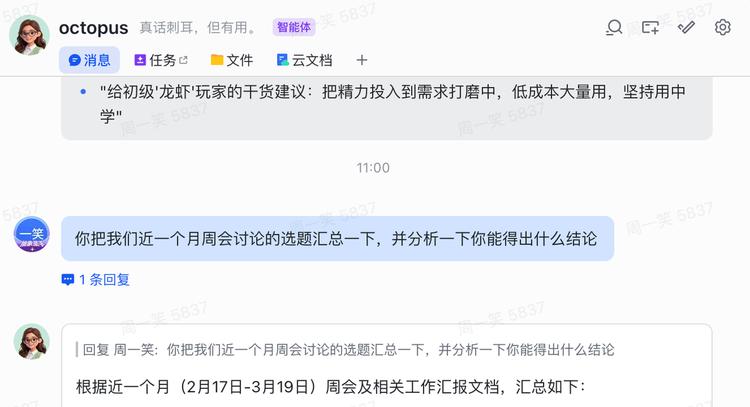
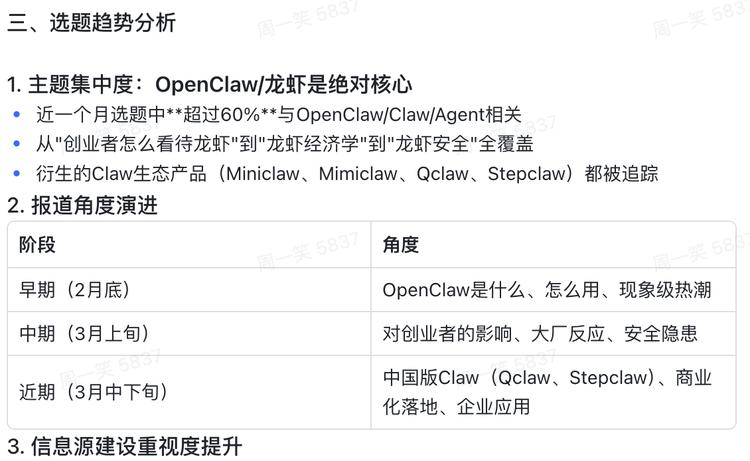
I tried a task, asking it to collect the weekly meeting documents scattered in various places on Feishu in the past month and analyze what conclusions could be drawn. These documents are distributed in different Feishu cloud documents, including meeting minutes, topic submission forms, and work reports, with different formats and structures. The intelligent partner integrated these contents and output a well-structured summary, covering the evolution trend of discussion topics, changes in focus, and even pointed out the risk of insufficient depth that might be brought about by the increased work rhythm. For a newly launched product, this retrieval and summarization ability exceeded expectations.
In another scenario, I asked the intelligent partner to help me build a topic tracking system in the multi-dimensional table. It first gave four versions of plans with different complexities, from the most streamlined version with five fields to the full version with propagation data tracking and double-table association of interviewees. Each version had a clear description of the applicable scenarios and field design. After selecting a plan, it directly generated a usable multi-dimensional table with fields, options, and views all configured. The whole process was just a few words in the chat box without leaving Feishu.
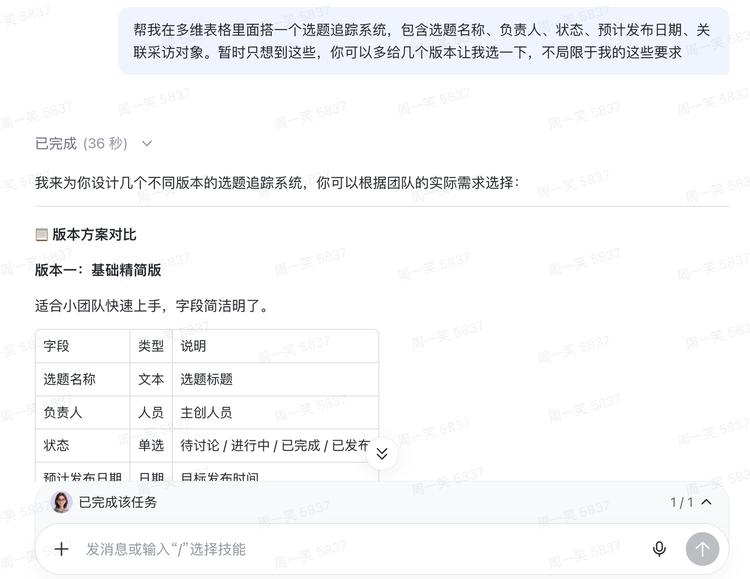

One of the produced versions
Of course, it is still in the early stage. There are occasional situations where the response is unstable, and its ability to break down complex tasks is also growing. But it is relatively smooth to use, a bit like a dedicated, work - version "lobster" that understands all the work context you've accumulated in Feishu.
3
After the "Lobster" (OpenClaw)
Similar things are also happening overseas. Slack is the most mainstream enterprise collaboration tool in the United States, covering millions of enterprises and carrying billions of weekly work conversations. In January this year, Salesforce remade Slackbot into an AI agent. CTO Parker Harris directly defined it as "the front door of the agentic enterprise". Salesforce's new official positioning for Slack is "the unified operating system for all enterprise agents". This is no longer an upgrade of a chat tool but a fundamental change in product definition.
Feishu is also exploring in a similar direction. The core of Slack is communication and integration, and it relies on third - parties for documents, databases, and project management. Feishu integrates communication, documents, multi - dimensional tables, approvals, and calendars on one platform and provides more than 2,500 standardized APIs. Yang Pan, the co - founder of Silicon - based Flow, believes that Feishu is not just an IM tool but a complete workspace platform. This set of structured work semantics, including documents, tables, message flows, approvals, and calendars, together forms the operable framework for enterprise operations. In such an environment, an agent is not just invoking isolated tools but operating an abstract model of an organization.
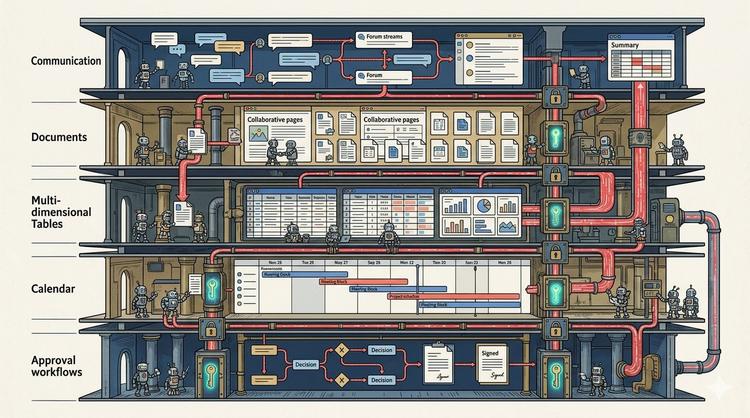
The evolution of computer interaction methods has a clear path, from the command line to the graphical interface to the touch screen. Each leap has reduced the cost of communication between humans and machines. In the past decade, the software industry has spent a lot of effort on the graphical interface of SaaS. But when agents start to take over the operation layer, the complex GUI is becoming less important. You input a natural language sentence, the agent calls APIs, reads and writes files, and executes processes in the background, and the result is directly pushed to the chat box. IM is becoming the command line in the natural language era, a CLI that is accessible to everyone without learning any syntax.
As early as 1997, artificial intelligence researcher Alper Caglayan judged in Wired magazine that agents would not exist as independent entities but would enter the interface, and every application would be agentized. Nearly thirty years later, this prediction is coming true. The platform is no longer just a collection of tools but the operating environment for agents to execute actions. Whoever controls this execution bus is not only a traffic entrance but also the center of the permission system, the precipitation point of behavior logs, and the scheduling layer of automation capabilities. The focus of competition has shifted from whose model is smarter to who is closest to permissions, context, and tool chains.
Of course, in the short and medium term, a more likely scenario is semi - automatic. The agent writes the weekly report, and you click to send. The agent organizes the meeting minutes, and you confirm the content. Humans are always in the loop. Fully automatic, unsupervised execution across systems is unlikely to occur on a large scale in the foreseeable future. The reason is simple: an organization is not a purely rational system, and many decisions are essentially about responsibility allocation, not about finding the optimal solution.
However, the direction is clear. Enabling everyone to have their own intelligent partner in Feishu is turning from a concept into a product. Looking back in the future, the real significance of this wave of "lobster" enthusiasm in the spring of 2026 may not lie in how far OpenClaw itself has gone, but in the fact that everyone realized for the first time that the upper limit of AI's value does not depend on what it can chat about but on how many processes it can take over.
This article is from the WeChat official account "Silicon Star People Pro", author: Zhou Yixiao. Republished by 36Kr with permission.