Milestone: A Glimmer of Hope for Restoring Sight to the Blind, Flexible Electrodes Implanted in the Cerebral Cortex, Brain-Computer Interface Receives FDA Breakthrough Device Designation
Recently, ReVision Implant, an innovative Belgian brain-computer interface company, announced that its core product, the Occular visual reconstruction brain-computer interface, has received the "Breakthrough Device Designation" from the U.S. FDA.
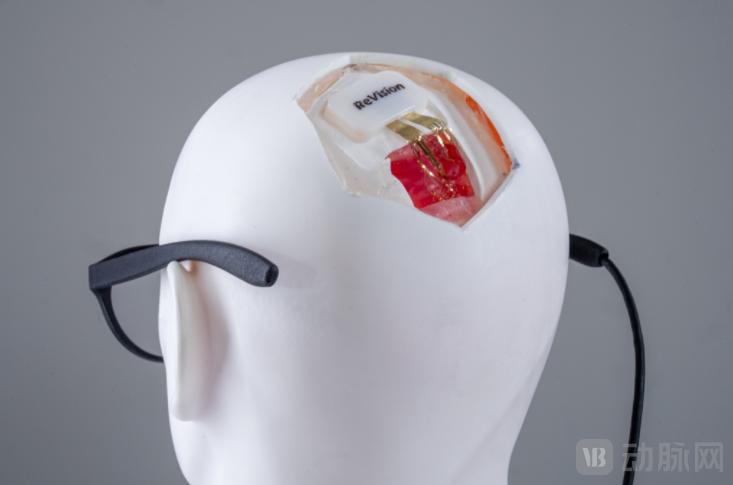
The core workflow of Occular is to "bypass the damaged visual pathway and directly activate the visual center of the brain." First, a micro-camera on the wireless glasses captures visual information about the user's surrounding environment. Then, this visual data is transmitted to a dedicated algorithm processing unit in the brain implant, which converts complex images into electrical stimulation codes that the brain can recognize. Next, flexible electrodes implanted in the visual cortex stimulate neurons in a specific pattern to generate phosphenes. Finally, the brain integrates these phosphene signals to form recognizable images, object outlines, and scene information, helping patients meet daily needs such as object recognition and autonomous navigation.
Different from traditional visual reconstruction brain-computer interfaces based on retinal stimulation, the Occular system directly connects to the visual cortex of the brain and can completely bypass the damaged eyeball and optic nerve. Therefore, in theory, this system is suitable for blind patients caused by various etiologies, including retinal degeneration and optic nerve damage, and has extremely broad clinical application potential.
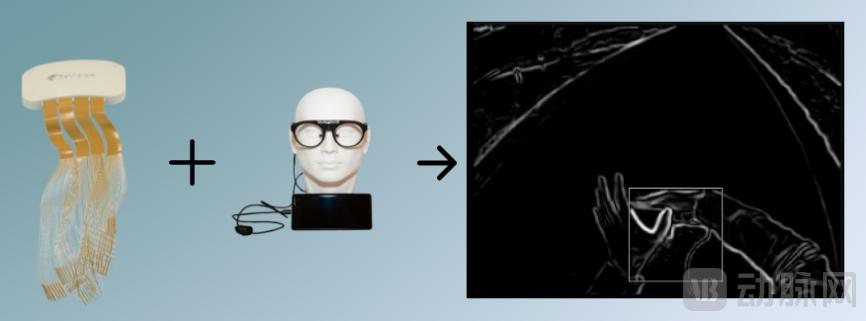
Occular, Image source: ReVision Implant.com
01
A demand gap of 40 million blind people: The evolutionary path from the retina to the visual cortex
Severe visual impairment and blindness have become a global public health problem that needs to be solved urgently. According to WHO statistics, there are currently about 40 to 45 million blind people in the world, and more than 200 million people have moderate or severe visual impairment. Moreover, this group is mainly concentrated in the Asia-Pacific region. More seriously, according to the latest article in The Lancet Global Health, it is predicted that this number will rise to 550 million by 2050.
In current clinical treatment, traditional surgeries and drugs can only address some reversible vision impairments, with a limited scope of application. Although the first retinal prosthesis product was introduced in 2002, it still relies on the remaining cells in the retina and is only suitable for patients with specific eye diseases such as retinitis pigmentosa, unable to benefit completely blind people or those with completely damaged optic nerves. At the same time, the number of electrodes in such prostheses is limited, and the resolution is low. Patients can only vaguely perceive light and shadow, which is difficult to meet the core needs of their daily independent lives.
02
Bypass the damaged eye and optic nerve: "Cortical implantation" is the key to breaking the situation
In the view of Dr. Frederik Ceyssens, the founder and CEO of ReVision Implant, the current top "bionic eyes" and "visual prostheses" products may have five core problems:
● Insufficient number of electrodes;
● Incorrect electrode implantation position: The latest research results show that implanting microelectrodes in the visual cortex of the brain can achieve higher resolution. In contrast, most visual prostheses developed so far are designed to be implanted in the eyeball;
● Backward stimulation algorithms: Simply increasing the number of electrodes cannot achieve a qualitative improvement in resolution;
● Poor biocompatibility of rigid electrodes and difficulty in large-scale expansion. Long-term implantation can easily cause inflammation and scar hyperplasia in brain tissue, leading to device failure. Flexible electrodes are difficult to implant and cannot penetrate brain tissue independently, lacking a large-scale implantation solution;
● Lack of peripheral vision or insufficient precision in the central vision.
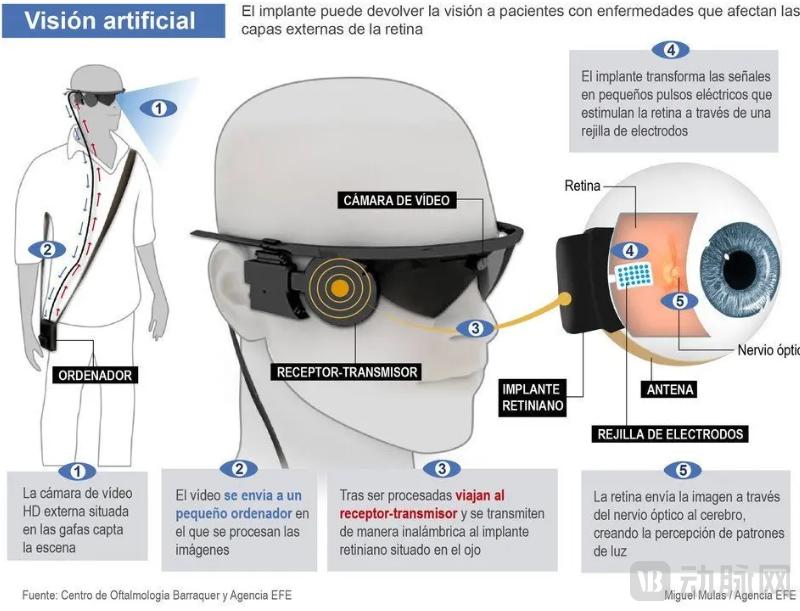
Argus II, the world's only visual prosthesis device approved for marketing by the U.S. FDA
From a technical principle perspective, human visual signals are ultimately processed by the visual cortex of the brain. Even if the eyeball or optic nerve is damaged, the neurons in the visual cortex of most patients remain intact, which provides core theoretical support for the development of "visual cortex prostheses."
In this context, ReVision Implant focuses on the core direction of visual cortex implantation. Relying on top-notch neuroscience and microfabrication technology, it specifically tackles common industry problems. After years of research and development, it has created the Occular system, which completely bypasses the damaged eye and optic nerve and directly connects to the visual cortex of the brain, filling the market gap for a global universal blind neural prosthesis.
03
The electrode thickness is only equivalent to a single brain cell, and the visual resolution is increased by 10 times
As a new generation of visual cortex prosthesis, the Occular system is different from traditional retinal prostheses and early cortical implantation devices. Relying on four core technological innovations, including ultra-flexible electrode arrays, a scalable implantation mechanism, wide-field vision coverage, and advanced stimulation algorithms, it has achieved a comprehensive upgrade in safety, effectiveness, and practicality.
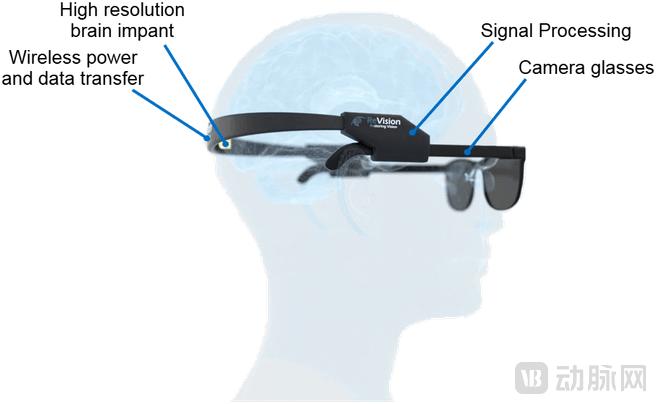
Occular, Image source: ReVision Implant.com
First, ultra-flexible biocompatible electrodes enable long-term safe implantation. The implantation electrodes of the Occular system are made of extremely soft and highly biocompatible materials. The electrode thickness is only equivalent to a single brain cell, which can move synchronously with the natural deformation of brain tissue, greatly reducing mechanical stimulation and immune response to brain tissue. At the same time, using semiconductor manufacturing processes, it combines high-density integration with mass production feasibility, and the number of electrodes can be expanded to thousands.
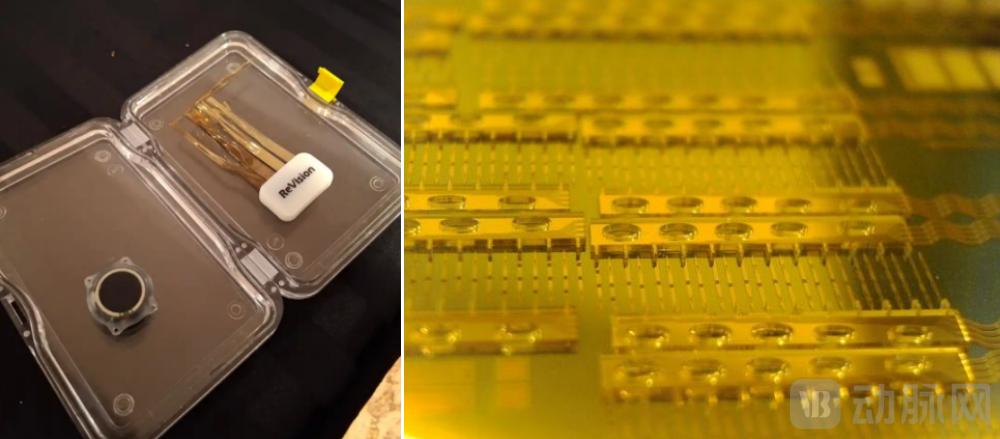
Ultra-flexible biocompatible electrode array, Image source: ReVision Implant.com
Second, a patented scalable implantation system solves the problem of flexible electrode implantation. Aiming at the pain point that ultra-flexible electrodes have insufficient stiffness and cannot be implanted independently, the company has developed a patented implantation technology. Relying on a degradable coating to temporarily increase the electrode stiffness, hundreds of electrodes can be implanted minimally invasively at one time. Animal experiments have confirmed that only a scar tissue with the thickness of a single layer of cells is formed after implantation using this technology.
Patented scalable implantation system, Image source: ReVision Implant.com
Third, the wide-field vision coverage design creates a more natural visual experience. Traditional visual prostheses only cover a local cortex, with a narrow and unnatural field of vision. Relying on the advantages of the flexible array, the Occular system can be implanted in the visual cortex areas responsible for the central and peripheral fields of vision at the same time, achieving full-field vision coverage and allowing patients to obtain a wider-field visual experience closer to nature, meeting the core needs of daily walking, navigation, and object recognition.
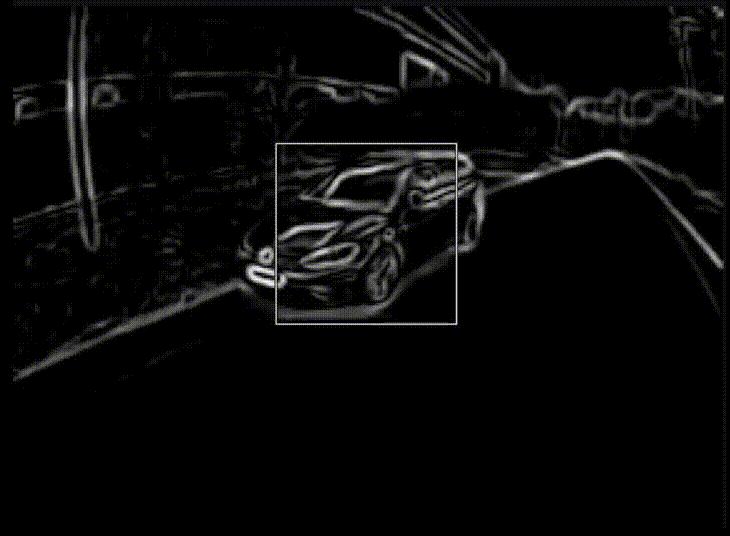
Image source: ReVision Implant.com
Fourth, advanced stimulation algorithms achieve an order-of-magnitude increase in resolution. Different from the mode of simply increasing the number of electrodes, the advanced stimulation algorithm developed by the company can increase the visual resolution by another 10 times, achieving a grayscale visual effect of more than 1000 pixels, reaching the standard for restoring practical vision. This allows patients not only to perceive light and shadow but also to recognize objects and complete basic daily tasks.
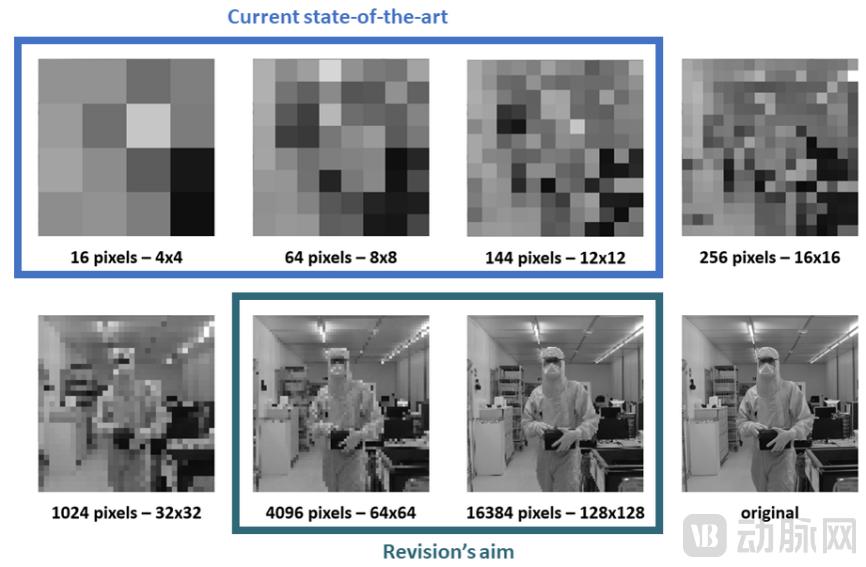
Image source: ReVision Implant.com
04
Two-year monkey brain experiments have been completed, and human clinical trials are expected to start in 2027
So far, Occular has completed long-term experiments in mice and non-human primates, fully verifying the excellent biocompatibility, long-term stimulation stability, and neural stimulation effectiveness of the electrode array. The experimental data shows that the electrodes can stably activate the visual cortex without obvious tissue damage, fully meeting the 10-year service life standard required by the FDA. Currently, an experiment to verify the ultra-long service life of 30 - 40 years is being carried out.
In addition, ReVision Implant has completed a small-scale pre-clinical human trial through cooperation with a Spanish university. After three blind volunteers were implanted with a small electrode array, they successfully restored some visual functions, achieving autonomous navigation, object positioning, and simple shape recognition, initially verifying the feasibility of the technology in human applications.
Relying on the policy support of the FDA's Breakthrough Device Designation, ReVision Implant plans to conduct a short-term acute intraoperative trial during the surgical resection of epileptic foci in epilepsy patients in October 2026 to verify the safety and feasibility of the implantation process in human trials. It is expected that early human clinical trials for blind patients will start in 2027 to comprehensively evaluate the visual repair effect and long-term safety of the Occular system. At the same time, the company is also promoting the research and development of a "fully wireless system" to gradually replace the early wired arrays and improve the convenience of product use.
This article is from the WeChat official account "Arterial Network" (ID: vcbeat), author: Ji Jiaying. It is published by 36Kr with authorization.