MicroLED catches the express train of optical communication
In just half a year, MicroLED has completed a remarkable leap across different sectors.
Half a year ago, when talking about MicroLED, it was still a highly anticipated new display solution for consumer electronics terminals such as AI glasses. Now, it has forcefully entered the optical module sector, achieving a breakthrough from being a technology reserve in the display field to becoming a key technology for optical interconnection in AI data centers. It has transformed from a “promising candidate” in the new - display sector to a breakthrough point for higher bandwidth in the optical communication field in the era of AI computing power. As a micron - scale inorganic self - emitting technology, the value of MicroLED has gradually shifted to the fields of optical interconnection and CPO optical modules. Relying on its natural advantages of low power consumption, high density, and high reliability, it has broken the dilemma of choosing between traditional optical and copper interconnections, providing a brand - new solution for high - speed computing power interconnection.
What is MicroLED?
MicroLED, short for Micro Light Emitting Diode (also known as μLED), is a micron - scale inorganic semiconductor self - emitting technology. The industry's general standard defines it as an inorganic LED light - emitting chip with a single - side length of less than 100μm (the mainstream mass - production specification is less than 50μm). It can serve as an independently addressable unit and achieve efficient photoelectric conversion through precise integration. Its extremely simple structure eliminates the redundant layers of traditional display technologies, and its core advantages are concentrated on the ultimate optimization of photoelectric performance, laying a foundation for applications in optical interconnection and CPO optical modules.
The light - emitting principle of MicroLED is the same as that of traditional LEDs, based on the P - N junction electroluminescence of third - generation inorganic semiconductor materials such as gallium nitride (GaN): When a forward voltage is applied to the chip, electrons and holes inside the semiconductor recombine, releasing photons to achieve the conversion of electrical energy into light energy.
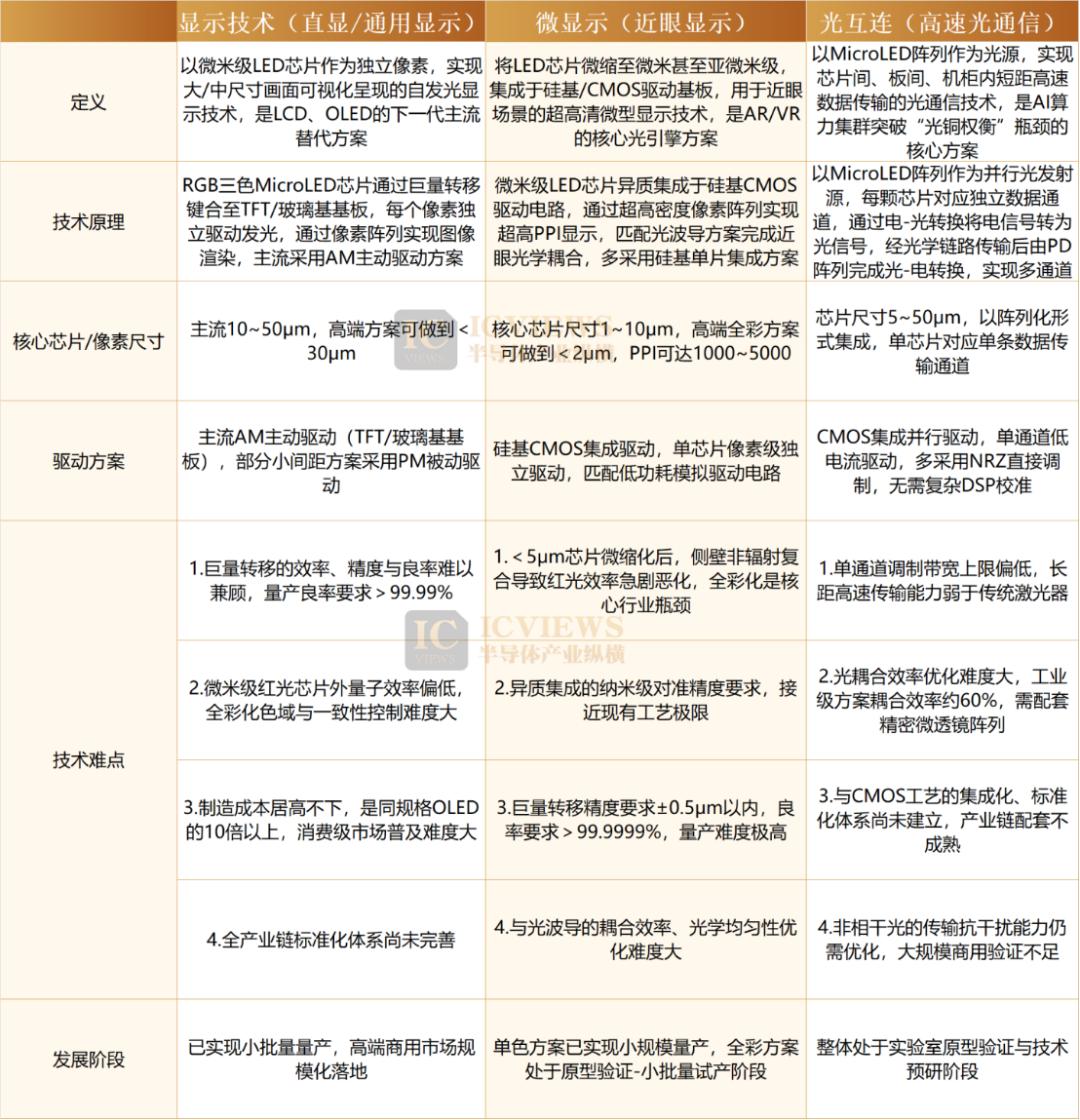
In display applications, each display pixel consists of three independent micron - scale LED chips of red, green, and blue. Each chip can be independently controlled by the driving circuit in terms of its power - on state and light - emitting brightness. Pixels that do not emit light can be completely powered off, achieving a truly pure - black display and completely avoiding the light leakage problem of LCDs. At the same time, the extremely simple structural design eliminates the backlight, liquid crystal layer, and polarizer of LCDs, as well as the organic light - emitting layer of OLEDs, greatly improving the light efficiency, stability, and integration level, and endowing it with the potential for cross - sector applications.
Breaking the Dilemma of Choosing between Optical and Copper Interconnections, MicroLED Unlocks New Possibilities for 1.6T+ Ultra - High - Speed Interconnection
The current explosive growth of AI computing power has put forward unprecedentedly strict requirements on the interconnection bandwidth, transmission distance, power consumption, and reliability of data centers. However, traditional interconnection solutions have always been unable to get rid of the fundamental dilemma of choosing between “optical and copper”, making it difficult to meet the needs of computing power upgrades.
Specifically, although copper cable links have the advantages of high energy efficiency and strong reliability, they have a natural shortcoming in transmission distance. The passive copper cable has a transmission distance of less than 2 meters, and the active copper cable can only increase it to 5 - 7 meters. Moreover, as the bandwidth rate increases, the problems of signal attenuation, electromagnetic interference, and crosstalk will intensify sharply, making it unable to adapt to long - distance and high - speed transmission scenarios. Although traditional optical links can achieve longer transmission distances, they come at the cost of high power consumption and low reliability. The power consumption of a single communication laser ranges from tens to hundreds of milliwatts. Large - scale array deployment will bring unbearable power consumption and heat dissipation pressure. At the same time, the complexity of multi - laser packaging will increase the failure rate, and reliability cannot be improved through redundant design. In scenarios with higher speeds of 1.6T/3.2T and above, this either - or dilemma becomes more prominent, becoming a key bottleneck restricting the scale expansion of computing power networks.
The MicroLED optical module, relying on the natural advantages of its materials and architecture, has achieved the combination of long - distance transmission, low power consumption, and high reliability, becoming an ideal light source to replace copper cables and complement traditional laser solutions. It shows strong application value, especially in the co - packaged optics (CPO) scenario of AI data centers. Compared with traditional laser solutions, the core advantages of the MicroLED optical module are concentrated in five aspects:
First: Ultra - low Power Consumption, Solving the Heat Dissipation Pain Point in High - Speed Scenarios
As a surface - emitting light source, MicroLED adopts an innovative “Wide and Slow (WaS)” architecture, abandoning the design concept of “a few high - speed channels” in traditional solutions. Instead, it achieves high bandwidth through the parallel transmission of a large number of low - speed channels. The essence of this architecture is to replace serial high - speed channels with parallel low - speed channels. For example, to achieve an 800G bandwidth, it can be completed in parallel through 400 channels with a single - channel rate of 2G, and the power consumption of a single - channel light emission is extremely low. The latest research data from the top journal in the photonics field under IEEE shows that in the short - distance optical interconnection solution based on MicroLED, the power consumption of a single channel can be reduced to 1/10 of that of the traditional VCSEL solution and 1/5 of that of the silicon - photonics solution. At the same time, the integration density of the optical engine can be increased by more than 3 times, fundamentally solving the power consumption and heat dissipation pain points in high - frequency scenarios.
Second: Ultra - high Reliability, Approaching the Stability Standard of Copper Cables
The size of MicroLED chips can be made as small as 10 microns or even smaller, enabling large - scale array integration within a single optical module and easily deploying redundant chips. For example, 400 channels can meet the 800G transmission requirement, but actually 500 chips can be deployed. Even if 10% of the chips fail, the 800G bandwidth transmission can still be stably guaranteed. This redundant design makes its reliability approach that of copper cables, completely solving the industry pain point of the synchronous increase in the failure rate of multi - channel deployment in traditional laser solutions.
Third: Strong Bandwidth Scalability, Adapting to the Evolution Needs of 1.6T/3.2T Computing Power
The bandwidth of the MicroLED optical module can be linearly expanded through two paths: “increasing the number of channels” and “increasing the single - channel rate”, without the need for a subversive adjustment of the core architecture. The ultra - high - speed requirements of 800G, 1.6T, and even 3.2T can be easily met by flexibly adjusting the channel scale, perfectly adapting to the continuous upgrade needs of the AI computing power network bandwidth.
Fourth: Full - ecosystem Compatibility, Seamlessly Connecting to the Existing Network Architecture
The MicroLED optical module does not need to change the existing industry ecosystem. It can be directly adapted to standard interfaces such as OSFP and QSFP, compatible with mainstream electrical host interfaces such as PCIe and VSR/MR, as well as mainstream protocols such as Ethernet, InfiniBand, NVink, and CXL. Without any modification to the existing hardware such as servers and switches, it can directly replace the existing optical and copper links, support the mixed deployment of copper cables and optical cables, and greatly reduce the threshold and cost of technology implementation.
Fifth: Naturally Adapted to CPO Heterogeneous Integration, in Line with the Trend of Next - Generation Optical Interconnection
MicroLED has the natural advantages of micron - scale light - emitting size, high modulation bandwidth, low threshold current, and two - dimensional array integration, which deeply match the heterogeneous integration requirements of CPO (co - packaged optics). Different from traditional lasers that require complex temperature control and wavelength stabilization designs, MicroLED has a simpler structure and higher integration level. It can be directly co - packaged with switching chips and ASIC chips without high - speed signal conversion, providing a simple and efficient solution for next - generation high - density computing power interconnection.
International Manufacturers Leading the Way: Accelerating the Industrialization of MicroLED Optical Interconnection
Relying on its breakthrough technological value in the field of optical interconnection, MicroLED has attracted intensive layout by enterprises in the global industrial chain, both upstream and downstream. International leading enterprises took the lead, increasing investment in technology R & D and industrialization, promoting the industry to quickly move from laboratory technology verification to the commercial implementation stage.
The technology giant Microsoft was the first to complete the prototype verification of the core architecture and launched an architecture called MOSAIC (full name: MicroLED Optical System for Advanced Interconnects). Based on the “Wide and Slow” design concept and MicroLED light sources, this architecture achieves long - distance, low - power, and high - reliability signal transmission. The prototype has been verified and has successfully passed the Ethernet and InfiniBand protocol stack tests. At the same time, its compatibility with new protocols such as NVlink and CXL has been confirmed. Simulation data shows that the transmission distance of mass - production - level modules can exceed 50 meters, and the power consumption has been significantly reduced compared with traditional optical links.
The wafer - foundry leader TSMC has reached in - depth cooperation with the US startup Avicena to jointly produce interconnection products based on MicroLED. Replacing traditional electrical connections with optical communication, these products feature the core advantages of low cost and high energy efficiency, precisely meeting the high - communication needs of GPU clusters and targeting the interconnection bottleneck in the AI computing power scenario.
The chip - design manufacturer MediaTek has independently overcome the MicroLED light source technology and developed a new active optical cable (AOC) solution, which is expected to be officially unveiled at the Optical Fiber Communication Conference (OFC) in April this year. At the same time, its newly launched customized ASIC design platform can provide a transmission interface solution for heterogeneous integration of electronic and optical signals, precisely targeting the AI and high - speed computing markets.
AUO in the panel field, relying on its 30 - year experience in glass manufacturing processes and combining its mature MicroLED mass - transfer technology, has officially entered the short - distance optical communication market of AI data centers, achieving a cross - border extension from display technology to the optical communication field.
In addition, the professional interconnection technology enterprise Credo Technology has strengthened its optical interconnection technology capabilities by acquiring Hyperlume and is collaborating with enterprises such as Microsoft to promote the R & D and implementation of MicroLED optical interconnection technology, further expanding the application scenario boundaries of the technology.
Domestic Enterprises Making Efforts: Multiple Breakthroughs across the Entire Industrial Chain, Catching Up Simultaneously
While international manufacturers are accelerating the implementation of technology, domestic industrial chain enterprises have also quickly followed up, achieving multiple breakthroughs in multiple aspects such as core chip R & D, module mass - production, and scenario verification, jointly promoting the industrialization process of MicroLED optical interconnection technology with international manufacturers.
In terms of core technology breakthroughs and industrialization implementation, several domestic enterprises have achieved phased results. ZhaoChi Co., Ltd. has completed the R & D of the light source chips for MicroLED optical interconnection CPO technology and entered the sample verification stage. Its 400G and 800G parallel optical transceiver modules have achieved small - batch production, taking the lead in achieving industrialization breakthroughs in some products. Sanan Optoelectronics, in collaboration with Tsinghua University and China Mobile, has made a major breakthrough in the fields of MicroLED optoelectronic devices and high - speed optical communication. It has successfully developed MicroLED light source devices with high - speed modulation capabilities. After testing, the 3dB modulation bandwidth is expected to exceed 7GHz, and the NRZ - OOK data transmission rate is expected to exceed 10Gb/s, completing the core verification of key technologies. Leyard has provided MicroLED optical module products to the Chinese Academy of Sciences to replace the original traditional optical transmission solutions. Currently, the solutions are in the R & D and verification stage, achieving the initial implementation of scenario pilots. XinXiangWei has signed a strategic cooperation agreement with BOE Huacan. The two parties will jointly tackle the R & D and production of MicroLED optical interconnection technology and optical modules. Currently, they are expanding the existing MicroLED product technology to the optical interconnection scenario of intelligent computing centers and simultaneously carrying out the evaluation and analysis of scenario systems and performance indicators.
Meanwhile, several manufacturers are conducting technology feasibility evaluations and preliminary layouts, accumulating strength for the subsequent implementation of technology. Unilumin Group said that its MicroLED optical interconnection technology is in the stage of technology feasibility evaluation and research. It will dynamically plan the R & D path and resource allocation in this technology direction based on the technology maturity curve and market demand changes. Jucan Optoelectronics has also carried out relevant technology layouts in the MicroLED field. Currently, it is in the stage of technology exploration and accumulation and has not been applied in the CPO field. It will flexibly adjust the promotion rhythm according to the technology maturity.
Conclusion
From in - depth technological exploration in the display field to cross - border breakthroughs in the optical interconnection sector, MicroLED is opening up a brand - new growth space in the era of AI computing power. With continuous investment from global industrial chain enterprises, continuous breakthroughs in technology R & D, and the continuous acceleration of the industrialization process, MicroLED is expected to completely rewrite the technological landscape in the field of data center interconnection and become one of the core underlying technologies to support the continuous upgrade of AI computing power.
This article is from the WeChat official account “Semiconductor Industry Insights” (ID: ICViews). Author: Peng Cheng. Republished by 36Kr with permission.