The Fission Map of HSG: How 12 Independent Institutions are Reshaping China's VC Landscape
There is an unwritten consensus in China's VC circle: If practitioners want to gain experience in a VC institution, the first names that come to mind are usually Sequoia Capital and IDG Capital.
This is not only because of their high profile, large scale, and verifiable performance, but also because they are like the Whampoa Military Academy, continuously sending top - notch investors who can take on important responsibilities to the industry.
Since 2014, there has been a wave of "independence" every few years. The new institutions founded by those who left are reshaping the landscape of China's VC/PE industry.
Of course, if we were to select the "champion in talent output" in China's investment circle, Sequoia Capital China would be the well - deserved winner.
This institution, helmed by Neil Shen, has a 20 - year history. It was once a leader among US - dollar funds in China, a holy land for graduates from top universities like Tsinghua and Peking to pursue their VC dreams, and has also nurtured a group of star investors who later established their own institutions.
IT Juzi plans to launch a series on the factional maps of founding partners of Chinese investment institutions. So, let's start the first article in this series with Sequoia Capital China (the first institution included in the IT Juzi database).
Leaving Sequoia Capital China to Found New Institutions: Who Are These 12 Top - Notch Investors?
According to IT Juzi's data, as of February 2026, a total of 12 investors left Sequoia Capital China and became founders of new institutions.
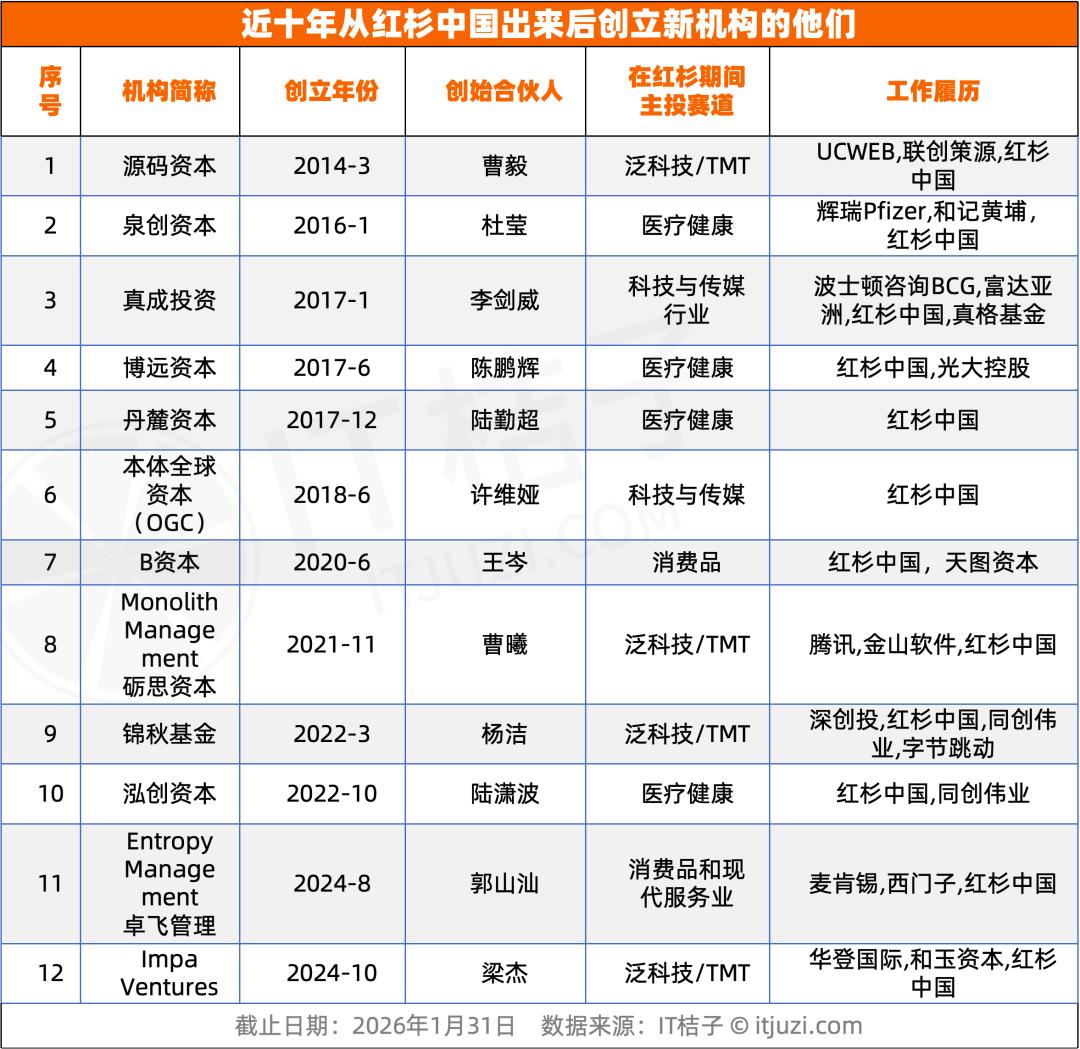
The time period when they founded new institutions spans 10 years from 2014 to 2024.
Taking 2020 as the dividing line, IT Juzi's data shows that the number of new institutions founded from 2020 to 2024 decreased by 80% compared with the previous five years. Those brave enough to leave top - tier institutions to start their own businesses during this period were extremely rare. However, several investors still decided to leave Sequoia Capital China, which shows their strength and courage.
The most recent one is Liang Jie, the former VP of Sequoia Capital China, who founded the US - dollar fund Impa Ventures at the end of 2024. It focuses on early - stage investments in fields such as AI technology and cryptocurrencies, and has publicly announced at least 5 projects in just over a year.
It's not hard to find that these investors' past investment experiences and core judgments are mainly concentrated in three major fields: healthcare, technology/TMT, and the consumer industry.
According to IT Juzi's statistics, Quan Capital, Daffodil Capital, Boyuan Capital, and Hongchuang Capital are all institutions focusing on healthcare investments. Their founding partners, Du Ying, Lu Qinchao, Chen Penghui, and Lu Xiaobo, all left Sequoia Capital China.
It's worth mentioning that Du Ying's process of founding Quan Capital was more circuitous, as she also went through an entrepreneurial stage in between.
Du Ying joined Sequoia Capital China in 2012 as a managing director, responsible for healthcare investments. During her tenure, she led investments in star projects such as BGI and Betta Pharmaceuticals.
With her R & D background at Pfizer, entrepreneurial experience at Hutchison China MediTech, and investment perspective from Sequoia, she left Sequoia in 2014 to found Zai Lab. Zai Lab adopted the License - in model to quickly introduce overseas innovative drugs and successfully listed on the NASDAQ in 2017.
After Zai Lab's successful listing, Du Ying, along with Wu Hui and others, jointly founded Quan Capital, which focuses on investments in the life - sciences field and has received support from Zai Lab. The size of its first fund is approximately $150 million.
In the general technology and TMT fields - traditional strongholds of Sequoia - a group of well - known investors in the industry have also emerged. For example, Cao Yi of Source Code Capital, Li Jianwei of Zhencheng Investment, Xu Weiya of Ontology Global Capital (OGC), Cao Xi of Monolith Management, Yang Jie of Jinqiu Fund, and Liang Jie of Impa Ventures have all gained investment experience at Sequoia Capital China.
Next, IT Juzi will introduce three representative cases of "entrepreneurial - type" investors from Sequoia.
Cao Yi Founded Source Code Capital 12 Years Ago, Kicking off the VC 2.0 Era
Cao Yi, born in 1984, is not only a representative of Chinese post - 80s investors but also a participant in China's Internet entrepreneurship wave, having personally witnessed the development of the mobile Internet from scratch.
Cao Yi has a background in the computer department of Tsinghua University. His career started at Ceyuan Ventures (formerly known as Ceyuan Capital). He participated in early - stage projects such as UC and NetQin and even had brief entrepreneurial experiences, including serving as the business director of UCWEB and co - founder of Alimama.
During this period, he met Zhou Kui, a partner at Sequoia Capital, through work and was invited to join in 2009. In just over five years, Cao Yi reached the position of VP at Sequoia Capital China.
In 2014, at the age of 30, Cao Yi made a decision that shocked both insiders and outsiders of the industry - leaving Sequoia to found Source Code Capital.
This move, regarded as "rash" at the time, actually kicked off the so - called "VC 2.0 era" in hindsight.
Cao Yi's confidence may come from his investment achievements at Sequoia: He participated in Meituan's Series A investment in 2010, and also made investments in star projects such as Xueqiu and Toutiao.
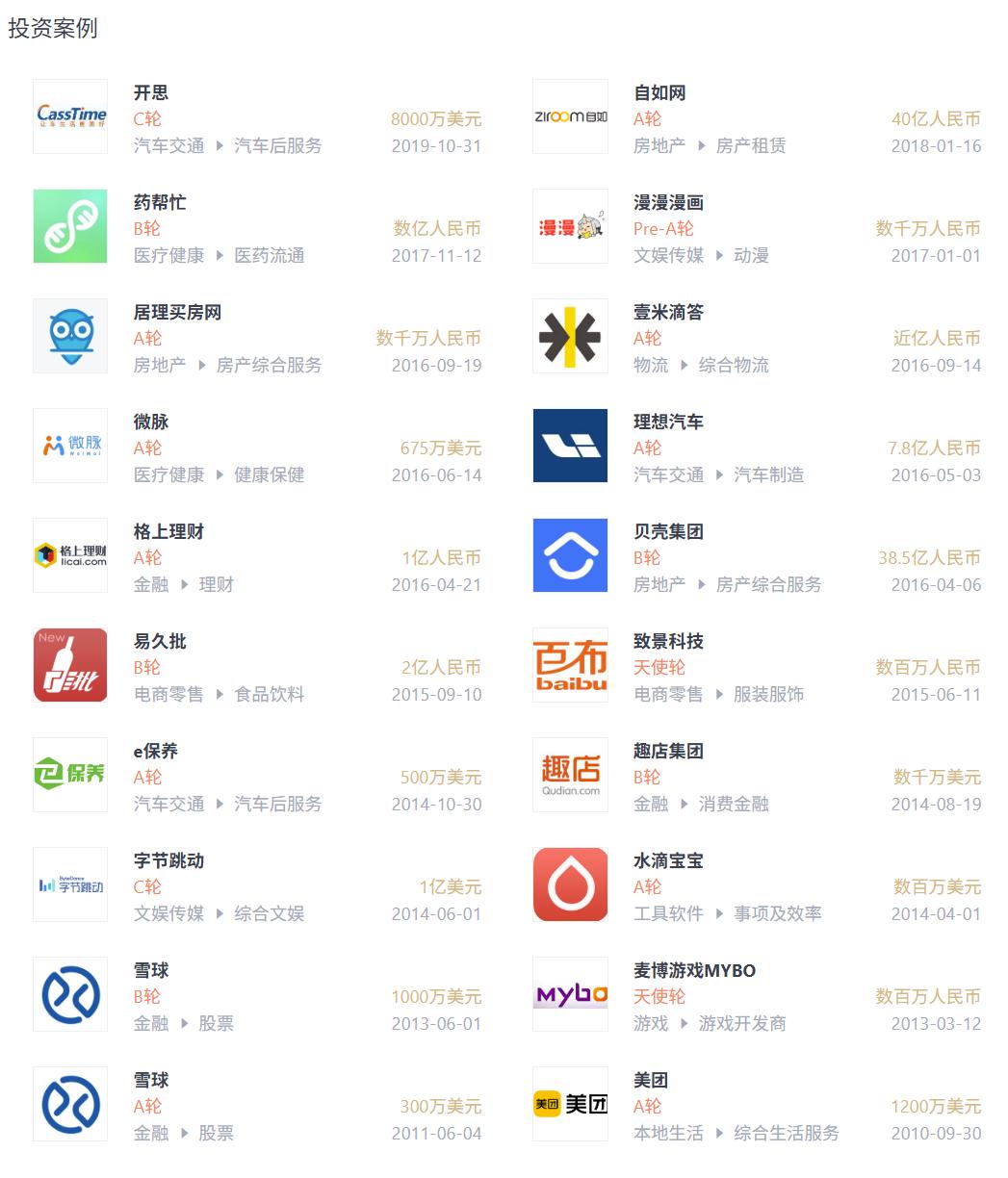
Some of Cao Yi's investment cases. Source: IT Juzi
More importantly, he understands the power of the "friend circle".
It is said that before Cao Yi left Sequoia, Zhang Yiming asked him, "Should you consider starting your own business?"
Later, Zhang Yiming not only became an LP of Source Code Capital but also held more than 10% of the shares in Source Code Capital as of 2022, making him the second - largest shareholder after Cao Yi.
The list of LPs for Source Code Capital's first $100 million fund is extremely impressive: More than a dozen founders of unicorn/listed companies, including Wang Xing, Zhang Yiming, Yao Jinbo, and Li Xiang, are on the list. Perhaps influenced by his early - stage investment experience at Ceyuan, Source Code Capital's early investment philosophy also has an Internet flavor - light - touch approach and quick decision - making.
Cao Yi once completed an investment by giving a Term Sheet in just 30 minutes, a speed that seems almost unimaginable to traditional VCs.
Today, Source Code Capital manages funds worth $7 billion (approximately 50 billion RMB), and its LPs include national - level guidance funds, sovereign wealth funds, and industrial capital. Source Code's investment direction has gradually shifted from TMT to cover more sectors such as industrial digitization, intelligent manufacturing, and life sciences.
Cao Yi himself ranked 35th on the 2024 Forbes Midas List, a significant jump from his 54th place in 2023.
Cao Xi Transitioned from the Youngest Partner at Sequoia and Founded Monolith Management 4 Years Ago
If Cao Yi represents the investment logic of the mobile Internet era, then Cao Xi represents the shift of a new generation of investors towards hard technology.
Cao Xi, born in 1985, was once the fastest - promoted and youngest partner in the history of Sequoia Capital China.
After joining Sequoia in 2013, he led investments in star projects such as Kuaishou, Douyu, and Tencent Music. In about 4 years, Cao Xi rose from an investment manager to a partner and became the youngest partner at Sequoia Capital China at that time.
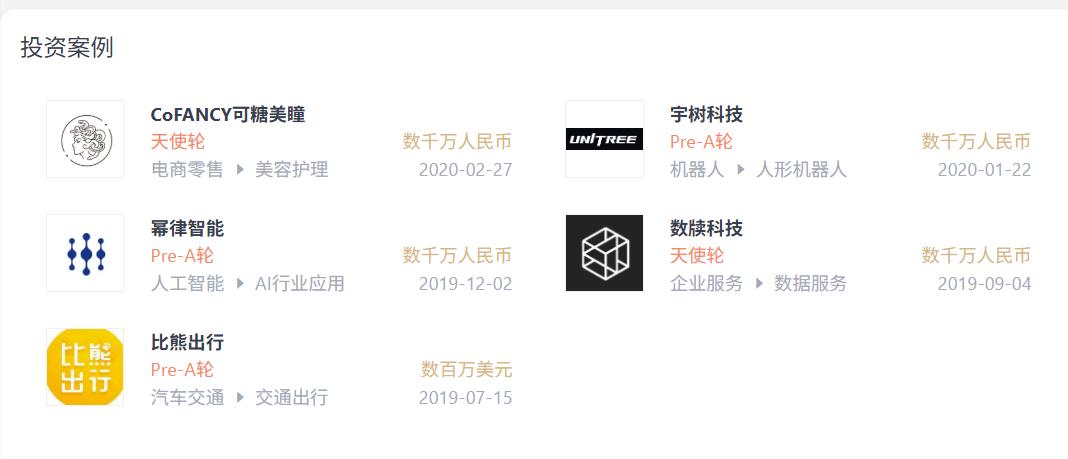
Some of Cao Xi's investment cases. Source: IT Juzi
In 2018, he participated in founding the Sequoia China Seed Fund. These four years taught him how to be the "number - one person" - systematically conduct early - stage investments.
In 2021, Cao Xi and Tim Wang, a former secondary - market partner at Boyu Capital, jointly founded Monolith Management.
The name is derived from the black monolith in "2001: A Space Odyssey", symbolizing the exploration of ultimate truth.
Monolith Management was different from the start: It simultaneously deploys in both the primary and secondary markets. The size of its first hedge fund was $500 million, and it quickly completed the first - close of its US - dollar VC Fund I, with a total managed - asset size of nearly $800 million.
In the wave of AI investments, Cao Xi showed an alternative style - not spreading the net but making heavy bets.
In early 2023, when major institutions were chasing large - model projects, Cao Xi calmly observed for a month and finally chose to make a heavy bet on Yang Zhilin's Kimi. He invested in three consecutive rounds and became its second - largest VC shareholder.
In addition, he also invested in hard - technology projects such as Unitree Robotics, Wuwenxinqiong, and GravityXR.
In 2025, Cao Xi made his debut on the Forbes Midas List (the list of the world's best venture capitalists), ranking 39th globally.
Guo Shanshan Started Secondary - Market Investments Last Year, a New Experiment by a Mid - Career Investor
In 2017, besides Cao Xi, Guo Shanshan was also promoted to partner.
However, he joined Sequoia three years earlier than Cao Xi and left three years later, which is an interesting coincidence.
In October 2024, Guo Shanshan (Colin Guo), a heavy - weight partner at Sequoia Capital China, founded Entropy Management, which became one of the most - watched personnel changes in the venture - capital circle that year.
Guo Shanshan's professional resume is almost perfect. He has mostly worked for top global Fortune 500 companies: from a consulting advisor with a McKinsey background to a supply - chain project manager at Siemens, and then grew into a senior partner at Sequoia Capital China.
After joining Sequoia in 2010, he led investments in a group of national - level apps such as Pinduoduo, ZTO Express, J&T Express, Manbang Group, BOSS Zhipin, Dewu, and Huolala, and served at Sequoia for a total of 15 years.
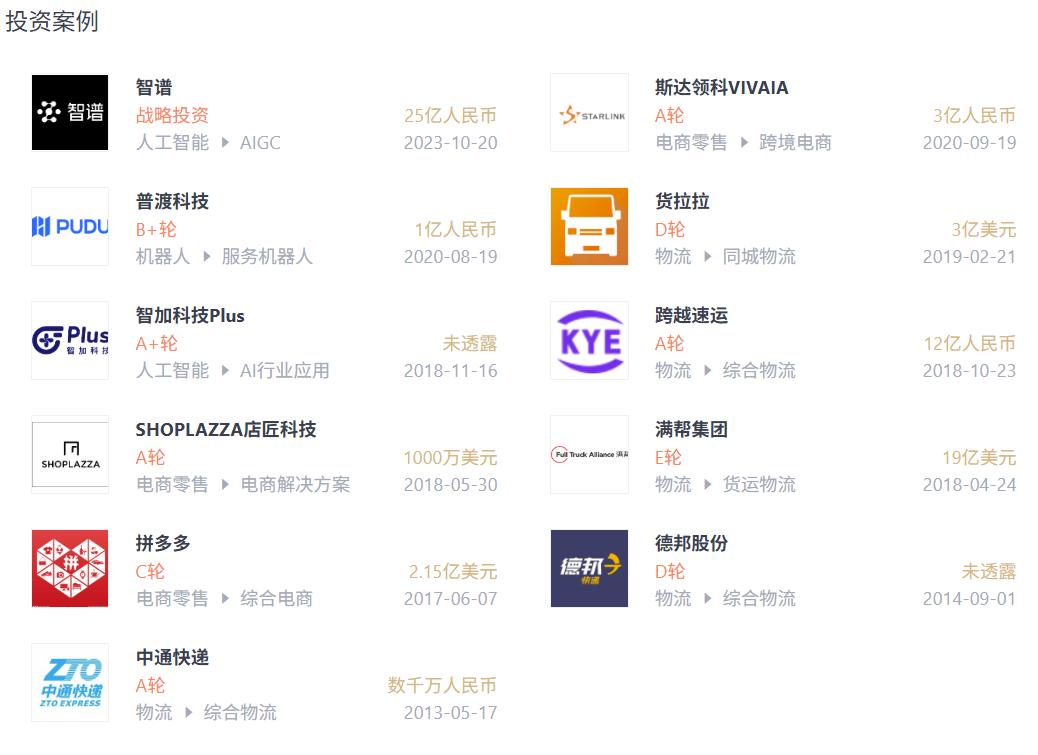
Some of Guo Shanshan's investment cases. Source: IT Juzi
In the 2023 Forbes China Top 100 Venture Capitalists list, Guo Shanshan's ranking jumped significantly from 27th in 2022 to 12th in 2023, making him second only to Neil Shen within Sequoia Capital China.
However, the positioning of Entropy Management was unexpected - it focuses on public - market equity investments, fund investments, and charitable activities, rather than the primary market that Guo Shanshan is familiar with.
He shared two considerations:
Firstly, he believes that his personality is more inclined to "gaining energy from solitude", while the primary market (VC) requires a lot of socializing and meeting people. The secondary market emphasizes restraint, risk control, and research on the company's fundamentals, which is more in line with his style.
Secondly, he mentioned that he is "afraid of regressing". He believes that continuing to work in the primary market at Sequoia would require as much effort and good luck as in the past 15 years, while shifting to the secondary market is relatively easier and has no historical baggage.
This may imply that even top - notch investors are looking for new battlefields and possibilities.
The Core Motivations for Investors to Leave
Think about it. Most of these people had reached high positions at Sequoia Capital China, such as partners or investment VPs. Isn't it more beneficial for their career development on such a platform? Why would they choose to establish their own institutions?
The core motivation is usually not a single factor but a combination of interest distribution, decision - making power, and track selection.
In terms of interest distribution, it may mean a higher carry ratio and a faster return cycle. In terms of investment decision - making power, they are no longer restricted by the processes and risk controls of large institutions and can make more flexible and rapid decisions, especially in early - stage investments.
In addition, some partners have in - depth knowledge in specific fields (such as the healthcare field). When their personal expertise deviates from the institution's strategy, leaving becomes inevitable.
In the investment industry, when reaching a certain height and position, everyone has to make a decision - to be a follower of Neil Shen or to become the next Cao Yi or Cao Xi?
For partners at Sequoia, staying on the platform means "a stable job", while founding a new institution is a "high - risk entrepreneurial venture".
- End -
More Articles
The Investment Heat in the Quantum Computing Track Rises Again: The Financing Amount in Q1 2026 Approaches the Whole of 2025
From YC to Returning to China to Start a Business, the AI - Native Hardware Company He Founded Announces Tens of Millions of Yuan in Financing
Just Two Days After the Company Was Founded, IDG Rushed to Transfer Funds! Who Is He?
When Young People Turn to AI Instead of Baidu for Answers, How Can Brands Get Recommended by Robots?
A New Unicorn Emerges in Hangzhou! An 85 - Year - Old Harvard Doctor Uses Brain - Computer Technology to Protect Autistic Children
WeChat Has Been Updated Again. If You Don't Star Our Account, You May Miss Our Posts and Won't Be Able to See the Cover Images. Please Click to Star Our Account to Receive Every Fresh Post in Time. We Look Forward to Meeting You Every Time.