Supply chain test for laser communication
Many people think that as long as there are satellites overhead, they can access the Internet.
They are completely wrong.
If you are in the center of the Pacific Ocean right now and a low - orbit satellite happens to fly overhead, congratulations — you are indeed "seen" by the satellite.
But if you want to watch a short video, sorry, this satellite can't help.
Because there is no ground gateway station directly below it, it is like a "blind man" unable to connect to the Internet. It can see you but cannot send data anywhere.
This is the most hidden pain point of the low - orbit constellation: No matter how many satellites there are, if there is no cooperation from ground stations, the coverage area will always be a false proposition.
The only way to break the deadlock is to let the satellites hold hands with each other and transmit data using lasers until the data is passed to the satellite passing by the gateway station.
This is Inter - Satellite Link (ISL) — the most hidden "load - bearing wall" of commercial spaceflight.
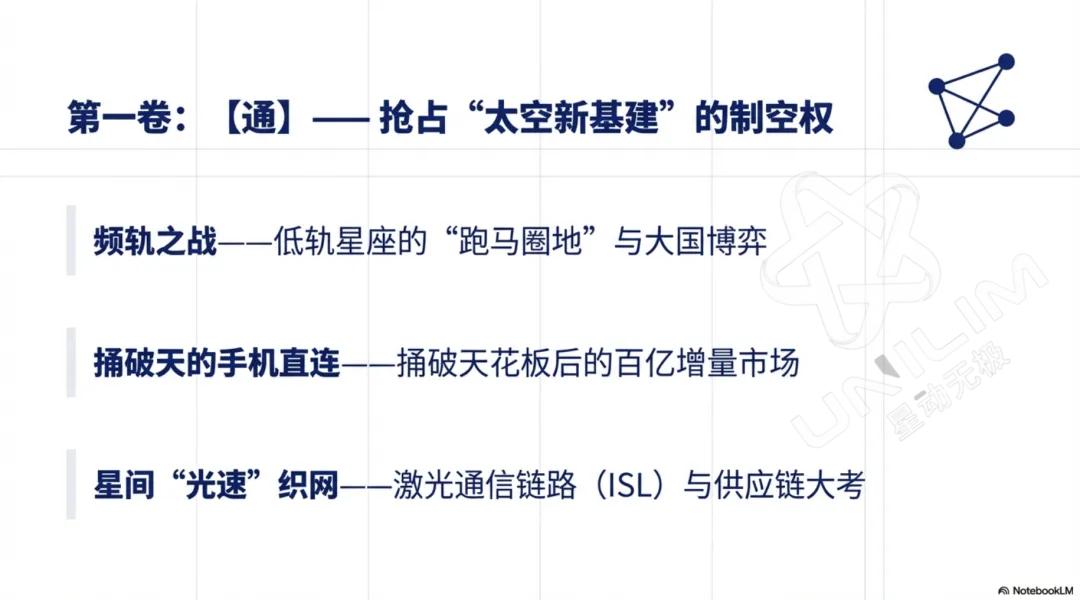
If the previous two articles (The Battle for Frequency and Orbit: The "Enclosure" and Great - Power Game of Low - Orbit Constellations and The Technical Dark Battle of Mobile - to - Satellite Direct Connection in 2026) explored the "foundation" and "facade", this article will directly target the most hardcore supply - chain battlefield in commercial spaceflight.
From the "artwork" in the laboratory to the "industrial product" on the assembly line, the mass production of laser communication terminals is holding back the global constellation construction.
I. The Limits of Physics and Engineering: "Threading a Needle" at a Speed of 27,000 Kilometers per Hour
Inter - satellite communication is not a new thing.
As early as last century, satellites transmitted data through microwaves. But microwave communication has a fatal bottleneck, that is the limited frequency - band resources, the inability to increase the bandwidth, and the ease of signal interception and interference.
Laser communication is completely different.
First, there is the bandwidth.
The carrier frequency of lasers is in the order of hundreds of THz, several orders of magnitude higher than that of microwaves. What does this mean? The transmission rate of a single laser link can reach dozens of Gbps or even hundreds of Gbps, while microwave links usually hover between a few hundred Mbps and a few Gbps.
For low - orbit constellations that need to transmit a large amount of remote - sensing data or support broadband Internet services, this is a qualitative difference.
Second, there is the confidentiality.
The divergence angle of the laser beam is extremely small, usually only a few milliradians, which means that the signal is almost impossible to be intercepted by a third party. In military and sensitive commercial applications, this is an irreplaceable advantage.
The best part is that laser communication does not require applying for a frequency band from the International Telecommunication Union (ITU). In today's increasingly tense spectrum resources, this is like an "outlaw", not restricted by ground communication rules.
But the price of laser communication is extremely high engineering difficulty.
Making two satellites thousands of kilometers apart "talk" with lasers, the biggest challenge is not to emit the laser, but to make the laser accurately hit the target.
Imagine this scenario: Two satellites are flying at a speed of 7.5 kilometers per second, equivalent to 27,000 kilometers per hour. The distance between them may range from a few hundred kilometers to several thousand kilometers, and their relative positions are constantly changing. The divergence angle of the laser beam is extremely small, usually only a few milliradians, which means that the diameter of the light spot of the beam thousands of kilometers away is only a few dozen meters.
To keep the lasers of two satellites aimed at each other during such high - speed movement, the difficulty is equivalent to: Standing in Beijing and accurately hitting a coin held by someone in Shanghai with a laser pointer, and both people are on a high - speed train.
This is the problem that the PAT system (Pointing, Acquisition and Tracking) needs to solve.
The working principle of the PAT system can be simply understood in three steps:
Acquisition: Two satellites first need to "see" each other. Due to the uncertainty of the initial position, usually a beacon light is used for large - angle scanning until the detector captures the signal from the other side.
Pointing: After successful acquisition, the main communication laser needs to be accurately aimed. This step requires extremely high precision, usually requiring micro - radian - level control.
Tracking: During the communication process, due to factors such as satellite attitude jitter and orbital perturbation, the laser beam will continuously deviate, and real - time adjustment is needed to maintain the alignment.
The core component to achieve all this is the Fast Steering Mirror (FSM).
What is the Fast Steering Mirror (FSM)?
If the laser communication terminal is compared to an eye, the fast steering mirror is its "eye muscle" — responsible for adjusting the beam direction at a microsecond - level speed to offset the slight jitter of the satellite's attitude.
The working principle of the FSM is based on the drive of piezoelectric ceramics or voice - coil motors. When the satellite's attitude changes slightly, the sensor will detect the deviation within a microsecond. The controller calculates the compensation angle, and the FSM completes the angle adjustment within milliseconds or even microseconds to ensure that the laser beam is always aimed at the target.
The technical threshold of this component is extremely high.
First, the response speed should be fast — the frequency of satellite attitude jitter may range from dozens to hundreds of hertz, and the response bandwidth of the FSM needs to reach several thousand hertz.
Second, the precision should be high — the precision of angle adjustment needs to reach the micro - radian level.
Third, the reliability should be strong — it should work continuously for several years without failure in the extreme space environment.
In the past, high - performance FSMs were almost monopolized by a few European and American companies, and the unit price was often hundreds of thousands of dollars. This is one of the important reasons for the high cost of inter - satellite laser communication.
II. The Cliff of Mass Production: The Pain of Transition from "Research - Oriented Customization" to the "Ford Assembly Line"
The cost curve of inter - satellite laser communication terminals is experiencing a cliff - like decline.
In the past, the cost of a single laser terminal used for deep - space exploration or national - level verification satellites was often tens of millions or even hundreds of millions of RMB. They were hand - crafted, and only a few could be produced in a year.
In the current situation in 2026, facing the launch demand of hundreds or thousands of satellites per year for the "Thousand - Sail Constellation" and "Starnet", the cost of laser terminals must be drastically reduced to the million - level or even hundreds of thousands of RMB.
Taking SpaceX's Starlink as an example, the cost of its inter - satellite laser terminals has reportedly dropped below $100,000. Considering that the number of Starlink satellites is in the tens of thousands, this cost level is the basis for commercial sustainability.
Although the scale of domestic constellations is currently smaller than that of Starlink, the "Thousand - Sail Constellation" is planned to have more than 15,000 satellites, and "Starnet" will have more than 30,000. The demand for low - cost laser terminals is equally urgent.
This is not a simple price reduction, but a reconstruction of the entire industrial logic. Behind the cost reduction is the reconstruction of a complete supply chain.
Component selection (replacing aerospace - grade components with industrial - grade ones): Traditional aerospace - grade components, although highly reliable, are expensive and have a long procurement cycle. Commercial spaceflight companies are increasingly using industrial - grade or even automotive - grade components instead, and compensating for the reliability gap of single components through redundant design and system - level reliability engineering.
Opto - mechatronic integration design: In traditional laser terminals, the optical system, mechanical structure, and electronic control are often designed separately, and the assembly and debugging are complex. New - generation products tend to have a highly integrated design, reducing the number of components and the difficulty of assembly.
Automated assembly and testing (replacing manual adjustment): Manual adjustment is a major cost. The industry is introducing automated assembly lines and optical automatic alignment equipment to significantly improve production efficiency.
The laser communication market in commercial spaceflight is in a stage similar to the chaotic period of mobile phone charging interfaces in the past.
The wavelength standards are not unified. Some use 1550nm, some use 1064nm, and some use other bands. Optical devices of different wavelengths are not interchangeable.
The communication protocols are fragmented. SpaceX's Starlink, OneWeb, Amazon's Kuiper, and domestic constellations like "Thousand - Sail Constellation" and "Starnet" each have their own communication protocols. Terminal manufacturers need to customize and develop for different customers.
Moreover, the interface specifications vary widely. The mechanical, electrical, and thermal interfaces of each company have different standards, increasing the difficulty of integration.
This chaos is a kind of protection for the first - movers. Once a terminal manufacturer enters the supply chain of a certain constellation, it is difficult for later - comers to replace it.
But for the entire industry, it means repeated construction and waste of resources.
The process of standardization is slowly advancing. The Consultative Committee for Space Data Systems (CCSDS) internationally is formulating relevant standards, and in China, it is being promoted by the Aerospace Standardization Research Institute. But in the face of commercial interests, standardization is destined to be a long - term game process.
III. Looking for the "Water Sellers": The Battle of Domestic Substitution of Core Components
Upstream Bottlenecks: Breakthroughs of Three Types of Core Devices
(1) Fast Steering Mirror (FSM) and Its Drive
The FSM is the core executive component of the laser terminal, directly determining the performance of the PAT system.
From the perspective of drive mode, FSMs are mainly divided into two categories:
Piezoelectric ceramic drive: It has a fast response speed (microsecond - level) and high resolution, but a small stroke (usually only a few milliradians). It is suitable for high - precision, small - angle fast adjustment.
Voice - coil motor drive: It has a large stroke (up to dozens of milliradians), but a relatively slow response speed (millisecond - level). It is suitable for large - angle acquisition and coarse tracking.
In practical applications, a composite structure of "voice - coil motor + piezoelectric ceramic" is usually adopted: the voice - coil motor is responsible for large - angle coarse adjustment, and the piezoelectric ceramic is responsible for high - precision fine adjustment.
In the past, high - performance FSMs were almost monopolized by a few companies such as Ball Aerospace in the United States and Physik Instrumente in Germany. Although China has a research foundation in institutions such as the Chinese Academy of Sciences and China Aerospace Science and Technology Corporation, it has long lagged behind in productization and engineering.
But changes are taking place, and a number of specialized and innovative enterprises are emerging.
A piezoelectric ceramic enterprise (name withheld at the request of the enterprise) relying on the background of the Chinese Academy of Sciences has accumulated a deep foundation in piezoelectric ceramic materials and precision drive technology. Its FSM products have entered the testing and verification stage of many commercial spaceflight companies.
A precision optical enterprise originally engaged in optical components for semiconductor equipment has entered the aerospace field with its precision machining capabilities. Its voice - coil motor - driven FSM has reached the international advanced level in terms of stroke and precision indicators.
The difficulties in domesticating FSMs lie in the need to break through in three aspects: materials (piezoelectric ceramics), precision machining (mirror substrates), and control algorithms (high - speed closed - loop control), and none of them can be missing.
(2) High - Sensitivity Detectors — the "Retina" for Receiving Weak Light Signals
After the laser travels thousands of kilometers in space, the signal will be greatly attenuated. The receiving end needs a detector with extremely high sensitivity to extract effective information from the weak light signal.
Currently, there are two main types of detectors:
APD (Avalanche Photodiode): It has high sensitivity, fast response speed, and mature technology, and is the mainstream choice for current inter - satellite laser communication.
SPAD (Single Photon Avalanche Diode): It has higher sensitivity and can detect single photons, but has a large noise and requires complex post - processing algorithms. It is used in extreme low - light scenarios such as deep - space communication.
The progress of domesticating detectors is relatively fast. After years of development in the domestic optical communication industry, considerable strength has been accumulated in the field of optical chips.
Accelink Technologies, Hisense Broadband and other traditional optical communication giants have widely applied their APD products in the ground optical fiber communication market and are expanding into the aerospace field.
Guoke Quantum, Wentian Quantum and other quantum communication enterprises have unique accumulations in single - photon detection technology, and the technical indicators of their SPAD products have reached the international advanced level.
The Institute of Semiconductors of the Chinese Academy of Sciences, China Electronics Technology Group Corporation and other research institutions are also continuously promoting the independent research and development of aerospace - grade detectors.
The difficulties in domesticating detectors lie in that aerospace - grade products need to meet strict requirements in terms of radiation resistance, wide - temperature operation, and long service life, which require a large amount of experimental verification and data accumulation.
(3) High - Power Erbium - Doped Fiber Amplifier (EDFA) — the "Energy Pump" for Long - Distance Laser Transmission in Space
When the laser travels thousands of kilometers in space, attenuation is inevitable. To ensure sufficient signal strength at the receiving end, the transmitting end needs to increase the laser power as much as possible. However, limited by the power of the laser itself, an optical amplifier usually needs to be configured at the transmitting end to increase the laser power to the watt - level or even ten - watt level.
EDFA (Erbium - Doped Fiber Amplifier) is the most mainstream optical amplification technology at present. It uses erbium - doped fiber as the gain medium and amplifies the signal light under the action of the pump light.
The technical threshold of EDFA lies in high power, high efficiency, and high reliability. Aerospace applications also require miniaturization, low power consumption, and radiation resistance.
The domestic EDFA industry also benefits from the development of ground optical communication.
Accelink Technologies, O - Network Technology, and Dacheng Optoelectronics and other enterprises have quite mature EDFA products in the ground optical fiber communication market and are making adaptive improvements for aerospace applications.
China Aerospace Science and Technology Corporation, the Chinese Academy of Sciences and other institutional units are also independently researching and developing aerospace - grade EDFAs.
The difficulties in domesticating EDFAs lie in the need to balance power, efficiency,