6G, Reaching from the Ground to the Sky
Mobile communication technologies iterate at a rhythm of one generation per decade.
The sixth - generation mobile communication technology (6G) targeting the year 2030 has entered a critical window period —
By 2026, the key technologies of global 6G are being verified, the standards are being established, and the prototype devices are being tested. All these indicate that 6G is no longer just a technological vision on white papers but is moving towards engineering reality.
The global competition around 6G technologies, standards, and industries has fully unfolded.
As the fourth installment of the "Prospects of Modern Communication and Intelligent Network Technologies" series in "Starship Knowledge Manufacturing", we invited Dr. Qian Hongsheng, a professor - level senior engineer in the communication industry, to write "Research on the Leap - forward Evolution of 6G from Concept Blueprint to Engineering Experiment".
This article is the first part, mainly focusing on two questions:
1. Since 5G is still being deeply implemented, why must we move towards 6G?
Where are the boundaries of 5G? What can 6G achieve that 5G cannot?
2. In the global communication competition, where does China stand at this moment?
The boundaries of 5G cannot hold back future demands
What we often hear as "1G, 2G... 5G, 6G" actually refers to "1G standard, 2G standard... 6G standard", all of which are wireless communication technology standards.
For example, 5G is the fifth - generation mobile communication technology — 5th Generation Mobile Communication Technology, abbreviated as 5G.
The iteration of these mobile communication technology standards has never been self - entertainment for technicians. Instead, each generation unlocks new possibilities and new scenarios. Of course, each generation also has its own boundaries and life cycle.
From a personal perception perspective, each generation of standards corresponds to the memory of an era —
1G freed us from the shackles of telephone lines. Holding the bulky "Big Brother" phone in hand was a symbol of status and the beginning of the mobile era.
With 2G, we chatted on QQ and first experienced what it meant to be "online".
With 3G, we browsed Weibo, opening the door to the mobile Internet and giving birth to the early mobile application ecosystem.
4G supported short videos, live broadcasts, and mobile payments. A single mobile phone could contain our entire lives.
What about 5G? To some extent, it didn't produce as many national - level applications as in the 4G era. But this is not a problem with 5G. As a technology and a standard, 5G solves problems on the technical and network sides. The weak perception among end - users has multiple reasons, including too few relevant applications and products. However, 5G has established the foundation for the full interconnection of people, machines, and things.
When it comes to the game of standard dominance, the story becomes much more complicated.
In the 1G era, Europe set the rules, and China didn't even have the qualification to participate. The entire mobile communication market was divided among eight systems from seven countries, known as the "Seven Countries, Eight Systems".
In the 2G era, Europe's GSM and the US's CDMA were in a stalemate, and China remained an onlooker.
In the 3G era, the situation finally changed. China's TD - SCDMA, Europe's WCDMA, and the US's CDMA2000 were listed as the three major international standards for the first time.
Since the introduction of the first GSM commercial system in 1992, China took ten years to develop 280 million mobile users, becoming the world's largest mobile operation network — and also having its own bargaining chips.
In the 4G era, Europe was out, and there were only standards from China and the US globally. At the same time, the "Entity List" targeting Chinese enterprises emerged.
In the 5G era, it can be simply understood that everyone shares a set of standards, and each country adds its own technologies. For example, Huawei, ZTE, and Qualcomm in the US each hold multiple patents. Generally speaking, the US lags behind China in 5G, and thus has taken multiple measures for sanctions.
Different from the 4G era, in the 5G era, people no longer discuss 5G as a single communication technology but as the infrastructure for national development.
Mobile communication technologies iterate every ten years.
The evolution of 6G, like every previous generation of mobile communication technology, will go through the following six stages👇
1. Standard proposal
2. Standard formulation
3. Manufacturers develop equipment according to the standards
4. Telecommunication operators purchase advanced equipment
5. Network deployment
6. The whole process of business operation, etc.
Currently, global 6G is entering a critical window period for standard establishment and prototype device testing.
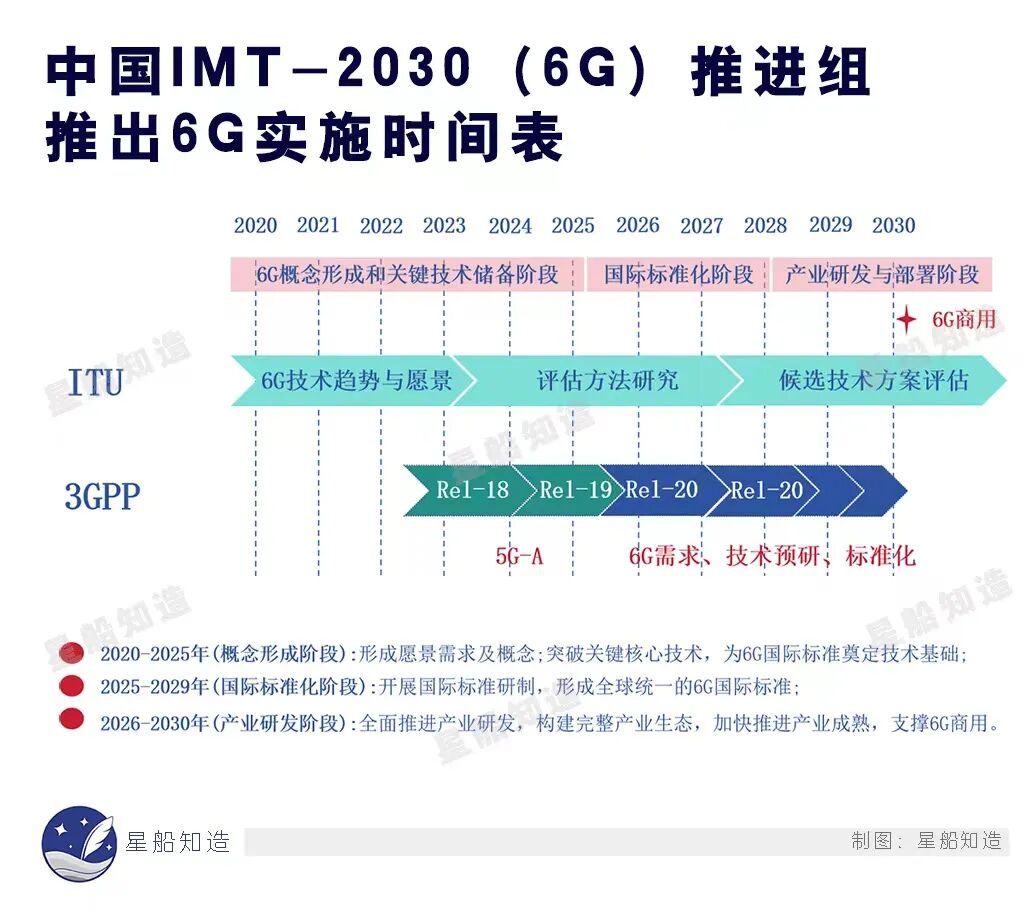
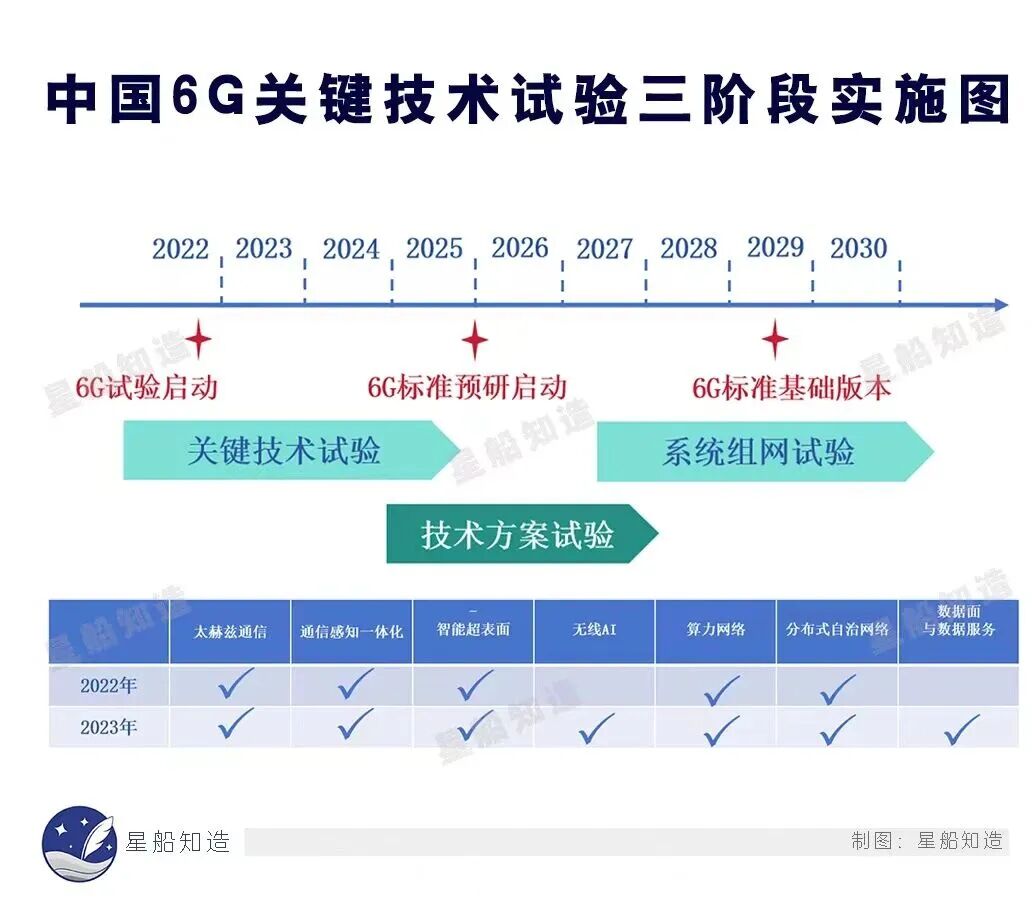
In January 2026, the State Council Information Office officially announced that China had completed the first - stage key technology tests for 6G R & D, formed over 300 key technology reserves, and officially launched the second - stage technology solution tests. This marks that China's 6G has completed concept verification and technology system construction and has fully entered the engineering implementation test period.
It is expected that before 2030, China's 6G will achieve large - scale network commercialization.
See the following figure for China's 6G implementation schedule👇
See the following figure for the three - stage implementation diagram of China's 6G key technology tests👇
Why must all major global powers move towards 6G?
Because the 10Gbps peak rate, 1ms latency, and ground - base - station networking mode of 5G are insufficient when facing future scenarios such as holographic communication, remote precise control, and coverage of ocean and desert blind areas: mainly not fast enough, not wide enough, and not smart enough.
Not fast enough — In terms of performance indicators, the peak rate of 5G is at the 10Gbps level. When facing the huge bandwidth requirements of future scenarios such as holographic communication, ultra - high - definition three - dimensional image transmission, and immersive interaction in the metaverse, it will seem not fast enough.
For example, the minimum air - interface latency is still 1ms. For scenarios such as remote precise industrial control, real - time response of unmanned systems, and high - level autonomous driving, this latency gap is sufficient to affect operational safety and the actual experience.
Not wide enough — 5G is a networking mode mainly based on ground base stations, which has natural coverage limitations👇
There are a large number of communication blind areas in areas such as the ocean, deserts, high altitudes, and polar regions, which cannot meet the continuous communication needs of scenarios such as ocean operations, polar scientific research, and emergency rescue.
As human activities are constantly extending to high altitudes, far - reaching seas, and deep space, the booming development of the low - altitude economy, satellite Internet, and ocean economy urgently requires an all - domain communication network with no dead angles and full coverage.
Not smart enough — The core capabilities of 5G are concentrated on "communication connection" and lack the integrated capabilities of environmental perception, distributed computing, and intelligent reasoning. In the future, intelligent industries, smart cities, and intelligent transportation require the network not only to play the role of a "data transmission pipeline" but also to become a "smart perception terminal" and an "intelligent decision - making brain", achieving the integrated fusion of communication, perception, computing, and intelligence.
Against this background, the core goal of 6G is —
From "ground coverage" to "full - domain coverage of air, space, land, and sea": It will break through the limitations of the ground, sending signals into the sky, the deep sea, and those corners that 5G cannot reach.
From "single communication" to "integration of communication, sensing, computing, and intelligence": It will no longer be just a simple connection but a fusion of connection and perception. Base stations can not only communicate but also "see" the environment; the network can not only transmit data but also perform computing and intelligence.
In short, the mission of 5G is "Internet of Everything". The vision of 6G is "Intelligent Internet of Everything"👇
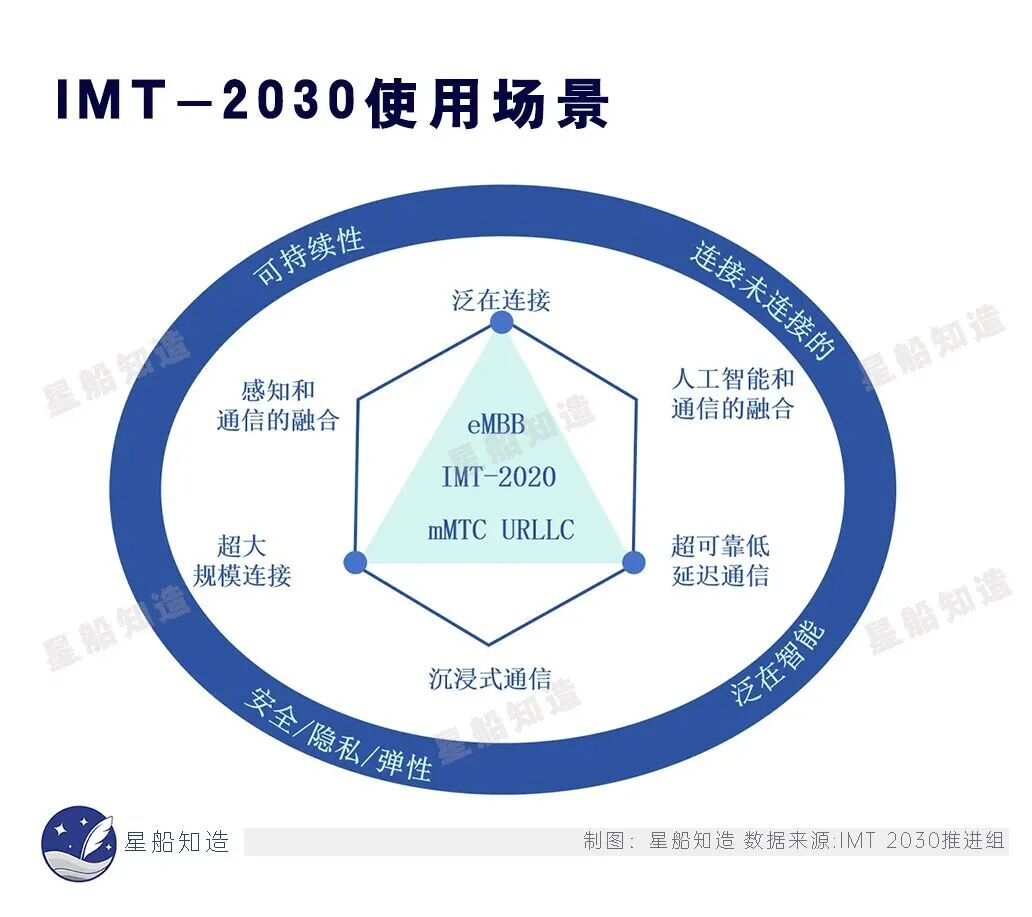
Illustration: 6G is envisioned to enable new usage scenarios, including immersive communication, ultra - reliable and low - latency communication, ultra - large - scale communication, and ubiquitous connectivity.
Compared with 5G, 6G needs to achieve "performance leap" and "scenario upgrade".
Let's first look at performance.
According to the latest indicators released by the ITU and the IMT - 2030 Promotion Group in 2025, the performance indicators of 6G have increased by ten times or even a hundred times compared with 5G. It will bring extreme breakthroughs in seven dimensions. Click on the following figure to enlarge👇
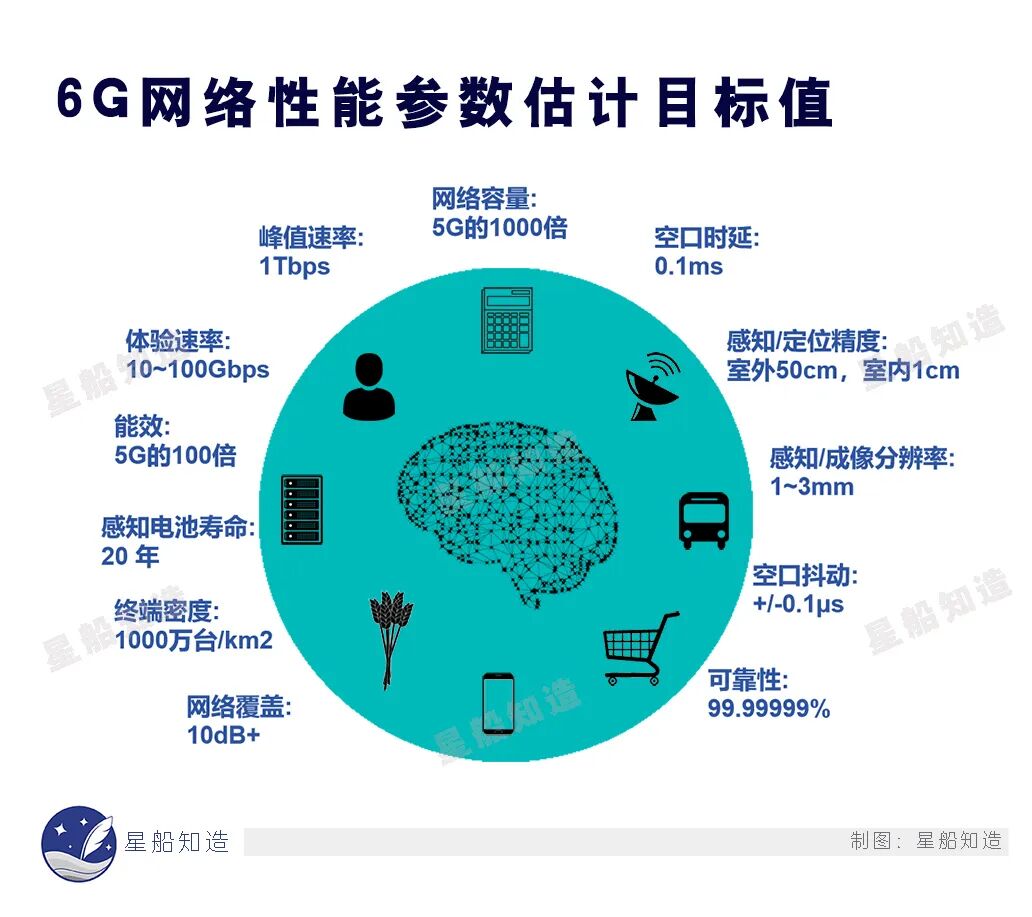
Figure: Estimated target values of 6G network performance parameters
The above figure shows "seven extreme performances":
First, ultra - high speed.
The peak rate of 6G can reach the 1Tbps - 10Tbps level, which is 10 to 100 times that of 5G, and the experience rate reaches 10 to 100Gbps.
An 8K ultra - high - definition movie can be downloaded in 1 second. Holographic content and metaverse interaction are no longer restricted by bandwidth.
Second, sub - millisecond latency.
The end - to - end latency is reduced to less than 0.1 milliseconds, a 10 - fold improvement compared with 5G. For the first time, the physical world and the digital world can be synchronized in real - time. Remote precise surgeries, industrial robot collaboration, and high - level autonomous driving can truly achieve "zero - latency" operations.
Third, ultra - dense connection: Thousands of devices can be connected to the same network, and the whole domain is interconnected.
The connection density reaches 1 million devices per square kilometer, which is 10 times that of 5G. Large - scale Internet of Things devices, massive sensors, and drone swarms can be online and connected concurrently. There will be no congestion in city - level Internet of Things applications.
Fourth, ultra - high mobility: Stay online at high speeds without connection interruption.
It supports a moving speed of over 1000 kilometers per hour. High - speed trains, civil airliners, and low - orbit satellites can maintain a stable connection during high - speed movement.
Fifth, full - domain seamless coverage.
6G will cover blind areas such as the deep sea, deserts, polar regions, and high altitudes that 5G cannot reach. Ocean operations, polar scientific research, and emergency rescue will have continuous and stable communication guarantees.
Sixth, sensing accuracy.
Centimeter - level or even millimeter - level sensing, with an imaging resolution of 1 to 3 millimeters. The network can not only transmit data but also complete environmental imaging, target tracking, and behavior recognition, becoming a real "intelligent sensing system".
Seventh, green and energy - efficient.
The network energy efficiency is increased by 100 times, and the battery life of terminal sensors can reach 20 years. The high - energy - consumption pain point of 5G base stations is expected to be completely solved in the 6G era.
Of course, these indicators are currently target values. As the standard - setting progresses, some parameters may be adjusted, and some extreme performances may not be met simultaneously. However, this does not affect the certainty of the overall 6G technology direction.

source: pixabay
Now let's look at scenarios.
The following scenarios are not just conceptual ideas in "Starship Knowledge Manufacturing", but are realities verified in China's 6G test network and have the foundation for large - scale implementation👇
Holographic communication and metaverse interaction: When having a cross - city meeting, the other person seems to be sitting right in front of you. In remote holographic teaching, the teacher seems to be walking beside you — Relying on ultra - high speed, low latency, and native AI capabilities, real - time holographic interaction between people and scenarios will become a daily occurrence.
Low - altitude economy and autonomous drone scheduling: Large - scale drone swarms can be accurately located and scheduled in real - time in the integrated air - space - land - sea network. Logistics distribution, power line inspection, emergency rescue, and agricultural plant protection — the value of the low - altitude industry will be further activated.
Intelligent connected vehicles and "vehicle - road - cloud integration": Sub - millisecond latency and centimeter - level positioning enable all - around real - time interaction between vehicles, roads, and the cloud. High - level autonomous driving above L4 level will have a communication foundation for implementation.
Industrial digital twin and unmanned manufacturing: Every device in the physical factory has