Why have Tencent, ByteDance, and Alibaba suddenly started "raising lobsters" collectively?
“I've always been afraid to install the original version, worried about information leakage. Today, I brought an old computer to give it a try.” At a recent offline installation event of a large company, Mr. Shang, who has been following “Lobster” for a long time, said.
Recently, several Internet companies have carried out offline installation activities for Lobster and successively launched new “Lobster” products they developed.
Why are large companies getting involved in the Lobster storm? Which one should novice users choose to install?
“Everyone is doing it”
“All companies are developing Lobster products. This is a trend.” At an offline installation event of a large company on the 14th, engineer Zhong Le (pseudonym) told China New Jingwei that they officially started developing Lobster products after the Spring Festival. In less than two weeks, they launched the Windows version installation package, and the MAC version will also be launched soon.
According to incomplete statistics by China New Jingwei, as of press time, 11 large Internet companies and technology enterprises, including ByteDance, Tencent, and Alibaba, have successively launched OpenClaw products. As early as January, JD.com officially announced the launch of OpenClaw cloud services.
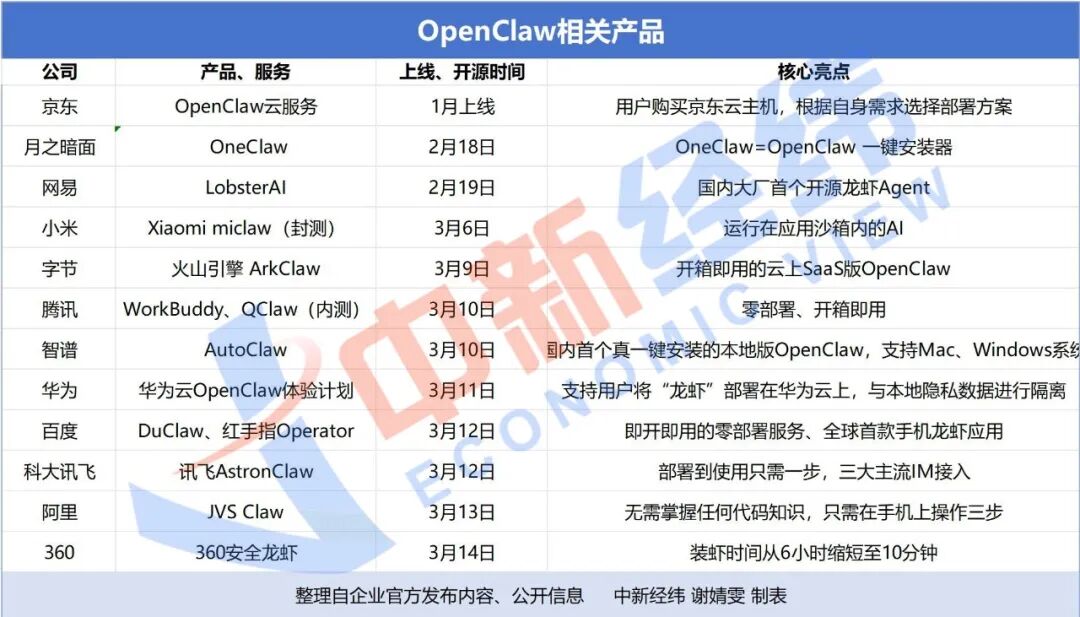
What's worth noting is that the new products recently released intensively are almost all responding to the biggest problems faced by users - high installation threshold and difficult uninstallation.
From the product introduction, compared with the original OpenClaw, which requires high - cost technical personnel for deployment, the new Lobster products recently launched by several large companies have the advantages of “zero deployment”, “ready - to - use out of the box”, and “simple operation”.
In terms of models, most Lobsters currently access the APIs of mainstream model manufacturers, including DeepSeek, Kimi, MiniMax, and GLM. According to an engineer, currently, some models have higher cost - effectiveness in token (the smallest data unit for processing text) consumption.
“This is a new battle for traffic entry.” At an OpenClaw exchange event held in Beijing on the 14th, Timi (pseudonym), the investment head of an enterprise, mentioned that due to the emergence of Agent, the advertising - based revenue model of Internet companies is being subverted.
Timi told China New Jingwei that now, major giants are competing to layout the Lobster business, which can at least ensure that they won't fall behind in the transformation. In his view, the Lobster entry is very likely to replace all mobile applications in the future.
According to reports from multiple media, on the 16th local time, Huang Renxun, the CEO of NVIDIA, said at the 2026 GTC conference that every enterprise in the world today needs to formulate an OpenClaw strategy, which is the new computer.
The original Lobster is not a consumer - grade product
While the technology circle is stepping up efforts to research and deploy OpenClaw, its security issues have also frequently attracted global attention. On March 18, the China Academy of Information and Communications Technology issued an article introducing that Lobster has three major pitfalls: “many self - vulnerabilities, easy for devices to be remotely controlled”, “many malicious skills, no guarantee for user data security”, and “no protection in community interaction, easy to be induced to launch attacks”.
The major Lobster - related products recently launched also focus on improving the safety factor, such as optimizing by isolating private data.
So, should novice users without a technical background install Lobster? And what should they pay attention to?
An industry insider who has used the original OpenClaw for more than a month told China New Jingwei that the original Lobster is not a consumer - grade product and is suitable for people with certain professional knowledge, such as professional developers. Currently, its technical requirements are relatively high, and it hasn't reached the stage where most ordinary users can operate it.
“The original version is suitable for people with certain professional computer knowledge who need to handle a large number of repetitive tasks. However, enterprises above the medium - size with a mature IT working environment and business security specifications basically won't allow employees to use it directly in the working environment.” The above - mentioned industry insider said.
Many industry - related people mentioned in interviews with China New Jingwei that the original Lobster is a relatively simple tool and usually needs secondary development for use.
Timi believes that for ordinary people, the Lobster products recently launched by domestic enterprises are completely sufficient. Users can experience them first and then use the original OpenClaw after having certain abilities.
“It depends on what you want to use Lobster for. If it's for a trial experience, you can use the Lobster products packaged by various AI companies. In this way, the installation cost is low, and you can experience the fun of Lobster as soon as possible; in - depth experience depends on whether you have a matching scenario for Lobster.” Yun Shu, a lecturer at the AGI community Vibe Coding, suggested.
On the 12th, at a Lobster media exchange meeting of an enterprise, for novice users who want to use Lobster, a security expert reminded: First, it's best to use a new computer; second, try to choose a Lobster that can run in a sandbox; third, be very careful when granting permissions. In addition, if the Lobster prompts that a patch should be installed later, users need to upgrade in time and do a good job in security defense.
The aforementioned article of the China Academy of Information and Communications Technology also reminded that individual users should adhere to three basic protection bottom lines when using Lobster - standardize the deployment method, use skill packages carefully, and do a good job in daily protection.
“Lobster can't be used casually.” Xiao Yanghua, a professor at Fudan University and the director of the Shanghai Key Laboratory of Data Science, said that there are security risks in unexamined and non - carefully deployed Lobster systems. Before installing Lobster, users can check whether the Skill is safe.
Regarding how to prevent privacy leakage, Xiao Yanghua suggested that when using Lobster, users should adhere to the principles of minimum collection, local or private processing of sensitive data, full - process encryption during transmission and storage, and strictly implement “authorization on demand, one - time authorization”, and at the same time, give users the right to query, delete, and turn off the memory.
The views in this article are for reference only and do not constitute investment advice. Investment is risky, and you should be cautious when entering the market.
This article is from the WeChat official account “China New Jingwei” (ID: jwview), written by Xie Jingwen, and is published by 36Kr with authorization.