Amid the surging computing power: Diamond copper ushers in a "must-have" moment
At the beginning of 2026, Jensen Huang, the founder of NVIDIA, made a high - profile visit to China, which instantly became a hot topic in the tech industry. Industry insiders revealed that one of the core purposes of his trip was to find an ultimate solution for high - end heat dissipation for NVIDIA's next - generation chips. In particular, Jensen Huang's meeting with Henan Chaoying Diamond Technology was keenly noticed by the industry, sending a clear signal that the "computing power overlord" was urgently seeking an ultimate solution to tame the fierce heat flow of the next - generation GPUs.
This move is not without reason. As early as CES 2026, NVIDIA officially announced that its next - generation Vera Rubin architecture GPUs would fully adopt the "diamond - copper composite heat dissipation + 45°C direct liquid cooling with warm water" solution, setting the tone for the global high - end chip heat dissipation technology route.
The Heat Dissipation Crisis Amid the Surge of AI Computing Power
Why does NVIDIA invest so much energy and resources in a single material? The answer may lie in the heat dissipation crisis behind the explosive growth of AI computing power.
In recent years, the demand for AI large - model training and inference has continuously increased the transistor density and operating frequency of chips. Heat accumulation has become the core bottleneck restricting the release of computing power. For every 10°C increase in temperature, the reliability of electronic devices decreases by 50%. More than 35% of electronic device failures are caused by overheating, and 40% of the energy consumption in AI data centers is used for heat dissipation.
Given the exponential growth of AI computing power, the outbreak of this "heat - cooling battle" seems inevitable.
As the power consumption of GPUs with the Blackwell architecture has exceeded 1000W, the Rubin architecture chips are moving towards over 1500W, with the peak power of some models approaching 2300W. The local heat flux density of the chips exceeds 1000W/cm², and traditional heat dissipation solutions are no longer effective.
For example, air - cooling technology is limited by the thermal conductivity of air and completely fails when the heat flux density exceeds 300W/cm². Although traditional liquid - cooling technology has some improvements, it has a long heat transfer path and high thermal resistance, which cannot meet the high - heat flux requirements of Rubin architecture chips. More importantly, traditional pure copper materials have inherent defects: their thermal conductivity is only 400W/(m·K), and their coefficient of thermal expansion (CTE) is as high as 16.5 - 17.5×10⁻⁶/K, which is significantly different from the expansion coefficients of silicon - based chips (3 - 4×10⁻⁶/K) and wide - bandgap semiconductors (4 - 5×10⁻⁶/K). Thermal stress is likely to occur during temperature cycling, leading to fatigue of the encapsulation layer and fracture of the welding interface.
Alloy materials such as tungsten - copper and molybdenum - copper can adjust the CTE to 6.5 - 7.5×10⁻⁶/K through composition adjustment, but they sacrifice thermal conductivity, with a thermal conductivity of only 180 - 210 W/(m·K), falling into a dilemma where high thermal conductivity and good matching cannot be achieved simultaneously.
It is obvious that traditional heat dissipation has reached its physical limit and cannot meet the heat dissipation requirements of ultra - high - power chips. NVIDIA urgently needs a multi - level architecture of "ultra - efficient local core heat dissipation + global efficient temperature control" to support further breakthroughs in chip power.
Diamond - Copper: A Game - Changer,
Breaking the Heat Dissipation Limit
The emergence of diamond - copper composite materials has achieved a game - changing breakthrough in technology.
It is understood that the core advantage of diamond - copper lies in the dual guarantee of ultra - high thermal conductivity and precisely adjustable coefficient of thermal expansion. The theoretical thermal conductivity of diamond can reach 2200 W/(m·K). After being combined with copper, the thermal conductivity of the material can be increased to over 600 - 1000 W/(m·K). At the same time, by adjusting the volume fraction and microscopic distribution of diamond particles, the CTE can be precisely adjusted to 5 - 7×10⁻⁶/K, which is highly compatible with mainstream semiconductor materials such as SiC and GaN, as well as the chip - PCB board combination.
This characteristic enables it to solve the heat dissipation pain points at the root. On the one hand, it can quickly conduct heat with high heat flux density, preventing local overheating of the chip. On the other hand, it can significantly reduce the pumping effect, reduce material warping and interface gaps, and improve the reliability of heat dissipation at the system level. In scenarios such as AI GPUs with power consumption exceeding 700W, HBMs with high - density packaging, and supercomputer chips, diamond - copper has become the irreplaceable optimal solution.
"Heat dissipation is no longer just an item for performance optimization but a strategic resource that defines the upper limit of products," said a heat dissipation expert from Huazhi New Materials, a wholly - owned subsidiary of Huatai Electronics. "When the chip power consumption breaks through the kilowatt mark, the problems caused by traditional heat dissipation solutions, such as performance frequency reduction, shortened lifespan, and increased energy consumption, are no longer tolerable. Diamond - copper has been upgraded from an 'optional solution' for high - end heat dissipation to a 'necessary option', which is an inevitable trend in the industry."
Jensen Huang's talks with heat dissipation solution suppliers and the simultaneous release of six chips on the Rubin platform, with the size of some chips expected to reach or exceed 100mm*100mm, further confirm this trend. The heat dissipation upgrade of large chips cannot rely solely on replacing traditional copper with diamond - copper. It is necessary to optimize from the overall system level.
NVIDIA's layout is not only to cool the current chips but also to pave the way for the next - generation 3D packaging and high - power - density chips, and diamond - copper is the core support of this strategy.
With the release of NVIDIA's solution, the focus of industry speculation has shifted from "what to use" to "how to use it". Will diamond - copper be used in the first - level packaging (heat spreader/heat sink) in direct contact with the chip or in the second - level packaging (liquid - cooling plate) for system - level heat dissipation?
From a technical perspective, the core value of the first - level packaging is to directly contact the chip to reduce the junction temperature, which requires extremely high matching of the material's coefficient of thermal expansion and high - quality interface bonding. The first - level packaging requires materials that can quickly conduct the core heat of the chip and adapt to the stress changes during temperature cycling to avoid damaging the chip. The heat - equalizing ability of traditional pure copper can no longer solve the problem of single - point local overheating of large - size SoC chips. The second - level packaging focuses more on system - level heat diffusion and achieves overall heat dissipation in combination with the cold plate. It is more sensitive to processing accuracy and cost control.
"NVIDIA may adopt an integrated solution of the first - level and second - level packaging," Huatai Electronics gave a clear judgment and technical prediction from the perspective of the industry supply chain. "The integrated innovation of the first - level and second - level packaging is the ultimate direction, but at present, the principle of coordinated optimization of cost and performance should be followed."
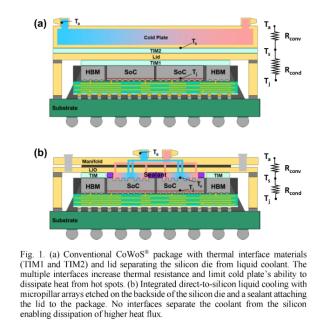
It is reported that NVIDIA is trying to fabricate micro - channels on silicon wafers and plans to make the diamond - copper heat spreader into a micro - channel structure simultaneously to achieve an integrated design of "chip - heat spreader - liquid cooling". This integrated solution is a complete optimization of the traditional CoWoS packaging heat dissipation system. The traditional CoWoS packaging has thermal interface materials (TIM1, TIM2), and there is a cover plate between the silicon chip and the coolant. Multiple interfaces significantly increase the thermal resistance and limit the heat dissipation ability of the cold plate for the hot spots of the chip. The integrated silicon direct - cooling solution etches micro - channels on the back of the silicon chip and uses a sealing material to seamlessly connect the diamond - copper micro - channel cover plate with the package, directly eliminating the barrier interface between the coolant and the silicon wafer and achieving efficient heat dissipation with a higher heat flux rate. However, the complexity of the welding process and the maintainability of the chip may be the key challenges to be overcome.
Huatai Seizes the AI Heat Dissipation Opportunity,
Constructs a Full - Scenario Heat Dissipation Map
In response to NVIDIA's possible technical path, Huazhi New Materials, a wholly - owned subsidiary of Huatai Electronics, has already formed a "dual - track parallel" layout strategy, and both tracks have entered the sample - sending and performance - verification stages for customers, forming a significant first - mover advantage.
At the first - level packaging level, Huatai Electronics has completed key simulation verifications, and the results show that diamond - copper has significant advantages over pure copper. It has laid out targeted welding solutions at the process end. By locally metallizing the diamond - copper and using soft solder to weld it to the back of the chip, it can quickly conduct the core heat. Huatai Electronics emphasizes that this solution can effectively solve the problem of local overheating of large chips and achieve rapid and uniform heat conduction.
At the second - level packaging level, Huatai Electronics has proposed a more feasible local inlay solution: inlaying diamond - copper materials in high - heat - flux density areas and then completing the overall heat conduction through the micro - channels of the liquid - cooling plate. This design takes into account both performance improvement and cost control and is the core optimization path for the second - level heat dissipation link.
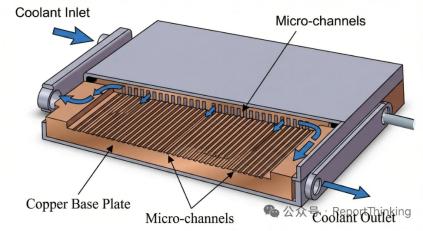
Image source: ReportThinking
As a company that started from the radio - frequency business, Huatai Electronics' cross - border logic of deploying diamond - copper stems from its long - term process accumulation and accurate insight into market demand.
It is understood that Huatai Electronics' diamond - copper business initially focused on the first - level heat sinks of high - power radio - frequency power amplifiers (PAs). At that time, silicon - carbide - based gallium nitride devices entered small - batch mass production, and traditional heat dissipation materials could no longer meet their high - power heat dissipation requirements. Huatai was the first to apply diamond - copper in this field. It was the almost - demanding heat dissipation requirements of radio - frequency PAs that forced Huatai to accumulate core technologies in diamond - copper interface modification, surface treatment, and precision processing. It has built a multi - series product matrix and completed the application for multiple core patents.
According to Huatai Electronics, "Our development path starts from specific needs and gradually expands the application scenarios. We initially focused on the first - level heat sinks of high - power radio - frequency power amplifiers, then expanded to the heat spreaders of digital chips, and then to the water - cooling plate solutions for the second - level heat sinks, forming a complete technological evolution context."
Now, relying on its core subsidiary, Foshan Huazhi New Materials Co., Ltd., Huatai Electronics has constructed a heat dissipation material matrix covering low - end, mid - end, and high - end full - scenarios. Its product line includes non - insulating heat dissipation materials such as molybdenum - copper, pure copper, and diamond - copper, as well as insulating and thermally conductive materials such as silicon nitride ceramics. At the same time, it has mastered core processes such as metal diffusion welding, CPC process, and micro - channel processing, completing the full - chain layout from material R & D to process implementation.
Among them, it has achieved a key breakthrough in the field of diamond - copper. Through the dual treatment technologies of surface metallization and copper - matrix alloying, it has significantly improved the interface heat transfer efficiency of the material. The thermal conductivity of its mass - produced diamond - copper products is stable at around 800W/(m·K), and it also has excellent thermal shock resistance. The overall technical level is in the first echelon in China, and it has become one of the earliest domestic enterprises to achieve mass production and commercialization of diamond - copper.
In terms of product implementation and application layout, Huatai Electronics has achieved full coverage of both the first - level and second - level packaging solutions for diamond - copper. The heat spreader/heat sink products for the first - level packaging use local metallization and soft - solder welding processes, which can effectively solve the problem of local overheating of large - size SoC chips and are currently being supplied in batches in the digital chip field. The liquid - cooling plate products for the second - level packaging use a local inlay design, inlaying diamond - copper in high - heat - flux areas to achieve a balance between heat dissipation performance and cost. The relevant products have completed sample - sending verification for customers.
Overall, from radio - frequency PAs to AI chips, Huatai Electronics' heat dissipation solutions have achieved full - scenario adaptation. For power chips such as silicon carbide and LDMOS, it combines the packaging capabilities of its Yaohua Factory to create exclusive heat sink solutions. For digital chips and computing power chips, it provides an integrated heat dissipation solution from the first - level heat sink to the second - level liquid cooling. For the extreme heat dissipation requirements of high - end equipment with a power of 4000W and a power consumption of 2000W, it has also developed a diamond - copper micro - channel liquid - cooling solution, which is currently in the technical demonstration stage.
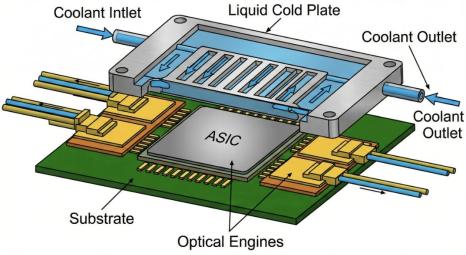
Image source: ReportThinking
The full - stack product and solution layout have given Huatai Electronics a significant first - mover advantage in the AI heat dissipation track.
Commercialization Bottlenecks:
Triple Challenges of Technology, Cost, and Ecosystem Collaboration
Although the diamond - copper track is highly popular, the industry generally believes that its application in data centers is still in the "early verification stage", and large - scale commercialization still faces multiple bottlenecks. Huatai Electronics pointed out that the core factors restricting its implementation are concentrated in three dimensions: technology, cost, and industrial chain collaboration.
At the technical level, three major problems restrict the industrialization process. First, diamond and copper are essentially non - wetting, and how to improve the interface thermal resistance between diamond and copper is the core of the technology. If the interface transition layer does not meet expectations, the thermal conductivity will be greatly reduced, even lower than that of pure copper. Second, the performance uniformity of large - size products. After the size of the diamond - copper composite material increases, local performance deviations are likely to occur. Third, the difficulty of precision processing. The high hardness of diamond leads to high processing costs.
At the cost level, the price of diamond raw materials is about 8 - 10 times that of pure copper. Coupled with the processing cost, it deters many low - and medium - power consumption scenarios.
At the industrial chain level, the collaborative system from material supply to chip design, packaging and testing, and system integration is not yet mature. There is a lack of a unified reliability evaluation standard, and the verification cycle is long.
In the face of these challenges, Huatai Electronics has achieved multiple core breakthroughs:
1) Overcoming the interface bonding problem and achieving performance breakthrough: Aiming at the problem of diamond - copper interface modification, through the dual technical means of diamond surface metallization and copper - matrix alloying, the interface transition layer reaches an ideal bonding state, and the interface heat transfer efficiency is significantly improved. The performance indicators are close to the theoretical values. At present, the thermal conductivity of its mass - produced diamond - copper products is stable at around 800W/(m·K), and it also has excellent thermal shock resistance. The overall technical level is in the first echelon in China.
2) Optimizing the process and production line to improve uniformity and reduce costs: By developing a multi - gradient sintering process, the problem of performance uniformity of large - size products has been effectively solved. At the same time, a dedicated processing line for diamond - copper has been established, which has significantly reduced the processing difficulty and manufacturing cost of the material, achieving a two - way optimization of product performance and cost