20 million "lobsters" enter enterprises: Alibaba's new story of enterprise agents | The front line
For Wu Zhao, the founder of DingTalk, the moment of epiphany in the AI era didn't come with the sudden emergence of ChatGPT, but as early as 2020. When he left DingTalk for the first time, he traveled across most of China, conducted research in many different cities, and then figured something out.
"I realized that the most disruptive change in the AI era is not something else, but the change of the user subject," he said. He noticed that in second - and third - tier cities and even more remote areas, due to the change of the Internet user subject, there emerged various different application supplies. The rise of applications like Pinduoduo is based on this logic.
After the arrival of large - scale models, this judgment became even clearer: In the AI era, the execution subject of the Internet has changed from humans to AI.
This judgment also ran through the new product launch event held by DingTalk on March 17.
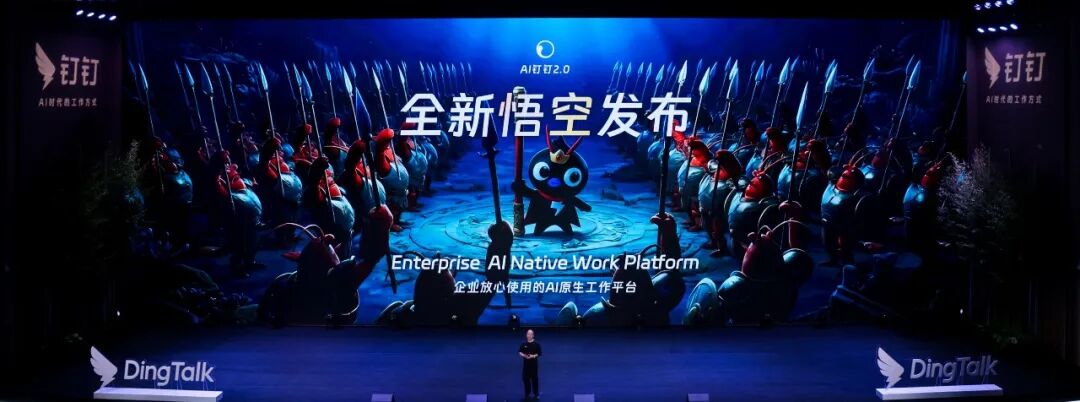
Almost at the same time, on March 16, Alibaba announced what is almost the most important strategic adjustment since the era of large - scale models - officially establishing the Alibaba Token Hub (ATH) business group and the Qianwen Division. Among them, the Wukong Division is positioned to "create an AI application entrance for the B - end and deeply integrate model capabilities into the enterprise workflow."
Source: DingTalk
This press conference took place when Alibaba completed a key strategic restructuring and was also the first official release of the ATH business group.
The most important change in DingTalk this time is the launch of a brand - new AI - native work platform called "Wukong". Symbolically, the business group where DingTalk belongs has been officially renamed the "Wukong Division".
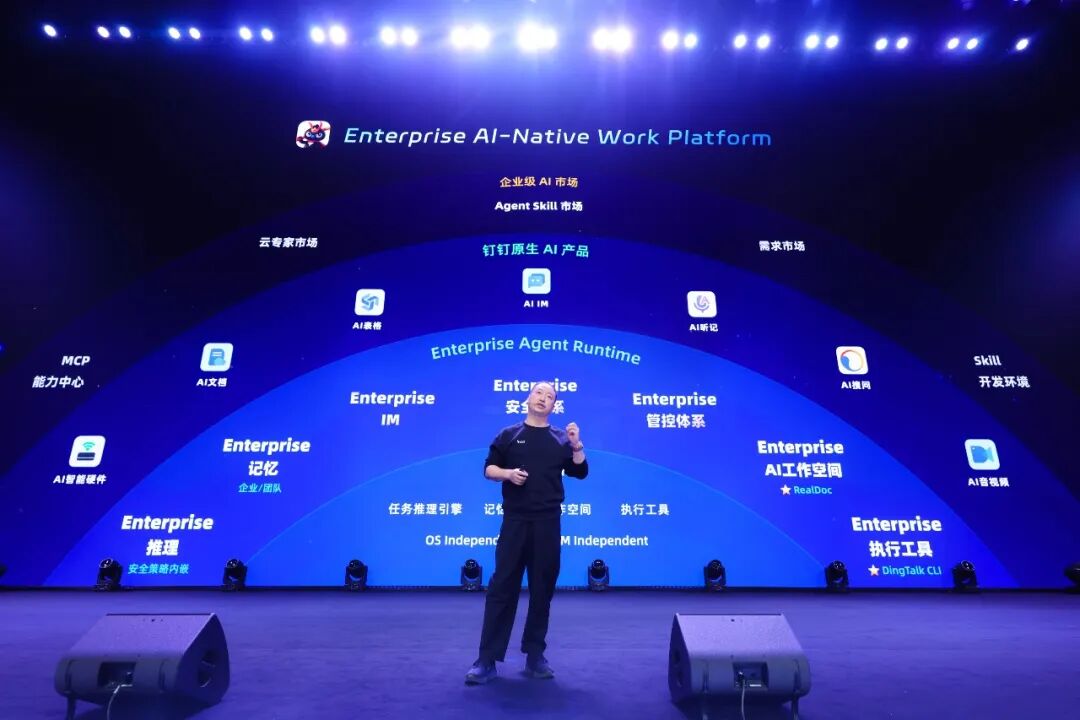
Wukong is independent of DingTalk but coexists with it in a close way. The Agent capabilities in DingTalk are provided by Wukong. This means that all 20 million existing enterprise users can also use the capabilities brought by Wukong in DingTalk in the future.
From the initial Laiwang, to DingTalk, and now to the "Wukong Business Group". Is this a kind of "self - revolution" to some extent?
Once upon a time, Wu Zhao whole - heartedly promoted DingTalk. He didn't even use WeChat himself and only used DingTalk to contact relatives and friends. But now, Wu Zhao said that he "has broken through self - attachment". "In the new era, it doesn't matter whether it's called DingTalk or Wukong," he said.
He explained that this is because the AI work platform in the new era does not depend on the DingTalk itself. "Whether you use DingTalk or not, whether you use Slack, Teams, Feishu, or Enterprise WeChat, it doesn't matter. Wukong can connect to all of them."
The birth of Wukong was not sudden. At the end of December last year, when DingTalk released the "Mulan Edition", Wu Zhao laid a foreshadowing: DingTalk's new positioning is Agent OS, the world's first intelligent operating system for AI work. At the same time, the enterprise AI hardware DingTalk Real was also launched. What was installed in this hardware at that time was the prototype of today's Wukong.
In terms of user experience, Wukong is a much more radical product than DingTalk. DingTalk has completed a comprehensive CLI (Command - Line Interface) transformation, allowing the Wukong Agent to natively operate thousands of DingTalk capabilities, rather than simulating human clicks on the graphical interface.
This means that functions that previously required human clicks on DingTalk can now be directly called by AI. When a user receives a customer email on the road, they can directly ask Wukong to remotely operate the company computer to download the file, organize it according to the previously processed customs declaration format, and send it back. The entire process does not require human intervention, and AI can complete the entire process of file downloading, format organizing, and sending to the mobile phone by itself.
From "personal toy" to enterprise productivity, Wukong focuses on enterprise - level security
Source: DingTalk
Most of the current AI Agents on the market can only do tasks such as writing copywriting and searching for information. Once they need to be connected to real - world enterprise business, problems arise: Who has the authority to call which data? Can the operations done by AI be traced? How to calculate the daily token cost? These problems have not been solved.
The design logic of Wukong is completely different. It directly inherits the enterprise's permission system. What data employees can see, AI can see. All operations run in the sandbox and can be traced. Token consumption is statistically calculated in real - time, and AI expenses are managed like a budget.
"This is the fundamental difference between Wukong and other AI Agents: Others solve the problem of making AI work, while Wukong solves the problem of making AI work safely, controllably, and with clear accounts in the enterprise," Wu Zhao said at the press conference.
Behind this difference is nearly 10 months of technical breakthrough by the DingTalk team. Wu Zhao admitted in an interview after the meeting that it is not easy to achieve enterprise - level security. "Just for file reading and writing, AI can do it thousands of times a second. To do version management and rollback, not many companies can achieve this."
While OpenClaw became popular, security issues also emerged. The National Internet Emergency Center issued a risk warning in March. The core problem is that the default security configuration is too weak, and it is easy for attackers to gain control of the system. Abroad, Meta and Google have already disabled or restricted OpenClaw on company devices.
DingTalk's attitude is also very clear. After OpenClaw became popular, many domestic enterprises inquired "whether they can use OpenClaw". The reply from DingTalk's customer service is: Without professional personnel to take security measures, it is not recommended to use it directly in the office environment.
Alibaba's B - end capabilities will be gradually connected, aiming for the "world's largest toB Skill market"
According to the plan, the B - end capabilities of Alibaba - affiliated companies such as Taobao, Tmall, 1688, Alipay, and Alibaba Cloud will be gradually connected to Wukong in the form of Skills.
Take product selection on 1688 as an example. In the past, merchants had to check the qualifications of suppliers one by one, compare prices, and negotiate terms. Now, Wukong can help users conduct background checks, automatically filter out unreliable suppliers, and give recommendations after comparing prices across the network. The entire procurement efficiency can be significantly improved.
Wukong has also launched an AI capability market, providing a full - set system from development, review, listing to distribution. Wukong is compatible with open - source Skills and aims to become the "world's largest toB Skill market".
Source: DingTalk
In addition, Wukong also released the OPT (One Person Team) solution this time, with the first batch of 10 industry versions launched: e - commerce, cross - border e - commerce, knowledge - based bloggers, development, stores, design, manufacturing, law, finance and taxation, and headhunting.
Different from most general Agent frameworks, Wukong OPT does not provide an empty framework but a packaged "Skill suite + workflow + industry data". Users only need to make decisions and accept the results, and the execution work is done by AI.
Cross - border e - commerce is a typical scenario. In the past, users had to check the hot lists on Amazon by themselves, compare prices on 1688, confirm inventory and logistics with suppliers, optimize product titles, and make multi - language videos. Now, with Wukong's "product selection radar - material production - selling point testing" process, a week's work can be completed in an afternoon.
Wu Zhao told 36Kr that in the future, the real competitiveness of Chinese Agents does not lie in competing in the field of native large - scale models. "In the model layer, China currently lags behind and needs time to catch up." The real strength lies in the combination of models and industries, using the models and experiences generated by industry data.
"If you can make AI understand the drawings of a manufacturing repair worker, the exponential transformation of China's production will begin," he said. "This is what we should focus on."
Source: DingTalk
Wukong's ambition is not limited to the domestic market. According to the plan, it will support connection to global mainstream IM platforms such as WeChat and Slack in the future, and can be used on both computers and mobile phones. For DingTalk's 20 million enterprise users, they can directly use Wukong after upgrading to the AI 2.0 version. The existing paid DingTalk customers can currently use Wukong for free.
The release of Wukong also marks that DingTalk has officially evolved from a collaborative office tool to an AI - native work platform. "In the past 11 years, DingTalk has changed our way of working. Today, Wukong is trying to define a brand - new way of working in the AI era," Wu Zhao said.