Claude Code and the man behind it
1
“Rome wasn't built in a day because it didn't have Claude Code.”
“Claude Code is all you need.”
“God took 7 days to create the world. If He had Claude Code, He could have launched on Monday and started iterating on Tuesday.”
“Interviewer: What programming language are you most proficient in? Me with Claude Code: English.”
“Previously, they were called full - stack engineers. Now, they're called 'people who can use Claude Code'.”
If you've delved a bit deeper into programming recently, you'll notice that the words “Claude Code” are appearing more and more frequently.
If someone understands technology, they'll tell you: Whatever Lobster can do, Claude Code can do it too.
Today, let's take a look at the great and amazing Claude Code. Please allow me to describe it this way.
Qian Zhongshu said:
“If you like an egg, why do you need to know the hen that laid it?”
Indeed, the frequent account - banning behavior of the company Anthropic and the anti - China remarks of its CEO have made me emotionally disapproving of this company.
But from a purely product perspective, this company does have something special.
It has successfully operated a technology brand and created an amazing product.
Although you don't like it, you have to use it.
So, with the attitude of learning from foreign technology to counter them, we also need to study it.
Next, Wei Xi will write several articles about Claude. This one is about the amazing product Claude Code and the man who created it, Boris Cherny.
I've searched for a lot of information, watched and listened to many interviews, and had many conversations with Claude opus4.6. The whole process was quite enjoyable.
Like Wei Xi's previous articles, this one is a bit long and a bit scattered, but it guarantees information density and incremental information. I'm sharing it with you —
2
I've always been curious — how did Claude Code become a programming tool that programmers almost worship like a religion?
Surprisingly, this tool was developed almost single - handedly by an immigrant engineer from Odessa, Ukraine, who had only joined Anthropic for a few months.
This man is Boris Cherny.
3
Boris was born in Odessa, Ukraine, and immigrated to the United States with his family in 1995.
That year, the Internet was in its infancy.
His grandfather was one of the earliest programmers in the Soviet Union, programming with punch cards. He didn't live to see the day when software replaced punch cards.
And his grandson eventually built an AI that can write code on its own.
4
Boris didn't receive any formal programming training. He learned to write code because he sold Pokémon cards on eBay in middle school —
By modifying the HTML of the product page to make it look better, he could sell the cards at a higher price. The blink tag helped him earn quite a bit.
He also hacked his TI calculator during a math exam to hide the answers and cheat.
Following the rules isn't his style. Later, he even set up a website to sell marijuana.
He studied economics in college but dropped out to start a business.
After dropping out, he started his first business at the age of 18. Later, he went to the hedge fund Coatue Management as an architect.
While working at the hedge fund, he had a serious motorcycle accident, breaking both his arms and couldn't write code for a month.
During the recovery period, because his hands still hurt, he was forced to learn programming languages with fewer keystrokes, and gradually got into Haskell and functional programming from CoffeeScript —
An accident actually broadened his technical vision.
5
In 2017, Boris joined Meta. He was promoted 4 levels in 5 years and eventually became a Principal Engineer — IC8, which is probably equivalent to P10 at Alibaba?
At Meta, he conducted a systematic causal analysis study, and the results showed that a clean codebase can improve efficiency by more than 10%. So, he pays special attention to code quality.
Before joining Anthropic, he also wrote a book: “Programming TypeScript: Making Your JavaScript Applications Scale”.
It was published by O'Reilly in 2019 — the first TypeScript book in O'Reilly's history.
6
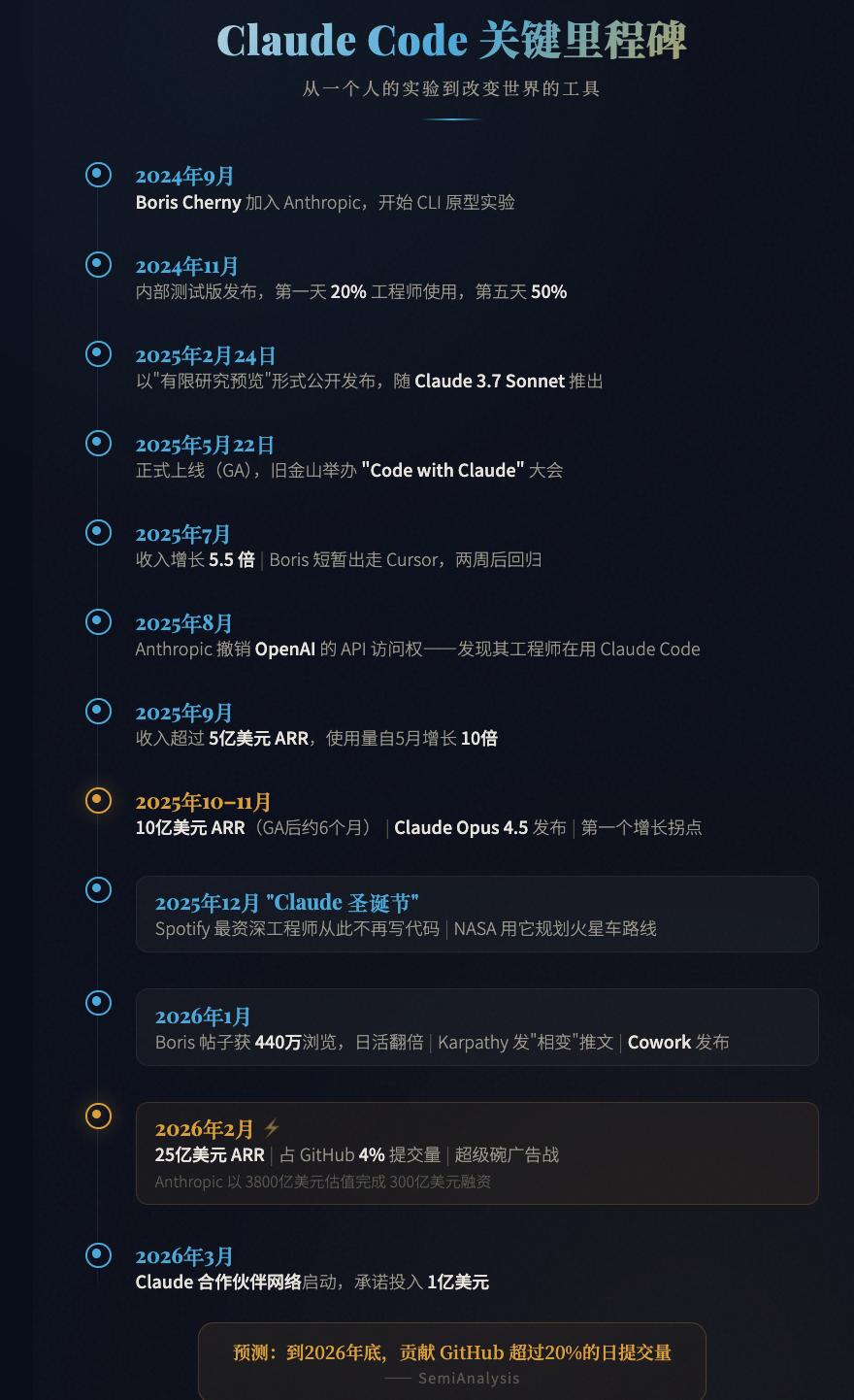
In September 2024, Boris joined Anthropic.
What attracted him was rather strange. During the interview, he had a meal in Anthropic's cafeteria and chatted with others. He casually mentioned an obscure science - fiction novel by Greg Egan, and found that everyone at the table had read it.
He thought this company was something special and decided to join.
His position is Member of Technical Staff — this is also the position of almost everyone at Anthropic. It's a very flat organization with technical employees.
His first PR (code submission) was rejected — The leader said it was because he wrote the code by hand.
The leader asked him to use Clyde (an internal predecessor tool). He rewrote the code with Clyde and it was successful on the first try.
This time, he had an intuitive understanding of the model's capabilities.
The key inspiration for Claude Code came from a conversation.
After chatting with Cat Wu (Anthropic's founding product manager, who was researching the computer operation ability of AI agents at that time), Boris had an idea —
Give the terminal access to the file system.
That's when the magic began.
7
In November 2024, Boris released a test version internally.
On the first day of its launch, about 20% of Anthropic's engineers started using it. By the fifth day, 50% of them were using it.
Now, more than 80% - 90% of Anthropic's code is completed by Claude Code.
Boris found that when the model has the ability to use tools, it shows an instinct — The model just wants to use tools.
“We found that the model already has a desire to use tools. We just gave it an outlet.”
This is highly consistent with a product design philosophy in Silicon Valley —
Don't assume what users need. Observe what behaviors they spontaneously generate in the product, and then turn that behavior into a product.
8
Why is Claude Code a command - line tool instead of an IDE?
Boris's logic is simple: The CLI is the fastest way to release and the easiest to iterate.
The terminal window doesn't need anyone's approval and doesn't need to go through any app stores. It can be updated at any time.
Many programming products stand in front of the model, building scaffolds by adding UI elements and other clutter.
Claude Code does the opposite.
Isaacson, the author of “Steve Jobs”, also wrote a book called “The Innovators”.
The book devotes a lot of space to the design philosophy of the legendary operating system UNIX — Small, modular, and combinable tools run in the terminal.
Claude Code's CLI - first design is a deliberate return to this philosophy. Its underlying tools (Read, Write, Bash, Grep, Glob) are the spiritual descendants of the UNIX toolkit.
Taste, Taste, and Taste again.
9
Claude Code is written in TypeScript, not Python.
This choice has a deeper meaning: TypeScript runs on the language that the Claude model is best at.
Yes, don't create friction between the tool and the model.
In contrast, OpenAI's Codex CLI chose Rust for performance and scalability.
Behind these two choices are two different worldviews: Anthropic chose affinity with the model, while OpenAI chose the limit of engineering performance.
The system prompt of Claude Code is about 2,800 tokens; the tool specification is about 9,400 tokens.
With just this little, Less is more.
Rich Sutton's “The Bitter Lesson” is framed next to the desks of the Claude Code team.
The core idea of this short article, published in 2015 and regarded as an AI bible, is simple: Believe in more general methods, and miracles will happen with generality.
(I suggest you find it and read it — it's very short, but you'll find it thought - provoking after reading.)
10
Claude Code also has a product philosophy: They always design products for the model six months from now.
Boris said that several co - founders of Anthropic are the top three authors of the “Scaling Laws” paper.
This exponential thinking has been deeply ingrained in Anthropic's DNA.
Claude Code's Agentic Search is based on glob and grep — two Unix commands that have existed for decades.
Anthropic initially tried complex methods like RAG and vector embedding, but finally found that directly using the simplest way to understand the codebase works amazingly well.
Trust the power of simplicity.
11
The Claude Code team never writes product requirement documents (PRD) or function planning books. They directly use code to make prototypes.
Boris said:
“Our culture is that we don't write much. We just show.”
Claude Cowork (the non - technical user version of Claude Code. Believe me, it's something you'll get addicted to once you use it. Go and try it. Tencent's WorkBuddy released a few days ago is a tribute to it) was developed by four engineers in ten days.
12
Another philosophy of the Claude Code team's work is: Provide unlimited tokens, but to a small number of people.
They force team members to use Claude Code to amplify their output. It's impossible to complete the work with a small number of tokens.
13
Boris himself opens five terminal tabs simultaneously every day. Each tab is an independent instance of Claude Code, and he can submit 20 to 30 PRs every day.
80% of the tasks start in Plan Mode.
Multiple sub - agents are used to review the code. The first batch of agents find problems (including false alarms), and then five more are activated to deal specifically with what the first batch of agents found.
14
“Latent Demand” — Perhaps a product that is misused is a good product.
After the release of Claude Code, non - technical people, such as financial analysts and salespeople, quickly started using it frequently. (I'm one of them. I use it to fix bugs, write PPTs on the web, change file formats, make English listening audio for my kids, and write articles.)
This misuse eventually gave rise to Claude Cowork — the non - technical user version of Claude Code.
15
Claude Code makes programmers addicted. A deep - seated psychological reason is that it gives a sense of inspiration —
It allows you to see things in your codebase that you've never noticed before from an AI's perspective.
Holmes has a classic line: “You do see, but you don't observe.” — You see, but you don't really notice.
The simplest principles lead to the same result.
16
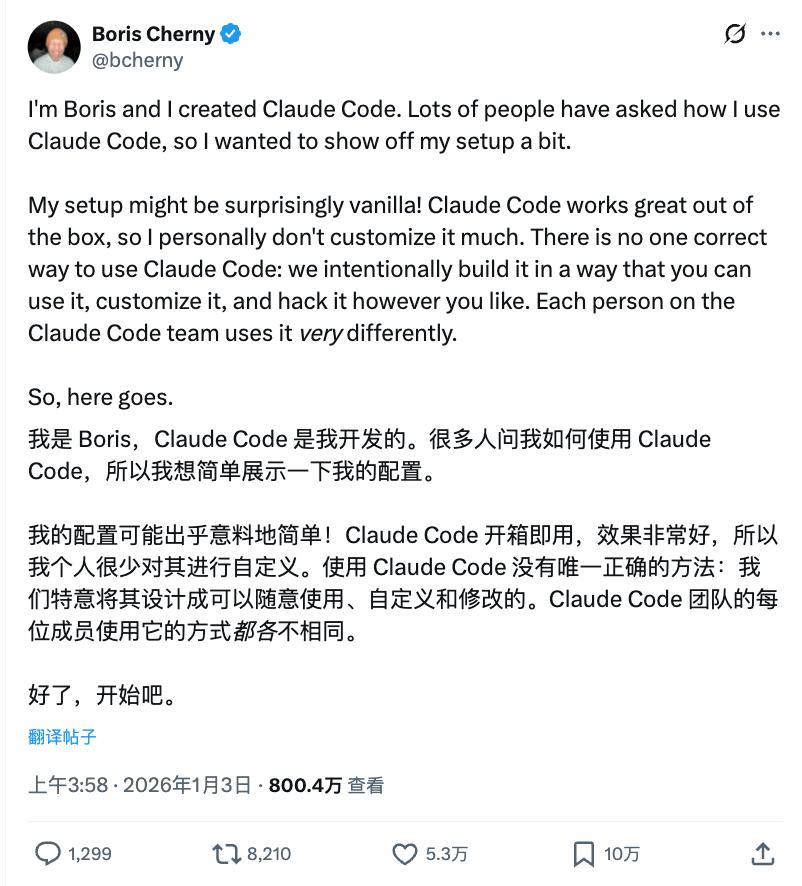
In January 2026, Boris posted a message on X, which was viewed 4.4 million times and then triggered an explosive growth in the daily active users of Claude Code.
The post is here: https://x.com/bcherny/status/2007179832300581177
The growth of Claude Code is not linear.
There are two obvious explosion points: one is in October 2025 when the model's capabilities significantly improved; the other is after Boris's post in January 2026, when the daily active users almost doubled.
The first explosion point comes from technology, and the second comes from promotion.
17
In February 2026, SemiAnalysis released an analysis report: Claude Code currently accounts for 4% of the public submissions on GitHub.
At this rate, by the end of 2026, it may contribute more than 20% of the daily submissions on GitHub.
The title of SemiAnalysis's report is just one sentence: “While you blinked, AI ate the entire software development.”
18
In December 2025, the co - CEO of Spotify said that Christmas was a singularity.
“When I talked to our most senior engineers, they said they hadn't written a single line of code since December.”
Anthropic's own data shows that from the early days of Claude Code's birth to one year later, the number of employees tripled, but the per - capita productivity of each engineer increased by about 70%.
A Google chief engineer publicly admitted at a Seattle gathering in January 2026 that Claude “replicated a year's worth of architecture work in an hour.”
19
Boris Cherny casually said a sentence in an interview, which spread widely in the programmer community:
“I uninstalled my IDE. I just didn't need it anymore.”
— I uninstalled my IDE because I no longer needed it.
The IDE is a programmer's temple.
But today, the temple has collapsed.
20
Boris shared the evolution of the proportion of AI - generated code in his work:
In February 2025, 20% of the code he wrote was generated by AI. In May, it was 30%. In November, it was 100% — he no longer writes any code himself.
21
Boris made a judgment in an interview: “This is the year of the generalist.”
Yes, the rise of generalists.
His logic is that when the execution cost approaches zero, judgment becomes the scarcest resource, and judgment often requires breadth, not just depth.
He predicts that the title “software engineer” will start to be replaced by “builder” this year.
“At this stage, it's safe to say that programming has been largely solved.”
If you said this two years ago, not many people would believe it.
Saying it today, most people just stay silent, and silence itself is the answer.
22
Hacker News is an important battlefield for programmers to discuss Claude Code.
“Claude Code is all you need” — 851 likes, 504 comments.
“Tell HN: I'm 60 years old, and Claude Code has reignited my passion” — 159 likes, more than 84 comments.
Kent Beck (a legendary software engineer