Investment enthusiasm in the quantum computing track is rising again: the financing volume in Q1 of 2026 is approaching that of the whole year of 2025.
Core Views
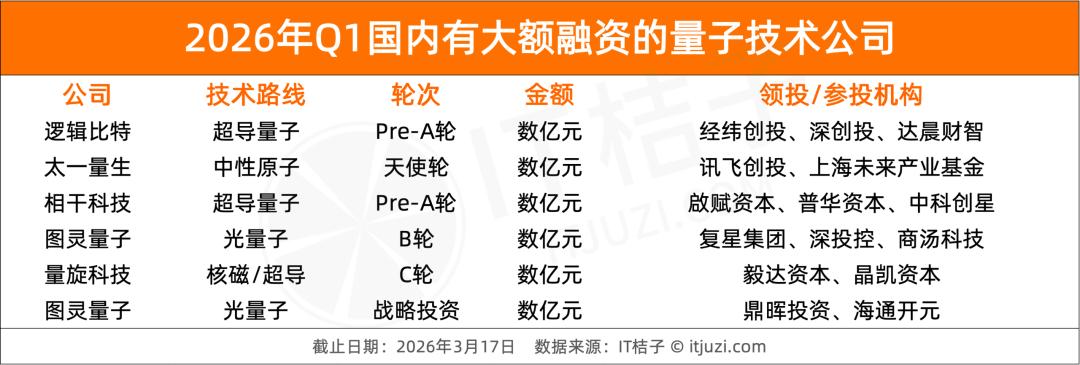
- The investment window has already opened. Today (March 17th), Logic Bit (Hangzhou Logic Bit Technology Co., Ltd.) announced the completion of a Series Pre - A financing of hundreds of millions of yuan. Well - known institutions such as Matrix Partners, Shenzhen Capital Group, and Fortune Capital jointly participated. This is the company's second financing since 2026, and the cumulative financing amount within the year is predicted to have exceeded 300 million yuan.
- The latest data from IT Juzi shows that the domestic quantum computing track is experiencing a significant capital recovery. As of March 17, 2026, IT Juzi has cumulatively recorded 150 financing events in this field, with an estimated total financing amount of 11.205 billion yuan. Notably, the total financing amount in the first three months of 2026 (up to March 17th) has reached 2.204 billion yuan, almost catching up with the full - year level of 2025 (2.473 billion yuan), and the monthly financing density has reached a record high.
Key Findings
● Sudden Rhythm Change: In 2025, there were 40 financings with a total of 2.473 billion yuan, while in Q1 of 2026 (as of March 17th), 17 financings with 2.204 billion yuan were completed, indicating an obvious trend of capital rushing in.
● Technology Route Differentiation: Photonic quantum computing (2.61 billion yuan, 30 financings), superconducting quantum computing (1.63 billion yuan, 16 financings), and quantum precision measurement (2.115 billion yuan, 25 financings) stand in a tripartite confrontation, with silicon quantum computing and quantum software rapidly catching up.
● Regional Pattern Echelons: Hefei (3.19 billion yuan), Beijing (2.57 billion yuan), and Shanghai (2.44 billion yuan) form the first echelon, accounting for 72.6% of the total financing amount.
● Valuation System Reconstruction: Leading projects such as Guoyi Quantum (valued at 8 billion yuan) and Turing Quantum (valued at 7 billion yuan) have entered the unicorn ranks. The investment logic has shifted from "looking at the team" to "looking at the number of physical qubits and engineering capabilities".
I. Market Heat: The Leap from the Laboratory to the Capital Table
1.1 Financing Rhythm: Characterized by "Acceleration" in 2026
Looking back at the domestic quantum computing investment and financing process, we can clearly see an evolution path from the technology verification period to the capital explosion period.
● 2017 - 2019: Cold start stage. There were only 8 financings in the entire track, with a disclosed amount of 243 million yuan. Most of them were angel rounds for startups led by university professors. The capital market's understanding of quantum computing still remained at the "concept verification" level.
● 2020 - 2022: Counter - cyclical growth period. Despite the impact of the pandemic, the number of financing events reached 34, with a disclosed amount of 3.645 billion yuan. The landmark event was that Origin Quantum completed a Series B financing of 1 billion yuan in 2022, kicking off the "billion - level" era of domestic quantum computing.
● 2023 - 2024: Rational correction period. Affected by the global ebb of hard - tech investment, there were 37 financing events with an amount of 1.726 billion yuan, and the valuation system went through a round of clearing.
● 2025: Recovery and warming. There were 40 financings throughout the year, totaling 2.473 billion yuan, and the main line of hard - tech investment was re - established.
● 2026: The market heat has shown exponential growth. In just Q1 (as of March 17th), 17 financings were completed, with a disclosed amount of 2.204 billion yuan. This phenomenon of "one quarter catching up with the whole year" reflects the strong expectation of the capital market for the commercialization inflection point of quantum computing.
Judging from the monthly distribution, in January 2026, the financing amount was 1.14 billion yuan (including large - scale transactions such as Turing Quantum's Series B and SpinQ Technology's Series C). In February, it was 450 million yuan, and as of the 17th of March, it had reached 620 million yuan. In particular, there were 3 financings on a single day on March 11th (Atom Matrix, Taiyi Quantum Life, and Logic Bit), indicating that funds are pouring in at an accelerating pace.
1.2 Large - scale Transactions: Billion - level Financings Become the Norm
There were 9 disclosed billion - level financings in Q1 of 2026, of which 3 were in the hundreds of millions scale:
● Logic Bit (March 17th, Pre - A/Pre - A+ rounds): Led by Fortune Capital and Matrix Partners, it focuses on the development of superconducting quantum computing chips and complete machines.
● Taiyi Quantum Life (March 11th, angel round): Led by iFlytek Venture Capital and Shanghai Future Industry Fund. It is a rising - star enterprise in the neutral atom route and set a record for the angel - round financing amount within half a year.
● Coherent Technology (February 9th, Pre - A round): Invested by Qifu Capital and Puhua Capital, it provides a full - stack solution for superconducting quantum computing.
In addition, Turing Quantum completed a Series B financing and a strategic investment on January 27th and January 8th respectively, with an estimated monthly financing amount of 600 million yuan, making it the biggest winner at the beginning of 2026.
II. Dispute over Technology Routes: Investment Logic of Parallel Multidisciplinary Approaches
Quantum computing has not yet formed a unified technology route like the "von Neumann architecture" in classical computing, and different physical implementation paths have their own advantages and disadvantages. IT Juzi data shows that the capital market is making "diversified bets" on each technology route.
2.1 Photonic Quantum Computing: A Pragmatic Choice with the Most Mature Industry Chain
In terms of cumulative financing amount, photonic quantum computing ranks first with 2.61 billion yuan, accounting for 23.3% of the entire track.
Its core advantage lies in industrial synergy. Relying on the mature optical communication industry chain, photonic quantum computing does not require an extremely low - temperature environment (dilution refrigerator) and can operate at room temperature. Moreover, it is naturally compatible with fiber - optic networks and can be easily integrated with existing cloud - computing infrastructure.
The leading projects have outstanding performances: Turing Quantum has cumulatively raised more than 1 billion yuan and is valued at 7 billion yuan. It focuses on photonic quantum chips and photonic quantum computers. Bose Quantum has released a coherent photonic quantum computer with 550 computational qubits and has established joint laboratories with several well - known universities. Jiuzhang Quantum, backed by the University of Science and Technology of China, developed the "Jiuzhang III" photonic quantum computing prototype, which is 1000 trillion times faster than supercomputers in solving specific problems.
For investors, the commercialization path of the photonic quantum route is relatively clear. In the short term, it can generate revenue through scenarios such as quantum AI acceleration and quantum secure communication, making it one of the options with the optimal risk - return ratio currently.
2.2 Superconducting Quantum Computing: The Choice of Giants and China's Catch - up
The superconducting route ranks second with a financing amount of 1.63 billion yuan, but the single - financing scale is relatively large, indicating high attention from capital to this route.
Superconducting quantum computing is the preferred route for international giants such as Google (achieved "quantum supremacy") and IBM (released a chip with more than 1000 qubits). It has the highest technical maturity, but also has extremely high engineering thresholds - it needs to operate in an extremely low - temperature environment below 10 mK and has strict requirements for measurement and control systems and quantum error - correction algorithms.
Logic Bit is a representative of this route. Founded by a team from Zhejiang University, it aims to achieve "logical qubits" with ultra - low error rates and has formed a full - process technical reserve covering the design of superconducting quantum chips, micro - nano processing, radio - frequency control, quantum computing, and simulation. The hundreds of millions of yuan Pre - A+ round financing completed today, plus the tens of millions of yuan Pre - A round on February 11th, have brought the estimated cumulative financing within the year to more than 300 million yuan, making it one of the companies with the fastest financing rhythm in 2026.
Origin Quantum, as the earliest domestic enterprise to layout the superconducting route, completed a Series B financing (1 billion yuan) in 2022 and is valued at 6.88 billion yuan. It has built a complete ecosystem from quantum chips to quantum cloud platforms.
2.3 Differentiated Opportunities in Other Routes
● Ion - trap quantum computing (financed 800 million yuan): Represented by Huayi Quantum (with a background from Tsinghua University and a Series A financing of hundreds of millions of yuan), it has extremely high technical precision but limited scalability, and is suitable for quantum simulation rather than general - purpose computing.
● Silicon quantum computing (1.29 billion yuan): Relying on semiconductor CMOS technology, it is compatible with existing chip - manufacturing production lines and has great potential for long - term cost reduction. Origin Quantum and others have already started to layout in this area.
● Quantum software and applications (1.85 billion yuan): Playing the role of "shovel sellers", Shenxi Fund, Baidu Ventures, Lenovo Capital and others completed 3 rounds of financing for Deep Science this year. It combines AI with quantum chemistry and focuses on materials research and development. Arc Quantum focuses on quantum EDA and measurement and control software, reducing the engineering threshold of quantum computing.
III. Regional Map: The Capital Siphon Effect of Scientific Research Sources
The financing in the quantum computing track shows a high degree of geographical concentration. Hefei, Beijing, and Shanghai have a combined financing of 8.196 billion yuan, accounting for 73.1% of the total scale, forming a "tripartite confrontation" pattern.
3.1 Hefei: The "Whampoa Military Academy" of Quantum Information
Hefei ranks first in the country with 34 financings and 3.19 billion yuan, and this advantage stems from the position of the University of Science and Technology of China as the birthplace of quantum information science.
● Origin Quantum (valued at 6.88 billion yuan and has cumulatively raised more than 2 billion yuan): It has built the most complete quantum computing industrial ecosystem in China, covering quantum chips, quantum measurement and control all - in - one machines, quantum operating systems, and quantum cloud platforms.
● Guoyi Quantum (valued at 8 billion yuan and a Series C financing of hundreds of millions of yuan): It is the leader in the field of quantum precision measurement. Its products include quantum diamond atomic force microscopes, electron paramagnetic resonance spectrometers, etc., targeting fields such as advanced materials, semiconductors, and life sciences.
In addition, projects such as Micro Era (quantum computing + biomedicine), Ocean Quantum (first - principles calculation software), and Guosheng Quantum (quantum industrial inspection) have formed a complete ecosystem from basic hardware to industrial applications. The "Quantum Avenue" built in Hefei High - tech Zone has gathered enterprises in the upstream and downstream of the industrial chain, forming a closed - loop from basic research to industrial application.
3.2 Beijing: The Arena of Tsinghua and CAS Systems
Beijing ranks second with 39 financings and 2.57 billion yuan, but has the largest number of projects, indicating the richness of the innovation ecosystem.
● Haidian District (12 financings, 580 million yuan): Relying on universities such as Tsinghua University and Beihang University, it has spawned projects such as Huayi Quantum (ion - trap, with a background from the Institute for Interdisciplinary Information Sciences of Tsinghua University), Zhengze Quantum (photonic quantum, with a background from the Department of Electronic Engineering of Tsinghua University), and Arc Quantum (quantum software, with a background from the Chinese Academy of Sciences).
● Economic and Technological Development Zone (13 financings, 980 million yuan): It has gathered hard - tech enterprises such as Bose Quantum (photonic quantum, with a 550 - qubit computer released) and SMIC Thermal (infrared quantum materials), with obvious advantages in industrial policies and space carriers.
● Chaoyang District (13 financings, 900 million yuan): It has enterprises such as Qike Quantum (ion - trap + quantum communication) and Zhongchuangwei Quantum (quantum secure communication network).
Beijing's characteristic lies in the continuous spillover of top universities and research institutions and the support of diversified industrial spaces such as Zhongguancun and the Economic and Technological Development Zone.
3.3 Shanghai: The Main Battlefield of Photonic Quantum and the Strong Intervention of State - owned Capital
Shanghai ranks third with 23 financings and 2.44 billion yuan, but has an absolute advantage in the field of photonic quantum computing.
● Turing Quantum (headquartered in Minhang District, Shanghai): A single project has contributed more than 1.5 billion yuan in financing, making it the absolute leader in Shanghai's quantum computing. The company focuses on photonic quantum chips and photonic quantum computers and completed two rounds of financing totaling 600 million yuan in January 2026. The investors include top institutions such as CDH Investments, Haitong Kaiyuan, and Fosun Group.
● Pudong New Area (8 financings, 540 million yuan): It has gathered emerging enterprises such as Taiyi Quantum Life and Micro Era, and Lingang New Area is also planning to build a quantum computing data center.
Another characteristic of Shanghai is the in - depth participation of state - owned industrial funds. Institutions such as Shanghai Future Industry Fund, Pudong Venture Capital, and Zhangjiang Science and Technology Investment were very active in Q1 of 2026, reflecting the local government's forward - looking layout of quantum computing as a future industry.
3.4 Differentiated Breakthroughs in Other Cities
● Shenzhen (9 financings, 910 million yuan): Represented by SpinQ Technology, it focuses on educational - level NMR quantum computers and industrial - level superconducting quantum computers and has completed a Series C financing (300 million yuan), forming a characteristic in quantum computing popularization and talent cultivation.
● Hangzhou (17 financings, 860 million yuan): Relying on Alibaba (T-head Semiconductor includes quantum computing research) and Zhejiang University (Logic Bit), it has achieved results in the fields of superconducting quantum computing and AI + quantum computing.
● Wuhan (5 financings, 261 million yuan): Zhongke Kuyuan is simultaneously laying out atomic quantum computing and quantum precision measurement and has received investments from institutions such as Zhongke Chuangxing and Optics Valley Financial Holding. It is an important center for quantum computing in central China.
IV. Capital Ecosystem: From Financial Investment to Industrial Collaboration
4.1 Map of Active Institutions
● Zhongke Chuangxing (10 investments): It has invested in projects such as Coherent Technology, Jiuzhang Quantum, and Zhongke Kuyuan. Its positioning as an "early - stage hunter of hard - tech" is highly consistent with the long - cycle and high - technology - threshold characteristics of quantum computing.
● Institutions with state - owned backgrounds: They were particularly prominent in 2026. Hefei Innovation Investment (7 investments) focuses on local projects. Legend Capital (5 investments) continues to increase its investment relying on Tsinghua resources. Industrial capitals such as Hillhouse Ventures, Baidu Ventures, and iFlytek Venture Capital are deploying through the CVC method, seeking sy