Interview with R & D personnel: The non-technical legacy of OpenClaw for embodied intelligence
In conversations with multiple ontology manufacturers, a term "intermediate state" was repeatedly mentioned. From their R & D perspective, it is not the disruptive technology mythologized by the outside world, but just a framework for taking over intermediate task processes; from a long - term development perspective, it is by no means the ultimate product, but just an episode in the long river of technology.
Calm down first, and then talk about the embodiment of OpenClaw.
In the more than a month since OpenClaw became popular, it seems to have almost completed the full cycle of a new technology. This AI agent framework, which was born in the open - source community and was supposed to follow a niche script, quickly became popular due to various subjective factors, setting off a craze for "raising shrimps" and giving rise to an industrial chain with installation fees of over a thousand yuan. If the story ended here, it wouldn't be a complete cycle. In just a few days, voices calling for a rational view of OpenClaw due to data privacy issues became louder, and paid uninstallation became a new side business.
Perhaps even the "father of lobsters" far in Austria didn't expect this.
Although the experience on the PC side is quite "typical", the autonomous calling and memory capabilities demonstrated by OpenClaw have shown another possibility for embodied intelligence, a possibility for embodied intelligence to enter the physical world and have real interactions in another way.
So, the embodiment of OpenClaw has become the hottest topic in embodied intelligence.
Some people regard it as the inflection point of a paradigm shift, and some people talk at length about how OpenClaw improves the quality and efficiency of embodied intelligence applications. For a while, OpenClaw seems not to be just an agent framework, but a new brain comparable to VLA.
The Embodied Learning Club has always been tracking the attempts of OpenClaw's embodiment. After having conversations with multiple parties, we found that the impact of Openclaw on the embodied industry does not lie in the product itself, but in leaving behind a solution.
Its real value is to provide a set of ideas, architectural paradigms, and engineering paths that can be reused by the entire industry.
Products will be iterated, surpassed, and become obsolete, but the solution will be precipitated into industrial infrastructure.
Lobster: The New Project PM
With just two lines of code, the robotic arm "obeys".
When Zhu Peiwei first integrated OpenClaw into the robot system, the process was so smooth that there was almost no story to tell. "It was installed with just two lines of code." There was no need to rewrite the control program; just adding an "intermediate layer" allowed the robot to understand vague instructions. From the specific workflow after installation, Lobster saved the researchers the time of calling each motor one by one. It sounds a bit like an "intelligent upgrade", but he frankly said that this change did not touch the robot's own capabilities, but only made the control method allow people to communicate with the software through natural language.
The real use actually happens outside the "robot itself".
Zhu Peiwei found that embedding OpenClaw into the entire R & D process and letting it act as an always - online project manager is more productive. OpenClaw can record development progress, track task nodes, synchronize team status, and even replace some of the work of project managers. The robot is just one part of the management system, rather than being given new action capabilities. In other words, "Lobster doesn't make the robot better at working".
This positioning explains why it seems "powerful" but does not constitute a technological breakthrough. Previously, engineering teams needed to spend a lot of time on process communication and task coordination. Now, these tasks are automatically organized, distributed, and tracked. What actions the robot performs is still determined by the original control system; what OpenClaw does is to make the complex project advancement process transparent, controllable, and traceable. It is more like a digital PM than the brain of embodied intelligence.
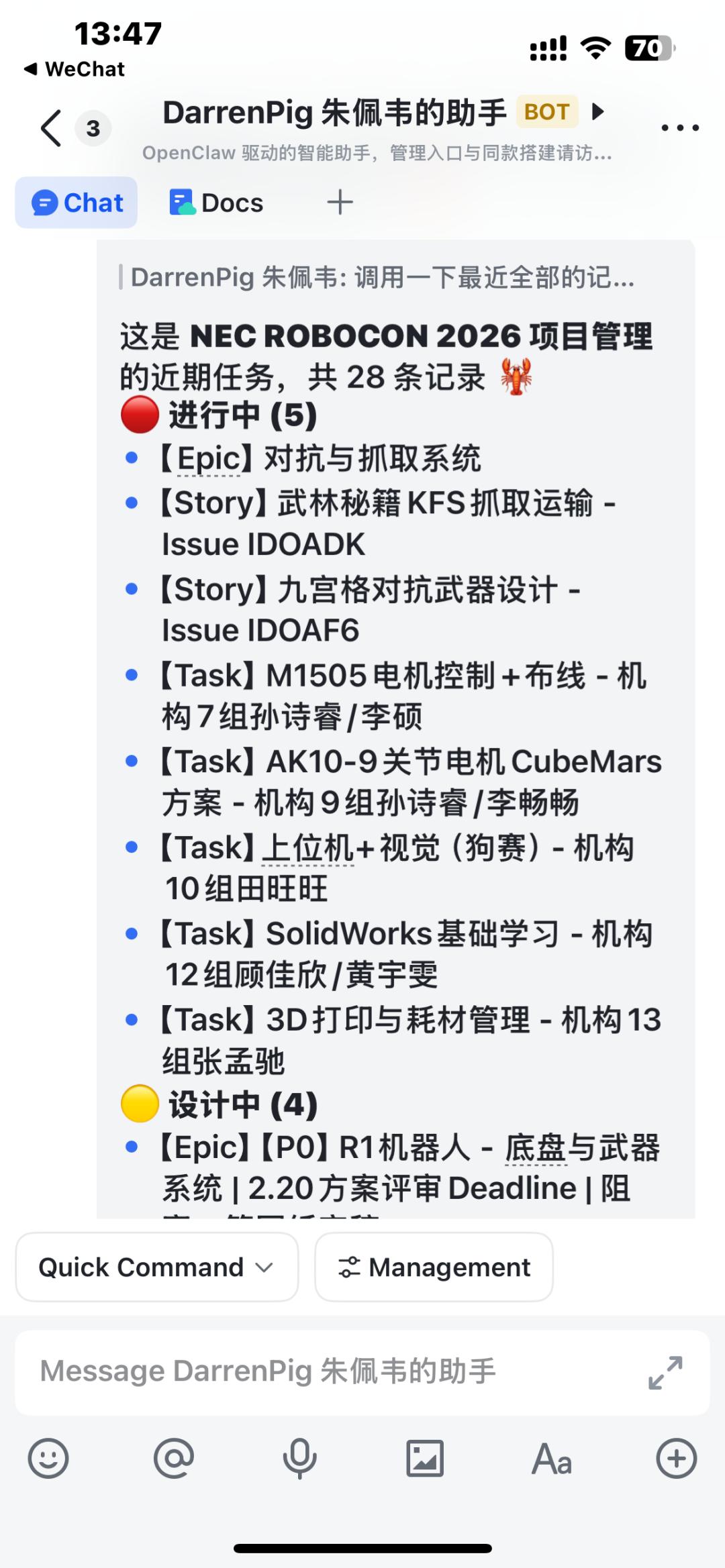
When the discussion turned to whether it can "make the robot work autonomously", Zhu Peiwei almost immediately separated the two. In his opinion, whether a robot can complete tasks independently depends on perception, decision - making, and control algorithms, rather than a "management tool". Contrary to the current view in the industry that Lobster is beneficial for "development" and "ability enhancement", Zhu Peiwei frankly said that for algorithm development, tools like Claude Code or other Vibe Coding - type tools are more direct and useful; from the perspective of improving the robot's capabilities, he believes that reinforcement learning (RL) and vision - language - action models (VLA) are more reliable paths. The deployment of OpenClaw has little to do with whether the robot can work on its own.
Therefore, he has no resonance with the public's anxiety about "the Terminator is coming". In the reality he describes, there are no awakened machines or out - of - control systems, only a software framework to help the team advance the project. The robot is still clumsy, relies on preset processes, and requires a lot of manual maintenance. The so - called intelligence is more like a "packaged experience" rather than real autonomous ability.
What better illustrates the situation is the attitude of the developer community. The developer community where Zhu Peiwei is located has about five thousand people, but according to his perception, the overall evaluation of "Lobster" is rather conservative, not as fanatical as the outside world imagines. The reasons are not only technical limitations but also security concerns. He once encountered a situation where a large number of poisoned Skills and the operation of OpenClaw itself led to the deletion of his own development environment and other files. This made him realize that once OpenClaw is connected to physical devices, the risk may come from itself.
Therefore, like many teams, Zhu Peiwei now only dares to use it in a closed and restricted environment and will not easily connect it to critical production systems or open networks. For the robot, this means that OpenClaw still remains in the experimental and demonstration stage, rather than being a reliable infrastructure. It's not so much that people are exploring the future as they are carefully avoiding new accidents.
If we must define the relationship between OpenClaw and the robot, Zhu Peiwei's answer is extremely simple: it is not a technology that makes the machine "learn to work", but a tool that better allows people to "organize work". In other words, it is a tool for managing people, not robots. The robot is still driven by algorithms, and its progress also depends on algorithms; Lobster just stands above the process, like a project manager who never gets off work, urging progress, keeping logs, and making coordination.
At least for now, it is far from the pessimistic narrative of science - fiction movies and closer to office software. Source: Zhu Peiwei, maintainer of the NEC New Energy Developer Community & team leader of the National College Student Robot Contest ROBOCON.
Two Ways to Use One "Shrimp", with Different Depths
Two weeks after the release of OpenClaw, the company where Liao Dengting works deployed OpenClaw in its internal office system. His work mainly focuses on VLA model research. Coincidentally, the company purchased a Zhiyuan robot, so Liao Dengting began to try to deploy OpenClaw on the robot.
During this process, Liao Dengting believes that there are obvious differences in the depth of OpenClaw's application on the robot.
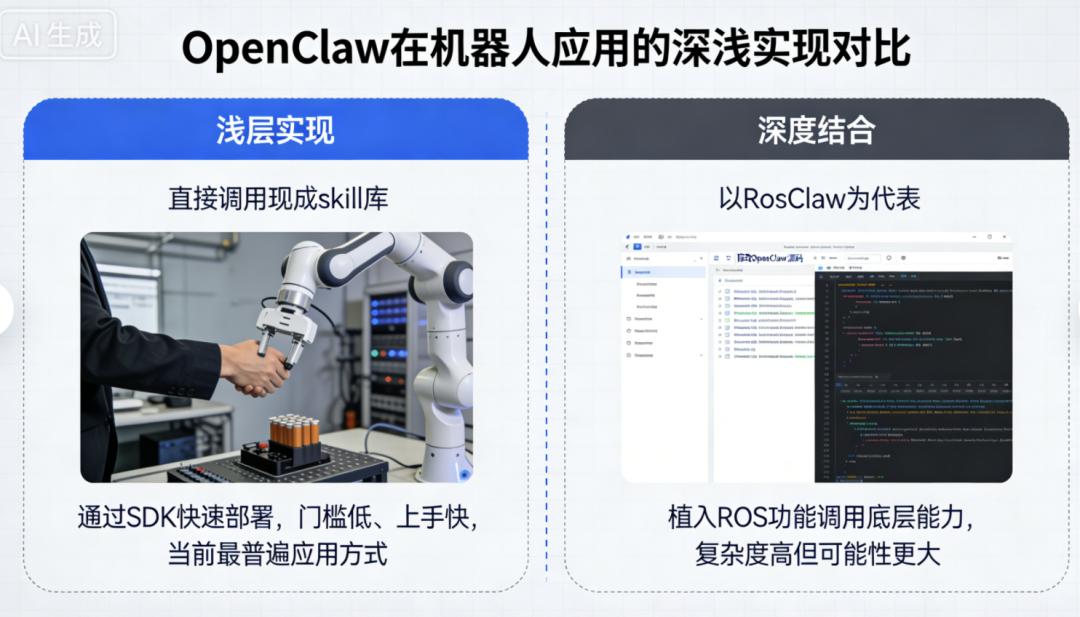
The shallower implementation is to directly call the ready - made skill library and quickly deploy through the SDK to achieve basic actions such as shaking hands and grasping objects. This path has a low threshold and is easy to get started, and it is currently the most common application method.
The deeper combination is represented by the recently emerged RosClaw, which requires modifying the OpenClaw source code and implanting the functions of the robot basic operating system ROS (Robot Operating System) into it, so as to call more abundant underlying capabilities. This path is more complex but also means greater possibilities.
From the actual effect, OpenClaw shows strong scalability and can automatically splice commands to complete composite tasks without explicit instructions.
However, the disadvantages are also obvious. Firstly, the response is slow. Each call needs to send the context to the large model, going through multiple links such as tool calling and command generation, resulting in a long chain. Secondly, the reliability is questionable. In the pure skill execution mode, once the instruction sequence is long and there are omissions or execution failures in the intermediate links, the system will not actively sense the abnormality.
This problem is not unsolvable. A feasible idea is to insert a verification hook after the task is completed to verify the execution result. If it fails, trigger a retry, which is equivalent to transforming the original open - loop system into a closed - loop system.
In addition, simplified versions such as PicoClaw and NanoBot have significantly improved response speeds and are more suitable for edge scenarios with limited computing power such as robots and single - chip microcomputers.
The recently widely circulated demonstration of the "spatial memory" of the Unitree robot is often attributed to OpenClaw. In his opinion, the core of achieving this ability is more likely to come from SpatialRAG technology, which constructs environmental videos or point - cloud data into a callable spatial database, enabling the robot to have environmental memory ability.
The role of OpenClaw in it is just to call this ability, and the same can be achieved by using other Agent frameworks.
He also pointed out that both the long - term and short - term memories of OpenClaw are stored in plain text rather than encoded structured information, making it difficult to efficiently process complex data involving multiple sensor dimensions in the robot system. In his view, the real - sense spatial memory ability still depends on the optimization of the brain and memory system levels, and may have little to do with the Agent framework.
Nevertheless, he is optimistic about the long - term prospects of the integration of Agent and robots.
He gave an example of a long - standing unmet need in the industrial scenario: making the robot "work according to the instructions". In current factories, most robotic arms rely on pre - programming and can only perform fixed tasks. They are helpless when faced with different tasks. The existing improvement path is to introduce VLA and VLM to improve versatility, but the real generalization ability is still difficult to achieve. If an Agent is introduced to the robotic arm, endowing it with the ability to call tools, understand instructions, and dynamically arrange action sequences, it may bring a more substantial breakthrough in operational ability than VLA.
He also mentioned a more imaginative direction: Agent - driven active data collection. Currently, some people have connected OpenClaw to a servo robotic arm with a camera and a microphone, allowing it to autonomously observe the environment and recognize itself. In theory, this kind of data can be used to train the model's understanding of the physical world. Of course, the premise is that the Agent has sufficiently reliable basic capabilities; otherwise, the collected toxic data will pollute the model.
In terms of computing power, he believes that the future pattern may be: simple tasks rely on the local computing power of the end - side for processing, while complex intelligent orchestration still needs to call cloud resources. This model places higher requirements on computing power infrastructure and low - latency communication, and also indicates a continuous increase in relevant demands.
He said bluntly in the interview that Agent may be a technological paradigm born for robots. Currently, most applications of Agent are limited to calling electronic tools, which certainly has its value. Once Agent truly has the ability to call physical tools, the value it can release will be far more than that. Source: Liao Dengting, an AI algorithm engineer at a telecommunications company.
Calibration of R & D Inertia
For ontology manufacturers, OpenClaw is neither a "savior" nor a "competitor", but a mirror and a key. It reveals the dark side of the industry's R & D inertia and provides a low - threshold path for breakthrough.
In conversations with multiple ontology manufacturers, a term "intermediate state" was repeatedly mentioned. From their R & D perspective, it is not the disruptive technology mythologized by the outside world, but just a framework for taking over intermediate task processes; from their long - term development perspective, it is by no means the ultimate product, but just an episode in the long river of technology.
"There is a limitation to all premises," said the technical leader of an ontology manufacturer. The limitation exists in space and task processes. Due to its potential for privacy leakage and data security risks, R & D can only be carried out in specific spaces and for specific tasks. It neither touches core data nor can verify the feasibility of intermediate processes.
The experiments of ontology manufacturers are very cautious, and their choice of words is also very careful. It is rare to hear the tone of "successfully running through". When asked whether a complete workflow can be formed, the manufacturers said that the more important meaning lies in entrusting process coordination to a more efficient framework and exploring new R & D models. Some manufacturers are also thinking that this kind of framework makes the team start to think about the boundaries of R & D and calling.
Specifically, in the previous R & D logic of ontology manufacturers, many capabilities are not impossible to achieve, but a single task requires a large amount of R & D and engineering efforts. This is not a very cost - effective economic account. However, OpenClaw can use mature models, systems, and links to turn the capabilities that originally needed to be developed and trained separately into capabilities that can be directly called and quickly combined.
Frankly speaking, after communicating with ontology manufacturers, it is not difficult to find that rather than talking about OpenClaw, it is better to talk about the combination of Agent and embodied intelligence, that is, Embodied Agent, which has a greater imagination space. (As an aside, it was once said that the English term for embodied intelligence, Embodied AI, was originally called Embodied Agent.)
Conclusion
Don't blindly believe in technological myths, don't give up bottom - level control, and find a balance between technology adaptation and industrial logic. This is the consensus of most embodied practitioners on the embodiment of OpenClaw and also an internal calibration.
We are not afraid of the FOMO emotion brought by new technologies. We just need to learn to anchor the original intention we should adhere to in the upsurge.
This article is from the WeChat official account "Embodied Learning Club", written by Peng Kunfang and Aruna, and published by 36Kr with authorization.