What will cooking be like when AI grows "eyes" and "hands"?
At the beginning of 2026, the entire tech circle was thrown into a frenzy because of a "lobster".
This open - source AI agent framework named OpenClaw has sparked a nationwide "lobster - raising" craze among employees of internet giants and ordinary users in a short period.
Why can an open - source project make people line up to install it?
The core reason lies in the paradigm shift that hits the pain point: Different from the large models in the past that could only chat with you in web dialog boxes, OpenClaw is a typical "executive agent". It can obtain the same level of permissions as users, automatically process data, organize desktops, and even complete practical instructions issued by users across applications.
The popularity of the "lobster" reflects the most real sentiment in the current tech consumer market: AI that "can only chat" can no longer meet users' needs. What we need are practical partners that can "do work for people", and it's not just that.

AI is breaking out of the screen
In the field of artificial intelligence, there is a famous "Moravec's Paradox": It is relatively easy to make a computer perform far better than an adult in an intelligence test, but it is extremely difficult to make it perceive the real environment and make physical movements like a one - year - old child.
Looking at the current AI landscape of smart home appliances, most enterprises are still struggling in the shallow waters of this paradox. In the virtual world, AI seems omnipotent - it can write code, make a well - structured business plan, and generate videos comparable to Hollywood blockbusters in just a few seconds. However, when this AI wave tries to enter the physical lives of ordinary people, especially in the kitchen scenario with numerous variables, it generally encounters an embarrassing "implementation gap".
Looking back at the intelligentization trajectory of the home appliance industry in the past few years, it is not difficult to find a tortuous path for AI implementation.
At first, it was the primary intelligence of "function stacking", and manufacturers simply did "addition". The typical feature of this stage was to directly add a voice interaction module or a Wi - Fi networking module to traditional hardware devices. It was not until consumers bought the products home that they found that the so - called AI just changed manual buttons to voice commands, and it didn't understand the essence of cooking at all.
Subsequently, the industry entered the passive assistance stage of "separation between software and hardware". Smart speakers or refrigerators with screens became the facade of the kitchen. Users could look up a large number of recipes on the screen and even watch teaching videos. But a fatal sense of disconnection also came: the information flow at the software level and the physical execution at the hardware level were completely two different things.
You see a perfect tutorial on sweet and sour spare ribs on the screen, but when you turn around and face the raw meat on the chopping board and the complex heat, you still feel at a loss. AI only exists in the screen. It "can't see" the user's dilemma and can't issue any substantial execution instructions to physical devices such as stoves and range hoods.
Dr. Zhou Haixin, the vice - president of Robam Appliance, pointed out the powerlessness of large models in the kitchen scenario: "The kitchen is the place with the most complex rules in the physical world: oil fumes involve fluid mechanics, heating ingredients involves thermodynamics, and stir - frying involves acceleration and torque. If AI can only chat on the screen, it will never help you when you are in a hurry in the kitchen."
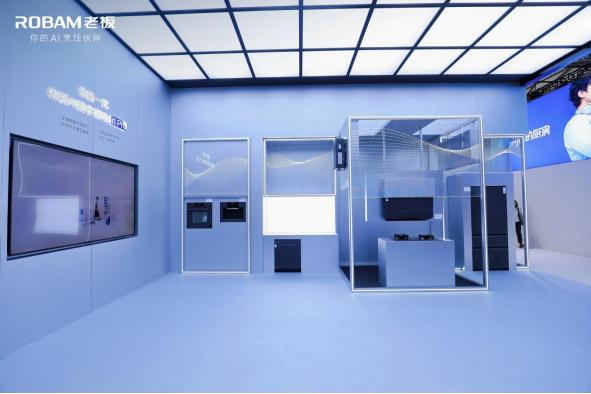
Obviously, in the third stage, for large models to truly create value in the kitchen, they must cross the "physical gap". This is not an easy task. Facing this extremely unstructured scenario, large models must complete the leap from "cloud computing power" to "physical work" and provide a complete set of overall solutions for AI - empowered cooking throughout the entire process to build a complete closed - loop of "perception - decision - action".

From "virtual dialogue" to "physical hosting"
The leap from "functional instructions" to "physical hosting" is not something that can be accomplished by simply rewriting a few lines of code. It is destined to be a fundamental reconstruction of the underlying hardware. For the entire home appliance industry, the traditional "central control screen" concept is showing signs of fatigue. To cross the "logistics gap", the industry needs a more thorough integrated solution for software - hardware collaboration.
If we take Robam Appliance's overall solution for AI - empowered cooking throughout the entire process as an industry observation slice, we will find that the core of crossing the gap lies in building an "invisible chef" with complete action capabilities: The AI cooking glasses are the sensitive "five senses", responsible for capturing external information; Shishen (God of Food) is the "brain", responsible for in - depth thinking and strategic decision - making; and the deeply - adapted AI digital home appliances are equivalent to the "limbs" that really do the heavy work. Only by connecting the underlying protocols can AI truly achieve full control of the physical environment in the kitchen.
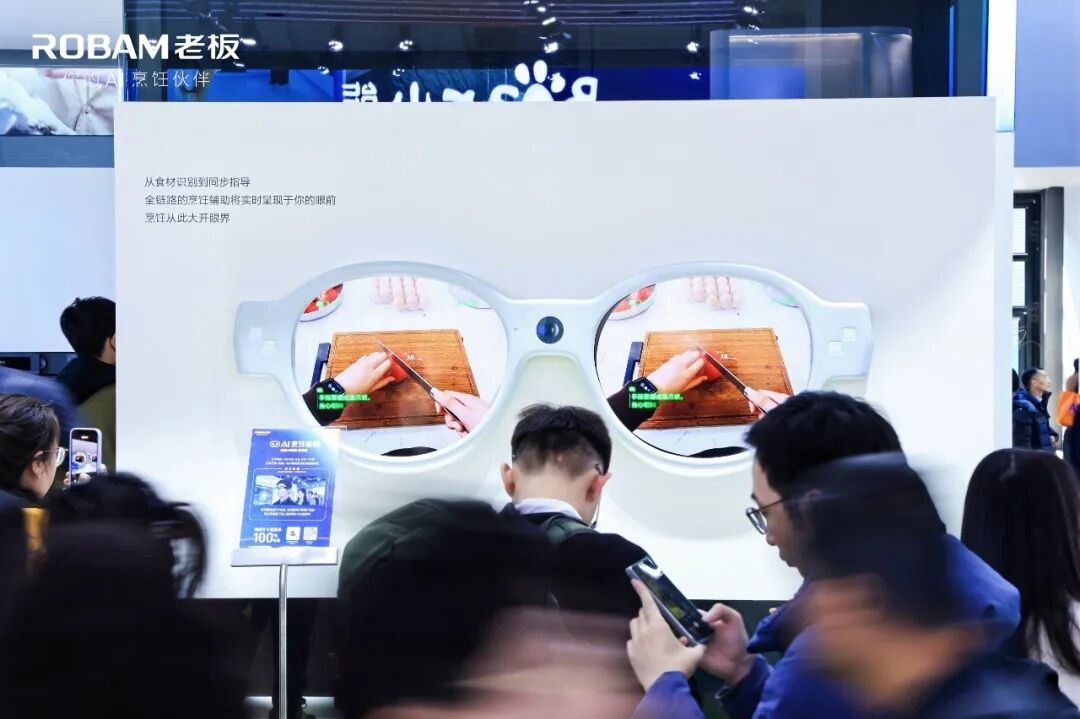
First, it is necessary to break the "blind spots" commonly existing in the industry and let the kitchen grow "first - person perspective" tentacles. The reason why traditional home appliances seem "stupid" is that they "can't see" the real situation in the kitchen. In the face of this perception bottleneck, Robam Appliance's solution is to break out of the traditional home appliance form and use AI cooking glasses as the perception tentacles for the large model to extend outward.

In practical applications, the AI cooking glasses can not only achieve sensitive voice wake - up and photo storage. More importantly, they can upload the captured multi - modal data such as images and sounds to the Shishen AI cooking large model in real - time for accurate recognition. This also gives AI the "first - person perspective" perception ability that is in sync with humans, which is the prerequisite for AI to truly understand the complex dynamics in the kitchen.
Next, on the basis of "understanding", it is possible to "be observant and proactive". After the recognition, the AI cooking glasses do not simply offer general online recipes. Instead, they will push customized recipes to users. At the same time, through first - person AR projection or voice interaction, they will prompt users in real - time about the best way to process ingredients, the precise amount of seasonings, and even adjust the heat, truly becoming a "personal intelligent agent".
Secondly, it is necessary to cross the "common sense" and build a super - brain that understands your taste better than you do.
As the dividends of the public corpus of general large models are gradually reaching their peak, private data in vertical scenarios are forming new industry barriers. In this regard, traditional manufacturing giants with decades of industrial accumulation show natural advantages.
Take Robam Appliance's Shishen AI cooking large model as an example. Its knowledge base does not come from the same - old searches on the Internet. Instead, it is built on the huge and real cooking data accumulated by Robam Appliance over 47 years, which can be precise to every stir - fry in a specific hardware environment. This decision - making ability based on real hardware is a solid barrier that general large models cannot reach.
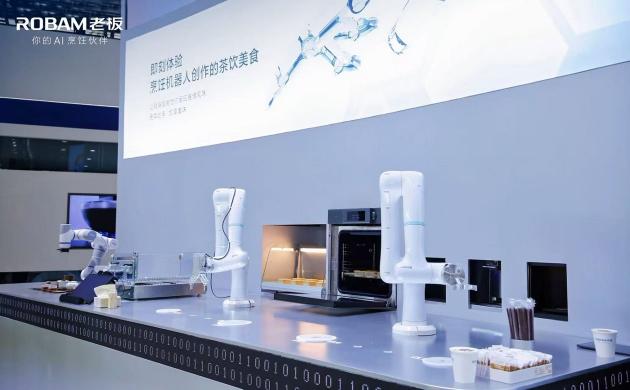
Finally, it is necessary to penetrate into the "fortress" of the physical world and let the large model truly grow the "hands and feet" to do work. No matter how perfect the computing power decision is, if it cannot be converted into physical work, it is still a cyber game. In this chain, the execution ability of the underlying hardware becomes the key to victory.
We can see that in the AI digital home appliance matrix represented by Robam Appliance's i1Pro, i9 and other product series, the underlying algorithm can independently take over the air volume adjustment of the range hood. Even in the most difficult open - flame cooking link, it has been included in the scope of intelligent hosting through high - precision temperature detection. Even in the post - meal link, the dishwasher can track the progress of the cleaning work based on the real - time temperature and humidity curve, making the whole cooking process end perfectly.
From understanding ingredients, planning paths, to taking over open - flame stir - frying and washing up, AI has finally completed the entire process from "watching you cook" to "helping you cook" in the most difficult physical battlefield - the kitchen.

"Manufacturing perseverance" in the wave of AI
In fact, beyond technology and products, when we examine Robam Appliance's implementation path from a higher industry observation perspective, we will find that this set of strategies provides a highly observable sample for the survival rules of the physical manufacturing industry in the AI era.
In the past few years when AI technology has been developing rapidly, all the spotlights have been on technology giants and star large - model startup companies. Pure technology players are keen to pursue the holy grail of AGI (Artificial General Intelligence) by "piling up computing power and competing on parameters".
In the traditional hardware field, in the face of the dimensionality - reduction strike of technology, many enterprises have fallen into a deep "FOMO" (fear of missing out) mood. They either blindly connect to general large models to add marketing gimmicks or follow the trend and invest resources in developing "virtual human assistants" that are divorced from actual needs.
For example, in the current hot "hundred - glasses war", most AI glasses on the market are competing in translation and teleprompters, still staying at the "passive assistance" level of information.
In this industry environment full of noise and confusion, some sober physical manufacturing enterprises have started to take a highly contrasting "independent path". Behind this independent path is a rare business perseverance.
For enterprises deeply involved in vertical fields, they know well that no matter how sophisticated the code is, it cannot replace real - fire stir - frying and physical work. Therefore, the moat of the manufacturing industry in the AI era is not to compete with technology giants in the parameter scale of the underlying large models, but to tap into their own industrial understanding, data base, and strong hardware execution ability accumulated over the years.
"You can copy a piece of hardware and train a similar model." Dr. Zhou Haixin pointed out the essence of this moat during an interview with 36Kr: "But it is very difficult to copy our in - depth insights into 'every stir - fry' in Chinese kitchens, difficult to copy the accumulation behind our hundreds of millions of cooking data, and impossible to build a complete system that can be independently controlled and seamlessly coordinated from the perception layer, decision - making layer to the execution layer like ours in a short time."
This means that the perseverance of physical enterprises in embracing AI is by no means to create technology gimmicks divorced from reality. Instead, it is to use AI to further amplify the professional value of the manufacturing industry itself, make large models adapt to the extremely complex but also full - of - life kitchen environment in Chinese families, and ultimately provide users with an effective solution to combat the fast - paced and high - pressure life.

The end of technology is to reshape the relationship between people and life
When we re - examine cooking, we will find that the kitchen is not only a functional space to satisfy our appetite. In the hot oil pan and rising mist, it naturally has a creative attribute and an emotional temperature.
The more powerful AI becomes, the more we need to stop and ask: What is the end of technology? Is it to completely remove humans from the kitchen with fully automatic machines?
The answer is obviously no. This is also the original intention of Robam Appliance's brand proposition of "Cooking freedom, enjoying creation, and fulfilling beauty".
In this era of "atomized survival", Robam Appliance's underlying logic is restrained and warm: The emergence of the AI cooking partner is to "fulfill" rather than "replace" - using cutting - edge technology to take over the cumbersome fire - control stir - frying and the anxiety - inducing post - meal cleaning, so as to return the freedom to enjoy cooking and creation in the kitchen to users completely.
It gives you the confidence to enter the kitchen at any time no matter how late you get off work. You don't have to be afraid of failure and can purely enjoy the creative fun of ingredient collisions, and heal the fatigue of the day in the rising smoke and fire, ultimately fulfilling the most real beauty in life.
From the germination of the concept to the physical implementation, the kitchen in 2026 is experiencing a real generational leap. When AI is no longer satisfied with chatting on the screen but truly starts to understand and take over the smoke and fire in the kitchen, our future lifestyle may have been quietly reshaped in the clashing of pots and pans.