Keep rising. Smartphones are seeing an "epic" price hike. An era is over.
An "epic" price hike of smartphones is intensifying.
According to Sina Tech, since March, the price increase of mobile phones will enter an accelerated phase. The price of new products will increase by at least 1,000 yuan, and the price of mid - to high - end flagship models may increase by 2,000 - 3,000 yuan.
The latest forecast from IDC also warns that in 2026, the average unit price of new global mobile phones will increase by 14%, and the price increase of flagship models will exceed 30%.
Brands such as vivo, Xiaomi, iQOO, and Honor... Almost all brands you can think of have started price adjustments in March.
This fierce wave of mobile phone price hikes may be far from over.
A huge chain reaction has begun, and unexpected events are happening one after another.
1
Smartphones are starting a "comprehensive price increase".
The Honor Power2, released in January, had a starting price of 2,699 yuan, 700 yuan more than the previous generation (starting from 1,999 yuan);
The Samsung S26 series, released in February, has a general price increase of at least 1,000 yuan. The top - end version has increased by 1,600 yuan compared with the previous generation, a significant increase of up to 20%;
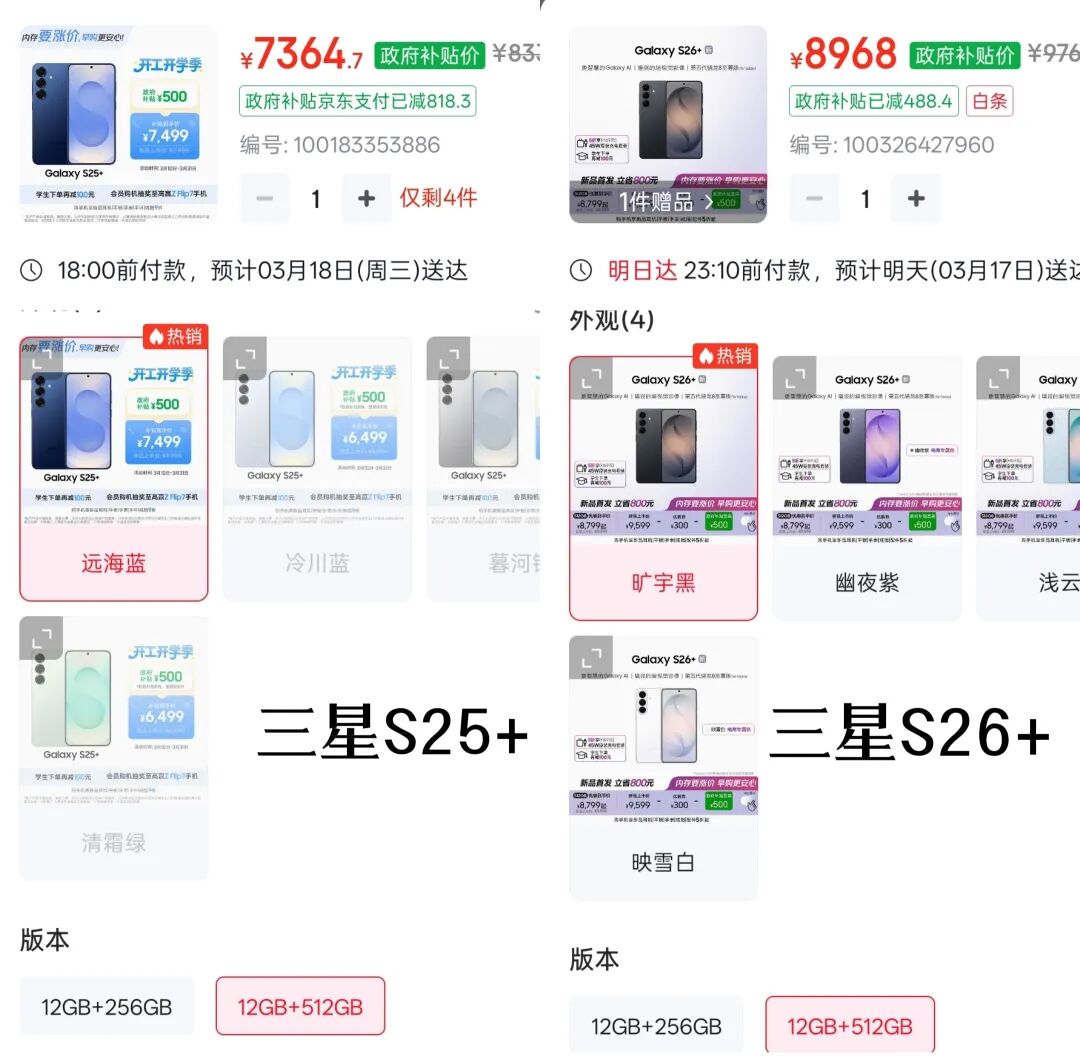
This is just the beginning. The price hike in March is even more fierce.
According to the Southern Daily, new mobile phones released after March will have a minimum price increase of 1,000 yuan, and mid - to high - end flagships will have a maximum increase of 3,000 yuan.
The industry generally believes that this is likely to be the largest - scale and most significant collective price adjustment in the mobile phone industry in the past five years.
Netizens exclaimed, "In the past, it was 'can't afford, domestic products', now it's 'can't afford domestic products'. Who would have thought that in 2026, the most cost - effective mobile phone would actually be the iPhone."
However, don't rush to scold mobile phone manufacturers - they may be more desperate than you.
2
In this wave of price hikes, the real beneficiaries are not mobile phone brands, but the upstream of the industrial chain - memory/storage chips.
How exaggerated is the price increase?
According to the Star Market Daily, the current procurement cost of smartphone storage chips has increased by more than 80% year - on - year. Industry insiders revealed: "This is a once - in - fifteen - year price hike."
In the past, storage chips only accounted for 10% - 15% of the mobile phone material cost, but now it has soared directly to 30% - 40%, tripling the proportion.
Mobile phone manufacturers have their own hard - to - tell difficulties.
Lei Jun frankly said in an interview: "In the past year, the price of memory chips has really skyrocketed, putting a great deal of pressure on us." He said that he would try various ways to minimize the difficulty for consumers to accept.
To put it simply: the price increase is not to earn more, but to survive.
Many budget phones are "losing money on each unit sold". The topic of "the disappearance of budget phones" has frequently hit the hot search.
Even, this round of memory price increase has become the last straw that broke the back of some mobile phone brands. According to Jiemian News, the former "king of domestic mobile phones", Meizu, has essentially suspended its mobile phone business and will officially delist in March 2026. As early as January this year, Meizu cancelled the launch plan of its new phone, the Meizu 22Air, due to the significant increase in memory prices.
3
The initial cause of the domino effect is actually - AI.
In 2025, the global investment scale of AI data centers reached 61 billion US dollars, hitting a new historical high. It has a large demand for memory and also has very high requirements, needing high - performance and large - capacity HBM to support the high - performance computing of large models.
When manufacturers prioritize ensuring the production of more profitable HBM, they will shut down some consumer - grade production lines, leading to an across - the - board price increase of memory.
Historically, there have been several significant price increases in memory sticks:
In 2013, a fire at the Wuxi factory of SK Hynix, the world's second - largest memory giant, burned half of its production capacity, and the memory price increased by 42%. From 2016 to 2018, with the explosion of mobile phone demand, the price of storage chips increased by more than 100%.
And this time, the global memory market has entered an unprecedented price - increase cycle:
According to the research institution Counterpoint, the memory price soared by 40% - 50% in Q4 of 2025, will increase by another 40% - 50% in Q1 this year, and is expected to increase by 20% in Q2. The upward trend may continue until the end of this year.
Not only mobile phones, tablets, computers, servers, home appliances, and even cars and medical equipment that require storage chips are all under the pressure of rising costs and chip shortages.
4
The key problem is that China mainly imports storage chips. In 2024, the total import value of chips was 2.7 trillion RMB, among which storage chips accounted for 663.7 billion RMB, 24.1% of the total.
What does 663.7 billion mean? In 2024, the total global trade volume of storage chips was 1414 billion RMB. China's import volume accounts for nearly half of the global total, more than the sum of Japan, South Korea, and the United States. The domestic self - sufficiency rate is only 22.25%.
On the other hand, South Korea has made a fortune.
Among the world's three largest storage chip giants, South Korea has two - SK Hynix and Samsung. In February 2026, South Korea's semiconductor export volume soared by 160.8% to 25.16 billion US dollars, setting a new monthly record.
Currently, the proportion of South Korea's semiconductor export volume in its total export volume has jumped from 16.3% in the same period last year to 34.7%, doubling directly, and has become the most important engine of the South Korean economy.
Looking into details, the three giants all made a fortune last year.
In 2025, Hynix's revenue increased by more than 30 trillion won year - on - year, its net profit doubled directly, and the net profit margin soared to 49%, with all performance indicators hitting new historical highs.
For Samsung Electronics, its annual sales in 2025 increased by 10.9% year - on - year, and its net profit increased by 31.2% year - on - year; for Micron, its revenue in FY25Q4 increased by 46% year - on - year, and its net profit increased by 70% quarter - on - quarter.
How strong is the monopoly of these three giants?
In the DRAM field of operating memory, the combined market share of the three exceeds 90%;
In the NAND field of solid - state drives, the combined market share of the three exceeds 60%;
In the HBM field, the so - called "computing power blood" of AI, the combined market share of the three is even more than 99%!
This means that Chinese mobile phone manufacturers have very limited bargaining power and can only passively accept the price increase from the upstream. As long as the global demand for AI computing power continues to skyrocket, the production capacity of storage chips will be preferentially supplied to the more profitable HBM, and consumer electronics can only wait in line or buy at high prices.
5
So, when will this wave of price hikes end?
In the short term, there is no sign of relief. The production capacity of the three giants in 2026 has already been "snapped up", and now if you want to place an order, you have to wait until 2027.
In February this year, SK Hynix said in a Goldman Sachs conference call that currently, Hynix only has about four weeks' worth of DRAM and NAND inventory, and no customer's demand can be fully met. Samsung and Micron also have tight production capacity.
The supply side is firmly controlled by the giants, and the demand side of AI is still crazily consuming production capacity, so mobile phones will continue to bear the pressure.
In the long term, domestic storage chip manufacturers are working hard to expand production, but it's like trying to quench thirst with distant water. Yangtze Memory Technologies Co., Ltd. and ChangXin Memory Technologies have launched their largest - ever production expansion plans, and the new factories are expected to start production in 2027.
Therefore, for ordinary consumers, in the next one or two years, mobile phones will probably only get more expensive. Budget phones may completely become history, and consumers of mid - to high - end phones should also be mentally prepared for a price increase of at least 2,000 yuan. In the past, we joked about "selling a kidney to buy an iPhone", but in the future, we may have to think twice even about domestic flagships.
The price hike is really painful, but it also makes us see a fact clearly: Whoever is at the upstream of the industrial chain has the pricing power.
This super - cycle of storage chips triggered by AI is reshaping the pattern of the entire consumer electronics industry. For consumers, perhaps the only thing they can do is to hold on to their wallets or - get used to this "new normal".
An era of "rock - bottom - priced" mobile phones has really ended.
This article is from the WeChat official account "Trend of Intelligence Valley". Author: Xiyun. Republished by 36Kr with permission.