With over 10 billion yuan in monthly financing, who is frantically vying for robots?
Almost on the same day, Galaxy Universal Robotics and Songyan Power announced the details of their new round of financing. The former raised 2.5 billion yuan, and the latter received 1 billion yuan. Both amounts are substantial.
The products of these two companies both appeared on the Spring Festival Gala of the Year of the Horse. When the new round of financing took place on March 2nd, only half a month had passed since the Spring Festival. The Spring Festival Gala of the Year of the Horse seems to have become the best roadshow venue for robot financing.
If the theme of 2025 was the "concept of embodied intelligence", 2026 is destined to be the year when the robot track explodes comprehensively.
Galaxy Universal Robotics raised 2.5 billion yuan in a single round of financing, and its valuation exceeded 20 billion yuan; Flexiv, which received hundreds of millions of dollars in investment, now has a latest valuation of 13 billion yuan; after Xingdong Jiyuan, Qianxun Intelligence, Zhipingfang, Lingxin Qiaoshou, and Xinghaitu completed their latest rounds of financing exceeding 1 billion yuan, their valuations exceeded 10 billion yuan... A series of figures are pushing the robot track to an unprecedented peak of popularity.
Data from IT Juzi shows that since 2026, there have been 189 equity financing events in the domestic embodied intelligence track. This means that on average, there are 2.6 financing events per day, and the financing amounts in February and March both exceeded 10 billion yuan.
The major investors behind these events come from top - tier VCs such as Sequoia China, Shenzhen Capital Group, and Hillhouse Capital, and there are also industrial giants such as Tencent, ByteDance, Alibaba, JD.com, Meituan, and Baidu. Hundred - billion - level robot industry funds from local governments have also been established one after another, and the third phase of the National Major Industry Investment Fund led a 2.5 - billion - yuan financing group to inject capital into leading enterprises.
From industrial robots to humanoid robots, from commercial services to home companionship, capital that doesn't want to miss the next big trend is pouring into this field with unprecedented enthusiasm.
However, beneath the prosperous surface, there are hidden undercurrents.
Across the ocean, the American humanoid robot startup Cartwheel Robotics declared bankruptcy in March 2026; the National Development and Reform Commission also publicly warned that the current humanoid robots are not fully mature in terms of technical routes, business models, and application scenarios, and we need to be vigilant against the structural risks brought by the "crowded" listing of products.
Is this the eve of a major industry explosion, or just a spreading bubble?
2.6 financing events per day on average
Behind the enthusiasm of capital are two Spring Festival Galas.
If the Spring Festival Gala in 2025 made Unitree Technology famous, then the Spring Festival Gala in 2026 was a collective showdown of robots - four embodied intelligence enterprises, Unitree Technology, Galaxy Universal Robotics, Songyan Power, and Magic Atom, competed on the same stage, setting a record for the density of robot appearances on the Spring Festival Gala stage.
It only took about two weeks to shift from the spotlight on the stage to the spotlight of capital.
On March 2nd, Galaxy Universal Robotics officially announced the completion of a new round of financing of 2.5 billion yuan. The list of investors is extremely impressive: the National Artificial Intelligence Industry Fund (the third phase of the National Major Industry Investment Fund), Sinopec Capital, Bank of China, SAIC Group, SMIC Juyuan, Yizhuang State - owned Investment, and other state - owned and industrial giants gathered together. The strength of their endorsement is extremely rare in the history of the robot industry. On the same day, another company that appeared on the Spring Festival Gala, Songyan Power, also announced the completion of a nearly 1 - billion - yuan Series B financing, led by Chendao Capital, an industrial investment platform under CATL.
Of course, only a few companies can make it onto the Spring Festival Gala. The financing map can present the current situation of the primary market for robots more clearly.
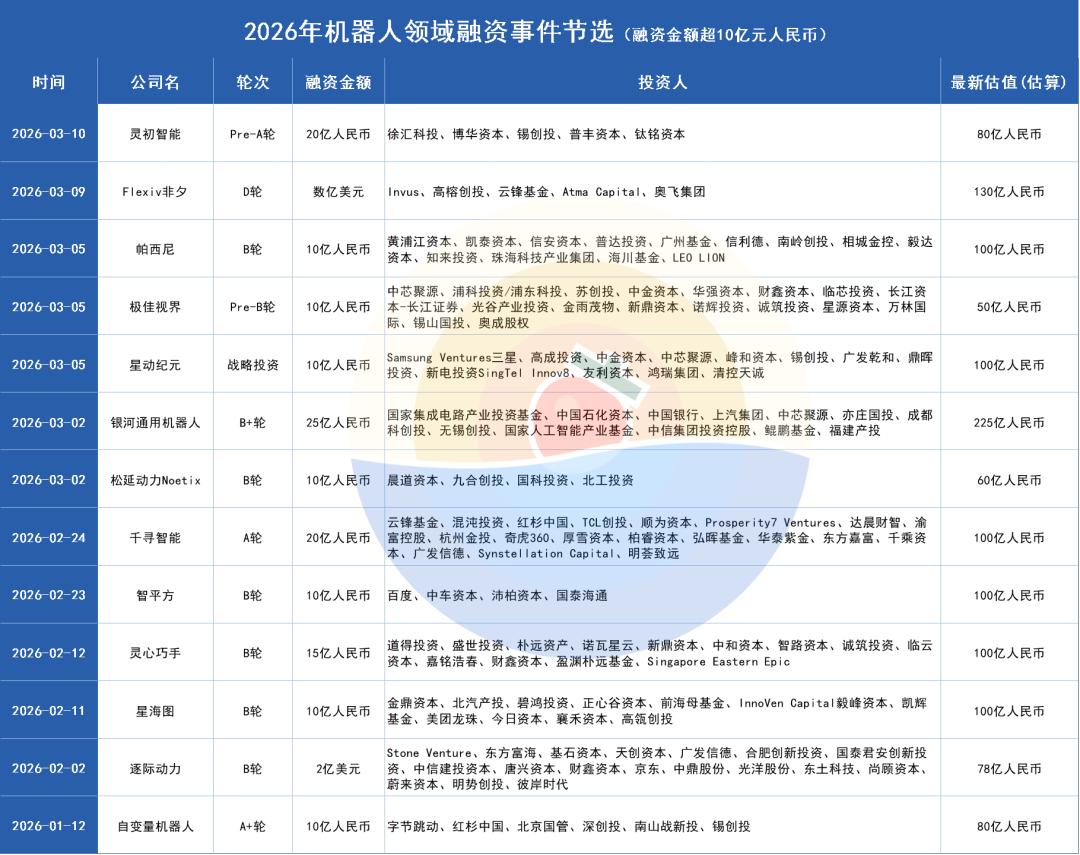
Important financing events in the robot field in 2026. Data source/IT Juzi. Chart made by Xinmei
According to the statistics as of March 13th, 2026, among the 189 financing events that have been completed, there were 13 events with a single - round financing amount exceeding 1 billion yuan. The highest single - round financing amount was achieved by Galaxy Universal Robotics. It is worth mentioning that Galaxy Universal is also the company with the highest cumulative financing amount in China at present.
This company, founded in May 2023, has completed 6 rounds of financing intensively in less than three years, with a cumulative investment of more than 6.8 billion yuan, breaking the cumulative financing record in the domestic embodied intelligence field. Its current valuation has reached 3 billion US dollars, making it the company with the highest valuation in the Chinese humanoid robot industry at present.
The company with the most frequent financing rounds is Zhipingfang. Founded by Dr. Guo Yandong, an artificial intelligence expert, in April 2023, this company completed 12 rounds of financing in the past year, including 7 rounds in 2025 and 5 rounds in the first two months of 2026, becoming the embodied intelligence enterprise with the fastest financing rhythm in the world. Its latest Series B financing exceeded 1 billion yuan, and its valuation also exceeded 10 billion yuan.
Beyond the leading position of top - tier companies, the structural characteristics of the entire track are also worthy of attention.
In terms of the types of financing companies, the robot track in 2026 shows the characteristics of diversification while focusing on core technologies.
Among the 189 financing events so far in 2026, more than 60% are related to embodied intelligence and humanoid robot companies, clearly playing the leading role. Embodied intelligence enterprises represented by Galaxy Universal, Zhipingfang, and Qianxun Intelligence focus on the full - stack self - research ability of "brain + cerebellum + body"; component companies represented by Pacini, Lingxin Qiaoshou, and Yingshi Robotics focus on core technologies such as tactile sensors, dexterous hands, and micro - precision moving parts, and have successively completed financing in the hundreds of millions of yuan level.
In terms of application scenarios, industrial robots are still the key investment direction for capital. Galaxy Universal has reached cooperation with customers such as CATL, Bosch Germany, and Toyota Motor, with a cumulative order of thousands of units; service robots and special robots are also booming, covering diverse scenarios such as underwater operations, garden maintenance, medical rehabilitation, and retail services.
This wave of enthusiasm did not come out of nowhere. Statistics from IT Juzi show that the investment activities in the Chinese robot field have followed a long - term upward curve.
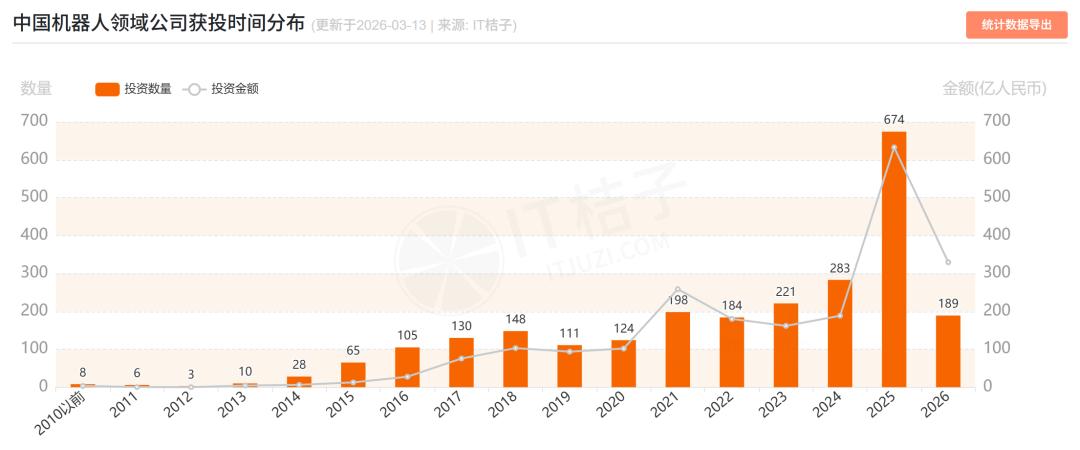
Distribution of investment times of Chinese robot companies. Source/IT Juzi
Before 2013, the number of investment cases per year was less than 10, and the market was still in its infancy; the pace accelerated in 2014, exceeding 100 cases for the first time in 2016, and continued to rise to 130 and 148 cases in 2017 and 2018 respectively. After a brief decline in 2019, it accelerated again in 2021 and further increased to 283 cases in 2024.
The real turning point occurred in 2025. The number of investment cases throughout the year jumped to 674, and the investment amount also reached a peak simultaneously. The capital enthusiasm for the Chinese robot industry reached an unprecedented high.
In 2026, this wave of enthusiasm not only shows no sign of subsiding but also presents a stronger "acceleration". As of March 13th, there have been 189 financing events in the domestic robot field, with an average of more than two events per day. Although the statistical period is short and not suitable for direct comparison with the annual data, based on the current rhythm, the total amount for the whole year still has the potential to reach a new high.
Who is making frequent investments?
Companies are vying for the spotlight on the stage, while capital has its own plans behind the scenes. Looking at the list of investors, three types of players are competing on the same stage, but each has its own rhythm and logic.
According to the data from IT Juzi as of mid - March 2026, the top - tier professional VCs still rank high in terms of investment frequency. Among them, Sequoia China leads with 10 investments in 2026, followed by Shenzhen Capital Group with 7 investments. BlueRun Ventures, CICC Capital, and Hillhouse Capital each have 6 investments and are tied in the third group.
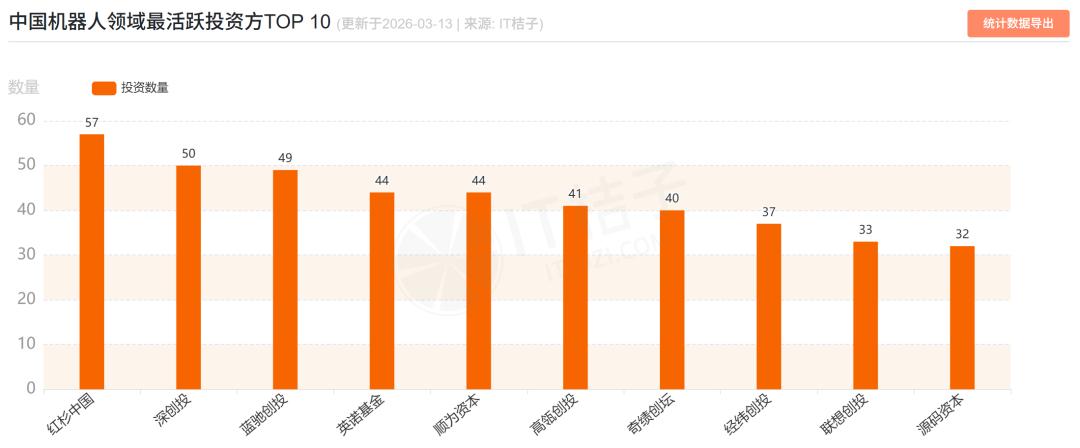
Top 10 most active investors in the Chinese robot field. Source/IT Juzi
If we look at the historical dimension, Sequoia China has made a total of 57 investments in the robot track, Shenzhen Capital Group 50 investments, and BlueRun Ventures 49 investments. The long - term layout of these top - tier institutions in this track far predates the arrival of this wave of enthusiasm.
The investment logic of professional VCs generally tends to "cast a wide net and cover more areas", holding companies with different technical routes in the same track simultaneously, rather than betting on a single horse.
In terms of specific investment preferences, each VC has its own focus.
Sequoia China has holdings in several companies such as Qianxun Intelligence, Independent Variable Robotics, and Zhijian Power, covering multiple technical links from the embodied intelligence brain to the robot body; Matrix Partners has laid out players leading in different technical routes such as Unitree Technology, Zhiyuan Robotics, and Galaxy Universal, and is more inclined to teams with obvious "technical differentiation"; BlueRun Ventures focuses on the early - stage segment.
The classic investment maxim "Investing is investing in people" is most fully verified in the robot track. Founders with top - notch academic backgrounds and core technology R & D experience in large companies or cutting - edge laboratories are more likely to gain early recognition and enter with high valuations.
Wang He, the co - founder of Galaxy Universal Robotics, graduated from Tsinghua University as an undergraduate and obtained a doctorate from Stanford University. He is currently an assistant professor and doctoral supervisor at Peking University and is one of the earliest scholars in the world to conduct end - to - end embodied large - model research; another co - founder of Galaxy Universal, Yao Tengzhou, has a master's degree from the Robotics Research Institute of Beihang University, studied under Professor Wang Tianmiao, a leading figure in the robot industry, and has worked in the R & D center of ABB Robotics, with more than a decade of entrepreneurial experience in the robot field; Guo Yandong, the founder of Zhipingfang, has a doctorate in artificial intelligence from Purdue University, worked at the Microsoft Research Institute in the United States, and later served as the chief scientist of XPeng Motors and OPPO... All these are typical examples of this path.
Zhang Han, a partner at Sequoia China, also emphasized this logic when talking about the invested company, Boundless Power, a general embodied intelligent robot company: "The Boundless Power team has the ability to innovate in underlying technologies and has rich experience and potential in engineering implementation and business ecosystem construction, with the opportunity to implement leading applications in the scenario side."
Compared with professional VCs that pursue financial returns, the entry logic of industrial capital is completely different. They care more about "strategic synergy" and therefore have a clearer screening preference for the types of invested companies.
Chendao Capital under CATL led a nearly 1 - billion - yuan Series B financing for Songyan Power. The underlying logic is that humanoid robots are an important terminal for high - density battery applications in the future, and investing is equivalent to locking in potential customers in advance; Baidu made a strategic investment in Zhipingfang, taking a fancy to the technical synergy space between its embodied large - model and Baidu's Wenxin series of models; ByteDance participated in the Series A+ financing of Independent Variable Robotics, which is also related to the layout direction of its Seed team's self - developed robot basic model.
An investor who has long been concerned about hard technology analyzed to "Xinmei" that traditional financial institutions pay more attention to track layout and financial returns, while industrial capital focuses on long - term strategic synergy and tends to invest in enterprises that have already launched products and can form resource support or ecological complementarity with their main businesses.
When talking about the current investment rhythm in the robot track, the above - mentioned investor admitted that although the company had laid out several early - stage projects in the early years, in the face of the high valuations of current star projects, the overall strategy has turned conservative. "Actually, we want to grab a share, but now we can't get in."
State - owned capital is the most prominent entrant in this round of financing wave, and it has a clear tendency to focus on top - tier companies when choosing investment targets.
The third phase of the National Major Industry Investment Fund made its first move through the National Artificial Intelligence Industry Fund by participating in the Series B+ financing of 2.5 billion yuan for Galaxy Universal Robotics, and joined hands with Sinopec Capital, Bank of China, SAIC Group, and other institutions. The strength of its endorsement is extremely rare in the robot industry.
At the local state - owned capital level, "hundred - billion funds" are springing up everywhere. According to incomplete statistics, since 2024, more than a dozen cities such as Beijing, Shanghai, Shenzhen, Suzhou, Chengdu, and Hefei have successively established robot industry funds, with a total scale of more than 200 billion yuan. From the central government to local governments, state - owned capital is strategically positioning itself in this future industry with unprecedented density and intensity.
The unavoidable industry reality
Beneath the prosperous appearance, a fundamental question remains unresolved - what actual problems are these robot companies that have received huge amounts of financing solving? Who are their products sold to? And how many have been sold?
Generally speaking, the product implementation paths of robot companies that have received large - scale financing mainly focus on two lines: the "labor - replacement route" for B - end industrial scenarios and the "companionship route" for C - end home or commercial services. The former has a higher short - term ceiling but is more difficult to implement; the latter has a relatively clear commercialization path but needs to overcome the hurdle of cost - effectiveness.
Taking the star companies on the Spring Festival Gala as samples, the answers show two completely different paths.
Galaxy Universal Robotics follows the B - end industrial and service route. Its product, Galbot, is positioned as an embodied intelligent robot that can "do work", mainly targeting scenarios such as industrial flexible production and smart retail. It can completely complete object recognition and path planning based on visual perception, breaking through the limitations of traditional industrial robots that rely on preset routes.
Songyan Power mainly targets the C - end consumer market. The "Xiaobumi", priced at 9,998 yuan, is currently the only bipedal humanoid product in China that has been mass - produced with a price below 10,000 yuan, focusing on home companionship and education scenarios.
In terms of mass - production capacity, Unitree Technology is a more representative benchmark.
According to the "2025 Humanoid Robot Market Research Report", in 2025, Unitree Technology's humanoid robot shipments exceeded 5,500 units, accounting for 32.4% of the global market. Both the shipment volume and market share ranked first in the world.
The common progress of these star companies is that they have all moved from "laboratory exhibits" to "deliverable products" and have begun to accumulate order data in real - world scenarios.
However, the entire industry still faces a common unsolved problem: no company