Deepexi Technology released a newly upgraded Deepexi enterprise large model, creating enterprise AI employees with 282 Skills.
In the past two years, the role of large models in enterprises has been somewhat "restrained".
In most companies, they are used to write copywriting, make summaries, and generate reports, which has indeed improved efficiency to some extent. However, they rarely truly enter the business processes of enterprises. The reason is not complicated: large models can understand language, but enterprise data is often scattered across multiple systems such as ERP, CRM, and production systems. The business logic is complex and highly specialized, making it difficult for AI to truly understand enterprises.
However, the situation is changing.
On March 12th, Deepexi Technology released an upgraded version of the Deepexi enterprise large model and launched the Deepexi OS AI-level enterprise operating system, which consists of the Deepexi enterprise large model, the FastAGI enterprise intelligent agent platform, and the FastData Foil enterprise data fusion platform.
Different from many previous enterprise AI products, the core goal of this system is to solve a more fundamental problem: how to enable AI to truly understand enterprises and participate in their business operations?
Zhao Jiehui, the founder, chairman of the board, executive director, and CEO of Deepexi Technology, said at the press conference, "The ultimate goal of implementing AI in enterprises is to continuously produce and correctly use AI employees based on the enterprise's own business knowledge and status. Ultimately, it's about how to operate on a large scale and generate a large number of AI employees to assist in liberating human work."
When the model can understand enterprise business and continuously perform specific tasks in the system, the large model itself will become part of the enterprise's operations.

Signals Emerge: Enterprise AI Employees Begin to Be Implemented and Scaled
Deepexi Technology's upgrade this time is interpreted by the industry as an early bet on the development stage of enterprise AI. Looking at the long - term trend, at this moment, policy signals, capital signals, and technological signals have emerged simultaneously in the enterprise AI track. The superposition of these three signals indicates that enterprise AI is gradually moving from the technology exploration stage to the large - scale implementation stage, and AI employees will be implemented on a large scale in the future.
First, there are policy signals.
In the 2026 government work report, "Artificial Intelligence +" was explicitly mentioned again. The key direction has shifted from the construction of computing power infrastructure and model capabilities in the past to AI applications and industrial implementation. The report proposed to promote the accelerated popularization of the new generation of intelligent terminals and intelligent agents and to promote the commercialization and large - scale application of artificial intelligence in key industries.
This change means that the focus of the AI industry is shifting from the supply side to the demand side. In the past few years, policies mainly focused on the construction of computing power, algorithms, and model capabilities. In the new stage, enterprise - level AI applications are becoming the real demand market for the artificial intelligence industry, and AI employees that can solve problems have become the focus of enterprises.
The second signal comes from the capital market.
Recently, Deepexi Technology released a profit forecast and was included in the Hong Kong Stock Connect. A company that has been deeply involved in enterprise AI for a long time is starting to move out of the technology verification stage and enter the stage of continuous revenue, which in itself is of symbolic significance.
In the logic of the capital market, enterprise AI is gradually developing a stable business model. As the revenue structure and customer scale become clearer, investors' valuation methods for enterprise AI may also shift from a simple technology narrative to the long - term value logic of replicable and scalable enterprise AI employee platforms and infrastructure companies.
The third signal comes from technology itself.
In the past decade, enterprise digitalization has gone through multiple rounds of technological waves. From ERP to BI and then to data middle platforms, enterprise systems have been continuously upgraded, but AI has never truly become a core capability within enterprises.
One of the key reasons is that enterprise data is completely different from Internet data. Internet data is usually public, standardized, and large - scale, which is suitable for large - model training. In contrast, enterprise data is scattered and full of a lot of unstructured information, and it also strongly depends on specific business contexts. This means that even if the model has strong language understanding ability, it is still difficult to truly understand the business logic of enterprises.
Therefore, in the past period, the application of large models in enterprises often remained at the level of question - answering, summarizing, or retrieving, and rarely directly participated in business processes.
It wasn't until ByteDance launched Trae IDE, Alibaba launched Tongyi Lingma, and overseas products such as Cursor and GitHub Copilot achieved large - scale implementation, which represented the accelerated generalization of AI for coding technology. The popularity of the open - source AI execution gateway OpenClaw formed a technological synergy with AI for coding. AI began to take on more executable tasks, such as automatically analyzing business data, dynamically adjusting production plans, implementing operational strategies, and even directly calling systems to complete operations.
Only when AI can finally participate in specific business operations does it become truly possible for enterprise AI employees to be implemented.
Against this background, Deepexi Technology's upgrade of the Deepexi enterprise large model and the launch of the Deepexi OS AI - level enterprise operating system are essentially attempts to seize this technological turning point: after understanding enterprises, AI can also take the next step, truly start working in enterprises, and become AI employees.
When policy orientation, capital signals, and technological capabilities change simultaneously, it often means a shift in an industry stage. Some technology companies, represented by Deepexi Technology, which have been deeply involved in the enterprise market for a long time, are already prepared.

For Enterprises to "Employ" AI Employees, They Need to Let Them Understand Enterprise Business
Enabling AI to truly understand enterprises and do practical things for them has always been a problem that Deepexi Technology has been trying to solve.
In the view of Zhao Jiehui, the founder, chairman of the board, executive director, and CEO of Deepexi Technology, whether enterprise AI can be implemented and become enterprise AI employees largely depends on a long - neglected ability - data governance ability.
Currently, enterprise data governance has actually gone through three rounds of evolution.
In the past two decades, the core of enterprise digitalization has been business software systems. Enterprise software represented by SAP and Oracle disassembled enterprise processes into system modules, managed business processes through software interfaces, and at the same time, precipitated enterprise operation data into structured tabular data. In this stage, data governance relied more on business software combined with an indicator system.
As the scale of enterprise data continued to expand, the industry entered the stage of data warehouses and data lakes. Structured and unstructured data could be stored uniformly and managed through data models. Some companies began to try to understand the enterprise data structure through ontology modeling, such as Palantir's Ontology model. However, this stage still highly relied on engineers - enterprises needed a large number of FDE (Forward Deployed Engineer) engineers to manually sort out the indicator system, business logic, and knowledge relationships, and then convert them into data models.
Zhao Jiehui said that the continuous development of AI technology has brought data governance into the third stage. Through large - model training, enterprises can input table structures, business logic, and knowledge systems into the model, and the model can automatically generate enterprise ontology models. This means that the data models that originally relied on engineers to build manually are now automatically generated by the model.
Ultimately, what can be directly delivered to customers is the enterprise large model itself.
Against this background, with the gradual maturity of Agent technology, the core deliverables of enterprise AI have also begun to change - AI needs to transform from a tool into an AI employee capable of participating in business execution.
Therefore, Deepexi Technology takes "understanding enterprise business + performing tasks" as the core ability of enterprise AI and launched the upgraded Deepexi enterprise large model at this press conference.
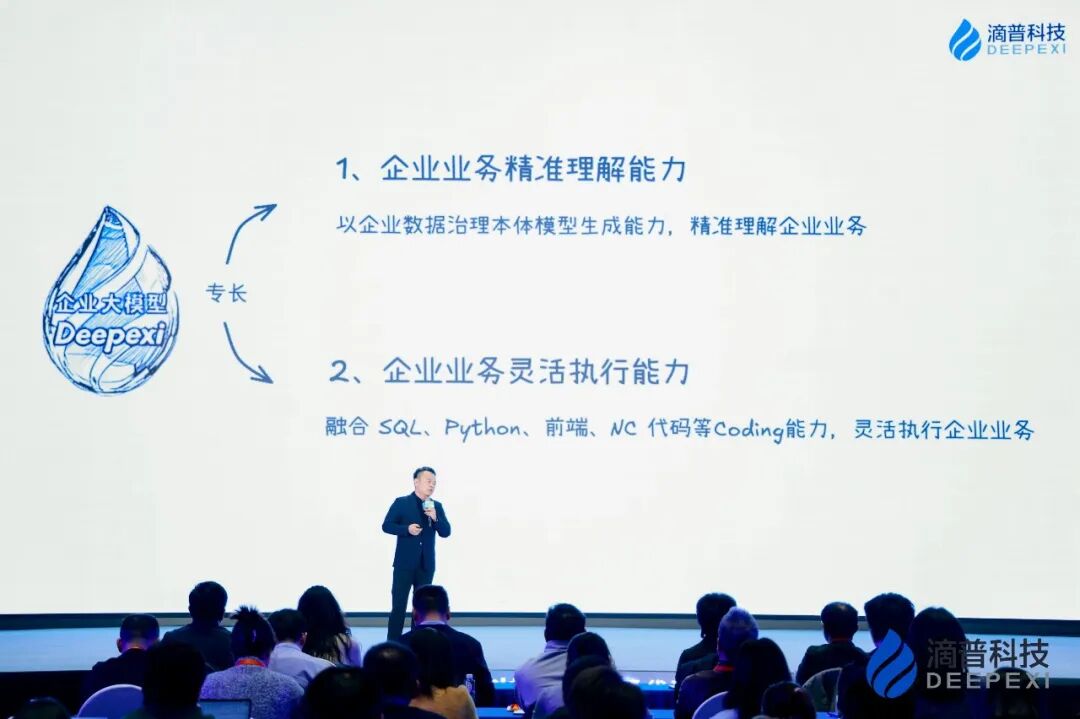
Specifically, the Deepexi enterprise large model mainly achieves this goal through two levels.
The first level is the understanding ability, enabling AI to understand enterprises through ontology modeling.
Enterprise data is often scattered across multiple systems. Although there are logical relationships between the data, these relationships often need to be manually sorted out and modeled by engineers. Deepexi Technology's approach is to form the Deepology enterprise ontology dataset through data governance, and then let Deepexi be trained based on this dataset. The enterprise business semantic structure is automatically constructed through the "ontology thinking chain" method. Under this mechanism, AI can automatically generate enterprise ontology models, sort out business semantic relationships, and understand enterprise business processes. In other words, the complex enterprise data system will be transformed into a business structure that AI can understand, which is the enterprise knowledge learning stage for AI employees.
The second level is the execution ability, enabling AI to directly participate in business operations.
The upgraded Deepexi not only can conduct analysis but also has the ability to directly call and generate code, such as outputting SQL, Python, and front - end code. This means that AI is no longer just giving analysis results but can directly query databases, process data, and even connect to enterprise backend systems or tools through code. When the understanding ability and execution ability are combined, the role of AI changes from a suggester to an executor, and enterprises can "cultivate" AI employees who understand them and can do things through the Deepexi enterprise large model.
In this architecture, the Deepexi enterprise large model is responsible for understanding enterprise business, while the Deepexi OS AI - level enterprise operating system proposed by Deepexi Technology attempts to build a complete set of enterprise AI infrastructure.
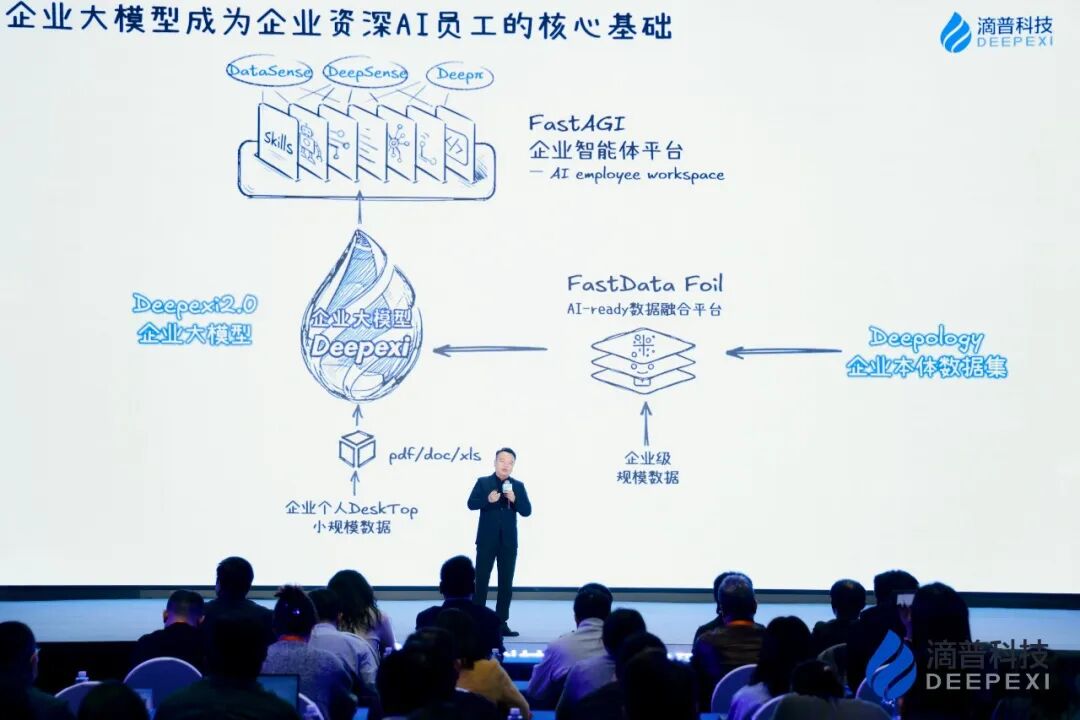
In addition to the Deepexi enterprise large model, this system also includes two key components.
The FastAGI enterprise intelligent agent platform is mainly responsible for task planning and execution. The platform abstracts common enterprise business tasks into reusable capabilities through the Skills system. Currently, it has precipitated multiple types of enterprise skills, including engineering design, operational decision - making, and data operation and maintenance, enabling multiple AI digital employees to collaborate to complete complex tasks.
The FastData Foil enterprise data fusion platform is responsible for enterprise data governance and analysis. The platform can process multi - modal data, including voice, video, and spatial data, and continuously build the enterprise ontology data system to provide a data foundation for model training and reasoning.
After the combination of the three, enterprises can complete the complete link from data governance, model training, to intelligent agent execution. This corresponds to the whole process of AI employees in enterprises receiving training, getting familiar with business, and independently completing work.
In other words, Deepexi Technology attempts to provide enterprises with a set of enterprise AI infrastructure that can support the large - scale implementation of AI employees.

Enterprise AI is about to Enter an Explosive Growth Period
In the view of Deepexi Technology, if the previous software systems solved the problem of information management, then in the future, the core intelligent capabilities of enterprises will gradually be borne by enterprise large models.
From the perspective of commercialization progress, the development of enterprise AI has begun to confirm this view.
As of June 30, 2025, Deepexi Technology had served a cumulative total of 283 enterprise customers. From the perspective of the revenue structure, in the first half of 2025, FastAGI and FastData contributed 55.3% and 44.7% of the revenue respectively. At the same time, according to Deepexi Technology's positive profit forecast for 2025, the revenue of the FastAGI business increased by more than 175% year - on - year. It is not difficult to see that Deepexi Technology's AI business has become a new growth engine.
In the past, enterprise AI projects were often delivered in a customized manner, requiring a large number of engineers to participate in the implementation. The revenue model was more similar to consulting or project services. When the proportion of product revenue continues to increase, it means that enterprise AI is gradually moving from the project - based model to the platform - based model. In the enterprise software industry, this is often an important sign that the business model is becoming stable. To some extent, it also means that enterprise AI is moving from the technology verification stage to the large - scale commercial stage.
This change is inseparable from the transformation of market demand.
IDC data shows that the market scale of China's enterprise AI services is expected to reach 45.6 billion yuan in 2025, with a compound annual growth rate of 38.2%. The market scale of enterprise - level AI Agents is currently about 23.2 billion yuan and is expected to exceed 65.5 billion yuan by 2027, becoming one of the fastest - growing tracks in AI applications.
From the perspective of the industrial structure, the AI industry can be roughly divided into three layers: the basic model layer, the application layer, and the infrastructure layer. Among them, the basic model provides general capabilities, the application layer is responsible for the implementation of specific scenarios, and the infrastructure layer is responsible for supporting the operation of the entire system.
The special feature of enterprise AI is that it often covers both the application layer and the infrastructure layer. On the one hand, enterprise AI needs to participate in business execution through Agents or AI digital employees; on the other hand, it also needs underlying capabilities such as enterprise large models and data platforms to support the system operation.
This "dual - layer structure" makes enterprise AI one of the most promising markets in the AI industry in terms of scale.
For this reason, many global technology companies, including OpenAI, Microsoft, and NVIDIA, are continuously increasing their investment in the enterprise AI ecosystem: OpenAI is embedding model capabilities into the enterprise software system through ChatGPT Enterprise, Assistants API, and enterprise Agent capabilities; Microsoft is deeply integrating AI into Office, Dynamics, and the development toolchain through the Azure AI and Copilot systems, trying to turn enterprise AI into the next - generation software platform; NVIDIA is approaching from another path, providing computing power and infrastructure for enterprises to deploy and run large models through CUDA, DGX, NIM inference services, and the AI factory architecture.
In Zhao Jiehui's view, when the enterprise large model can truly understand enterprise business and form a complete infrastructure with the data platform and intelligent agent system, the implementation path of enterprise AI employees will gradually become clear. The core deliverables of enterprise digital systems will gradually evolve from software systems to AI digital employee systems. The enterprise large model built around enterprise data, business understanding, and execution capabilities will also become the core foundation of the next - generation enterprise IT construction.
From a more in - depth perspective, the development path of enterprise AI is, to some extent, repeating the evolution logic of the previous enterprise software industry.
In the early days of enterprise digitalization, the core deliverables were software systems, which helped enterprises achieve informatization and process standardization; then data platforms became the new infrastructure, and enterprises began to make decisions and operate around data; in the AI era, enterprises are gradually "hiring" a group of enterprise AI employees who can work continuously, quickly understand the company