The unicorn startup Frore Systems, valued at $1.64 billion, officially announced that it has unlocked the ultimate bottleneck of AI computing power.
On March 16, 2026, Frore Systems, a leading innovator in thermal management in Silicon Valley, officially announced the completion of a $143 million Series D financing round. Its valuation soared to $1.64 billion, successfully propelling it into the ranks of new unicorns in the AI heat dissipation sector. The reason this news shook the entire AI hardware circle is not simply due to capital chasing but because the company used a disruptive technology to completely break the computing power shackles that have plagued the industry for decades. It abandoned the "mechanical thinking" of traditional heat dissipation and created a heat dissipation system through precision manufacturing processes, transforming heat dissipation from a "supporting role that drags down computing power" to a "core engine for releasing computing power."
As the global demand for AI computing power surges towards a three - fold increase by 2030, and as the power density of NVIDIA's next - generation Rubin GPU exceeds 1950W and the power of a single cabinet approaches 400kW, while everyone is competing in terms of the number of chip transistors and the scale of model parameters, Frore proved through a "manufacturing revolution" that the ultimate bottleneck of AI computing power has never been the chip itself but heat dissipation. The key to breaking this bottleneck lies in completely reconstructing the manufacturing logic of heat dissipation.
To understand Frore's disruption, one must first clarify a core difference, which is also the fundamental confidence for it to achieve a $1.64 billion valuation and become a unicorn: Traditional heat dissipation is "mechanical processing," while Frore is "micro - growth." The gap between the two is like the chasm between hand - crafted parts and the chip lithography process. Although they both seem to be "heat dissipation," they are actually in different technological dimensions.
For a long time, whether it is air - cooled fans or traditional liquid - cooled radiators, they cannot break out of the framework of "mechanical processing." Cold plate cutting, pipe welding, and hose splicing can only achieve a maximum precision of the millimeter level. The drawbacks of this extensive manufacturing are obvious. There must be gaps in pipe connections, which not only increase the interface thermal resistance but also are the root cause of liquid leakage risks. The diameter of traditional liquid - cooled channels is generally between 1 - 2 millimeters, resulting in high fluid flow resistance and low heat exchange efficiency, which cannot meet the heat dissipation requirements of ultra - high - power chips like the Rubin GPU. Even more fatal is that the limitations of mechanical processing make heat dissipation modules rely on customized production and cannot achieve standardization and large - scale production. This is also one of the core reasons why liquid - cooling technology, although highly anticipated, has been difficult to popularize (currently, cold - plate liquid cooling accounts for 65% of the liquid - cooling market, but the overall penetration rate is still low).
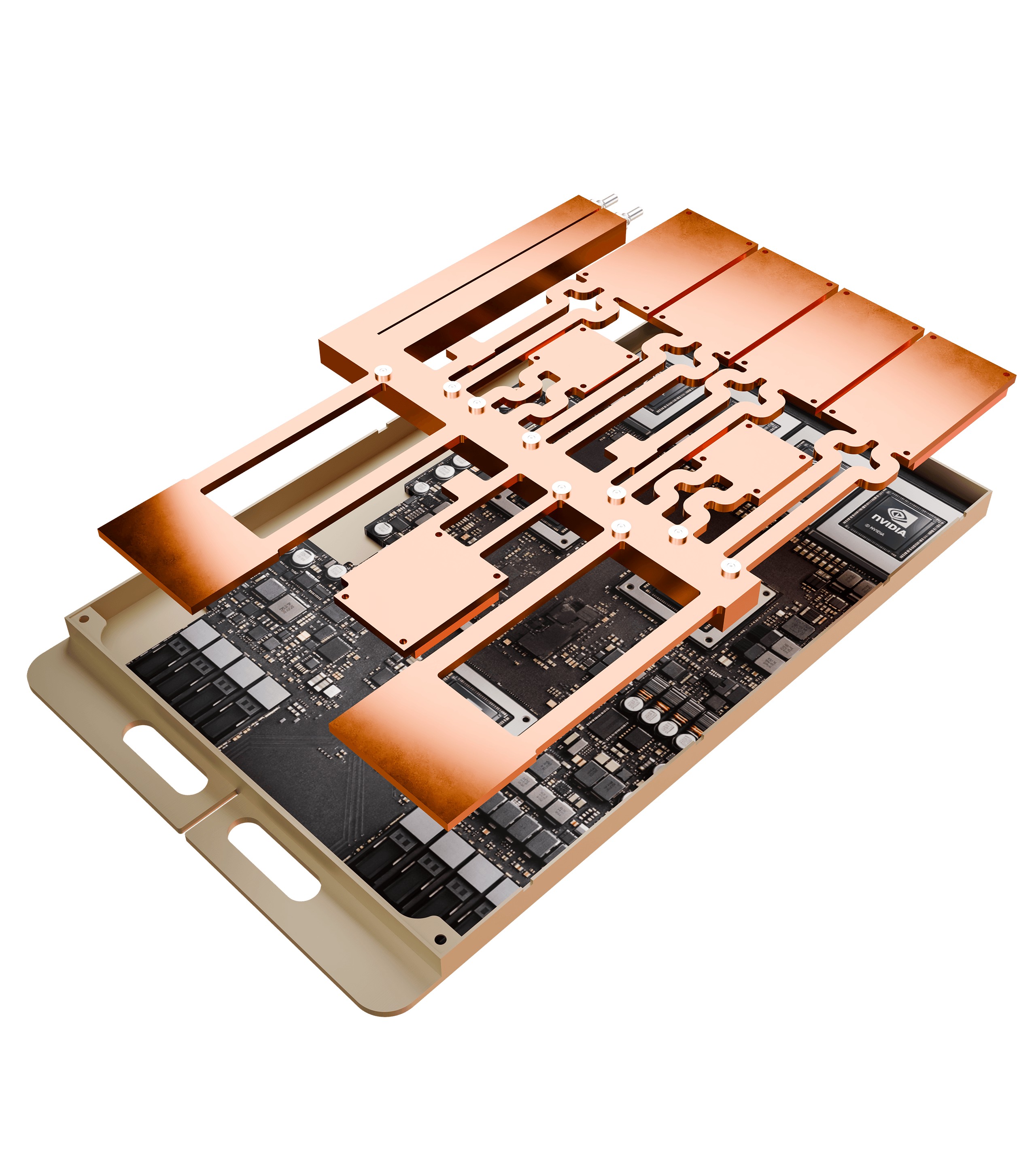
Frore's uniqueness lies in that it breaks out of the traditional mechanical processing mindset and completely transfers the precision logic of manufacturing to heat dissipation production. Its latest product, LiquidJet Nexus, uses a proprietary precision manufacturing process. It is not a simple "processing" but a "growing - type" construction of the microstructure to create an extremely fine heat dissipation system. This technological path is fundamentally different from traditional heat dissipation and builds an insurmountable technological barrier.
The most intuitive manifestation of this unique manufacturing is the design and production of the 3D short - loop jet channels. The diameter of traditional liquid - cooled channels can only reach the millimeter level, while the diameter of the jet channels of LiquidJet is only in the micrometer range, and it can be customized according to the hot - spot distribution of the GPU. These micro - level channels can guide the cooling medium to directly impact the core of the chip heat source, completely breaking the fluid retention layer and enabling "zero - distance" contact for heat transfer. Data is the most convincing: its heat conduction efficiency is 75% higher than that of mainstream cold plates. This breakthrough is not a simple parameter optimization but an innovation at the level of the heat transfer principle.
Relying on its own manufacturing base in Taiwan, China, the yield rate of this series of products is stably above 95%. This is also the core support for it to gain capital favor and have large - scale commercialization capabilities. After all, any black technology in the laboratory can only truly change the industry pattern when it is put into mass production.
If the chip - level manufacturing process is the "technological core" of Frore, then the Zero Hoses lightweight integrated architecture of LiquidJet Nexus is the "practical weapon" for it to break through industry pain points and quickly capture the market, and it is also an important extension of its technological uniqueness. The "original sin" of the hoses in traditional liquid - cooling systems has long been an industry consensus. The dense hoses are like cobwebs winding inside the server, not only taking up a lot of space and being prone to dust accumulation and aging but also making liquid leakage a Damocles sword hanging over the data center (the annual liquid leakage rate of traditional liquid cooling is about 0.1%, and a single leakage can cause the entire cabinet of servers to shut down, resulting in losses of millions).
The Zero Hoses design of LiquidJet Nexus is not simply "removing the hoses" but an integrated reconstruction based on chip - level manufacturing. Multiple LiquidJet heat dissipation modules are integrated into one, completely eliminating all hoses, connectors, and manifold structures. This design brings about a disruptive change. The deployment of liquid cooling has been simplified from a "careful engineering task" to an "easy operation like plugging in memory," with the deployment efficiency increased by more than 50%. The weight of the heat dissipation system is reduced by 55%, and the volume is greatly compressed, perfectly adapting to the NVIDIA Kyber ½U high - density computing tray, doubling the number of GPUs deployed in a single rack and directly doubling the computing power density. More importantly, the design without interfaces and hoses directly reduces the liquid leakage rate to 0, eradicating the industry's chronic problem at the root.
The ultimate implementation of Frore's technological uniqueness is reflected in its perfect adaptation to NVIDIA's next - generation Rubin GPU, which is also its "fatal attraction" to stand out and gain industry recognition. It is reported that LiquidJet Nexus can reduce the operating temperature of the Rubin GPU by 8°C through its 3D short - loop jet technology, directly increasing the AI Token generation efficiency per second by 4%. This means that the performance of the Rubin GPU will be fully released, and it will no longer be forced to down - clock or limit power due to overheating, truly achieving "full - load operation." For AI data centers pursuing extreme computing power, this 4% increase is not a simple parameter growth but a real increase in production capacity and cost optimization.
From the perspective of commercial investors, Frore's $1.64 billion valuation is never an endorsement of "a single heat dissipation product" but a collective vote for "the future direction of the heat dissipation industry." In the past decade, the focus of innovation in AI hardware has always been on chips, computing power, and models, and heat dissipation has always been regarded as a "supporting link," with its industry value being severely underestimated. However, as the power density of chips continues to break through physical limits, heat dissipation has become the last shackle restricting the release of computing power. The emergence of Frore has completely reconstructed the industry value of heat dissipation, transforming it from a "cost center" into a "performance center, efficiency center, and safety center."
From the perspective of industry analysts, the rise of Frore marks that the heat dissipation industry has officially bid farewell to the "mechanical era" and entered the "chip - level era." The significance of this paradigm shift is no less than the breakthrough of AI chips from traditional processes to advanced processes. While everyone is chasing chip performance upwards, Frore is delving into the manufacturing precision of heat dissipation downwards, using a unique process to solve the underlying problems of computing power release. This "reverse breakthrough" precisely hits the core pain points of AI infrastructure. According to industry forecasts, the market scale of liquid - cooled servers in China will reach 25.7 billion yuan in 2026, and Frore's technological route is expected to redefine the competitive landscape of the liquid - cooling industry.
Of course, Frore still needs to overcome challenges on its commercialization path. One is ecological adaptation. Most existing server architectures are designed based on traditional liquid cooling, and large - scale upgrades require in - depth collaboration with mainstream server manufacturers. The other is market education. For operation and maintenance teams accustomed to fans and hose - based liquid cooling, the reliability and operation logic of the "radiator" still need long - term verification in actual scenarios. However, it cannot be denied that Frore has preempted the industry trend. Its technological uniqueness not only solves the most real pain points in the industry but also redefines the technological standards for AI heat dissipation.
When we talk about the future of AI computing power, we often focus on the number of chip transistors and the scale of model parameters, but we ignore a simple logic: no matter how powerful the computing power is, if it cannot be effectively dissipated, it will eventually become "paper performance." Frore has proved with its $1.64 billion unicorn valuation, manufacturing process, and innovative Zero Hoses architecture that the real technological revolution is often hidden in the overlooked underlying fields.
Saying goodbye to fans and hoses is not only a tidying - up innovation inside the server but also a redefinition of the limit of AI computing power. The rise of Frore is not only a victory for a single company but also an awakening of the entire heat dissipation industry. As heat dissipation enters the chip - level era, the next explosion point of AI computing power has quietly arrived.