Earning 85% less, where has Li Auto's profit gone?
|GUIDE|
■ Why did Li Auto stall in 2025?
■ Can returning to extended - range technology help Li Auto get out of the internal strife?
■ Where are the real challenges in the transformation to embodied intelligence?
In 2025, Li Auto experienced a slowdown.
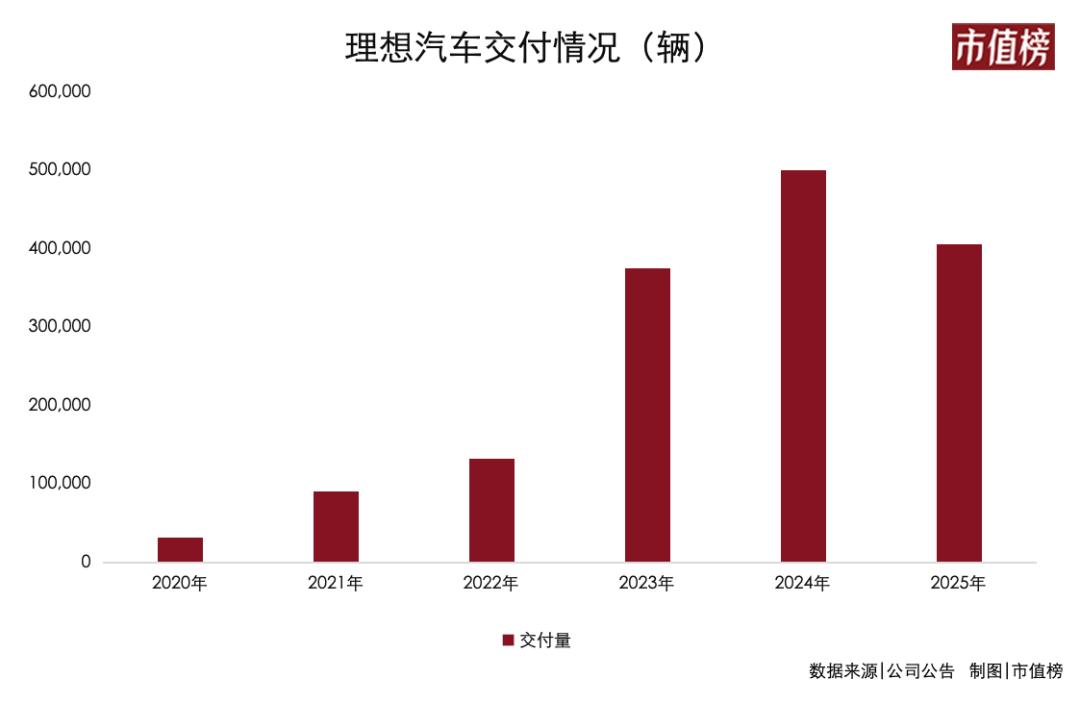
In terms of sales volume, the annual delivery in 2025 was 406,000 vehicles, a year - on - year decline of 18.8%, and it achieved 63.5% of the annual sales target of 640,000 vehicles. This once leading new - energy vehicle startup dropped to the fifth place in terms of sales among new - energy vehicle startups, and it was the only one with a year - on - year decline in sales.
Due to the decline in the average price, in 2025, Li Auto's revenue dropped by 22.3% to 112.3 billion yuan, with a larger decline than the delivery volume.
In terms of profitability, in the third quarter, affected by the MEGA recall incident, Li Auto's 11 - quarter consecutive profit record was ended. There was a slight recovery in the fourth quarter, but the annual net profit of 1.14 billion yuan decreased by 85.8% year - on - year.
2025 was also a year of in - depth adjustment for Li Auto. This adjustment left marks both at the operational level and in the capital market.
In the field of new - energy vehicles, the advantages of extended - range models were being chased by more and more automakers. The pure - electric models faced a series of challenges, from poor market sales to recalls due to the anti - corrosion performance of the coolant and production capacity bottlenecks. At the same time, Li Auto chose to expand its technological boundaries externally and fully shifted to the battlefield of embodied intelligence, which requires a longer cycle and greater investment.
In terms of capital market performance, in 2025, Li Auto's stock price fell for half a year.
Before the release of the financial report, the news that "Li Xiang is considering repurchasing some Hong Kong - listed shares of Li Auto" circulated in the market.
It should be noted that since its listing in Hong Kong in 2022, Li Auto has never conducted share repurchases, and Li Xiang himself has never increased his shareholding in the company. If this repurchase can be implemented, it will be the company's first share repurchase since its establishment.
At this time, the significance of the word "repurchase" is self - evident. So, has Li Auto passed its most difficult time?
01 Has the darkest moment passed?
After the recall and losses in the third quarter, with the one - time disturbances subsiding, Li Auto's financial and operational data seem to have improved.
In the fourth quarter, Li Auto's revenue increased by 5.2% quarter - on - quarter to 28.78 billion yuan. The overall gross profit margin rebounded by 1.5 percentage points to 17.8%, among which the vehicle gross profit margin rebounded by 1.3 percentage points to 16.8%. The net profit changed from - 624 million yuan in Q3 to 20.2 million yuan.
Putting these figures together, it seems that the spring has finally bounced back a little from being compressed to the bottom.
However, the situation is not as optimistic as it seems on the surface.
If the impact of the recall incident is excluded, Li Auto's actual vehicle gross profit margin in Q3 was 19.8%. In comparison, the 16.8% vehicle gross profit margin in the fourth quarter actually showed a significant decline.
In Q4, Li Auto had an actual operating loss of 443 million yuan. The net profit remained positive mainly due to the support of financial interest and other revenues.
Why did the gross profit margin decline?
On the one hand, the i6 is not a profitable model, and its sales proportion was increasing in the fourth quarter. The i6 is priced at 249,800 yuan, and the actual price can start from 239,800 yuan with discounts.
Some reports said that before the dual - supplier switch of the i6 was completed, the gross profit margin would be less than 15%. The production capacity of the i6 climbed slowly in the fourth quarter, and the delivery was repeatedly postponed. Recently, Li Auto announced that the production capacity bottleneck has finally been alleviated. 17,000 and 16,000 vehicles were delivered in January and February respectively, and the monthly production capacity will climb to 20,000 in March. But before that, it was difficult to reduce costs and improve the gross profit margin through the scale effect.
On the other hand, in order to cope with the competition, Li Auto provided relatively large discounts on car sales in the fourth quarter, especially for the L series, but it still couldn't stop the 60% year - on - year decline in the sales of the L series.
In other words, in 2025, Li Auto was in a situation where high - profit models were hard to sell, and volume - driving models were not profitable.
According to current information from various sources, the downward trend of the gross profit margin will continue into 2026.
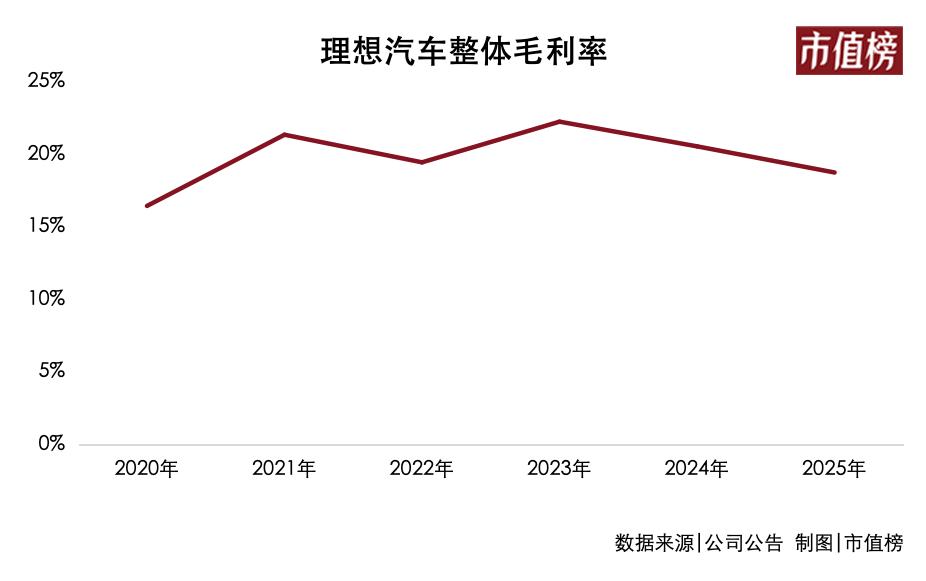
Li Auto expects the delivery volume in the first quarter to be between 85,000 and 90,000 vehicles, a year - on - year decrease of 3.1% to 8.5%; but the total revenue will be between 20.4 billion and 21.6 billion yuan, a year - on - year reduction of 16.7% to 21.3%.
According to Bloomberg's comprehensive forecast, the market previously estimated the revenue to be 24.01 billion yuan. The delivery volume guidance is generally in line with the market forecast, but the revenue guidance is 2 - 3 billion yuan short.
If calculated by the price per vehicle, the price per vehicle in Q4 was about 250,000 yuan, and it will further drop to 222,000 yuan in Q1 of 2026. This means that more low - price models like the i6 will be needed to drive sales, while the L series models are still under heavy pressure.
Recently, the continuous rise in the prices of raw materials such as upstream lithium batteries and storage chips will also put pressure on the restoration of the gross profit margin in 2026. Research reports show that Li Auto expects the annual vehicle gross profit margin to be 15% in 2026. Based on this, both Citigroup and Bank of America believe that Li Auto has the risk of losses in 2026.
At the earnings meeting, Li Xiang said that in the mid - to - high - end market above 200,000 yuan this year, the number of newly launched models is more than the total of the past few years, while the growth of the entire market is very limited.
In this situation of even more intense competition, Li Auto's annual sales target for 2026 is to achieve a growth of more than 20%, that is, 487,000 vehicles. That means in the next 9 months, the average monthly sales volume should reach 44,000 - 45,000 vehicles.
How to arrange the product layout in 2026 has become the top issue for achieving the target.
02 Correcting internal strife: Returning to extended - range technology and betting on the i9
The mutual competition among products was the most obvious internal strife for Li Auto in 2025.
For example, the lower - priced L6 has configurations such as a refrigerator and a screen. In order to maintain the price range of 320,000 yuan, the i8 intentionally reduced its configurations. The L series did not achieve a situation where 1 + 1 > 2, and there was even a diversion of customers.
The root of this situation can be traced back to the organizational adjustment in 2024.
After the unsuccessful launch of the MEGA, Li Auto split its product line into three independent teams. The first product line covers models above 400,000 yuan (MEGA/L9), the second product line covers models between 300,000 and 400,000 yuan (L8/L7/i8), and the third product line covers models below 300,000 yuan (L6/i6).
The products in different price ranges are intended to accurately target the market, but on the contrary, it is easy to have problems such as fighting independently and resource competition. Coupled with the Max, Pro, Ultra and other versions of different models, the positioning of the products is not clear, which increases the decision - making difficulty for consumers.
Li Auto also realized this problem. The adjustment logic is to increase the luxury of the flagship models, create a gap in terms of positioning, product strength, price, etc., and minimize the internal competition and consumption between pure - electric and extended - range models in the same price range.
In December 2025, Li Auto announced the merger of the first and second product lines, which were taken over by Tang Jing, the former president of the first product line. This "product line experiment" that lasted for a year and a half finally came to an end.
The actual actions of correction will be reflected in the product rhythm in 2026.
An important action is to return to extended - range technology. According to a report from 36Kr Pro, the internal judgment is that the core market for extended - range vehicles in the future will mainly be above 400,000 yuan.
In 2026, the L series will undergo a major facelift and streamline the SKUs. There will no longer be so many versions, and the whole series will be standard - equipped with 5C super - charging technology, completely eliminating the pain point of "a discounted experience for the entry - level version".
Compared with the current models, the core changes of the new extended - range models are: a battery capacity of over 70 kWh, a pure - electric range of over 400 kilometers, the self - developed third - generation extended - range generator achieving "senseless power generation", and the self - developed Mach 100 chip being installed for the first time.
The new - generation L9 to be launched in the first half of 2026 is also regarded as the key for Li Auto to break the deadlock. If Li Auto wins the battle of the L9, the following products will naturally thrive.
However, the challenges cannot be ignored.
In terms of total volume, the development and popularization of super - charging technology have weakened the overall market share of extended - range models. According to data from the China Passenger Car Association, the proportion of extended - range vehicles in the new - energy vehicle wholesale structure declined for several consecutive months in the second half of 2025.
In terms of structure, the competition is becoming more and more intense. In terms of configuration, the "refrigerator, color TV, and big sofa" configuration has been replicated. In terms of batteries, since 2025, more automakers have promoted large - battery extended - range models as a transitional solution to the mainstream price range. In terms of intelligent driving, the Wenjie M9, with Huawei's ADS intelligent driving system, has continuously squeezed the market.
Whether the upgraded L9 can break through in the "fierce competition" remains a huge unknown.
The actions in the field of pure - electric vehicles are concentrated on the i9. The pure - electric flagship SUV, the Li Auto i9, will be launched in the second half of 2026. The i9 and the extended - range flagship L9 Livis form a dual - flagship layout of "extended - range + pure - electric".
The ideal rhythm is: in the second quarter, use the upgraded extended - range flagship L9 and the Livis version to stabilize the basic market, and then let the i9 attack the high - end pure - electric market in the second half of the year.
Once the L9 and i9 are highly successful, Li Auto will completely pass the darkest moment, and its product strength and brand potential will also reach a new level. At the same time, it can also promote a faster recovery of the gross profit margin.
However, when the pure - electric range of extended - range vehicles exceeds 400 kilometers and supports 5C super - charging, will the experience boundary between them and pure - electric vehicles become less clear? Will the "dual - flagship" strategy turn into another form of internal strife? These need to be verified by consumers' choices after the new cars are launched.
03 Challenges in the transformation to embodied intelligence
It must be admitted that Li Auto's pace of transitioning to pure - electric vehicles was relatively late, and the path was quite bumpy.
This also made Li Auto realize that if the products only stay at the level of "electric vehicles", the competition will fall into a parameter war; if it only focuses on being a "smart terminal", it is easy to repeat the functional involution of smartphones.
Li Xiang's answer is: to turn the car into an embodied intelligent product in the physical world. Li Auto is very determined in its full - scale transformation to embodied intelligence.
Surrounding embodied intelligence, Li Auto has launched multi - dimensional reconstructions, including products (not elaborated here), the sales system, the R & D system, etc.
In terms of the sales system, in March 2026, the "store partner program" was officially launched, delegating the pricing power. The store managers are fully responsible for the business results. At the same time, the assessment mechanism has been expanded from a single sales volume indicator to the overall business results of the store, and a profit - sharing mechanism has been introduced.
In terms of the R & D system, in January, Li Auto made an adjustment. The R & D team is no longer divided into departments according to traditional software and hardware functions. In this adjustment, Li Auto reconstructed the R & D system into four major sectors: the organ system, the brain system, the software body, and the hardware body, and three major teams: the base model team, the software body team, and the hardware body team.
Li Xiang calls this new set of logic "organizing in the way of creating digital humans and silicon - based humans".
Li Auto once reflected internally that it used to over - emphasize the R & D cost - effectiveness ratio, that is, when the revenue decreased, the R & D budget also had to be compressed, which would lead to a vicious circle. Now, this indicator is being gradually downplayed, so that R & D investment is no longer restricted by rigid constraints.
This was fully reflected in the fourth quarter: against the background of shrinking revenue, marketing, and management expenses, Li Auto's R & D expenses increased by 25.3% year - on - year. The annual R & D investment was 11.3 billion yuan, and half of it was invested in AI, including chips, models, operating systems, etc.
However, transformation is not achieved overnight.
First, the change in the route has led to personnel changes. Personnel turmoil and transformation pains are also factors contributing to the current situation.
From July 2025, when Jia Peng, the person in charge of intelligent driving technology R & D, started taking sick leave, and the departure of the three - person end - to - end team, to the R & D system adjustment in January 2026, several core backbones left one after another, including Lang Xianpeng, the person in charge of intelligent driving; Han Ling, the person in charge of intelligent driving products; Qin Dong, the person in charge of the chip department's SoC; and Chen Wei, the person in charge of the base model.
Li Xiang said that the short - term effect of this adjustment is that "recently, everyone has found that the work efficiency has become higher. The training efficiency of the intelligent driving model has changed from being iterated once every two weeks to once a day." Li