In 2026, mobile phone manufacturers flocked to the "safe haven" of foldable screens.
Niche foldable smartphones are becoming the focus of attention for smartphone manufacturers.
On March 1st and 10th, 2026, Honor held two press conferences in succession to launch the foldable flagship, Honor Magic V6. It is equipped with the self - developed top - grade black diamond screen, the 2800MPa Honor Shield steel hinge, and a 6850mAh battery, with a starting price of 8,999 yuan. Li Jian, the CEO of Honor, said that the Magic V6 has the all - dimensional strength to achieve a "foldable grand slam" and can be regarded as the "king of foldables".
OPPO has also officially announced that it will hold a new product launch on March 17th to introduce the OPPO Find N6. It will debut the new - generation titanium alloy sky hinge and sky memory glass, achieving the effect of "invisible creases and long - term flatness". Liu Zuohu, the chief product officer of OPPO, believes that the Find N6 not only represents a huge leap in foldable screen technology but also realizes remarkable progress in user experience.
It's not just Honor and OPPO that are launching new foldable products. Next, Xiaomi, vivo, and Huawei will also successively update their respective annual foldable flagships. More notably, this autumn, Apple, which has always been "aloof", will also enter the foldable screen market and launch the iPhone Fold with a horizontal inward - folding design.
In fact, the concept of foldable smartphones is not new. As early as February 2019, Samsung launched the world's first mass - produced foldable smartphone, the Galaxy Fold, which is exactly seven years ago. For the straight - screen smartphone industry, seven years is enough time for the iPhone to evolve from its first - generation product to the iPhone 6. However, the foldable screen market has been a bit "slow - burning", and it wasn't until this year that Apple decided to enter.
This naturally raises questions: Why are smartphone manufacturers all intensifying their efforts on foldable products in 2026? Can foldable smartphones become the next big hit? What value do foldable smartphones hold for the smartphone industry?
The overall smartphone market is shrinking, and manufacturers are struggling
Even today, smartphones remain the mainstream computing platform for the public. However, due to increased homogenization and over - performance, consumers' motivation to replace their phones has been continuously weakening, and the ceiling of the smartphone market has been lowering.
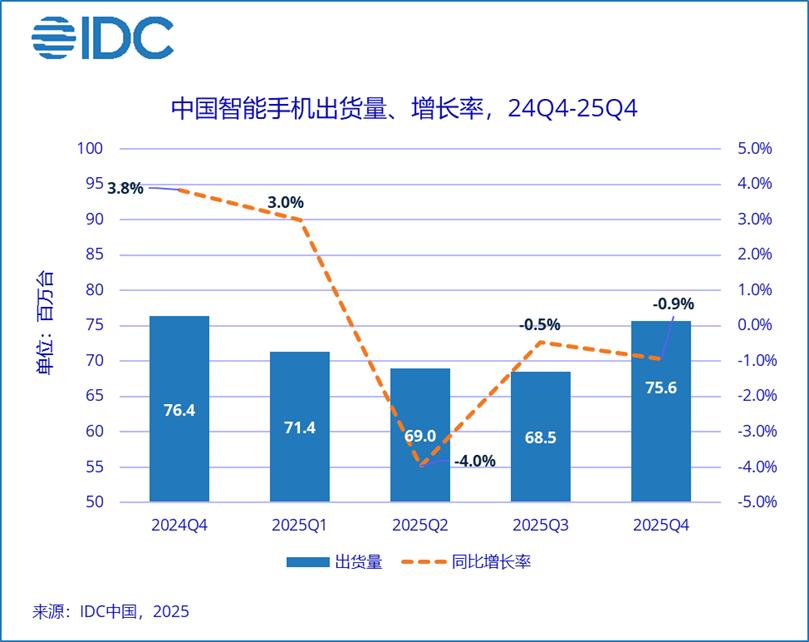
Source: IDC
IDC data shows that from 2019 to 2025, the annual shipment of smartphones in China decreased from 370 million units to 284 million units, with an average annual compound decline rate of 4.31%. It can be said that the Chinese smartphone industry has long entered the stock era.
In view of the shrinking market dividends, in order to maintain their influence, many smartphone manufacturers have had to engage in a cut - throat competition in terms of underlying configurations, and their performance has accordingly "changed".
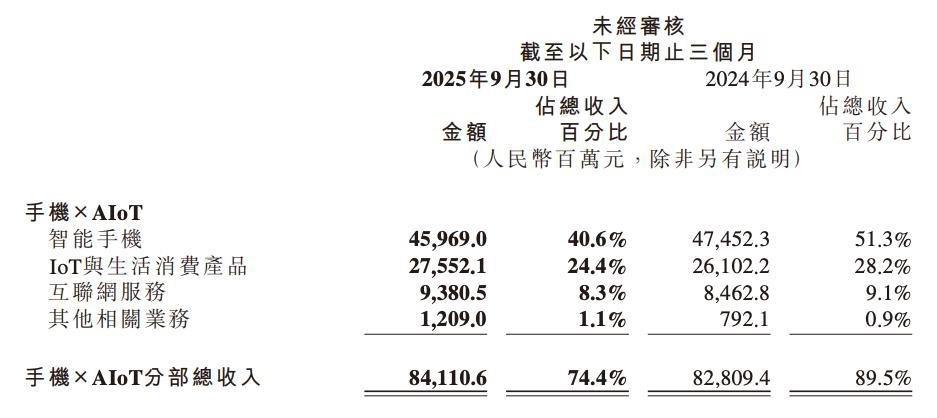
Source: Xiaomi's Q3 2025 financial report
For example, Xiaomi's Q3 2025 financial report shows that the shipment of Xiaomi phones reached 43.3 million units, a year - on - year increase of 0.5%. However, during the same period, the average selling price of Xiaomi phones was only 1,062.8 yuan, a year - on - year decrease of 3.6%; the gross profit margin was 11.1%, a year - on - year decrease of 0.6 percentage points. Since the increase in shipment volume could not offset the decline in price, Xiaomi's smartphone business revenue in this quarter was 46 billion yuan, a year - on - year decrease of 3.1%.
It's true that not all manufacturers have fallen into the quagmire of negative growth against the backdrop of the continuously declining smartphone shipment scale. A typical example is Apple, which, with the iPhone 17 series launched in September 2025, showed strong growth potential during the downward cycle.
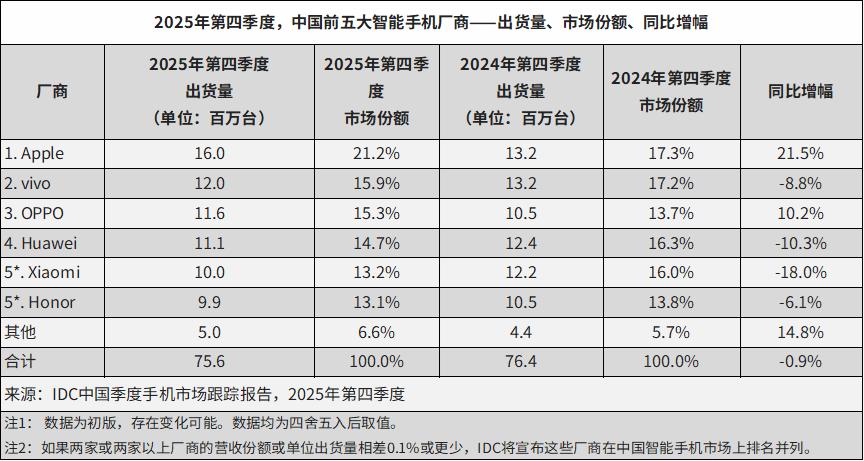
Source: IDC
IDC data shows that in the Chinese smartphone market in Q4 2025, Apple's smartphone shipment was 16 million units, ranking first, with a year - on - year increase of 21.5%. Data disclosed by the digital blogger "RD Observation" shows that as of the 9th week of 2026, the sales volume of the iPhone 17 series in the Chinese market was 23.8397 million units, far ahead of a host of Android flagships.
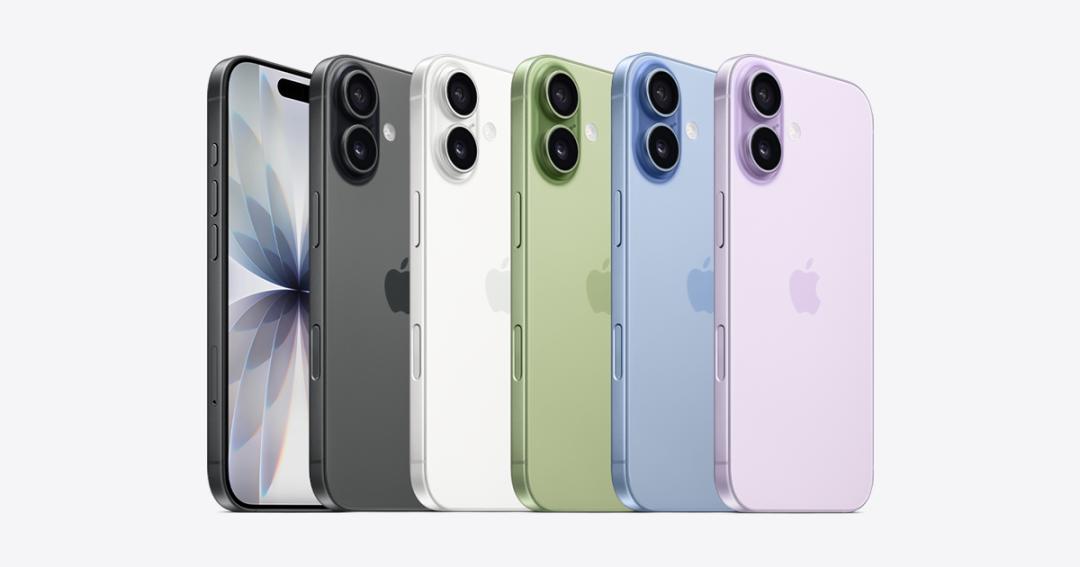
However, it should be noted that the remarkable sales of the iPhone 17 series are largely based on Apple's "aggressive" upgrades. The standard version of the iPhone 17 no longer adheres to the "entry - level" configuration. Instead, it uses the second - generation ultra - ceramic crystal panel, is equipped with an LTPO screen, supports ProMotion and full - screen AOD, and has a peak brightness of up to 3000 nits.
By improving the underlying configuration, Apple has indeed gained some breathing space. However, this also shows to some extent that against the backdrop of increasing market downward pressure, Apple has lost the dominant position in competition and has to maintain the competitiveness of its products through passive "involution".
Source: Apple
As Li Nan, the former vice - president of Meizu Technology, said, "The current success of the iPhone 17 series is mainly due to a sudden surprise. However, if the Android camp actively fights back, even if the iPhone 17 wins this time, the iPhone 18 and 19 will eventually be defeated." As Android smartphone manufacturers launch counter - attacks, Apple still needs to face the challenge of the continuously lowering ceiling of the smartphone market.
Just when smartphone manufacturers are feeling anxious due to intensified competition, the emerging foldable smartphones have provided a new outlet for the industry. Data disclosed by IDC shows that from 2021 to 2025, the annual shipment of foldable smartphones in China increased from 1.5 million units to 10.01 million units, with a compound annual growth rate of 60.7%.
Although the annual shipment of foldable smartphones is not large, the growth potential contained in this market has provided a rare incremental space for smartphone manufacturers trapped in the stock competition. After entering the foldable smartphone market, smartphone manufacturers are expected to reshape the growth logic through form innovation and balance the downward pressure caused by the continuously tightening overall market space.
The soaring memory prices make foldable phones a "safe haven"
The fundamental reason why smartphone manufacturers are intensively increasing their efforts on foldable products in 2026 is, of course, the continuous shrinkage of the overall smartphone market. A more direct and practical factor is that against the backdrop of rising memory prices, foldable smartphones with stronger bargaining power have become a "safe haven" for manufacturers to hedge against cost pressure.
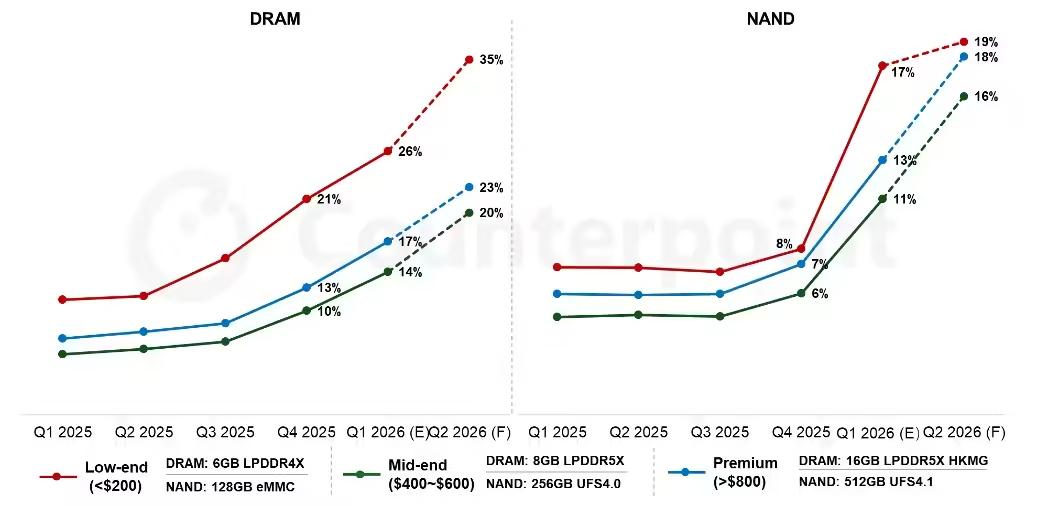
Source: Counterpoint Research
As is well - known, since the second half of 2025, due to the soaring demand for AI computing power, memory prices have skyrocketed. A research report disclosed by Counterpoint Research shows that in Q1 2026, mobile memory prices continued to rise significantly, with the DRAM price increasing by more than 50% quarter - on - quarter and the NAND Flash price increasing by more than 90% quarter - on - quarter.
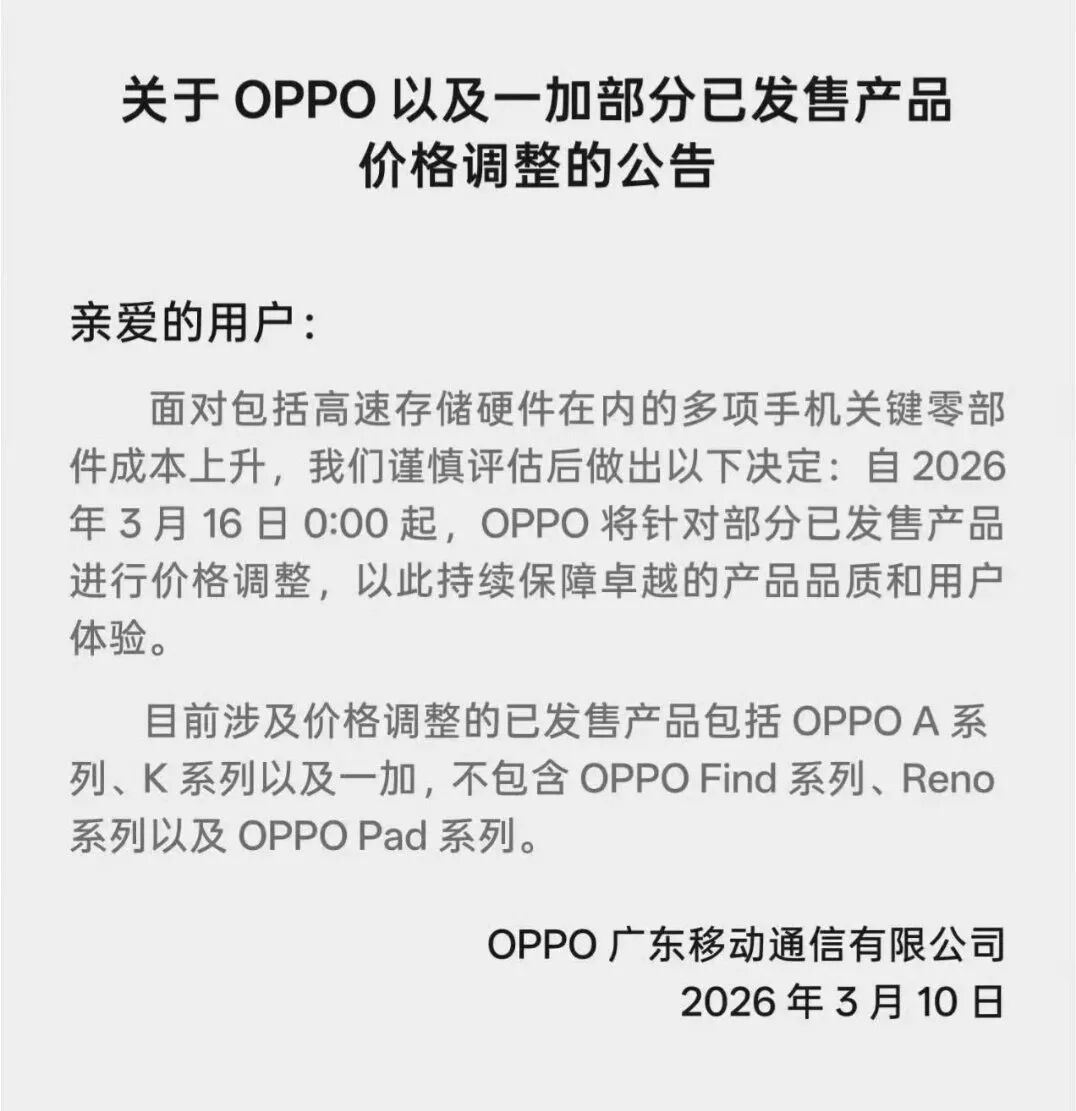
Source: OPPO
Against this backdrop, smartphone manufacturers have had to transfer the cost pressure to the consumer market. On March 10th, 2026, OPPO issued an announcement saying that in the face of the rising costs of multiple key smartphone components, including high - speed storage hardware, starting from March 16th, the prices of some already - released products in OPPO's A series, K series, and OnePlus will be adjusted.
In order to balance the pressure of the sharp increase in the cost of upstream components, some smartphone manufacturers have even chosen to "take a step back". On March 11th, the well - known digital blogger "Digital Chat Station" revealed that "there's no other way. Mid - and low - end new phones are starting to test 90Hz drop - notch screens." It should be noted that 120Hz punch - hole screens have long been popular in mid - and low - end models, and 90Hz drop - notch screens were the mainstream configuration around 2019. This significant regression in configuration reflects the helplessness and compromise of smartphone manufacturers.
Given that consumers' motivation to replace their phones has already weakened, the increase in smartphone prices and the reduction in configuration caused by the soaring memory cost pressure will obviously further suppress consumers' demand for new phones.
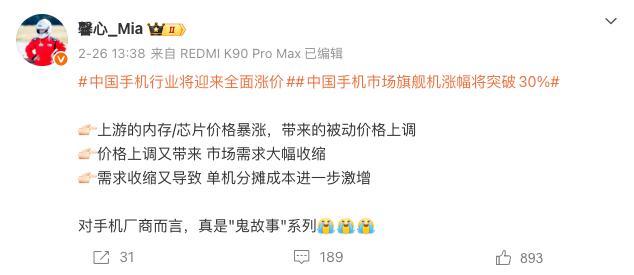
Source: Hu Xinxin
On February 26th, 2026, Hu Xinxin, a product manager at REDMI, posted on social media that the sky - rocketing prices of upstream memory and chips have forced up the phone prices; the price increase has led to a significant contraction in phone demand; and the contraction in demand has further increased the cost per unit. "For smartphone manufacturers, it's really a 'horror story' series."
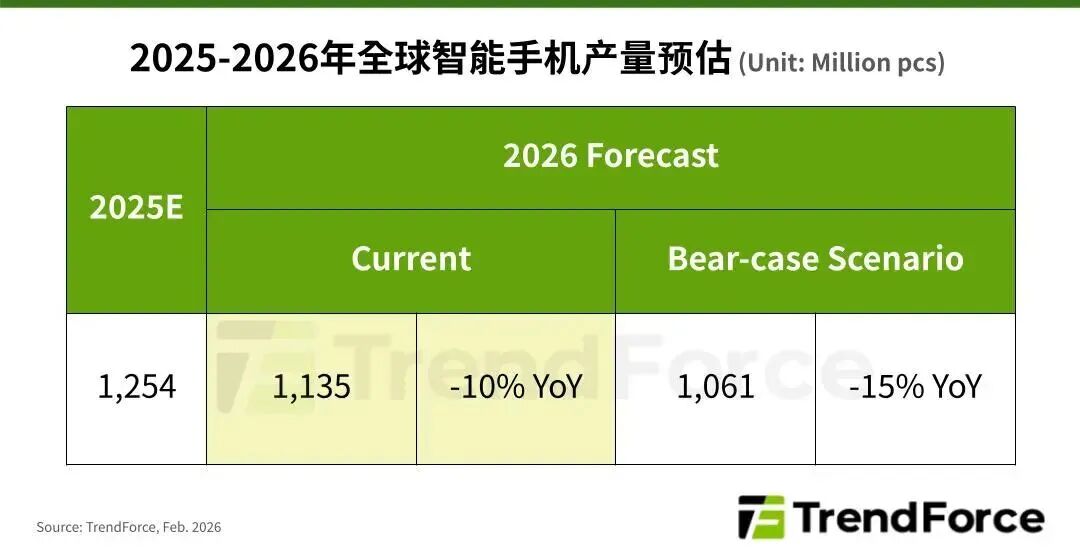
Source: TrendForce
In February 2026, the research data released by TrendForce showed that under the baseline forecast, the global smartphone production in 2026 is expected to be 1.135 billion units, a year - on - year decrease of 10%; under the pessimistic forecast, the production may drop to 1.061 billion units, a year - on - year decrease of 15%.
Against this backdrop, smartphone manufacturers are all increasing their efforts on foldable smartphones. Naturally, it's because this market still maintains positive growth. More importantly, the high prices of foldable smartphones can, to a large extent, offset the increase in memory prices.
On February 28th, 2026, the Price Monitoring Center of the National Development and Reform Commission issued an announcement titled "The continuous rise in storage chip prices and their transmission to the downstream". It showed that as of January, the prices of both DRAM and NAND flash memory had reached the highest levels since data became available in 2016. Among them, the average contract price of DRAM (DDR4 8Gb 1G*8) was 11.5 US dollars, an increase of about 83% compared with September 2025; the average contract price of NAND flash memory (128Gb 16G*8 MLC) was 9.5 US dollars, nearly 2.5 times higher than that in September 2025.
A simple linear calculation shows that from September 2025 to January 2026, the storage cost of a 12GB + 256GB phone increased from about 136 US dollars (about 936.07 yuan) to about 290 US dollars (about 1996.04 yuan), with a net increase of about 1059.97 yuan.
It should be noted that the above calculation model is relatively rough and does not consider factors such as shipment volume and the bargaining power of smartphone manufacturers, so it does not represent the actual terminal cost. However, considering that most current phones use the LPDDR5 + UFS storage combination, which is more expensive than DDR4 + MLC, the actual cost pressure faced by smartphone manufacturers may not be less than the above - mentioned data.
For mid - and low - end models, since their selling prices are not high, if the increase in memory cost is directly passed on to the market, it is likely to arouse consumers' resistance.
Take a phone with a 12GB + 256GB configuration that originally sold for 2000 yuan as an example. If the price is increased by about 1000 yuan according to the memory price increase, the overall price of the phone will reach 3000 yuan, a staggering 50% increase. Such a significant price increase is obviously unacceptable to consumers of mid - and low - end phones, who are highly sensitive to prices.
In contrast, due to higher R & D costs and significant differentiation, foldable smartphones are often priced at tens of thousands of yuan and can more calmly handle the pressure of rising memory prices.
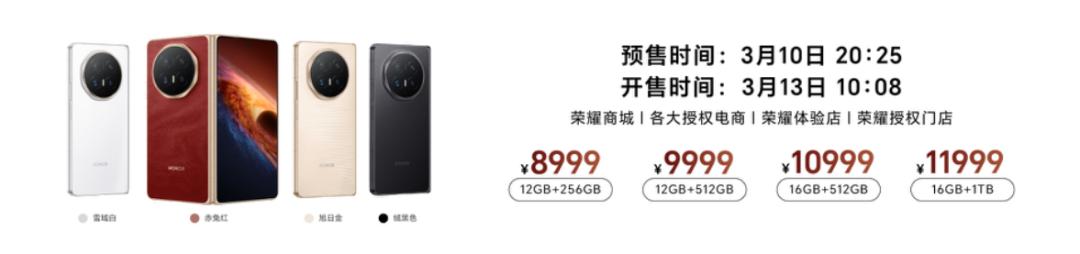
Source: Honor
Take the Honor Magic V6 as an example. The prices of its 16GB