In his senior year, his graduation project topped GitHub. Three months later, he secured 30 million yuan in investment from CHEN Tianqiao... He is the protagonist of a feel-good story in the AI era.
During the week when Baifu's reality started to go haywire, he was still preparing for his graduation defense.
His email inbox had over 99 unread messages every day. Investment institutions, startup teams, HRs from big companies, and developers from open - source communities... Everyone was looking for him. The cause was a graduation project completed in just ten days, which made it onto the global trending list on GitHub. The number of stars was rising at a visible pace. Some companies sent job offers directly, some developers wanted to collaborate, and some investors wanted to fund him.
Baifu glanced at the messages for a while and then simply marked them all as read and stopped looking.
Three months later, his second project, MiroFish, topped the GitHub list again. This time, he received 30 million yuan from Chen Tianqiao, the founder of Shanda.
As a senior undergraduate student who hadn't graduated yet, without a team or a company, he managed to top the hot list of the world's largest developer community twice and got an entry ticket to the AI startup scene. All he had was a computer and a "digital team" composed of agents.
Baifu isn't doing traditional Vibe Coding. He directs this AI crew like a director: validating ideas, optimizing logic, and then rapidly generating products. In just ten days, he completed what used to take a team weeks or even months. From the public opinion analysis of BettaFish to the multi - agent deduction of MiroFish, he's attempting more and more daring feats: using AI to simulate complex societies and even predict future events.
However, when the grand vision of "using AI to predict the world" was proposed, doubts emerged. Can a demo completed in ten days really carry such a lofty goal?
Baifu told GeekPark that his expectation for MiroFish isn't a "prophetic prediction machine." It doesn't aim to predict the future accurately every time. Instead, it tries to transform the multiple possibilities that could only be imagined intuitively into a set of scenario deductions that can be observed, compared, and iterated. Before major decisions are made, it lays out the key variables and game relationships on the table.
01
A Graduation Project Written in Ten Days
Suddenly Made It onto the GitHub Hot List
The story starts at the end of last year.
At that time, Baifu was still a senior undergraduate student, looking for a topic for his graduation project. His technical background isn't particularly legendary. He majored in computer science and first got into programming on the front - end. He was attracted by the feeling of "creating something with just a few lines of code" after seeing someone build a beautiful website with code. Later, he gradually developed his back - end development skills, started learning Python and Java, and got into machine learning and deep learning.
The creation of the BettaFish project wasn't due to his technical accumulation but rather an intensive research phase for his graduation project.
Before starting to write code, Baifu spent a lot of time thinking about three things: Why to do it, for whom to do it, and how to do it.
He noticed that there were many "AI + news summary" projects in the open - source community. Some people made daily news digests, and some created information - screening tools. However, in the more specialized field of public opinion analysis, there were almost no open - source projects that truly integrated the capabilities of large models. Most traditional public opinion tools still stay at the data dashboard level, rather than using AI to understand the information itself.
"The open - source community actually lacks a more AI - powered public opinion analysis tool," he recalled later.
After the direction was determined, the development speed picked up. Baifu calls himself the "director," and the AI is like an executive team. He first used a demo to validate his ideas and then continuously generated code and adjusted logic through AI coding tools. The whole project, from the concept to the runnable version, only took ten days.
Initially, his expectations for this project were quite low. "I'd be very satisfied if it could get 1,000 stars," he said.
However, things quickly exceeded his imagination.
After the project was launched, BettaFish quickly made it onto the GitHub Trending list. The number of stars started to rise at a visible pace. Almost every one or two hours, when he refreshed the list, the number would increase further.
During that time, he refreshed the GitHub page almost every hour, watching the star count keep rising. "I was really excited at first," he said. But after the number reached 10,000 stars, he gradually became "desensitized." "After reaching 10K, I kind of lost the feeling," he said.
For a student still preparing for graduation, this sudden attention was both exciting and confusing to some extent. With so many opportunities emerging at the same time, making a choice became difficult.
"When there are too many choices, you actually don't know which one to pick," he said.
That week, he truly realized for the first time that this graduation project, which was originally completed in ten days, was turning into something entirely different.
02
AI Makes "One - Person Product Development" a Reality
If we only look at the result, the ten - day development of BettaFish might seem like an accidental success. However, what's truly important about this project is the new development method behind it, which is the recently much - discussed Vibe Coding.
In the past, software development usually followed a relatively clear assembly - line process: product managers proposed requirements, architects designed the system, engineers wrote code by modules, and finally, it went through testing and iteration. Each role had a clear division of labor.
However, after the popularization of AI programming tools, this process has been re - compressed.
In Baifu's description, AI has become a collaborator in the development process. Developers no longer need to type code line by line. Instead, they describe functions, structures, and logic in natural language, let the AI generate code, and then make continuous adjustments based on the results.
During this process, the role of human developers has also changed.
"People are more like directors." Developers need to decide what problems the product should solve, how the system should be architected, and how each function should be split. The specific implementation part can be completed by AI. In many cases, the development process is more like a rapid experiment: first generate a demo to verify if the idea is valid, and then make continuous adjustments and iterations.
This approach might seem like "writing less code," but in fact, it's more about changing the developer's focus from "writing implementation" to "making decisions."
The most direct result of this change is a significant increase in development efficiency.
The development cycle of BettaFish was only ten days. In the traditional software development process, even for a small tool, it often takes weeks or even months from requirement confirmation to product launch. However, with the assistance of AI coding tools, many tasks that used to require a lot of repetitive work have been greatly compressed.
Baifu mentioned in his communication with GeekPark that in subsequent attempts, the development speed was even faster than that of BettaFish.
Many functions no longer need to be built from scratch. Instead, the AI generates the basic framework, and then developers make adjustments and optimizations. They can continuously experiment with new combinations.
In a sense, this development model is changing the productivity boundaries of individual developers.
In the past, one person could usually only maintain small - scale projects, and the development of a complete product relied on team collaboration: front - end, back - end, design, and testing, with each person responsible for a different part. However, with the help of AI tools, one person can quickly complete prototype development and even launch a usable product.
This has also led to the frequent mention of the "super - individual" role.
Before the emergence of AI, starting a business usually meant forming a team, raising funds, and collaborating through division of labor. However, now, the first version of more and more products no longer comes from a team but from an individual.
One person defines the requirements, designs the product, and implements the technology, and then uses AI tools to fill the gaps in their capabilities.
The emergence of BettaFish coincides with this change.
It's both an open - source project and a signal: in the AI era, the threshold for software development is being re - defined. When tools can take on more and more execution tasks, the core value of human developers lies in asking questions, designing systems, and judging what's worth creating.
And this is where the era of "one - person product development" begins.
03
From Public Opinion Analysis to "Predicting the Future"
The popularity of BettaFish initially stemmed from the fact that it was a "graduation project completed in ten days." What really kept developers interested in it was the product itself.
In terms of functionality, BettaFish has a very clear positioning: an AI - driven public opinion analysis assistant. Simply put, it solves a problem that many people face - too much information but difficult to understand quickly.
In traditional public opinion systems, users usually can only see keyword statistics, data charts, and public opinion curves. The real analysis still needs to be done manually. BettaFish tries to hand this process over to AI.
Its workflow is roughly divided into three steps:
The first step is information collection.
The system automatically collects information from public channels such as news websites, social media, and forums and continuously updates the data sources.
The second step is content understanding.
The large model conducts semantic analysis on this information, identifies key events, emotional tendencies, and discussion hotspots, and organizes the scattered information into structured content.
The third step is to generate an analysis report.
Users only need to input a topic of interest, such as a company, an industry, or a public event, and the system can automatically generate a public opinion analysis report, including the event context, opinion distribution, and public opinion trends.
BettaFish is like an "AI research assistant": it helps users read the Internet and then summarizes the key points. This product form also quickly attracted attention in the open - source community. Many developers found that it demonstrated a new product idea - using large models to replace the traditional information - organizing process.
However, in Baifu's view, BettaFish is just the first step.
After the project gained attention, he quickly started exploring a new direction: MiroFish. And this project was also the result of ten - day Vibe Coding.
The goal of BettaFish is to understand information in the real world, while the goal of MiroFish goes further - it tries to deduce possible future paths.
In concept, MiroFish is designed as a multi - agent prediction system.
The system first continuously obtains information from the real world, including news events, market data, and social media discussions. This data is input into a simulation environment to build an ever - updating "digital society."
In this environment, different AI agents are assigned different roles, such as enterprises, investors, the media, or ordinary users. Each agent makes decisions based on its own goals and the information it has and interacts with other agents.
As a large number of interactions occur, the system generates different development paths, thereby simulating the possible evolution directions of certain events.
For example, when there is major news in an industry, the system can simulate the different reactions that market participants might have, so as to observe the possible development trends of the event under different conditions.
The biggest difference between this method and traditional prediction models is that it doesn't just do statistical analysis. Instead, it observes how the system evolves by simulating social behavior.
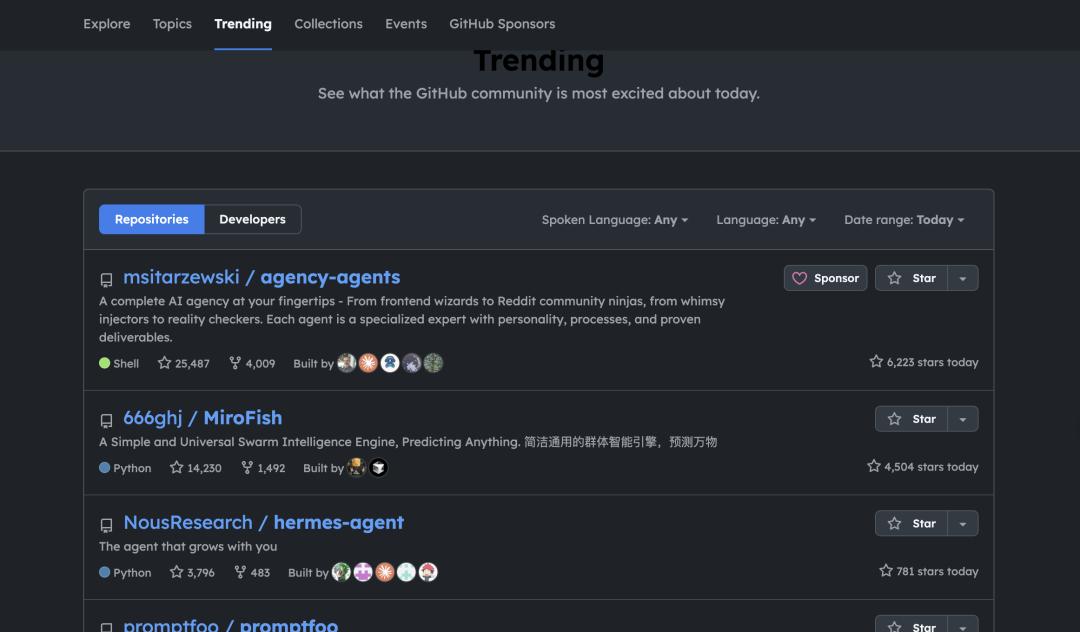
As of the morning of March 13th, MiroFish had 14,230 stars on GitHub | Image source: GeekPark
MiroFish also made it onto the global GitHub Trending list and once topped the list, surpassing other institutional and individual projects to become a global open - source hot topic. As of the morning of March 13th, MiroFish had 14,230 stars on GitHub.
In a sense, MiroFish is more like a "digital sand table." Real - world data is continuously input, and AI agents make decisions and interact within it, thereby continuously generating new possible paths.
In Baifu's words, BettaFish analyzes the present, while MiroFish "deduces the future."
04
The Window for AI Startups Has Opened
In the past few years, software startups usually required a whole team: some were responsible for product design, some for front - end and back - end development, and others for testing, operation, and growth. Even for the initial version of a product, the cost and time investment were significant.
However, the emergence of AI tools has changed all that.
During Baifu's development process, many tasks that used to take a lot of time can now be quickly accomplished with the help of AI coding tools. From code generation to function debugging and system framework construction, developers can focus more on product ideas and system design.
A direct result of this change is that the threshold for starting a business is significantly decreasing.
One person can quickly create a product prototype to verify if an idea is valid and can also launch a usable version in a shorter time. For many young developers, this means that the cost of trying to start a business is lower and the cycle is shorter.
In a sense, AI is transforming software development from a "heavy - engineering" process into something closer to a rapid experiment.
And capital has quickly noticed this change.
After the BettaFish project became popular, Baifu's email inbox was almost filled with various emails, including exchanges from developers and cooperation invitations from investment institutions. Eventually, this project, which was originally just a graduation project, attracted the attention of Chen Tianqiao, the founder of Shanda, and received an investment of about 30 million yuan.
For investors, the significance of such projects isn't just about a specific product but a new form of entrepreneurship they represent.
Chen Tianqiao said that he chose to support the incubation of MiroFish because it represents the direction he has always valued - making AI move from simply "answering questions" to truly "solving problems."
In his view, MiroFish is trying to explore what would happen if we break the dependence on a single model and let multiple agents jointly explore the problem space in a collective - intelligence way. By having multiple agents obtain signals from the real world and conduct collaborative deductions, the system can try to predict the possible evolution of complex problems. It can help people turn the uncertain future into a discussable, verifiable, and iterable hypothesis in a lower - risk environment.
For Shanda, the core logic of investing in MiroFish is to "invest in people." The birth of MiroFish made Chen Tianqiao see that young entrepreneurs not only can define real problems, use AI for rapid iteration, but also solidly turn ideas into usable products. He said, "In this new AI era, I will regard the success of these young AI talents as the most crucial sign of my own personal success again."
As AI can take on more and more tasks at the execution level, the way software products are created is also changing. More and more projects may start from an individual's idea, which is the so - called "super - individual" that has been frequently mentioned recently.
In the past, a complete software product usually required team collaboration. Now, with the help of AI tools, one person may be able to complete most of the work from idea to product prototype.
The stories of BettaFish and MiroFish provide a typical example. When AI becomes a developer's collaborator, one person may be able to create a product that used to require a team. The new round of startup window in the AI era has opened.
05
Super - Individual Entrepreneurship in Chen Tianqiao's Eyes
The stories of Baifu and many super - individual developers tell us that in the AI era, one person may be able to create a product that originally required a team. So, what does such an opportunity mean for college student entrepreneurs?
Chen Tianqiao, the founder of Shanda, told GeekPark that the important thing is not to regard the "first job" as the end but as the starting point for the compounding of abilities. First, build a solid foundation, create high - quality works, and improve the learning speed.
The greatest opportunity for college student entrepreneurs in the AI era lies in the equalization of resources. One person can quickly create a minimum viable product (MVP), iterate rapidly, and reach global users with the help of AI