The performance of Li Auto in 2025 can only be rated 60 out of 100.
On the evening of March 12th, Beijing time, Li Auto disclosed its fourth - quarter financial report. The operating revenue reached 28.775 billion yuan. Even though the outside world's forecast for Li Auto's fourth - quarter performance was relatively conservative, the actual performance still fell short of analysts' expectations. The gross profit was 5.131 billion yuan, corresponding to a gross profit margin of 17.8%. The gross profit margin of the automotive business was 16.8%, and the net profit was only 20 million yuan, barely turning positive, which was also lower than analysts' expectations.
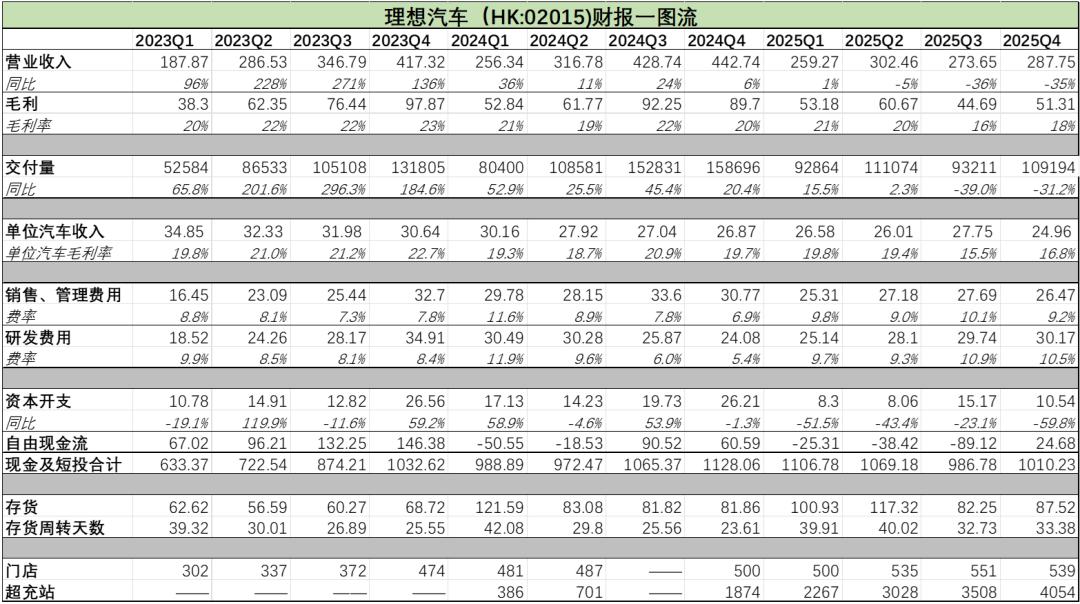
Picture: A one - page overview of Li Auto's financial report. All data in this article are from the financial report, unit: billion yuan
During the third - quarter earnings conference, Li Xiang himself shared his views on "Li Auto's next decade". He elaborated on the company's internal thinking to investors from three aspects: organizational structure, product, and technical route. At the organizational level, Li Xiang believes that the company needs to return to the startup model led by the founder. At the product level, Li Auto aims to transform into a robotics company, using cars as the carrier. At the technical level, the company should focus on investing in technologies related to embodied intelligence in the physical world.
The newly released fourth - quarter report is the first financial report disclosed by Li Auto after Li Xiang's reform declaration in the third quarter. Therefore, in addition to discussing the basic financial performance, we will also pay attention to the progress of Li Auto's reform and transformation.
In summary:
· Li Auto's fourth - quarter revenue was lower than expected, and the company actively lowered its expectations for the first quarter of 2026. Before the launch of the redesigned models, the possibility of a short - term rebound in performance is relatively small.
· The sales volume of Li Auto i6 increased, but the sales of the L - series models were relatively sluggish, leading to a decline in the price system, a significant drop in the gross profit margin, and a decline in the profit per vehicle, which directly affected the company's profit.
· With a cash reserve of tens of billions, the investment on the cost side in 2025 did not change much. The overall expense ratio was stable, and the capital expenditure slowed down. For Li Auto, which aims to transform, this approach seems a bit conservative.
· Overall, Li Auto can only get a score of 60 in 2025.
01
A total of 406,000 vehicles were delivered throughout the year, with a target completion rate of 63%
Li Auto delivered a total of 109,200 vehicles in the fourth quarter, a year - on - year decrease of 31.2%. The total number of vehicles delivered throughout the year was 406,000, a year - on - year decrease of 18.8%.
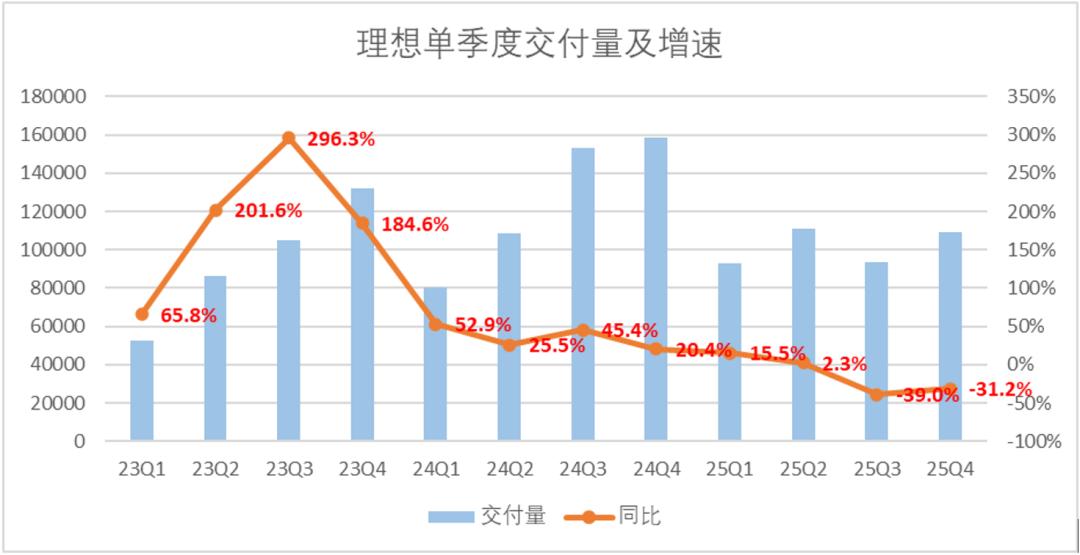
At the beginning of 2025, Li Auto's overall sales forecast was 640,000 vehicles. Looking back at the end of the year, the annual target completion rate was only 63%. Coupled with the impact of the subsidy reduction and trade - in policies in some regions in the first quarter of this year, the expected performance in the first quarter is not optimistic. According to the disclosed data, the delivery volume in January decreased by 7.5%, and in February, it basically remained the same year - on - year on a low - base level.
According to the data from Dongchedi, the Li Auto i6 model delivered 16,883 vehicles in January and 16,007 in February, accounting for 61% and 60.6% of the total delivery volume respectively. Correspondingly, the proportion of the L - series product delivery volume decreased significantly. In January, all L - series models delivered a total of 9,358 vehicles, and in February, a total of 8,980 vehicles. The delivery volume failed to exceed 10,000 for two consecutive months. It can be said that currently, Li Auto's sales are actually supported by the low - priced i6 model.
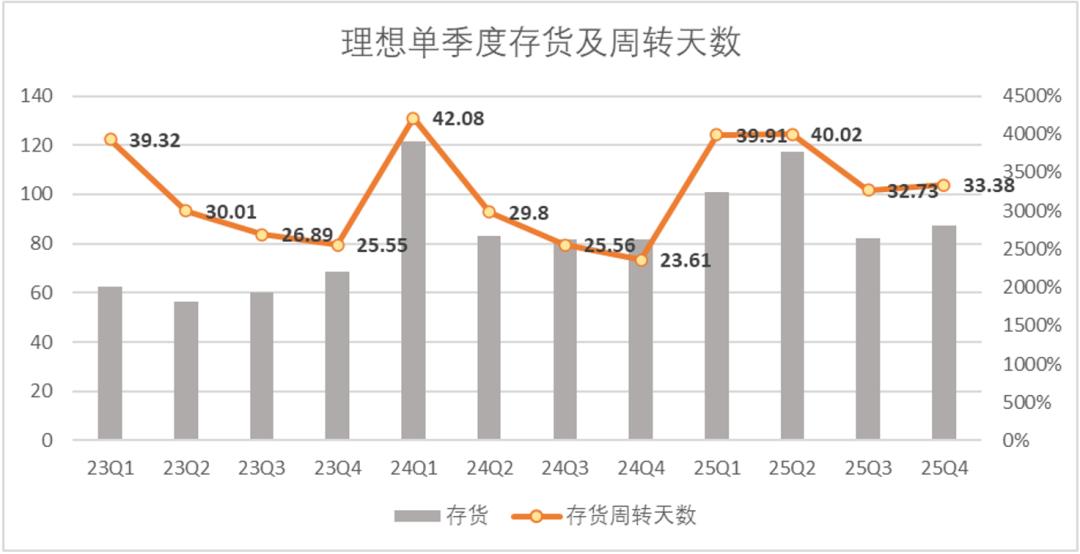
Of course, there is also good news. Firstly, Li Auto maintained a good production - sales ratio. Although the inventory increased, the turnover rate remained stable, and the inventory pressure was not large. The inventory clearance cycle will not be too long. Secondly, despite the mediocre performance in the first quarter, the management is still relatively confident, and the target for this year is set at 500,000 vehicles.
For Li Auto, before the redesigned L - series models are launched (the Li Auto i9 is not a high - volume model), the delivery volume may not improve significantly, which is also directly reflected in the financial report.
02
The revenue was lower than expected, the guidance was lowered again, and there is no obvious recovery signal in the short term
In the fourth quarter of 2025, Li Auto's revenue reached 28.8 billion yuan. With the previously disclosed delivery volume, the average estimate of analysts was 29.3 billion yuan. That is to say, Li Auto's fourth - quarter revenue performance was even lower than the conservative estimate. It is very likely that the company chose to offer price promotions at the end of the year, which pulled down the actual revenue performance.
Actually, the revenue performance in the fourth quarter is a microcosm of Li Auto's performance throughout the year. In 2025, Li Auto's annual revenue decreased by 22.3% year - on - year, and the overall decline was even greater than the decline in vehicle deliveries. On the one hand, it was due to the price structural contraction brought about by the launch of the i6 at the end of the year. On the other hand, Li Auto's sales performance this year really fell short of expectations, and the company may have carried out multiple rounds of price promotions.
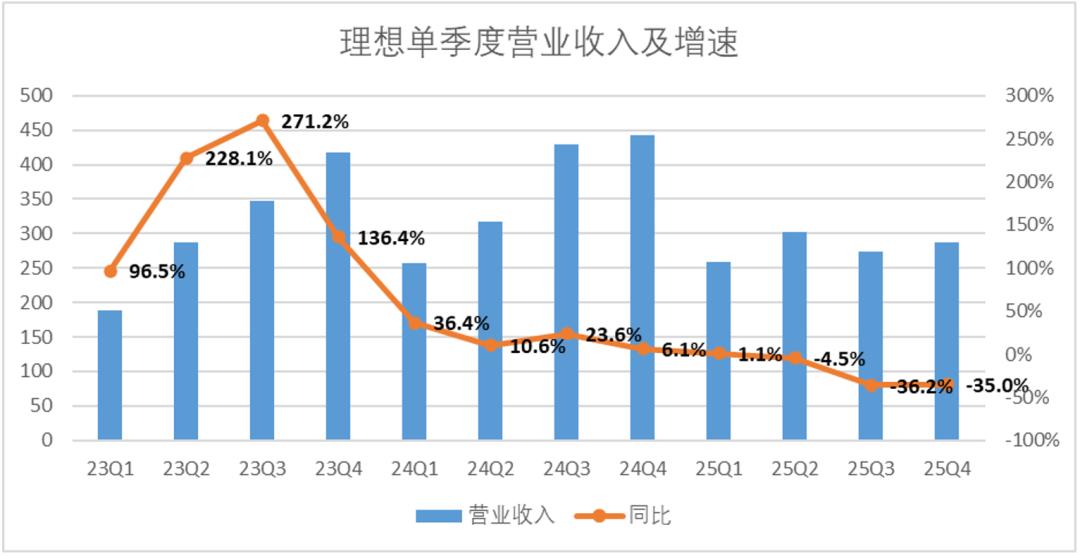
The management's revenue guidance for the first quarter of this year is between 20.4 and 21.6 billion yuan, showing a significant decline both quarter - on - quarter and year - on - year, and it is also lower than the previous market estimate of around 24 billion yuan.
Currently, before the redesigned L - series models are launched (the Li Auto i9 is not a high - volume model), it is very difficult for Li Auto to recover its revenue. After all, currently, mainstream automakers have launched models that compete with the L - series products, basically squeezing out Li Auto's L - series market share. If the changes in the new L - series models are not significant, it will be difficult to regain the market.
03
After the recall incident, Li Auto recorded operating losses for two consecutive quarters
In the fourth quarter of 2025, Li Auto's overall gross profit margin was 17.8%, only higher than that in Q3 of 2025, which was affected by the recall incident. Correspondingly, the net profit margin was very low. Excluding non - recurring gains and losses, Li Auto's net profit margin has been negative for two consecutive quarters.
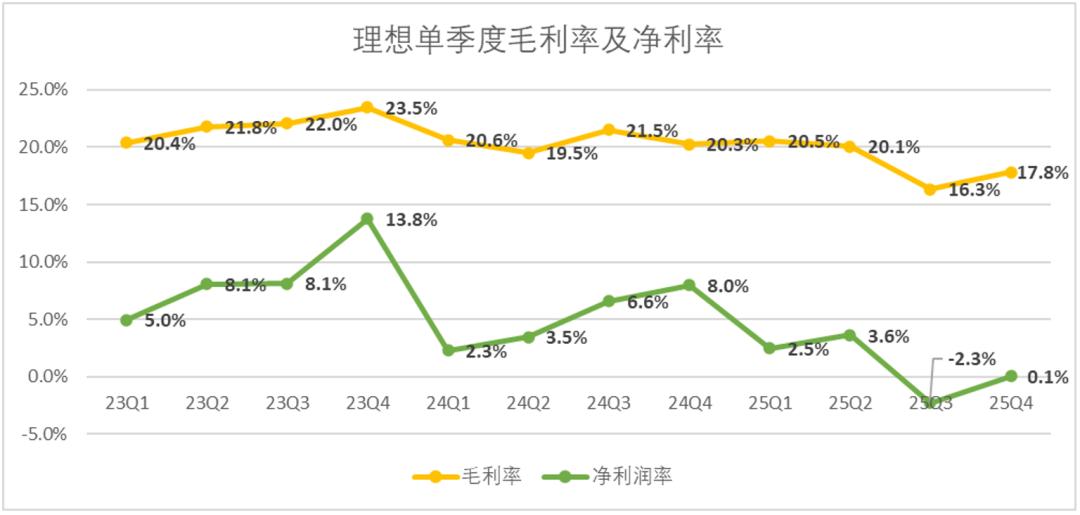
The main reason for the low gross profit margin in the fourth quarter is the increase in the sales volume of the low - priced and low - margin i6 model. From the per - vehicle model, the per - vehicle revenue reached a new low since 2022, only 249,600 yuan. This is also the first time since its listing that the average per - vehicle revenue of Li Auto has been lower than 250,000 yuan. The pressure of the price war is really great.
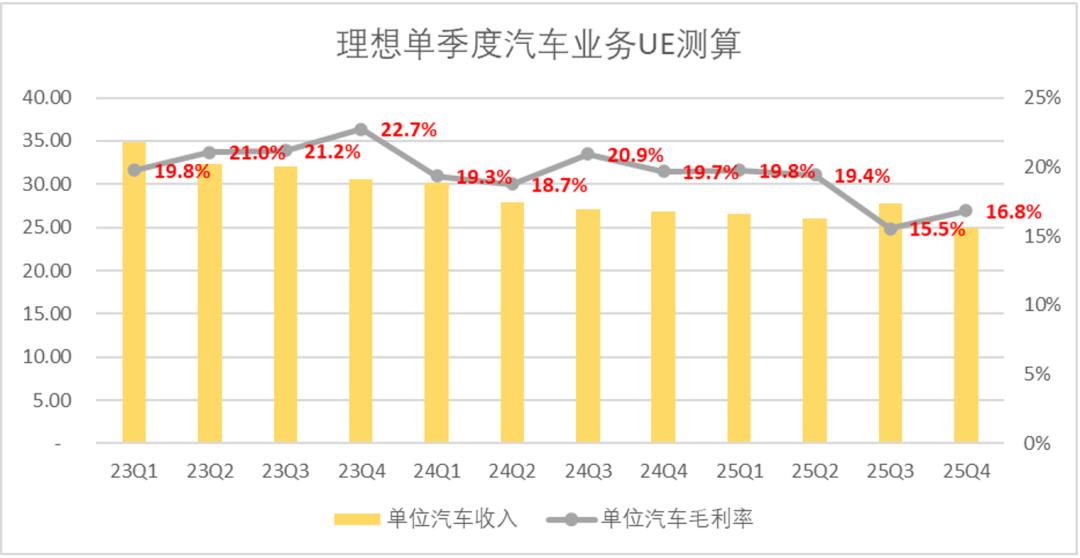
Although the i6 has high sales volume, with the current scale, it has not yet achieved a positive cycle of scale - driven profit. In the fourth quarter, the per - vehicle cost of Li Auto was 207,600 yuan, and the overall per - vehicle gross profit margin was only 16.8%. For Li Auto, the brand's moat also seems to be gradually disappearing.
Overall, Li Auto's net profit in the fourth quarter was only 20 million yuan, just turning profitable. However, a lot of the profit came from interest income. After excluding non - recurring gains and losses, Li Auto was still in the red in the fourth quarter.
04
The R & D expenses increased slightly, the senior management was reshuffled, and the transformation pace was slow
After talking about the organizational reform in the third quarter, as Li Xiang said, Li Auto did experience a reshuffle at the organizational structure level. In the past six months, eight senior executives have left the company. In the fourth - quarter earnings call, Li Xiang also responded to the issue of organizational structure reform for the first time.
While blessing the departing old employees, Li Xiang revealed that some young technical and business managers within the company have got opportunities, and a large number of post - 90s and post - 95s employees have taken on key positions. He believes that this is a win - win situation for Li Auto.
Such a large - scale personnel change was not directly reflected in the financial report. In the fourth quarter of last year, despite the significant decline in revenue, Li Auto's expense ratio remained very stable. The sales and management expense ratio was maintained within 10%, reaching 9.2%.
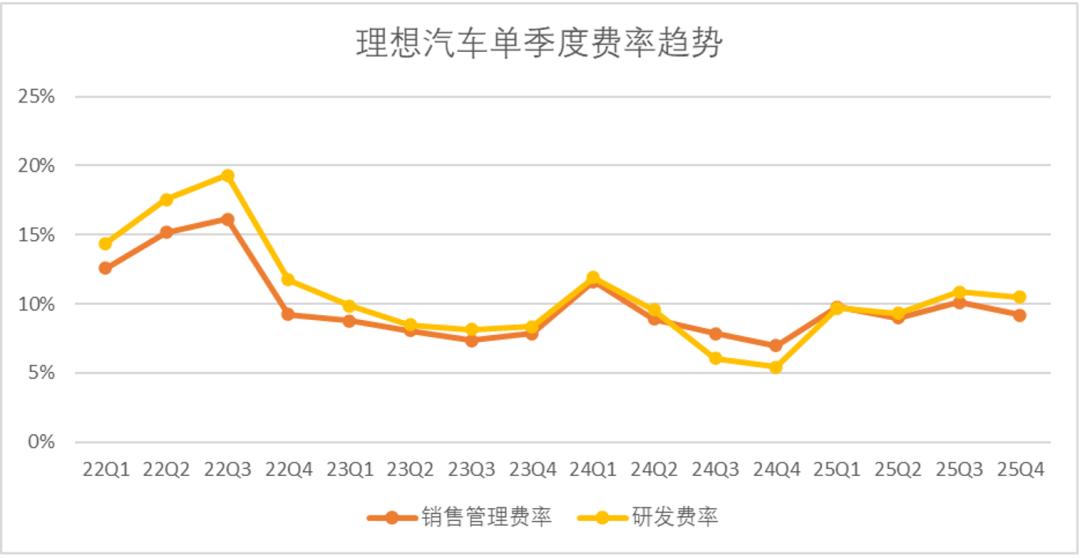
With the ultimate goal of embodied intelligence, Li Auto's R & D investment in 2025 did increase. The R & D expense ratio in the fourth quarter was 10.5%, compared with only 5.4% in the fourth quarter of last year. And during the earnings conference, the management revealed that about half of the R & D expenditure was spent on AI.
It may seem that a lot of money has been invested, but actually, the main reason for the increase in the expense ratio is the decline in revenue. The total R & D expenses in 2025 reached 11.3 billion yuan, while in 2024, it was also 11 billion yuan. The actual difference in investment is not very large.
Obviously, compared with the grand vision envisioned by Li Auto during the third - quarter earnings conference, an investment of about 10 billion yuan is not far ahead. Not to mention Tesla, which has not yet included AI in its financial statements, NIO's R & D investment in 2025 was also about 10.6 billion yuan.
Maybe Li Auto's transformation just started in the fourth quarter, and the R & D team has not been fully established, or maybe it is not yet the stage of heavy R & D investment. In short, Li Auto's expense control was relatively stable in the fourth quarter, and there was no obvious increase in the expense ratio driven by the transformation.
05
The capital expenditure slowed down significantly in 2025, and the channel side began to shrink
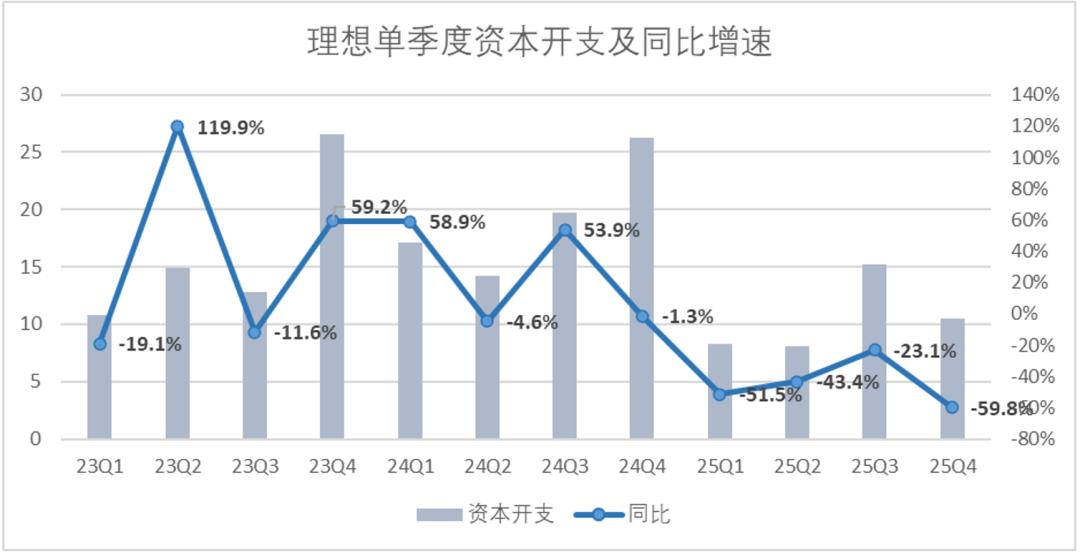
Another indicator to judge Li Auto's transformation pace is the speed of capital expenditure. In 2025, Li Auto's total capital expenditure was 4.21 billion yuan. Not to mention comparing with other large Internet companies with high capital expenditure, even compared with Li Auto itself, it was a year with relatively weak capital expenditure. The capital expenditure has been declining for five consecutive quarters, and the annual capital expenditure decreased by 45.6%.
At the same time, Li Auto also fulfilled the management's commitment to make every penny count. It actively reduced costs on the channel side. As of February this year (Li Auto's financial reports usually disclose channel data from January to February. That is, the second - quarter report discloses channel data as of July, and the fourth - quarter report discloses channel data as of February of the following year), Li Auto had 539 sales stores nationwide, and for the first time since its listing, the number of stores decreased.
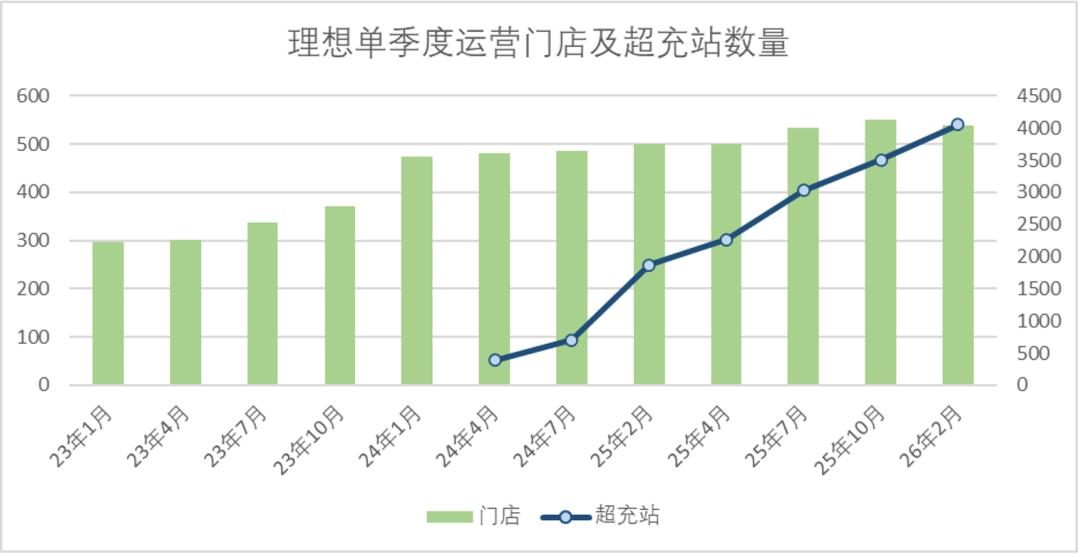
Of course, the investment in the pure - electric field has not weakened. Currently, Li Auto's construction of super - charging stations is gradually accelerating. As of February, the number of super - charging stations exceeded 4,000 for the first time.
06
With tens of billions in hand, Li Xiang is more conservative than expected
It is worth mentioning that although the expense control investment is relatively slow, the capital expenditure is still declining, and the transformation pace is not as rapid as the market expected. However, compared with its peers, Li Auto has a unique advantage: it has a very abundant capital reserve.