For just 9.9 yuan, let's make friends. ByteDance's ArkClaw might be more suitable for ordinary people.
A few days ago, a photo of a public welfare event where OpenClaw was installed at Tencent's entrance went viral on WeChat Moments.
Even more surprisingly, the founder of OpenClaw personally reposted it, saying, "OpenClaw in China has reached the next level."
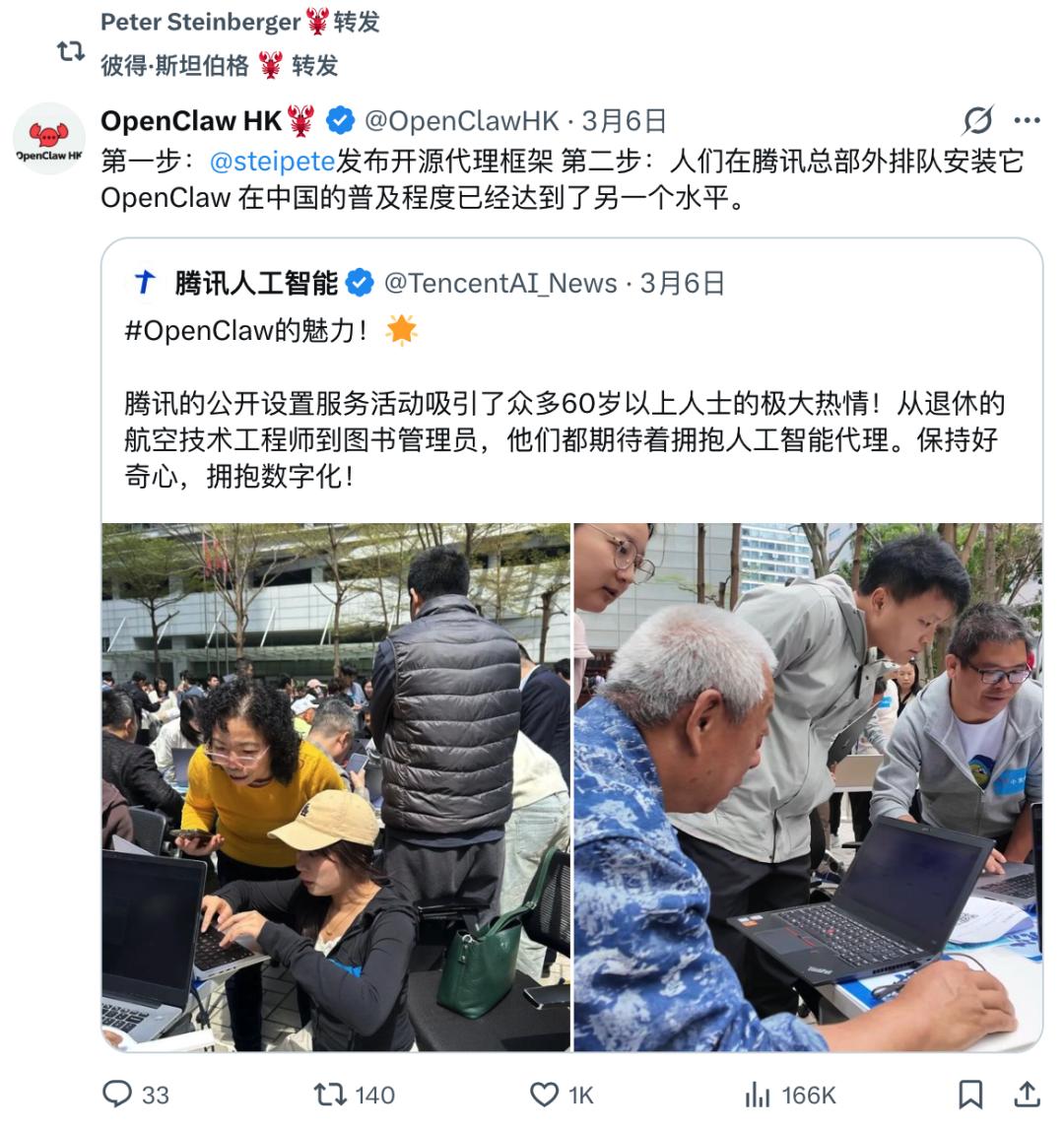
The founder of OpenClaw reposted the Tencent event | Image source: X
I casually forwarded the screenshot to a WeChat group.
A friend quickly replied with a message: "I've seen this thing everywhere all day, but I still haven't felt any real use cases. Can you give an example?" This question really hit the nail on the head. In the past two weeks, the popularity of OpenClaw has almost covered the entire tech circle. Installation services have sprung up everywhere, and offline events have been held one after another. At the same time, another voice has been spreading: "So what after installing it?"
This is probably the most surreal scene in 2026: on one hand, there is widespread public enthusiasm, and on the other hand, there is collective confusion after installation.
As I was thinking about how to reply, I saw that ByteDance's Volcengine launched ArkClaw, and I heard it received good feedback.
I decided to try it out and then show my friend what OpenClaw can really do.
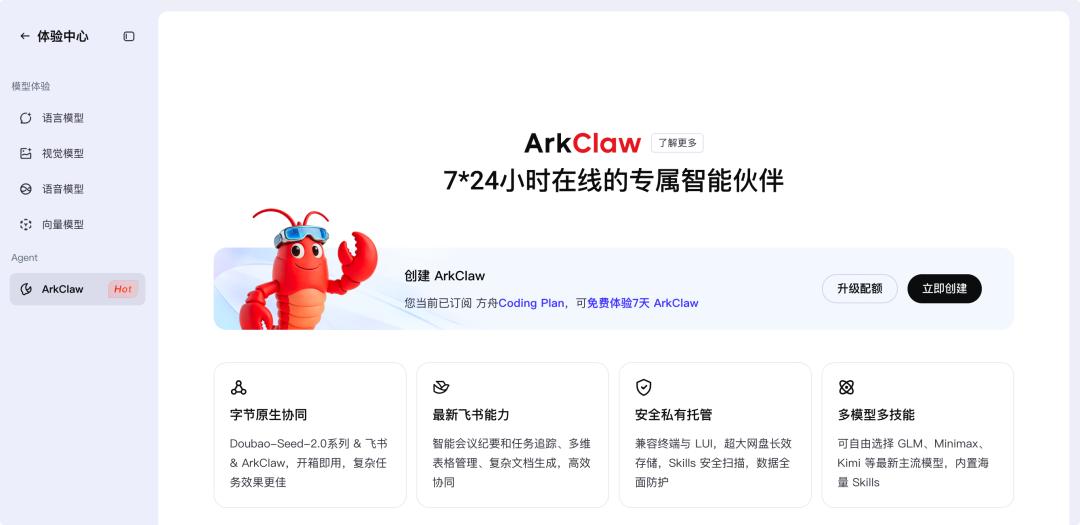
The homepage of ArkClaw | Image source: ArkClaw
01
Run ArkClaw in Five Minutes
I have to say that the access documentation for ArkClaw (you can view it by clicking "Read the original article" at the end of the article) is very detailed:
The access process is very simple: find the ArkClaw entrance in the Volcengine console, subscribe to a membership, then click "Create now". After waiting for about two minutes, a cloud-based OpenClaw instance will be up and running.

The main interface after creating ArkClaw | Image source: ArkClaw
With the deployment done, I plan to turn my ArkClaw into a super Jarvis:
Currently, ArkClaw has integrated many functions, such as various practical skills, and it has access to Volcengine's file transfer service (for interacting with files with the "lobster") and Feishu documents.
But I think it's still not enough. I want to connect ArkClaw to a super Agent tool and a communication tool that I can use directly.
The first step is to connect to ByteDance's Anygen. This will give my ArkClaw the ability of a general Agent.
Anygen is a general Agent launched by ByteDance, comparable to Manus, and it is mainly designed for office scenarios. The connection method is very simple. Just open Anygen, click the prompt on the interface, and you will get a connection instruction.

The homepage of Anygen | Image source: Anygen
Then I sent the connection instruction to my ArkClaw, and it instantly gained the capabilities of Manus level.
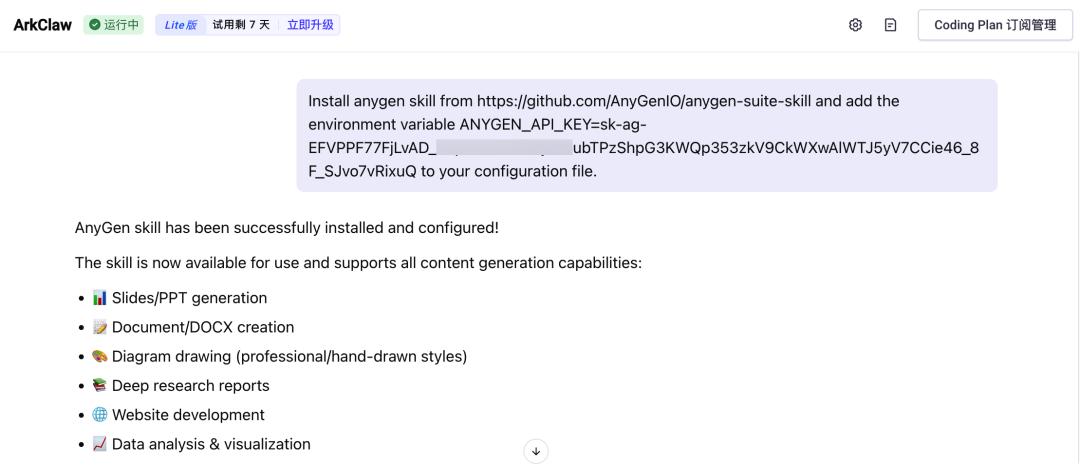
Connecting Anygen to ArkClaw | Image source: ArkClaw
The second step is to connect to ByteDance's Feishu. This will allow me to call my OpenClaw anytime and anywhere.
ArkClaw has made quite detailed optimizations for the Feishu channel:

The main interface of ArkClaw | Image source: ArkClaw
Configure the Feishu application step by step according to the documentation, then click "Message channel", fill in the key of the Feishu application, and wait patiently.

The main interface of ArkClaw | Image source: ArkClaw
After the update, when you send a message in the Feishu robot, the Feishu robot will return a Pairing code. Give this code to ArkClaw, and the entire configuration is completed.
ByteDance's ecological advantage here is obvious: Feishu is a well - established collaboration system within ByteDance. ArkClaw can call Feishu's native document, schedule, and message capabilities. This advantage of native integration is really hard for other manufacturers to achieve.
After this step, my super Jarvis is ready.
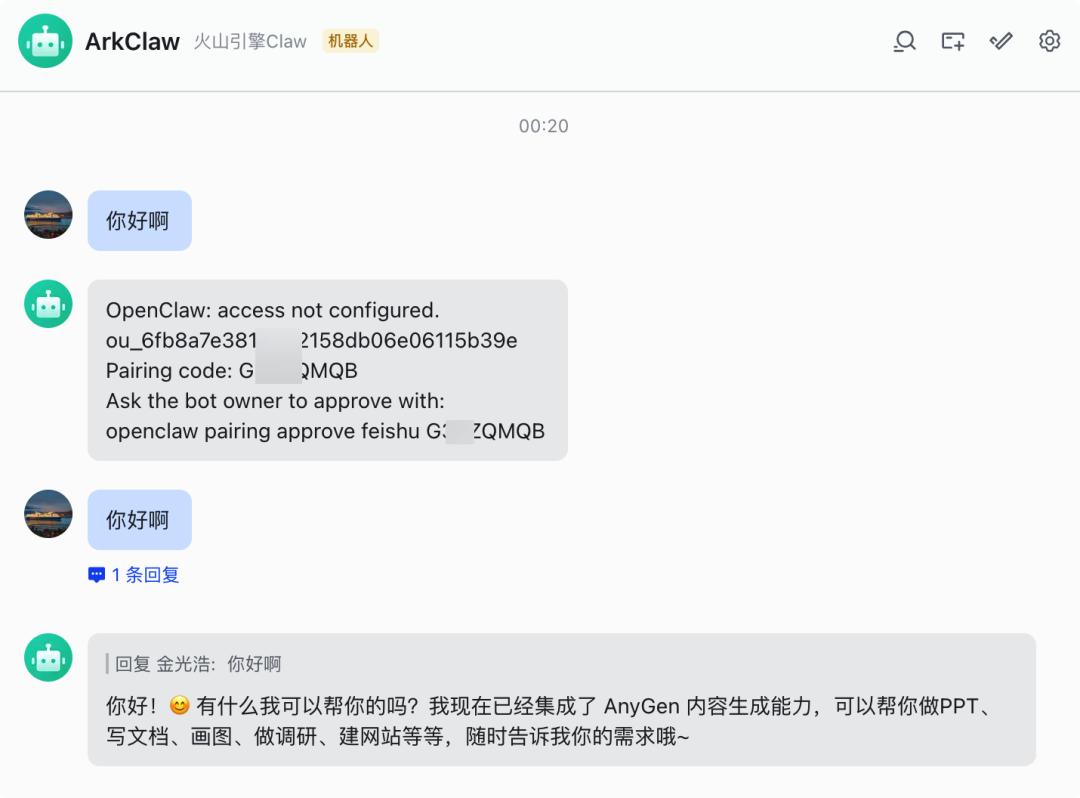
Controlling ArkClaw in Feishu | Image source: Feishu
02
Actual Test of ArkClaw's Capabilities
After configuring the tools and skills, my ArkClaw can do more things.
Next is the actual test session:
"1. Use ArkClaw to conduct an in - depth research on OpenClaw"
Currently, the most proficient ability of large models is still research. And through the optimization of context engineering, agents can bring this ability to the extreme. As mentioned before, one of the user - friendly features of ArkClaw for ordinary users is that it has a large number of built - in common skills.
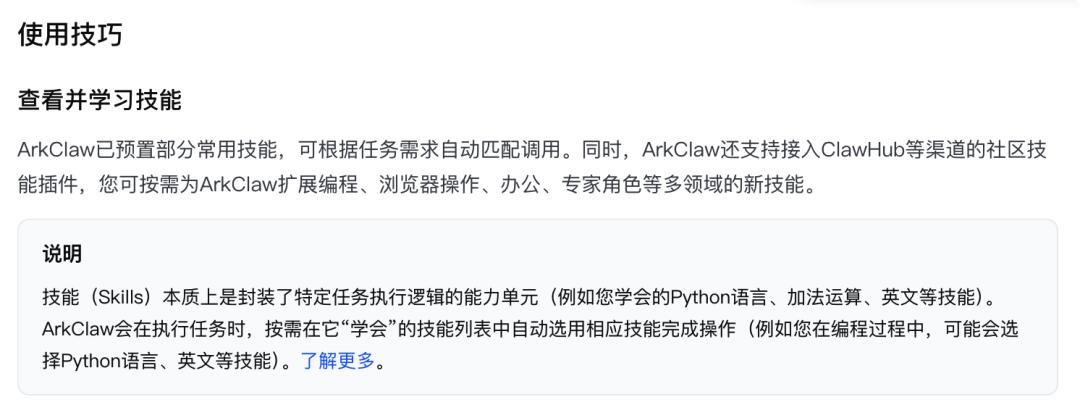
ArkClaw documentation | Image source: ArkClaw
For example, for the research skill, we just need to give it the research task:
Help me create a research report on the mainstream OpenClaw deployment solutions in the market in 2026 (coze claw, ark claw, minimax claw, q claw, AutoGLM claw, Baidu Cloud claw, Xiaomi mobile claw, Huawei Cloud claw, Alibaba Cloud claw). It should include a systematic analysis of the features and functional differences of each, and finally recommend a few manufacturers for me.
After waiting for a few minutes, you can get a quite complete research conclusion.

Controlling ArkClaw in Feishu | Image source: Feishu
"Case 2: Use ArkClaw to create a teaching PPT for installing Claw"
Research is just a warm - up. Let's use ArkClaw to do something that can really save us time.
Since we connected to Anygen before, ArkClaw's ability to create PPTs is very strong.
Recently, the business of installing OpenClaw has been booming. We can let ArkClaw create the PPT for our offline coffee chat sharing.
For example, we can give the following prompt to ArkClaw and let it use Anygen to create a PPT for us.
Recently, the installation of OpenClaw has been very popular. I want to hold an offline coffee chat for multiple people to install OpenClaw. At that time, I'll let everyone follow my steps to install ArkClaw together. Please use anygen to generate a detailed teaching PPT based on the document at https://www.volcengine.com/docs/6396/2227963?lang=zh#4PEmzLCz.
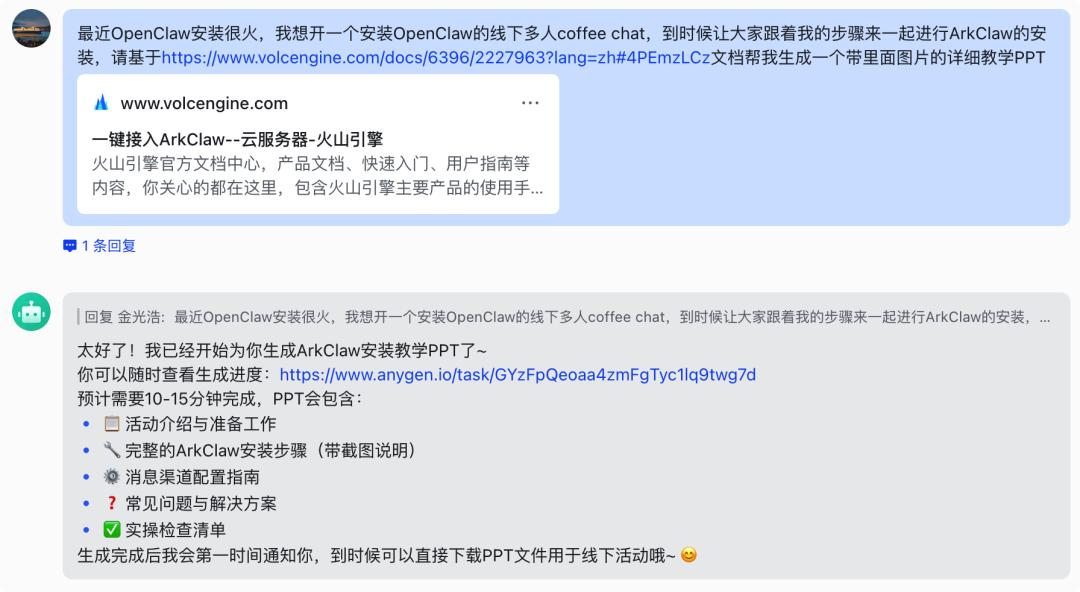
Controlling ArkClaw in Feishu | Image source: Feishu
As you can see, the final generated PPT is very impressive and can be edited further.
This is an effect that is very difficult to achieve with any skill.
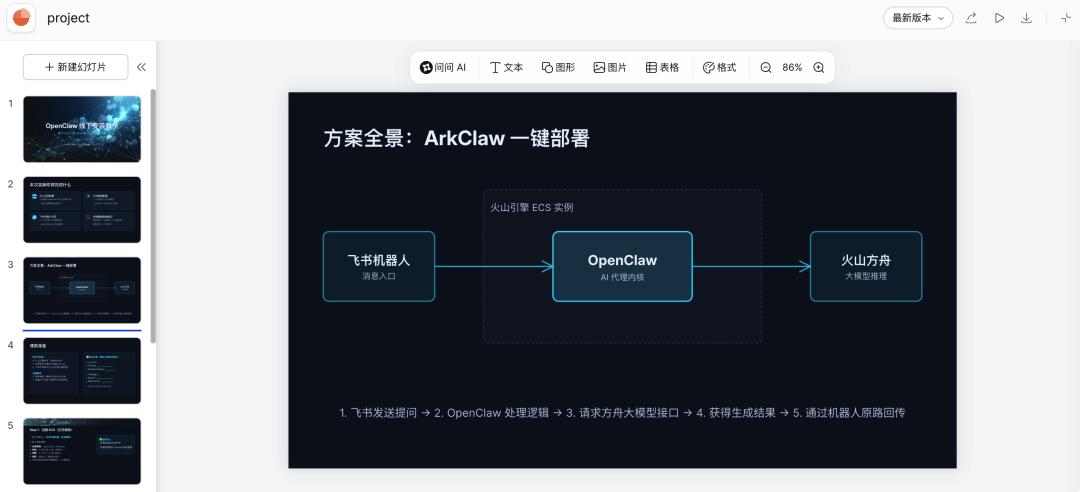
Viewing the implementation effect in Anygen | Image source: Anygen
After finishing, I thought carefully. If I had to create such a PPT without AI tools before, it would take me at least three hours. But with ArkClaw, I can let it do it on my phone in less than 10 minutes, and I can directly download and use it.
So, is OpenClaw really just a toy?
Maybe not. Many people think OpenClaw is like a toy because the engineering of the native OpenClaw is really rough. Most manufacturers just release it without any product packaging, which makes users feel it's just a toy.
If you look at the official OpenClaw project, you'll see all kinds of unsolved problems reported by users.

OpenClaw's github issue | Image source: github
But ArkClaw is quite smart in this regard:
It doesn't directly release OpenClaw. Instead, it adds an extra layer of packaging, solves some design problems of OpenClaw itself, and makes it very smooth for users to configure Feishu. It also embeds various skills, so the experience is quite good.
"Case 3: Use ArkClaw to read the content in Feishu documents regularly every day and send it to me"
Of course, to make good use of OpenClaw, we can rely on the optimization of manufacturers like ArkClaw. But there is another way: on the basis of the manufacturer's optimization, we can actively explore how to use it well.
In my experience, the upper limit of OpenClaw's value depends on how much effort you are willing to spend on tuning it.
How can we use OpenClaw to create some practical applications?
We should start from our most frequent daily scenarios.
For example, I need to browse a lot of AI information every day to find some interesting AI tools and experience them. But recently, there is too much content to read.
If you want to solve this problem, you can find some skills online, but you may find that the generated results are not very good. The root cause of the problem is, as mentioned before, not ArkClaw's problem, but the general context engineering of OpenClaw.
So, I spent half a month researching my problem and found a workable solution:
I can first use n8n to generate content regularly: n8n/ArkClaw >> Regularly >> Read from a certain information source >> Write to Feishu documents
Then use ArkClaw to read the generated content regularly: ArkClaw >> Regularly read >> Feishu documents >> Send to me
This solution does have a threshold, but if you are willing to spend an afternoon learning n8n, the return will be obvious.
At present, due to the poor engineering of OpenClaw, only such a relatively complex workflow arrangement can activate all the capabilities of your OpenClaw and generate real practical value.
