Warehousing Revolution in the Trillion-Dollar Cross-Border Market: Frost & Sullivan Interprets How WMS Becomes the Intelligent Hub of Cross-Border Supply Chain
Recently, Frost & Sullivan, the globally renowned growth consulting firm, officially released the *2026 White Paper on China Cross-border E-commerce WMS Industry*.
The report clearly points out that China's cross-border e-commerce sector has fully entered the era of refined management. As the core tool for digital warehouse management, Warehouse Management System (WMS) is reshaping the new paradigm of global inventory management with its standardized and intelligent full-link control capabilities.
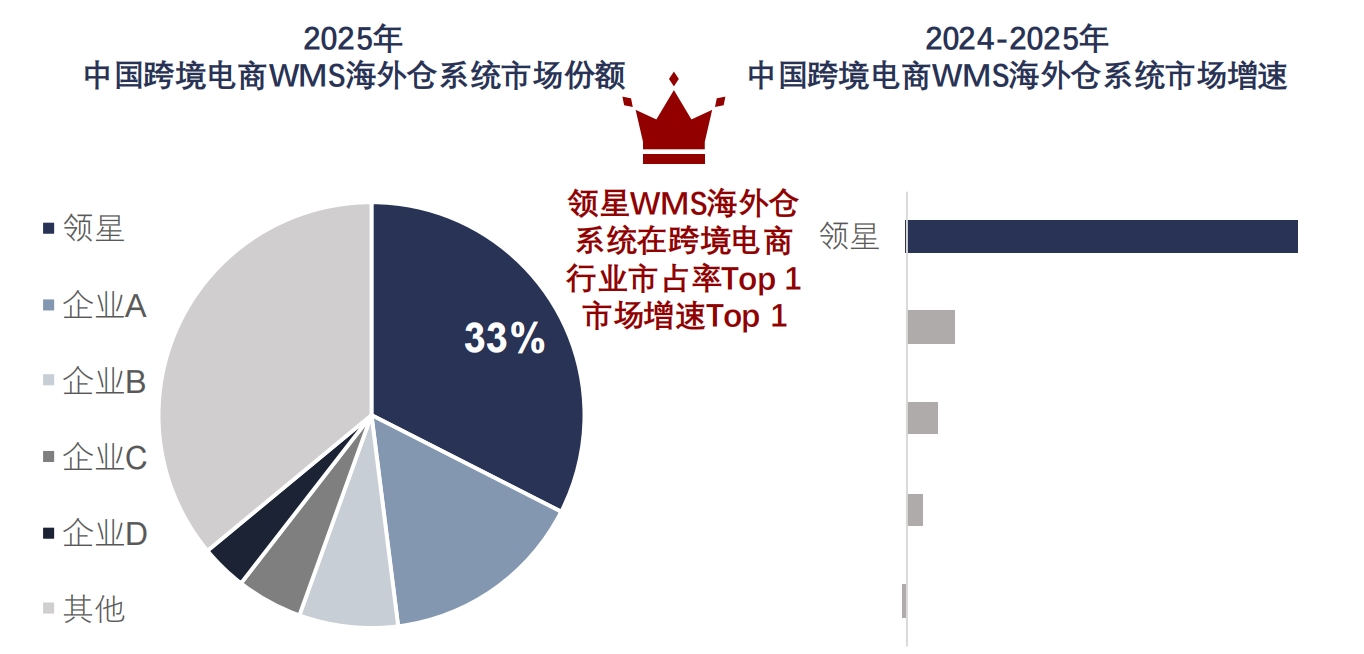
The white paper not only outlines the clear picture of rapid industry growth and accelerating concentration of market pattern with authoritative data, but also reveals a key industry fact: in the core track of overseas warehouse systems, Lingxing WMS ranks first in the industry in terms of market share, and also wins the first place in market growth rate from 2024 to 2025, becoming a benchmark case prominently included in the report.
Source: *2026 White Paper on China Cross-border E-commerce WMS Industry*
Based on the core conclusions of the white paper, 36Kr will deeply analyze the growth logic and future trends of the cross-border WMS industry, and take Lingxing as a sample to interpret how leading enterprises can firmly occupy the core position in the digital transformation of cross-border supply chains by building core capabilities that meet industry demands.
01 The Golden Growth Period of Cross-border WMS is Coming: From Tools to Infrastructure, the Industry Ushered in Transformation
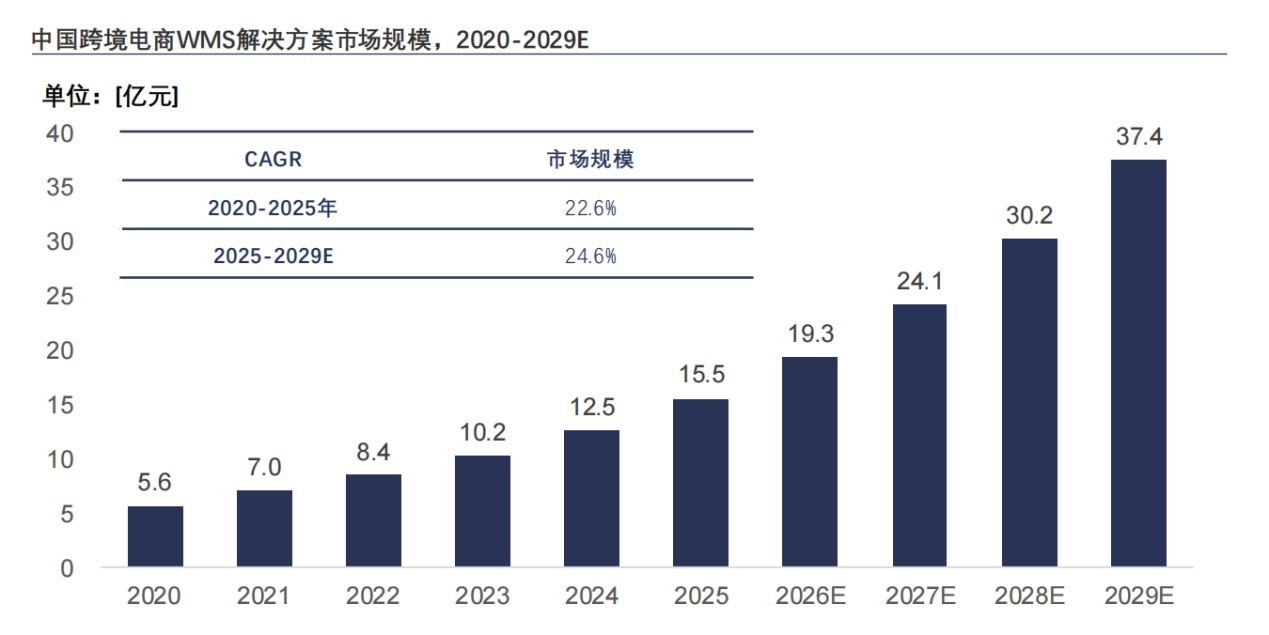
According to the data from the *2026 White Paper on China Cross-border E-commerce WMS Industry*, China's cross-border e-commerce WMS industry has entered the golden period of large-scale growth. From 2020 to 2025, the compound annual growth rate of China's cross-border e-commerce WMS solution market reached 22.6%, maintaining a rapid expansion trend.
It is estimated that from 2025 to 2029, the industry's compound annual growth rate will further rise to 24.6%, the market size is expected to reach 3.74 billion yuan in 2029, and the industry development potential will continue to be released.
Source: *2026 White Paper on China Cross-border E-commerce WMS Industry*
The core logic behind the industry explosion lies in the value leap of cross-border e-commerce WMS from "basic management tool" to "core infrastructure". It is not a simple replica of traditional warehousing systems, but a full-link digital solution tailored for cross-border e-commerce enterprises, overseas warehouse operators and cross-border supply chain service providers, which accurately solves the core pain points of traditional cross-border warehousing such as low efficiency, high cost and high compliance risk.
Specifically, its advantages are reflected in the whole-process control capability, for example, it can realize closed-loop management from stock preparation and warehousing, overseas warehouse storage, order picking, outbound distribution to return processing and multi-platform inventory synchronization; it is also reflected in the deep adaptability to cross-border scenarios, for example, it can flexibly cope with multi-language, multi-currency, multi-platform rules and international compliance requirements.
The actual measured data of the white paper confirms its value. Compared with traditional warehousing management, cross-border e-commerce WMS can achieve multiple benefits including 30% improvement in order processing efficiency, 40% reduction in cargo detention rate and 40% reduction in inventory backlog cost.
This rapid growth is not accidental, but the superposition resonance of multiple deterministic driving factors.
On the one hand, the continuous expansion of the cross-border e-commerce market scale, the increasing popularity of the dual-track logistics mode of direct mail express + overseas warehouse, and the steady increase in the penetration rate of overseas warehouses have directly generated rigid demand for professional WMS; while freight forwarding enterprises have transformed into warehouse operations relying on their own logistics resources and customer advantages, which has also brought a large number of new demands to the industry and further expanded the market space.
On the other hand, policy dividends at the national level such as tax incentives, customs clearance facilitation and support for overseas warehouse construction continue to be released, creating a favorable environment for industry development.
At the same time, the in-depth implementation of cutting-edge technologies such as AI, Internet of Things and cloud computing provides core technical support for the intelligent upgrading of WMS.
Looking back at the development context of the industry, cross-border WMS has completed three key iterations: from the basic warehousing management stage centered on inventory query and simple inbound/outbound scheduling in 2015-2017, to the cross-border exclusive adaptation stage focusing on multi-platform docking and return process optimization in 2018-2020, and then to the lean management stage that realizes deep integration with ERP/MES systems and focuses on cost reduction and efficiency improvement in 2021-2023, the industry is becoming mature in continuous upgrading.
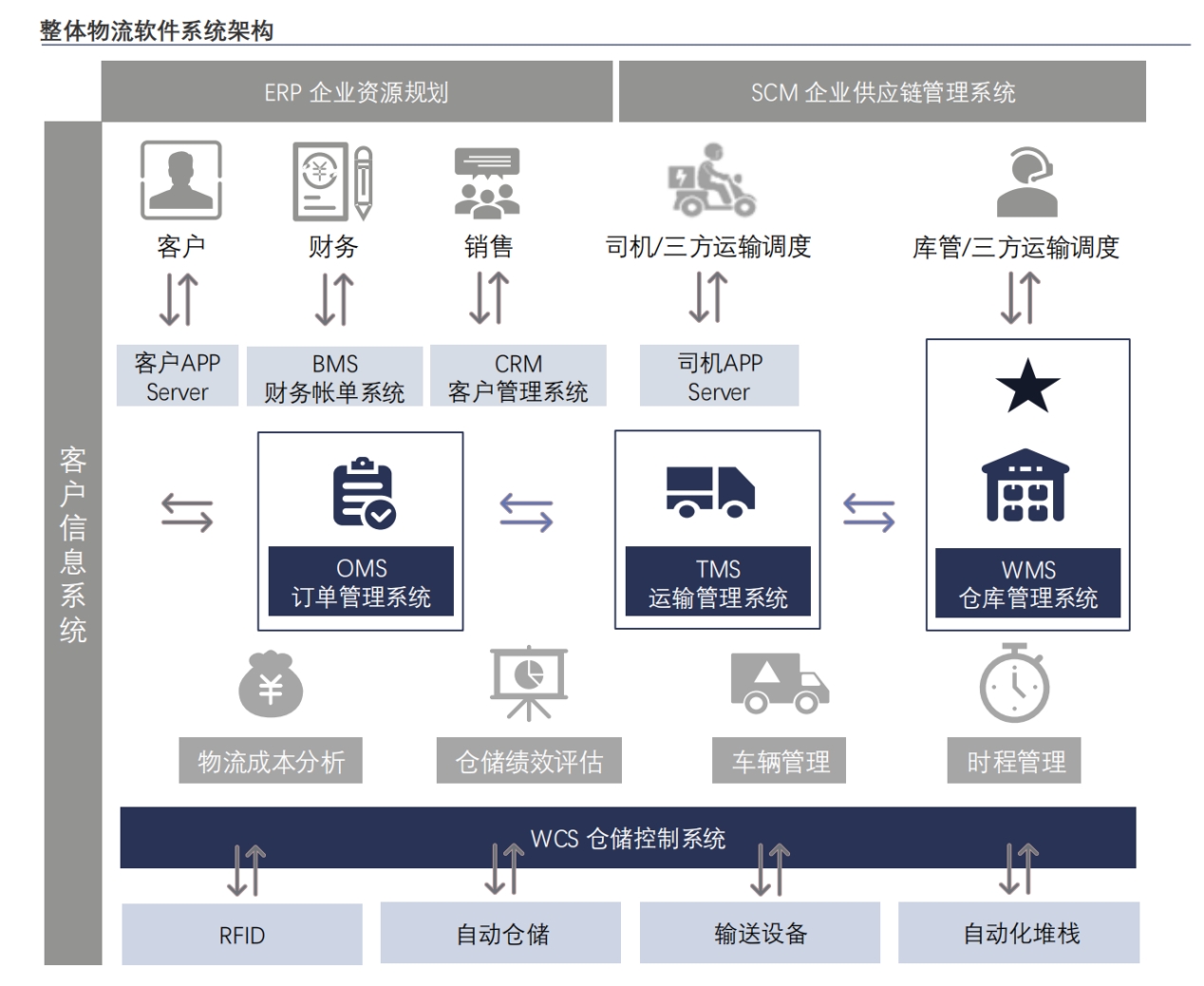
Nowadays, cross-border WMS has officially entered a new cycle of "AI-driven + ecological integration". Market demand has been upgraded from basic order and inventory management to high-level capabilities such as demand forecasting, intelligent replenishment, full-link early warning and automated equipment collaboration, and the role of warehousing has also been upgraded from a single storage node to an intelligent fulfillment center of the global supply chain.
Source: *2026 White Paper on China Cross-border E-commerce WMS Industry*
This round of industry upgrading marks that cross-border warehousing has officially shifted from passive execution to active intelligent decision-making, and from single warehousing management to an intelligent supply chain system covering the whole link. Driven by both the rapid growth of the industry and the improvement of capabilities, the market pattern is also accelerating to concentrate on leading enterprises, and the industry has entered a critical stage of survival of the fittest.
02 CR5 Exceeds 64%: Cross-border WMS Enters the Era Dominated by "Double First Place"
The white paper data confirms the trend of leading concentration: in 2025, the CR5 of China's cross-border e-commerce WMS overseas warehouse system market has exceeded 64%, and more than 60% of the market share is concentrated in the hands of leading enterprises.
This means that industry resources are accelerating to tilt towards players with core competitiveness, the living space of small and medium-sized manufacturers is further compressed, and the competitive pattern of "the strong will always be strong" has been formed.
In the leading camp, Lingxing WMS performs particularly well and becomes the core leader under the trend of industry concentration. The white paper clearly shows that Lingxing WMS ranks first in the whole industry with a 33% market share in the overseas warehouse system; at the same time, against the background of the overall rapid growth of the industry, its market growth rate from 2024 to 2025 also ranks first in the industry.
Behind this achievement is Lingxing WMS's in-depth understanding of cross-border industry scenarios and full-link capability layout.
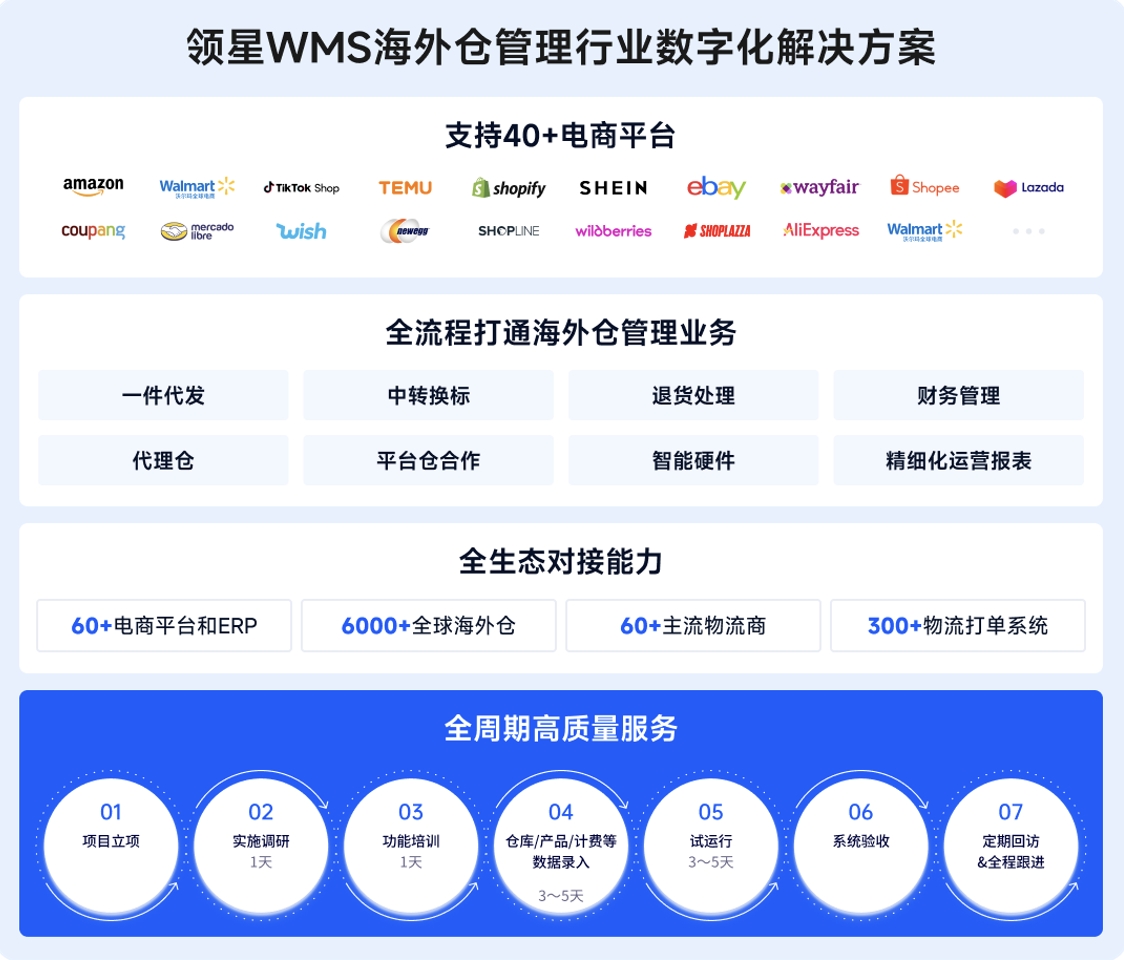
At present, Lingxing WMS has covered more than 90 countries and regions around the world, docked more than 40 mainstream cross-border e-commerce platforms, and fully opened system docking with various ERPs, realizing the efficient integration of cross-border fulfillment ecology.
Source: Lingxing Official Account
In terms of product capabilities, Lingxing WMS builds a full-process solution around the real business scenarios of overseas warehouses, covering core scenarios such as one-piece delivery, stock preparation transit, return and label changing, agent warehouse operation, and intelligent hardware integration, which can adapt to the operation needs of different types of overseas warehouse enterprises.
Different from traditional single-function systems, Lingxing realizes data interconnection and process integration of inventory, orders, warehousing and logistics through the deep collaboration of ERP and WMS, forming obvious advantages in efficiency, accuracy and cost control.
In addition, AI intelligent algorithms further support intelligent packaging, intelligent sorting, in-warehouse analysis and strategy optimization, promote the upgrading of overseas warehouses from manual operation to automated and intelligent management, and provide data support for operational decision-making.
Up to now, Lingxing WMS has served more than 6000 overseas warehouses, helping more than 20000 enterprise employees to expand their global business, and its scale and maturity have been fully verified by the market.
A local 3PL service provider in the United States focuses on providing stable and efficient warehousing and logistics services for cross-border sellers. In order to further upgrade its warehouse distribution operation capabilities and strengthen service competitiveness, it selected Lingxing WMS, which is professionally reputed in the industry, with complete system and outstanding ease of use.
By implementing full-scenario warehousing management, intelligent sorting, intelligent early warning and Track123 full-process logistics tracking capabilities, the enterprise has greatly improved order processing efficiency, continuously optimized logistics costs, and effectively reduced fulfillment risks such as wrong delivery and missing delivery.
In actual operation, wave processing, rapid order printing, secondary sorting error prevention combined with PDA paperless operation efficiently solve the problem of fine management of massive SKUs; digital capabilities such as personnel efficiency reports, inventory analysis, and automatic order allocation help enterprises continuously optimize in-warehouse operation processes, strengthen operation management, and comprehensively improve service stability and customer satisfaction.
03 The Industry Enters the Era of Refined Management, How Can Leaders Accurately Match Market Demands?
The Frost & Sullivan white paper clearly points out that the cross-border WMS industry has entered the era of refined management.
The industry competition logic is undergoing fundamental changes: the focus of competition between enterprises is no longer the completeness of single function, but turns to the comprehensive competition of full-scenario adaptation, intelligent application and ecological collaboration. The market's requirements for the system have also been upgraded from the basic "usable" to "efficient, stable, implementable, and long-term supporting business growth" which is "practical, effective and durable".
For overseas warehouse operators and cross-border sellers, the parallel operation of multiple platforms, multiple warehouses and multiple logistics channels has become the norm. Traditional decentralized systems are prone to cause data fragmentation, process jams, compliance hidden dangers and cost out of control.
What enterprises really need is an integrated solution that can connect global data, uniformly schedule resources, and realize full-process visibility and controllability, so as to support large-scale and global expansion.
The ability to achieve real refined and integrated management is exactly the key to widen the gap between leading enterprises and ordinary manufacturers.
Source: *2026 White Paper on China Cross-border E-commerce WMS Industry*
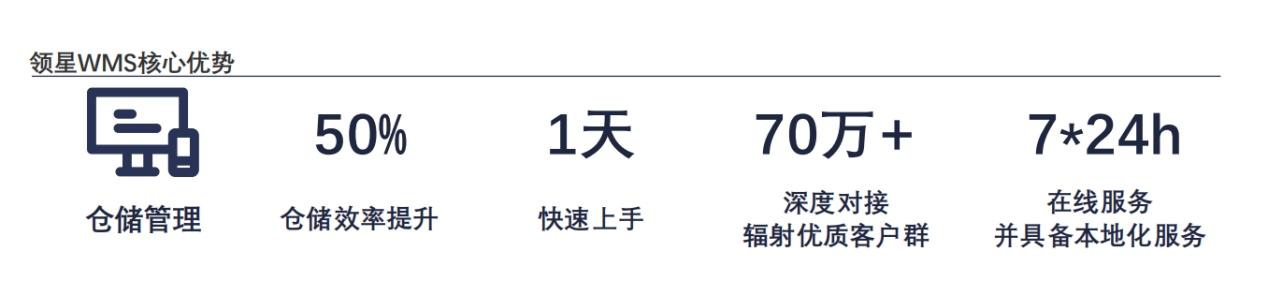
Lingxing WMS builds a business closed loop covering the whole process around this core demand. The system deeply connects modules such as warehousing, storage, picking, outbound, return, inventory, billing, and reports, supports multi-warehouse networking, cargo owner grading, permission isolation and real-time inventory linkage, enabling complex operations to collaborate efficiently in one system, and solving the problem of information islands from the root.
In terms of intelligent upgrading, the industry has moved from process electronization to intelligent decision-making, and simple function superposition no longer constitutes an advantage.
Through Lingxing AI intelligent algorithm, the system can realize functions such as intelligent packaging optimization, in-warehouse intelligent sorting, and intelligent business data analysis, helping overseas warehouses to realize full-process intelligent and automated management, effectively improving the operation efficiency in the warehouse, providing accurate data support for managers, and facilitating scientific decision-making.
This deep intelligence not only improves personnel efficiency and accuracy, but also continuously reduces inventory backlog and logistics waste, which is highly consistent with the lean management direction advocated by the white paper.
Ecological collaboration capability has also become an essential foundation for leaders. The cross-border fulfillment chain is long with many participants, and only a truly open, compatible and efficiently connected system can release the maximum value.
Taking Lingxing WMS as an example, it continuously improves its ecological layout, stably interconnects with mainstream e-commerce platforms, ERPs, logistics service providers and overseas warehouse networks, forming a collaborative system of data interconnection, process integration and complementary services, helping enterprises reduce docking costs and improve turnover efficiency.
More importantly, in the era of refined management, service delivery capability beyond products has become a key difference. Lingxing WMS forms a full-cycle service system with efficient online deployment, standardized implementation, professional after-sales support and continuous product iteration, which can not only meet the urgent needs of enterprises for rapid launch, but also continuously respond to optimization in later operation, ensuring stable system operation and long-term business growth.
From the perspective of industry development, the core competitiveness of Lingxing WMS is not a single function or short-term growth rate, but the accurate matching of the demands in the era of refined management. Based on integrated processes, driven by intelligent technology, broken boundaries through ecological collaboration, and escorted by professional services. This set of capability combinations is not only the underlying logic for it to occupy the two first places, but also sets a clear development benchmark for the cross-border WMS industry.