NIO finally turns a profit. Can Li Bin pop the champagne?
NIO's users and its Chairman Li Bin can finally breathe a sigh of relief. After 11 years of establishment, NIO has finally turned a profit.
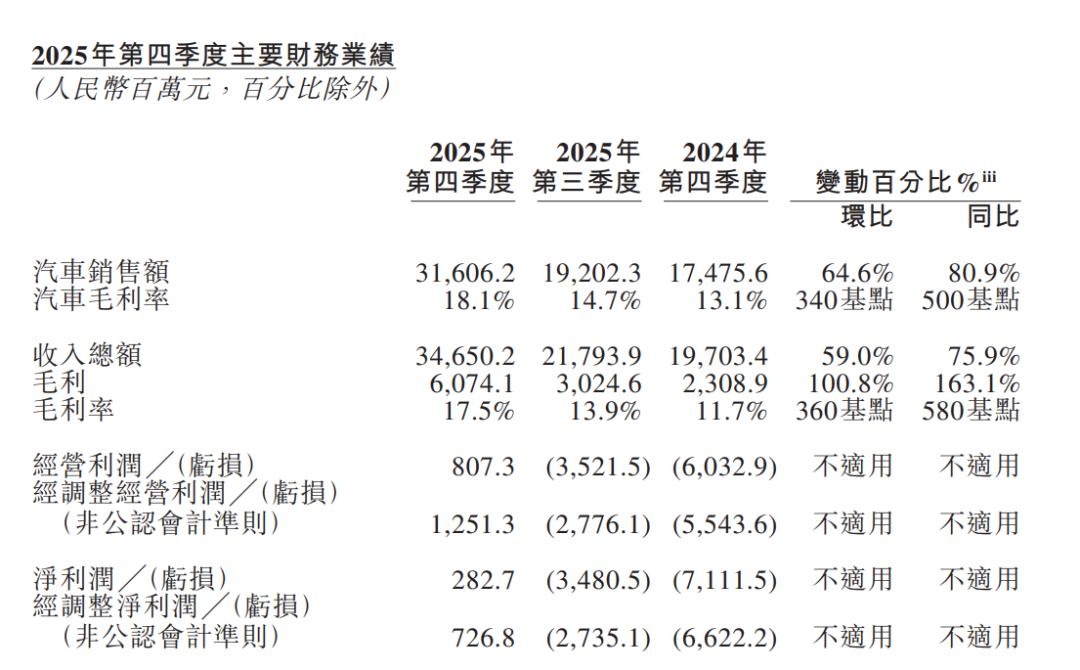
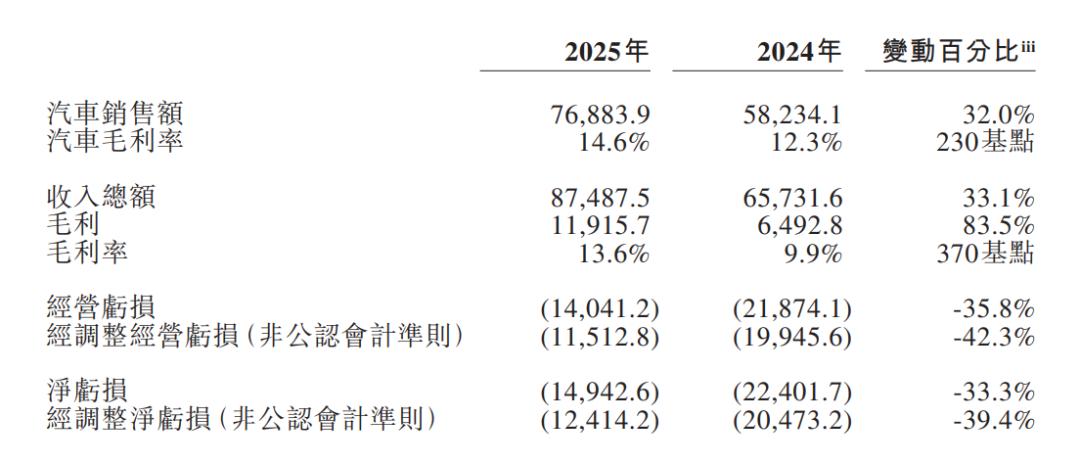
On March 10th, NIO released its financial report for the fourth quarter and the whole year of 2025. The report shows that in this quarter, NIO delivered a total of 125,000 vehicles, a year-on-year increase of over 70%. The operating profit (Non-GAAP) was 1.25 billion yuan. Li Bin finally fulfilled his promise of quarterly profitability that he had been "calling for" for a year.
In terms of basic financial indicators, both NIO's revenue and profit quality significantly improved in the fourth quarter of 2025. The overall revenue was 34.7 billion yuan, a year-on-year increase of 76%. The total gross profit reached 6.07 billion yuan, a year-on-year increase of 163.1%. Most importantly, NIO's cash reserve reached 45.9 billion yuan, a quarter-on-quarter increase of about 9.2 billion yuan. All signs indicate that NIO has finally emerged from the "ICU" and entered a normal business cycle.
Looking back at NIO's journey in the automotive industry, in 2014, Li Bin personally invested $150 million to show his determination. Over the past 11 years, NIO has faced numerous doubts from the market and users' concerns about the company's "bankruptcy". During each earnings season, Li Bin was often described as the "unluckiest" and "most capable of attracting investment" CEO in the automotive industry. To save market confidence, Li Bin talked about "profitability" and "survival" more than once in 2025 alone.
"My responsibility is to manage NIO well and ensure its survival. This is the greatest responsibility to our 800,000 users."
Perhaps, as Li Bin said in August last year when facing users' doubts. In order to survive, NIO carried out a thorough self-revolution in the whole year of 2025 - from the organizational structure to the product logic, from the supply chain to the channel strategy, it comprehensively "slimmed down + improved efficiency". Now, as NIO has achieved quarterly profitability, all the doubts have become a thing of the past.
With this report card, can Li Bin pop the champagne? Maybe it's still early, but at least, he and the whole team have turned "survival" into a starting point for "living better".
The profit - making speed from car sales finally outpaced the expenditure
In a nutshell, NIO's performance this quarter was "amazing".
First, let's look at the revenue side. In the fourth quarter, NIO's revenue from car sales was 31.6 billion yuan, exceeding the previous market expectation of 30.6 billion yuan. The gross profit margin of car sales was 18.1%, a quarter-on-quarter increase of 3.4 percentage points. Both the overall revenue and the profitability have significantly improved.
The main reason for the improvement is the increase in the average revenue per vehicle this quarter. The average selling price of NIO's vehicles this quarter was 253,000 yuan, getting rid of the "awkward" situation where the average price per vehicle in the previous quarter was 220,000 yuan, which was far from the price of the basic models of the main brand.
The increase in the average revenue per vehicle is mainly the result of the large - scale sales of NIO's large luxury SUV, ES8, this quarter. In the fourth quarter, NIO sold a total of 124,807 vehicles, among which the sales volume of ES8 was about 39,650, accounting for 32% of the total sales volume, which overall pulled up the average selling price of NIO's vehicles.
After looking at the revenue, let's look at the cost. The cost per vehicle of NIO this quarter was 207,000 yuan, a quarter-on-quarter increase of 19,000 yuan. This part can be considered that the relatively high manufacturing cost of the high - priced ES8 is also higher. However, it should be noted that under NIO's large - scale strategy in the whole year of 2025, the increase of 19,000 yuan in the vehicle manufacturing cost is actually the result after cost control.
Currently, NIO generally adopts the NT3.0 platform, 900V high - voltage architecture, self - developed chips, and supply - chain collaboration to reduce costs. Overall, the gross profit margin of ES8 exceeds 20%. On this basis, combined with the quarter - on - quarter increase of 43% and the year - on - year increase of 72% in NIO's quarterly sales volume, the resulting scale effect further spreads the vehicle manufacturing cost.
Looking at the overall picture, how much cost has NIO reduced through its large - scale strategy in 2025? This can be seen by referring to the gross profit per vehicle.
In the fourth quarter, the gross profit per vehicle of NIO was 46,000 yuan, an increase of 14,000 yuan compared with 32,000 yuan in the previous quarter. The increase in gross profit led to a quarter - on - quarter increase of 3.4 percentage points in the gross profit margin of car sales, reaching 18.1%. To be a bit more critical, although the 18% gross profit margin is not high (around 20%) compared with the leading global intelligent automobile companies or the premium that luxury cars should have. But for NIO itself, the continuous improvement of the gross profit and gross profit margin from car sales has indeed changed the market's previous stereotype that NIO "doesn't know how to control costs".
Finally, let's look at NIO's most important "cost - reduction task" for the whole year. In the fourth quarter, NIO's sales and administrative expenses were 3.54 billion yuan, a quarter - on - quarter decrease of 650 million yuan, and the corresponding expense ratio was 10%, basically reaching the general level of new car - making forces (compared with Li Auto and XPeng). In terms of R & D expenses, NIO spent 2 billion yuan this quarter, a quarter - on - quarter decrease of 360 million yuan. It should be noted that the reduction of R & D expenses is not a sign of NIO "downplaying R & D", but a return to a relatively normal level.
So, overall, under the "combination punch" of NIO's revenue, profitability, cost control, and expense control, NIO finally achieved a positive quarterly operating profit.
Looking forward to the next quarter, NIO is a bit conservative. According to the earnings guidance, NIO expects to sell 80,000 - 83,000 vehicles in the first quarter of 2026.
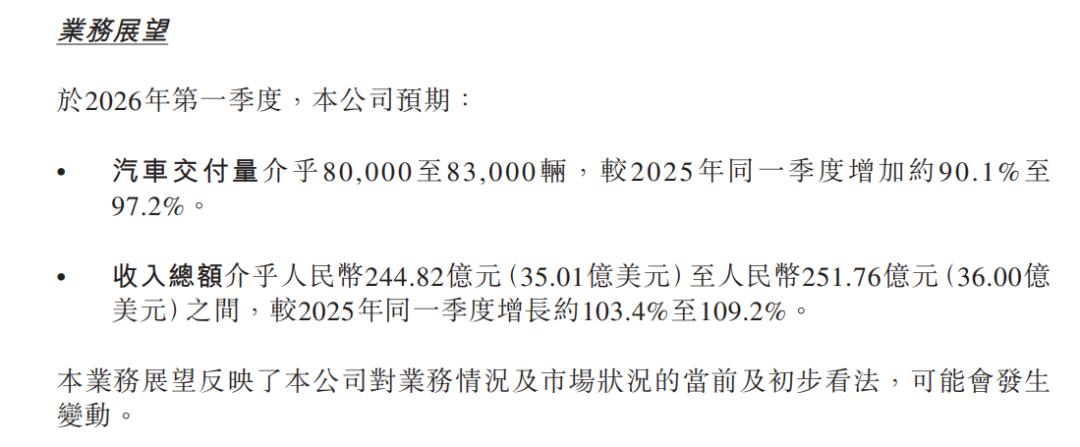
Although this data already shows a year - on - year increase of 90.1%, and the first quarter is also the traditional off - season for the Chinese auto market. However, considering that NIO's sales volume in January (27,000) and February (21,000) in 2026 is already known. This means that NIO is expected to sell 32,000 - 35,000 vehicles in March, which is generally lower than the monthly performance in the fourth quarter of 2025.
But looking forward to the whole year of 2026, NIO is very confident. In the earnings call, NIO predicted a year - on - year increase of 40% - 50% for the whole year of 2026. NIO hopes to rely on the new ES series and the large SUVs such as LeDao L80 to be launched in the second quarter, and through the collaboration of multiple product matrices, further increase the proportion of high - gross - profit models to achieve the annual growth target.
All in all, the earnings report for the fourth quarter of 2025 undoubtedly opened a good start for NIO's operation in 2026.
The year when NIO learned to spend money and reconciled with its obsession
In the past year, NIO has achieved a "turnaround" from the "ICU" to a positive business cycle. If we summarize NIO's changes in 2025 in one sentence, it is "learning to spend money and reconciling with past obsessions".
On the business side, the most core change of NIO is the CBU (Cell Business Unit) reform. The core logic of CBU is simply "everything should be centered around ROI (return on investment)". In terms of actual operation, it means that each department should settle costs separately and calculate the costs that have been spent and will be spent on different projects. For example, calculating the labor cost according to the working hours of employees, or removing unnecessary welfare budgets.
Consumers who visited NIO's sales stores in 2025 can clearly feel the specific performance. For example, NIO has cut a large number of unnecessary storefronts in shopping malls, and there are now fewer decorative flowers in NIO Houses. Guangzhui Intelligence still remembers that when test - driving a NIO car in 2024, the salesperson even asked if the customer wanted to participate in the owner's gathering, which was a bit overwhelming. Now, these "fancy" things are gone, and the car - viewing process has returned to the normal process of inquiry, test - drive, and negotiation on configurations.
In terms of company operation, NIO has implemented CBU in a resolute manner.
"The whole company has to calculate. There is nothing that can't be calculated clearly. Things that can't be calculated clearly should not exist."
As Li Bin once emphasized in an internal meeting. At the organizational structure level, the most prominent example is reflected in the LeDao brand. At the 2024 Guangzhou Auto Show, Ai Tiecheng, the president of LeDao, a sub - brand of NIO, publicly made a military order to achieve a monthly delivery of over 10,000 units for the LeDao L60 in December 2024 and strive for a delivery target of 20,000 units in March 2025. However, this goal was not achieved in the first quarter of 2025, and in April, the person - in - charge of the LeDao brand was replaced by Shen Fei, the former person - in - charge of the energy business.
In terms of user service, the first is the reform of sales channel management. Currently, NIO and LeDao share the store network to increase the reuse of human resources. In remote areas, NIO also promotes the practice of one person taking multiple positions or managing multiple stores. It is expected that in 2026, NIO will also expand the three brands to more sinking markets through the "Sky Stores".
On the sales side, NIO has abolished the KPI assessment of test - drive volume and call volume and introduced the "Fellow Direct Access" model (integration of sales and Fellows, with users/partners being connected throughout the process). The management conducts online live - broadcasts every Thursday to respond to front - line feedback, which directly improves the order - locking rate. In essence, this model also reduces the in - store personnel configuration and increases the efficiency of in - store communication with customers. Sales staff have also shifted from "heavy offline assets" to "light online digitization".
On the after - sales side, NIO previously emphasized "full self - operation" and hoped to achieve an ultimate experience through heavy investment. Now, NIO has outsourced non - core businesses such as painting, car washing, and valet driving, cut nearly 80 internal KPIs/indicators (only leaving core indicators such as user satisfaction and on - time delivery rate), and streamlined the team by 20% overall.
"On the battlefield, getting the victory is the most important thing. It doesn't matter whether the bayonet is wielded gracefully or the grenade is thrown in a beautiful arc. Survival is the most important thing." Li Bin summarized in an internal meeting.
Reflected in the more macro company financial statements, it can be confirmed that NIO has been "slashing" costs since the second quarter of 2025.
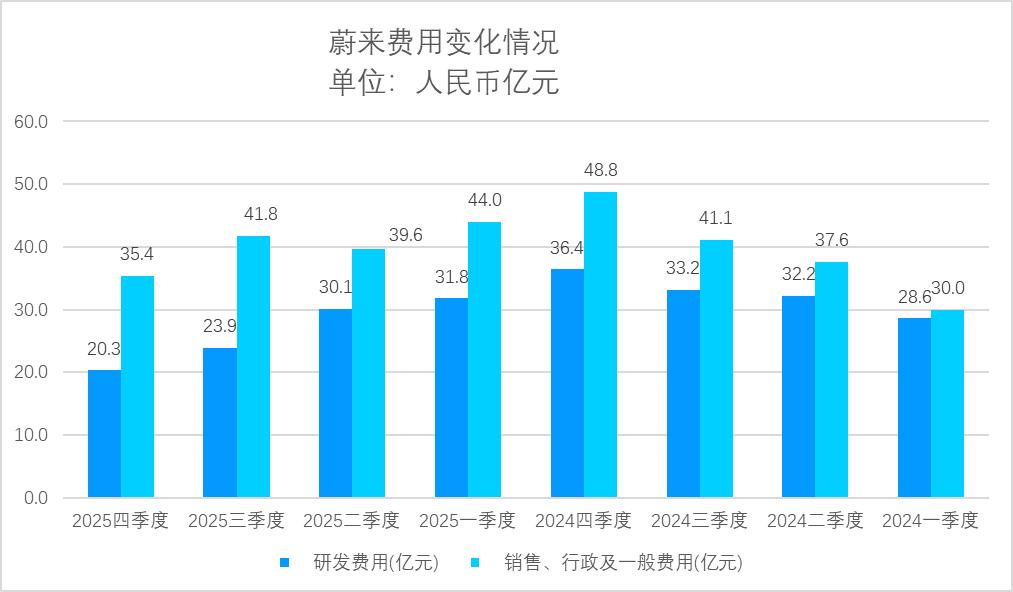
Specifically, in order to shape the image of a luxury car brand, NIO used to have a very "generous" expenditure. In the second - quarter financial report, NIO's sales and administrative expenses decreased by 440 million yuan quarter - on - quarter to 3.96 billion yuan, and R & D expenses decreased by 170 million yuan to the level of 3 billion yuan. By the third - quarter financial report, NIO's free cash flow started to turn positive, which means that NIO no longer needs to "burn money" extra to maintain the same market competitiveness.
All these changes have finally led NIO to harvest the hit model ES8. NIO's products have finally "reconciled" with market demand.
"It's very difficult for NIO to participate in market competition if it keeps the high price... The most important thing is for NIO to survive!"
As Li Bin said at the ES8 launch event, the biggest change in the new ES8 compared with the previous generation is the price. The old - style NIO ES8 was priced at 498,000 - 598,000 yuan, while the new ES8 is priced at only 406,800 - 446,800 yuan, directly "slashing" the price from the 500,000 - yuan level to the 450,000 - yuan level. Considering the impact of the BaaS plan, the model can be purchased for as low as 298,800 yuan. The new pricing system can target consumers with a budget of 300,000 - 500,000 yuan.
The price reduction is mainly because NIO has corrected the previous problems of over - equipping on the NT2.0 platform and excessive SKU numbers, and changed to a more large - scale and cost - conscious design. For example, the second - generation platform used 4 NVIDIA Orin X chips for intelligent driving, while in the third - generation platform, it has been changed to the self - developed Shenji chip. "The Shenji NX9031 can bring a cost advantage of about 10,000 yuan per vehicle," Li Bin said. In addition, the models on the second - generation platform had differences in the specifications of the center console armrest box, screen parts, and the color of NOMI, which have now been unified.
At the product design level, NIO has finally understood consumer demand.
As a luxury SUV, what users need from the ES8 is "bigness", high - end configuration, and a sense of luxury. In response to these needs, NIO has made a series of adjustments. In terms of size, the new ES8 is larger than its competitor, the Wenjie M8. In terms of configuration, the new ES8 has been upgraded in key parameters such as battery capacity, cruising range, and fast - charging system. Moreover, this time NIO has finally "seriously" started to design luxury - perception configurations for luxury - priced cars, providing users with a large screen, large - area soft - wrapping, and three zero - gravity seats. In other words, NIO has finally found out "how to