Chen Tianqiao invested in a post-2000s individual.
In just 10 days, a senior undergraduate student developed an open - source project using Vibe Coding and secured an investment of 30 million yuan from Chen Tianqiao, the former richest man in the Chinese internet industry.
This is not a fictional success story but a reality that has already occurred in the AI era.
The protagonist of this story is Guo Hangjiang. On GitHub, his profile name is BaiFu. According to his personal profile, he is a student at Beijing University of Posts and Telecommunications. His primary programming language is Python, and he has long been interested in deep learning, large language models, graph computing, and agent systems. In the past few months, he has dedicated most of his energy to the design of agent architectures and the exploration of practical application scenarios.
Not long ago, his open - source project, MiroFish, topped the global trending list on GitHub. It is a new - generation AI prediction engine based on multi - agent technology. By extracting seed information from the real world, such as breaking news, policy drafts, and financial signals, it automatically constructs a high - fidelity parallel digital world. In this space, a large number of agents with personality settings, long - term memory, and behavioral logic continuously interact and evolve. Users can inject variables from a "god's eye view" and observe possible future paths under different conditions.
Before MiroFish, Guo Hangjiang had already attracted attention with another open - source project, the multi - agent public opinion analysis tool BettaFish (Chinese name: Weiyu). This project also once topped the GitHub trending list, and it was from then on that his name came to Chen Tianqiao's attention.
After moving to the United States, there was not much public news about Chen Tianqiao for a while. However, since last year, he has become more vocal in the tech circle and put forward a business concept of the "AI - native era".
Investing in Guo Hangjiang is, to some extent, an extension of this concept. He published a blog post last year titled "I Choose, I Bear, Therefore I Am", in which he put forward a highly subversive view: the rise of the "super - individual", that is, the democratization of the "Musk model".
Now, Guo Hangjiang is on the path of exploring the "super - individual". In his view, this is a path of advancement with a very low threshold but leading to great success.
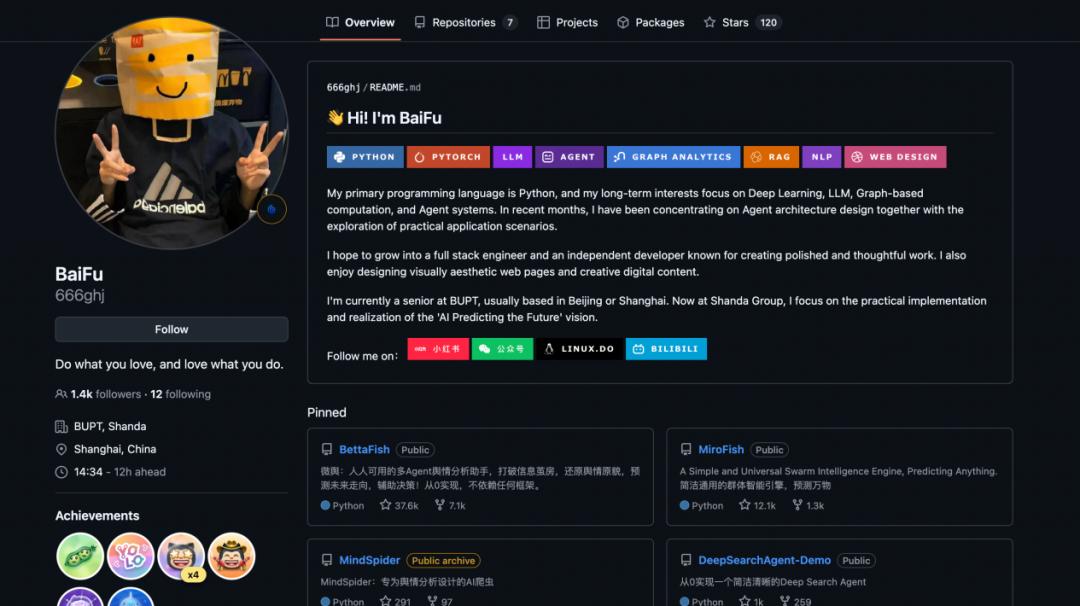
Guo Hangjiang's GitHub profile
Senior Undergraduate Student Secures 30 Million Yuan in Investment
Three months ago, Guo Hangjiang was still anxious about finding an internship. At that time, he had just determined his postgraduate study destination and had already finished his graduation project ahead of schedule. He planned to use this free time to find an internship.
So, during a ten - day holiday, he completed the open - source project BettaFish using Vibe Coding and posted it on his GitHub profile.
According to the project introduction, "Weiyu" is an innovative multi - agent public opinion analysis system developed from scratch. It helps people break through the information cocoon, restore the original appearance of public opinion, predict future trends, and assist in decision - making. Users only need to state their analysis requirements in a chat - like manner, and the agents will automatically analyze more than 30 mainstream social media platforms at home and abroad and millions of public comments.
In just one week, the number of stars for the project soared from a few hundred to 20,000 and continued to rise. Now it has received 37,700 stars.
After quickly topping the GitHub trending list, BettaFish became a highly discussed project in the developer community at that time. Guo Hangjiang's email was flooded with various job offers and investment intentions.
For Guo Hangjiang, his life during that period underwent a complete and earth - shattering transformation.
It was a phone call from Shanda that changed the fate of this 20 - something young man.
Chen Tianqiao, the founder of Shanda Group, showed great interest in the project and proposed to have a personal chat.
Chen Tianqiao was straightforward. He said that the technical level of BettaFish was not particularly outstanding. However, what Shanda valued was Guo Hangjiang's complete planning of the entire process from data collection, analysis to prediction in the project, as well as his ability to "identify and define truly valuable problems and attempt to solve them in new AI - based ways".
After joining Shanda, Guo Hangjiang began to implement the "prediction" function that he had conceived during the BettaFish period but had no time to work on. This led to the creation of MiroFish, which also took only ten days.
On the night when the project was completed, looking at the working program, Guo Hangjiang excitedly recorded a somewhat rough demonstration video and submitted it directly to Chen Tianqiao's desk.
Within 24 hours, the two had a second conversation, and Chen Tianqiao immediately decided that the group would invest 30 million yuan to fully support the in - depth incubation of MiroFish.
Overnight, Guo Hangjiang went from an intern at Shanda to the CEO of an AI startup, embarking on his "super - individual" journey.
The Rise of the Super - Individual
"For the first time, I directly felt how urgent the domestic market's demand is for young people who have AI skills, are creative, and can turn ideas into reality."
Guo Hangjiang recalled this "magical" entrepreneurial experience in his WeChat official account article titled "In 3 Months, from the Frenzy of the Open - Source Project BettaFish to Securing 30 Million Yuan in Investment, I Experienced the Super - Individual Era Brought by Vibe Coding".
This is not an isolated case. Recently, similar stories have been emerging more and more frequently: some people create an AI tool in a few weeks and it quickly becomes popular in the product community; others attract the attention of capital and companies with a small - scale project.
A term has been frequently mentioned - OPC (One Person Company).
This concept has quickly gained popularity from the developer community to the startup circle. Especially during the recent popularity of OpenClaw, which has sparked a national "lobster - raising" craze. Many people are starting to try whether one person, with the help of AI, can create a "company - level" product.
The policy - making level has quickly caught on to this trend. Cities like Shenzhen and Wuxi are providing subsidies for "lobster - raising", and Beijing, Suzhou, Hangzhou and other places have also introduced support policies for individual AI entrepreneurs. The super - individual is no longer just an internet narrative but is being treated as a new form of production organization.
So, what kind of people can become super - individuals?
In a speech at the end of last year, Chen Tianqiao gave an inspiring explanation. He said that many people mistakenly think that a super - individual is a "jack - of - all - trades", which goes against the natural laws for carbon - based beings. Even Elon Musk can't be a top - notch rocket scientist, a top - notch brain scientist, and a top - notch automotive engineer at the same time. However, he uses "will" and "credit" to aggregate the best external brains of humanity to serve him. He only needs to do two things: first, give an extremely ambitious Prompt (choice); second, take full responsibility (ownership) with all his assets. The rest of the execution will be done by the best external brains of humanity (in the future, it will be AI).
In his view, a new leverage relationship is being formed between humans and AI. Responsibility is the fulcrum, AI's execution is the lever arm, and choice is the direction of the applied force.
In the past few decades, humans have been competing in terms of execution ability. However, after the emergence of AI, the execution ability has been infinitely magnified by technology. So, the focus of the problem has shifted. "Now, what really matters is who has a more stable fulcrum and who makes more accurate choices," he said.
Based on this judgment, Chen Tianqiao proposed a symbolic path called the three - level structure of "minimum viable responsibility".
The first level is to establish a "human - machine firewall".
At this stage, humans act as gatekeepers of the real world. No matter how perfect the solutions provided by AI are, they must be checked and confirmed line by line by humans.
The second level is to learn to predict probabilities.
After establishing the role of gatekeeper, humans also need to become "prophets" in a sense. AI is good at fitting the past, but humans still have an intuitive ability to bet on the future.
The third level is to actively embrace chaos.
AI naturally prefers order and looks for stable structures in data, but the real world is not always like this. Many truly important problems occur in places with missing data, chaotic information, and human - to - human games. Therefore, the ultimate mission of humans is to embrace these uncertainties, find the corners not covered by models, and solve problems full of complex games.
The organization itself will, of course, also change accordingly.
In Chen Tianqiao's imagination, a company will no longer be just a collection of people but more like a "responsibility container". It exists in the form of a legal and capital entity, taking on the costs, risks, and responsibilities that an individual cannot bear for these super - nodes.
The AI Vision of the Former Richest Man
In the early 21st century, Chen Tianqiao conquered the Chinese internet with his game empire and once became the richest man in China. Later, due to health issues, he gradually withdrew from the public eye. In 2012, Shanda completed its privatization and delisting. In 2014, its core business was sold, and Chen Tianqiao left the business empire he had built.
In the following years, he moved between Singapore and the United States and tried to re - enter the business world as an investor. He transformed Shanda into a technology investment platform, allocating funds through the public market, venture capital, and private equity. During this period, he invested in companies such as Legg Mason, LendingClub, and Sotheby's. However, due to regulatory concerns about his Chinese nationality, he was never able to join the board of directors and truly participate in corporate decision - making.
Meanwhile, Chen Tianqiao devoted a considerable amount of energy to brain science research. In 2016, he and his wife, Luo Qianqian, announced a donation of one billion US dollars to establish the Tianqiao and Chrissy Chen Institute for Neuroscience (TCCI), a public - welfare research institution.
In the past decade, the research results funded by TCCI have been continuously published in top - tier academic journals such as Nature and Neuron, covering key areas such as serotonin mechanisms, neural circuits, sleep, and memory.
In recent years, Chen Tianqiao has extended his long - standing interest in human cognition to cutting - edge AI research.
In 2023, Chen Tianqiao announced another investment of one billion yuan in AI + brain science. In October 2025, at the first TCCI AI - Driven Science Symposium held in San Francisco, Chen Tianqiao officially announced an additional investment of one billion US dollars in computing power to specifically support "AI - driven scientific research", with a focus on supporting structural experiments and the innovation of young scientists.
Based on the research results of brain science technology, Shanda's AI team mainly focuses on the field of long - term memory. In October 2024, a team under Shanda Group published an article related to the field of long - term memory titled "Long Term Memory - The Foundation of AI Self - Evolution".
In August 2025, the AI technology team EverMind, fully incubated by Shanda Group, officially launched the EverMemOS project and publicly released the open - source version in November.
Chen Tianqiao himself is also trying to verify a more personal concept. At the end of December 2025, Chen Tianqiao wrote an article to announce an experiment on the "AI - native corporate form", and through a series of public logs, he will fully record the whole process from the conception to the implementation of a company.
This company is called Tanka. According to the currently disclosed information, Tanka aims to create an AI communication platform with long - term memory capabilities. Its core is the self - developed MemGraph technology, which can record and learn from users' past conversations and provide situational insights and proactive follow - up capabilities during communication.
Chen Tianqiao said that no matter what the final result is, he will take full responsibility for this attempt: if it succeeds, it may become a new organizational model in the AI era; if it fails, it will also provide a real reference for future generations.
This article is from the WeChat official account "Dongshisitiaotiao Capital" (ID: DsstCapital), written by Wei Xianghui and published by 36Kr with authorization.