Ideal: When the car is "crippled", can it only rely on robots as a "lifeline"?
Li Auto (LI.O) released its Q4 2025 financial report after the Hong Kong stock market closed and before the U.S. stock market opened on the evening of March 12th, Beijing time. Although Li Auto had relatively well communicated the downward trend of the gross profit margin from car sales in the fourth quarter, even under a pessimistic outlook, the actual Q4 performance was rather mediocre. Specifically:
① Revenue was slightly lower than expected, mainly due to a significant decline in the average selling price of cars: In the fourth quarter, Li Auto's car sales revenue was 27.3 billion yuan, a year-on-year decrease of 36%, lower than the market expectation of 28.2 billion yuan. This was mainly because the average selling price of cars in this quarter decreased by 27,000 yuan quarter-on-quarter to 250,000 yuan (the market expected 258,000 yuan). The vehicle model structure continued to shift towards lower-priced models (the proportion of the low-priced i6 increased, while that of the high-priced Mega decreased), and Li Auto also increased the discount on the old L series in the fourth quarter, pulling down the average selling price of cars.
② The gross profit margin from car sales basically met expectations and Li Auto's previous guidance: In the fourth quarter, the gross profit margin from car sales was 16.8%, a decrease of 3 percentage points compared with the real gross profit margin of 19.8% from car sales after removing the impact of the Mega recall in the third quarter. This also met the management's previous guidance of 15.8% - 16.8%.
The decline in the gross profit margin from car sales was mainly due to the quarter-on-quarter decline in the average selling price of cars. Although the i6 had strong sales in the fourth quarter, it was still restricted by the industrial chain (insufficient battery supply). The scale effect was not fully realized in the fourth quarter (the total sales volume only increased by 17% quarter-on-quarter to 109,000 units), thus offsetting the impact of the decline in the unit price of cars.
③ Operating profit was in the red, and net profit relied on financial income to support: In the fourth quarter, Li Auto's operating profit turned into an actual loss of 400 million yuan, while the "real" operating profit after removing the impact of the Mega in the previous quarter was still on the verge of break-even (-70 million yuan).
In the fourth quarter, with a year-on-year decline of 31% in sales volume and the gross profit margin from car sales falling below the healthy level of 20% (only 16.8% in this quarter), but without any sign of a reduction in R & D investment, Li Auto's operating profit also declined significantly. This was the first time since 2023 that the operating profit was in such a "dangerous" state. Li Auto is currently facing considerable operating pressure.
The final "net profit" indicator still barely remained positive, but this was not due to the improvement of the main business. Instead, it highly relied on the "decoration" and increase of about 430 million yuan in interest income generated from the company's large cash reserves. If this non-operating financial income is stripped out, Li Auto has actually entered the loss zone.

Overall, although Li Auto had well communicated the performance in advance and gave everyone a "heads-up", in this performance, the real average selling price and gross profit margin from car sales both showed a quarter-on-quarter downward trend, and the net profit was already on the verge of break-even. It can be seen that Li Auto is still facing huge operating pressure.
The incremental contribution from the mass production ramp-up of the new all-electric i6 model in the fourth quarter still failed to save the continuously declining basic sales volume of the L series (the sales volume of the L series decreased by 60% year-on-year, and the overall sales volume in the fourth quarter decreased by 31% year-on-year). The low pricing of the all-electric models not only dragged down the overall gross profit margin from car sales (the gross profit margin of the i6 model was less than 15% when the monthly sales volume was below 20,000 units), but also created a "self - competition effect" on its own L series basic sales volume.
Regarding the market's most concerned expectations:
① The sales volume guidance was basically in line with expectations:
The sales volume guidance for the first quarter is 85,000 - 90,000 units, basically in line with the market expectation of 88,000 units. The implied car sales volume in March is 31,000 - 36,000 units (28,000 and 26,000 units in January and February respectively). The quarter-on-quarter increase in sales volume is expected to be due to the gradual release of the production capacity of the popular i6 in March (the management previously expected that the monthly sales volume of the i6 model would reach 20,000 units after the Spring Festival).
However, the sales pressure on the old L series is still huge: The sales volume of the old L series in January - February 2026 was only 18,000 units (the average monthly sales volume was only 9,000 units), a 67% decrease compared with 55,000 units in the same period last year. The models are outdated, the competition is intensifying (competitors have launched larger and cheaper models targeting the L series), and the sales squeeze effect of its own all-electric i6 + i8 on the old L series still exists. Finally, this sales volume guidance still represents a year-on-year decrease of 3% - 9% compared with 93,000 units in the first quarter of last year.
② However, the revenue guidance was significantly lower than expected, and the implied average selling price of cars would continue to decline:
With the sales volume expectation basically in line with the market, the revenue guidance is significantly lower than the market expectation, mainly because the average selling price of cars in Q1 2026 will continue to decline significantly, from 250,000 yuan in Q4 2025 to the expected 222,000 yuan in Q1 2026.
Dolphin Jun believes that this continued significant downward trend is mainly due to a. With the release of the i6's production capacity, the proportion of the low - priced i6 is expected to increase from 26% in Q4 2025 to 60% in Q1 2026 quarter-on-quarter; b. Continuing to significantly reduce the price of old models to welcome the new car cycle starting from Q2.
Based on the above significantly downward average price expectation, and the relatively weak sales volume in the first quarter (the Q1 sales volume decreased by 17% - 22% quarter-on-quarter compared with Q4 2025, resulting in an increase in the fixed cost per vehicle and a weakening of the scale effect), coupled with the recent price increase of bulk raw materials such as upstream lithium batteries and storage chips, which has a negative impact on the BOM cost, Dolphin Jun expects that the gross profit margin of Li Auto's vehicles in the first quarter will continue to decline quarter-on-quarter and reach the operating bottom (the market expects the gross profit margin from car sales in the first quarter to remain the same as in Q4 2025).
But looking at the overall performance in 2026 after getting out of the operating bottom in the first quarter:
① Li Auto is about to launch a major facelift of the L series models + 1 new all-electric car, the i9
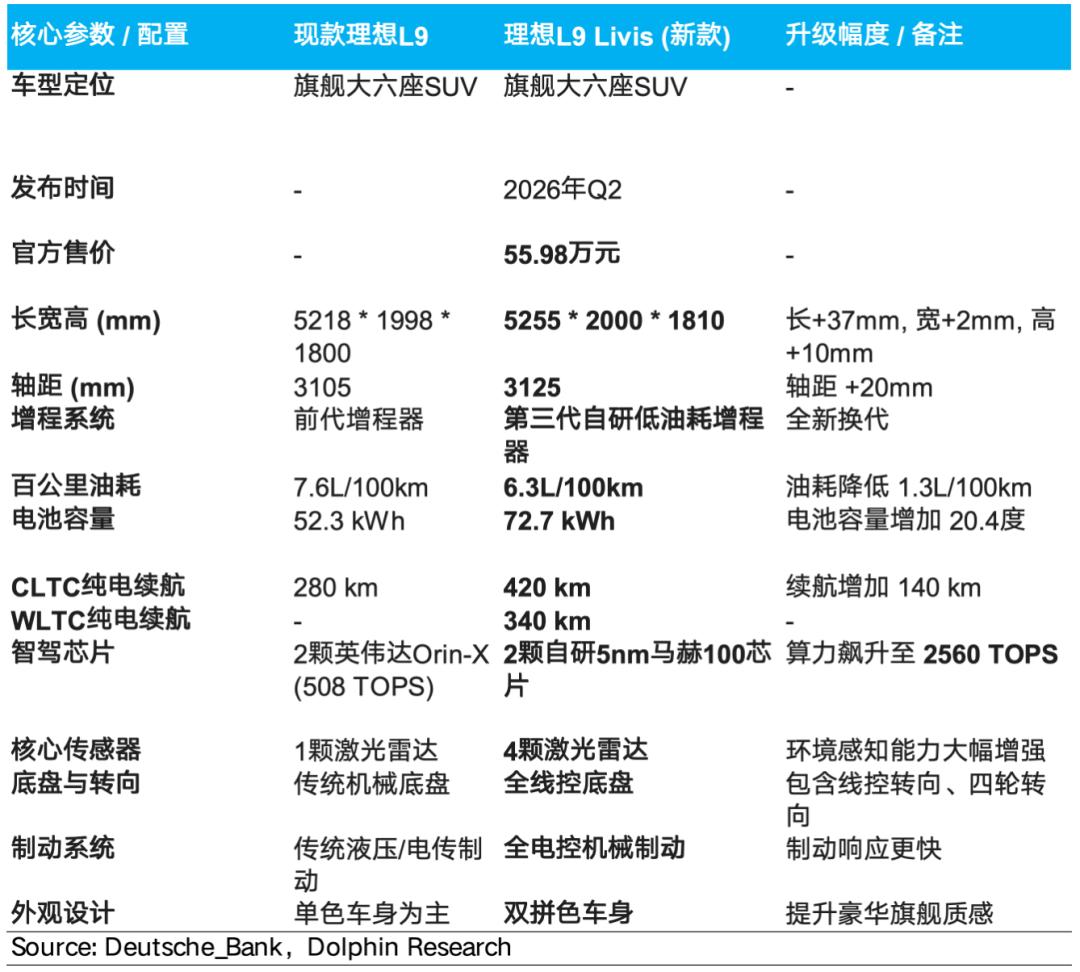
Li Auto will start to launch three major facelift models of the Li L series in the second quarter of 2026. The Li L9 will be the first to be launched in the second quarter. It is expected that the overall price range of the L9 will continue to shift down to the 320,000 - 380,000 yuan range of the original L8 series (the current price of the flagship version, the L9 LIVIS, is 559,800 yuan)
Followed by the L7 and L6 models.

From the currently released L9 series, Li Auto has achieved a comprehensive upgrade (a. Increasing the vehicle size; b. Significantly increasing the battery capacity and all-electric range, and upgrading the range extender system to reduce fuel consumption; c. The self-developed 2560 TOPS Mach chip is about to be installed; d. Upgrading the wire - controlled chassis (supporting four - wheel steering) and the mechanical active system, etc.).
It can be seen that in its vehicle strategy in 2026, Li Auto plans to: a. Increase the configuration and reduce the price, shifting the price of the L9 model to the L8 price range; b. Streamline the SKUs and make the entry - level models fully equipped; to face the more intense market impact of the switch to the large - range extender series in 2026 and save the "endangered" basic sales volume of the L series.
② Li Auto's strategy of continuous investment in AI is expected to remain unchanged:
a. The self-developed computing power base is about to be launched: The self-developed "Mach 100 (M100)" chip using 5nm process is about to be mass - produced. The effective computing power of its dual - chip configuration per vehicle is as high as 2560 TOPS. This chip will be first installed in the new - generation flagship L9 Livis model, and it is planned to promote the full - series standardization of the VLA large model in 2026.
b. Cross - border embodied intelligence: The R & D efforts are officially extended to "space robots", integrating the base model, self - developed chips, and the robot operating system. It is rumored that Li Auto's first embodied intelligent two - wheeled robot is expected to be officially unveiled in the first half of this year.
From the current stock price of Li Auto, the market's sales volume expectation for Li Auto in 2026 is 500,000 units, a 23% increase compared with 406,000 units in 2024. The incremental volume is mainly contributed by the major facelift of the Li L series + the full - year delivery cycle of the i6.
If this sales volume expectation is met, Dolphin Jun expects that the P/S multiple of Li Auto in 2026 will be about 1 time. Although this earnings report and guidance are rather mediocre, and the revenue guidance is even lower than expected, Dolphin Jun expects that a. With a very high - safety - margin cash reserve: Li Auto still has 101.2 billion yuan in cash on hand (net cash of 91.7 billion yuan), and the cash on hand is still sufficient; b. A new round of major new car cycles will start in the second quarter (the facelifted L9 will be launched first); c. Li Auto's embodied intelligence is also expected to be unveiled;
This can provide short - term imagination space and relatively solid support for Li Auto. However, whether it can achieve a strong reversal and upward breakthrough on this basis still depends on whether the "increase configuration and reduce price" major facelift starting in the second quarter can truly save and stabilize its "endangered" L series basic sales volume in the current highly competitive large - range extender market.
The following is a detailed analysis
Since Li Auto's sales volume has been announced, the most important marginal information lies in: 1. The gross profit margin from car sales in the fourth quarter; 2. The performance outlook for the first quarter of 2026.
1. The real gross profit margin from car sales has deviated from the "20% healthy line"
Let's first look at the car sales business, which the market is most concerned about. Since Li Auto had communicated in the previous quarter, the guidance for the gross profit margin from car sales in the fourth quarter was 15.8% - 16.8% (a quarter - on - quarter decline of 3 - 4 percentage points compared with the real gross profit margin of 19.8% after removing the Mega recall event in the third quarter).
This low guidance was mainly due to the continued quarter - on - quarter decline in the sales volume proportion of the high - priced Mega and the large - scale terminal discounts on the L series in the fourth quarter. Therefore, the market's expectation for Li Auto's gross profit margin from car sales in the fourth quarter was only 16.6%.
The actual gross profit margin from car sales in this quarter was 16.8%, basically in line with the market expectation and Li Auto's guidance. However, the average selling price of cars still declined quarter - on - quarter, dragging down the gross profit margin from car sales in this quarter.
(Note: The data of the gross profit margin from car sales in Q2 2022 is after excluding the impact of more than 800 million yuan in contract losses, and the data in Q2 2023 is after excluding 400 million yuan in warranty deposits)

Looking specifically from the perspective of per - vehicle economics:
1. The per - vehicle price declined significantly quarter - on - quarter, mainly due to the shift in the vehicle model structure and promotional discounts
The average selling price of cars in this quarter was 250,000 yuan, a quarter - on - quarter decrease of 27,000 yuan, lower than the market expectation of 258,000 yuan, resulting in the car sales revenue being lower than expected. This was mainly because of the shift in the vehicle model structure and the increased discounts on the old L series:
① The proportion of the low - priced i6 increased, while that of the high - priced Mega decreased
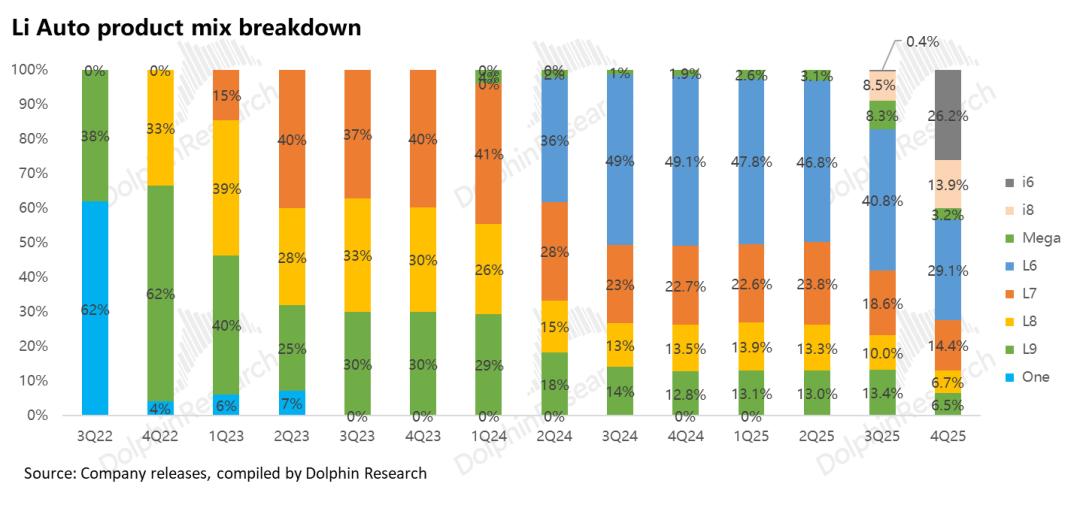
The vehicle model structure of Li Auto shifted downwards in this quarter. Due to the strong sales of the low - priced i6, its proportion in the vehicle model structure increased by about 25.7 percentage points quarter - on - quarter to 26.2%, while the proportion of the high - priced Mega continued to decline (a quarter - on - quarter decrease of 5 percentage points to 3.2%), pulling down the overall average selling price of cars.
② Li Auto still increased the discounts on the basic models of the L series
In the fourth quarter, the basic sales volume of the Li L series still faced a situation of "internal and external troubles": internally, the lower - priced all - electric models created a self - competition effect on the L series, and externally, competitors had launched large - size range - extender SUVs targeting the Li L series, and the competition had become extremely intense. Therefore, Li