The foundation of the Galaxy Universal Super Brain has been laid, and China's embodied intelligence stands at the forefront of global innovation.
The evolution of artificial intelligence is destined not to be confined within the screen.
As the computing power dividend in the digital world gradually approaches its limit, the extension of AI into the physical world is becoming the next stop in industrial development. Among them, embodied intelligence, the most representative of these trends, has been regarded by the state as a new strategic high - ground.
During the Two Sessions on March 4th, when answering questions from Chinese and foreign journalists about scientific and technological innovation, Lou Qinjian, the spokesperson for the Fourth Session of the 14th National People's Congress, mentioned that humanoid robots are becoming an important direction for China's scientific and technological innovation. He also stated that 2025 is a crucial year for the domestic humanoid robot industry to achieve dual leaps in technological breakthroughs and scenario implementation.
He also emphasized that in the coming period, China will further strengthen original innovation and research on key core technologies, promote the in - depth integration of scientific and technological innovation and industrial innovation during the "15th Five - Year Plan" period, and accelerate the breakthrough of core technologies in key areas.
The macro - level industrial positioning was quickly echoed in the capital market.
Recently, Galaxy Universal, an embodied intelligence company, announced the completion of a new round of financing of 2.5 billion yuan. After the investment, its valuation exceeded 20 billion yuan, making it one of the highest - valued enterprises in the domestic embodied intelligence field. Even in the continuously heating up wave of embodied intelligence financing in recent years, 2.5 billion yuan is an extremely rare figure.
It also signals that the general large - model base of embodied intelligence has been elevated to the same strategic infrastructure level as chips.
The heavy investment from capital stems from Galaxy Universal's self - proof in extreme environments. At the Spring Festival Gala in the Year of the Horse, Galbot, a robot under Galaxy Universal, discarded pre - written programs and independently completed non - standardized operations such as playing with walnuts, picking up broken glass, folding clothes, and skewering sausages. All actions were decided in real - time by the "Galaxy Star Brain".
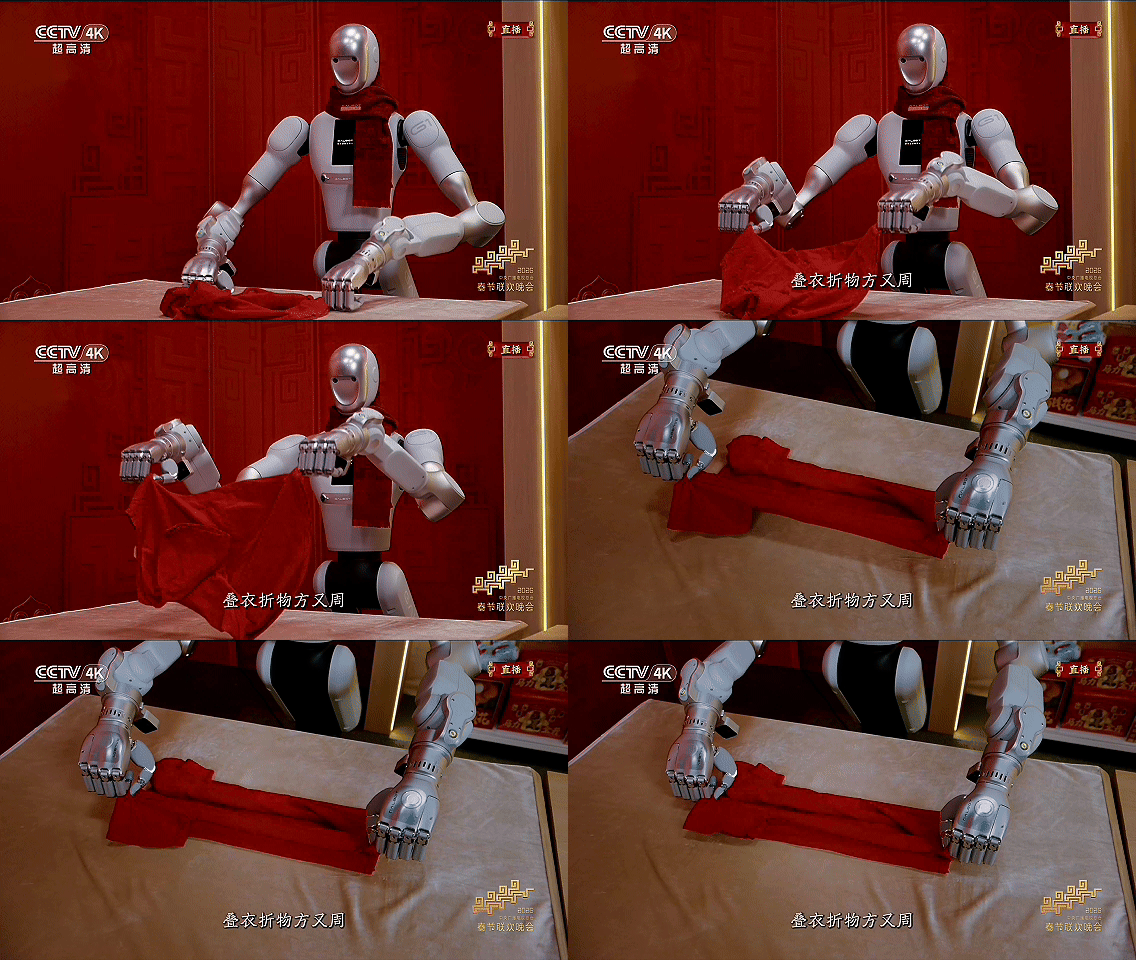
In the past few years, humanoid robots often attracted attention with pre - written scripts for running, jumping, or mechanical dances. This time, the robots focusing on "independent work" proved on the Spring Festival Gala stage that they have truly stepped out of the laboratory and have the ability to break through in the complex world.
So, why do both capital and the Spring Festival Gala point to this young company?

The "OpenAI Moment" of Embodied Intelligence
Peeling off the surface of the 2.5 - billion - yuan financing, the logic behind the continuous investment in Galaxy Universal by capital becomes gradually clear: just as OpenAI opened up a new technological paradigm for general large models, this company is also trying to blaze a pioneering path in the field of embodied intelligence.
Before 2023, AI technology had been widely applied in vertical scenarios, but it remained at the stage of tool enhancement, lacking an underlying model that could unify the boundaries of multi - task capabilities. The launch of GPT 4.0 set a new technological coordinate for general artificial intelligence: large - scale pre - trained models can handle multiple types of tasks such as language, code, and logical reasoning through a unified architecture.
Based on this, the current robot industry is in a period of contention among a hundred schools of thought.
Let's first look across the ocean. The leading American echelon represented by Figure, Tesla (Optimus), and 1X is focusing on the breakthrough of the underlying algorithms of the "brain", craving for end - to - end large - model capabilities and generalized cognition. For example, Figure, backed by OpenAI, is promoting the Vision - Language - Action (VLA) model, hoping to enable robots to understand more complex real - world contexts; Tesla's Optimus is trying to reuse the visual understanding and computing power system accumulated in its Full Self - Driving (FSD) for autonomous driving and transfer it to robot control and decision - making.
However, these explorations are still in the early stage, and there are continuous controversies over commercial implementation and the authenticity of demonstrations. For example, most of the publicly displayed operation videos of Figure's humanoid robots are completed in laboratory environments, and the capabilities demonstrated by Tesla's Optimus are mainly concentrated on basic tasks such as folding clothes and moving items. It still takes time to verify whether they can truly enter complex real - world scenarios.
An important reason is that many robot systems still use imitation learning as an important training entry. That is, through "behavior cloning", they learn action strategies from human demonstration data. This method can quickly obtain basic operation capabilities, but once they leave the scenarios covered by the demonstration data and enter the real environment full of random variables, robots are still prone to perform poorly due to the lack of in - depth understanding of the physical world.
Now, let's turn our attention back to China. The display - type capabilities represented by dance, confrontation, and high - dynamic movements have allowed more and more people to intuitively feel the breakthroughs of humanoid robots in dynamic control and mechanical structure, and companies like Unitree have received high attention. This technological route is of course necessary - high - dynamic control ability is a necessary foundation for embodied intelligence to enter complex environments.
However, this is not the whole story of robots. The ultimate goal of humanoid robots is not only to complete high - difficulty actions but also to enter real scenarios to "work", which is also the current consensus in the robot industry.
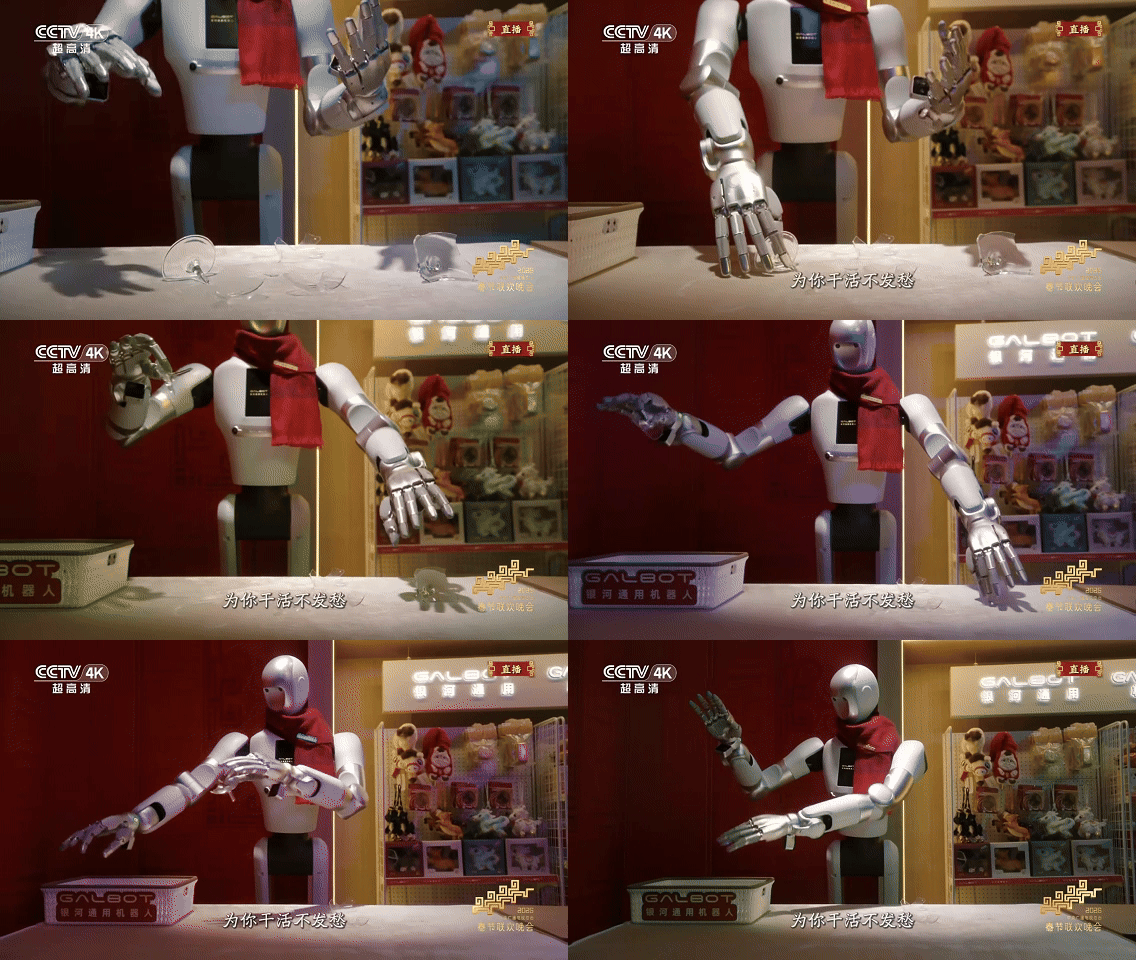
The purpose of Galaxy Universal's technological route is to be able to "work".
The prerequisite for robots to enter all industries to "work" is excellent generalization ability, that is, the ability to understand complex environments and flexibly execute tasks. The foundation that supports Galaxy Universal to achieve this ability is its independently developed "Galaxy Star Brain" (AstraBrain). According to the company's introduction, it is the world's first full - body and full - hand end - to - end embodied large model that integrates "brain - cerebellum - neural control" into one model.
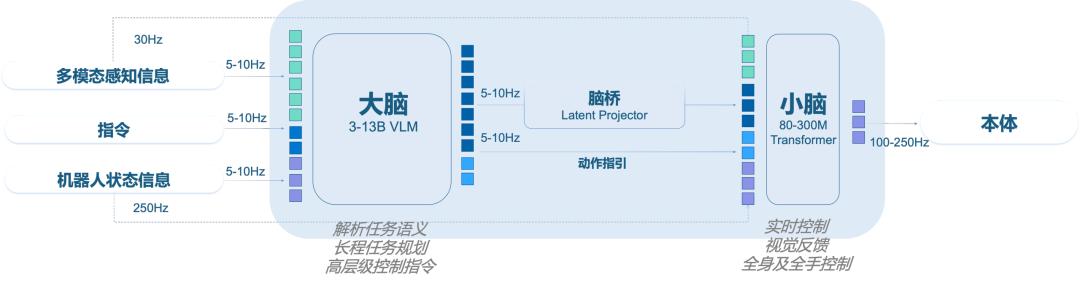
Traditional robots often can only do what they have seen. However, AstraBrain, which covers multiple dimensions such as operation and navigation, has reconstructed this paradigm from the underlying logic. Its high - dimensional generalization ability enables robots to have human - like intuition and common sense when facing unknown variables, so that they can think and execute at the same time.
At the operation level of the "hands", it solves the common problem in the industry of "misalignment and grasping nothing". Aiming at the pain points of traditional large models, such as the easy grasping failure of monocular vision and the extreme dependence on expensive real data, the Galaxy Star Brain has built a dual - base for operation.
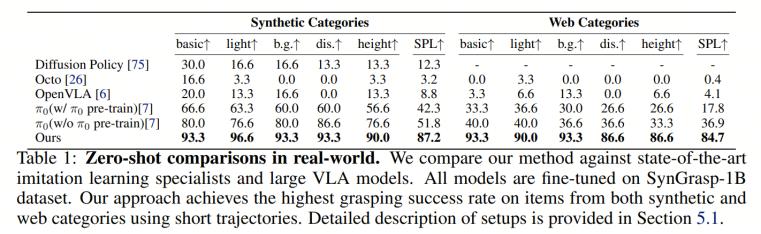
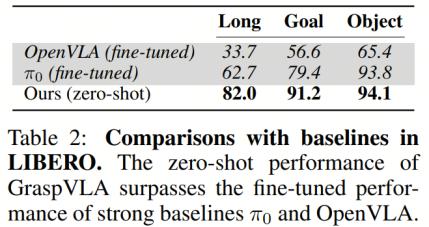
Among them, GraspVLA combines a large amount of simulated synthetic data to achieve zero - shot generalization on real machines for illumination and interference objects. Its real grasping success rate significantly exceeds that of mainstream large models such as OpenVLA and Octo.
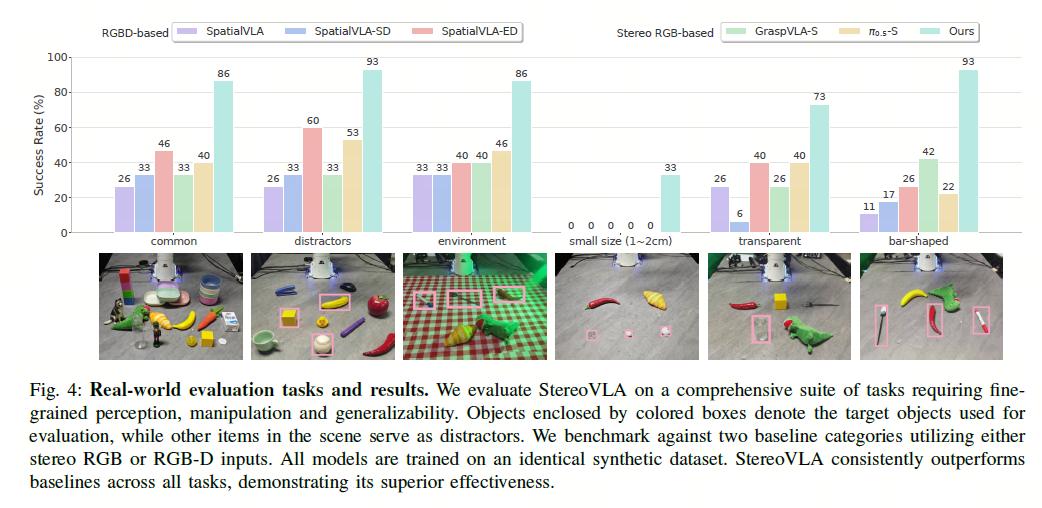
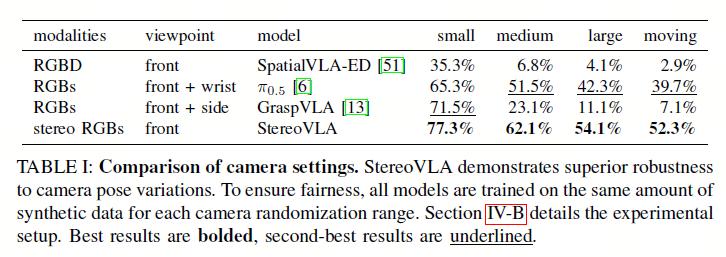
StereoVLA creatively introduces stereo vision, accurately overcoming the operation blind spots of transparent and small objects. Its task success rate significantly leads existing work.
Beyond operation, AstraBrain further breaks the original isolation phenomenon at the navigation level, which is like the "feet".
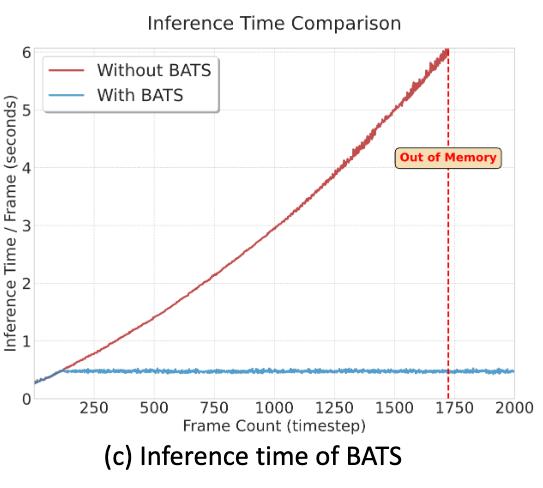
In the past, navigation algorithms were fragmented. Those who made cars only focused on cars, and those who made robotic dogs only focused on dogs. The navigation large model of the Galaxy Star Brain breaks this "ontology isolation" and uses a unified framework to command wheeled robots, quadruped robotic dogs, drones, and autonomous vehicles. More impressively, in order to enable the large 7B - parameter base to run in real - time on real robots with limited computing power, the team independently created the BATS sampling strategy, which adaptively retains key frames like the human brain, achieving stable long - range following for more than 30 minutes without memory overflow.
This reconstruction of the underlying architecture enables Galaxy Universal's commercialization not to stay at fragile single - point demos. It can also run a closed - loop operation in complex real environments such as industrial manufacturing and smart retail. Following the logic established by OpenAI, the new paradigm that Galaxy Universal is trying to establish is clear: robots should not be toys for people to watch but a productive tool.
Whether it is the operation accuracy that outperforms the industry or the navigation ability that transcends the ontology, the high - dimensional generalization ability of this smart brain does not come out of thin air. The real driving engine behind it is the underlying resource in the field of embodied intelligence - data infrastructure.

Data Infrastructure: The Real Divide in Embodied Intelligence
In the past few years, the robot industry has been trapped in a paradox: under laboratory conditions, robots perform highly controllably; but in the real environment, they often encounter frequent mistakes.
The core of the problem lies in that the data scale and data structure are not sufficient to support the complexity of the real world. Every interaction in the physical world is a superposition of multiple complex variables. Therefore, the requirement of embodied intelligence for sample complexity is much higher than that of pure digital models.
In this global competition, the ability to obtain high - quality data is becoming the dividing line for whether an enterprise can truly survive.
To overcome the data mountain, American manufacturers such as Tesla have adopted the "real - machine teleoperation" route: hiring a large number of operators to wear motion - capture equipment and remotely control robots like playing VR games to collect real - world data manually. Although this hardcore Silicon Valley approach has high data fidelity, the cost is extremely high. Moreover, in the face of the hundreds of millions of long - tail edge scenarios (Corner Cases) in the physical world, the amount of data collected purely manually can only increase linearly, and it is easy to reach the bottleneck of scale.
To break this situation of being crushed by "computing power + financial resources", Chinese enterprises must find a more engineering - intelligent way to break the deadlock.
Galaxy Universal is a typical representative. This company has not only built a global - leading 10 - billion - level embodied intelligence dataset but also pioneered the data infrastructure "Galaxy Star Workshop" (AstraSynth), forming a significant advantage in data, the core production factor.
The core logic of this approach is a virtual - real fusion training paradigm that "takes synthetic simulation data as the main and real - machine data as the auxiliary". In a high - precision physical simulation environment, the system can generate a large number of diverse scenarios, allowing robots to experience various extreme situations in the virtual world and then polish them in actual combat with a very small amount of real - machine data.
For example, in the grasping task, this system can generate robot trajectory data at the level of one billion frames within a week. The system will randomly change the object placement, lighting conditions, background environment, and interference objects, allowing the model to see more possible combinations during the training stage.
Based on the virtual - real fusion data path, Galaxy Universal has achieved the generalization ability for new scenarios and new objects under few - shot or even zero - shot conditions. It is reported that its training efficiency is 1000 times higher than that of leading companies in the industry, and the success rate of the model trained based on this dataset reaches 99%, which is in the leading position among global embodied intelligence enterprises. Currently, Galaxy Universal is also one of the few enterprises in the world that has achieved a closed - loop in the entire chain from simulation data training to generalized grasping commercialization.
It is worth mentioning that at the 2025 Big Data Expo, the "high - quality synthetic dataset" achievement of Galaxy Universal was officially released by the National Data Administration as a typical case of high - quality datasets, which also marks that this path has been recognized at the official level and has become a demonstration sample for data infrastructure in the field of embodied intelligence.
Galaxy Universal's technological advantages are closely related to the technical background of its founding team. The founder, Wang He, graduated from Stanford University and studied under Professor Leonidas J. Guibas, an expert in the fields of computer vision and geometric processing. He has long been engaged in the research of end - to - end embodied large models. After returning to China, he founded the first academic laboratory in China dedicated to embodied intelligence. More than a decade of underlying technology research has finally become the solid barrier of Galaxy Universal today.
In the world of large models, computing power determines explosive power; while in the elimination competition of embodied intelligence, those who master the data infrastructure that can generate data at low cost and sustainably truly have a moat.